
✨ Golden Number Explained: What It Is, Where It Appears & Why It Matters
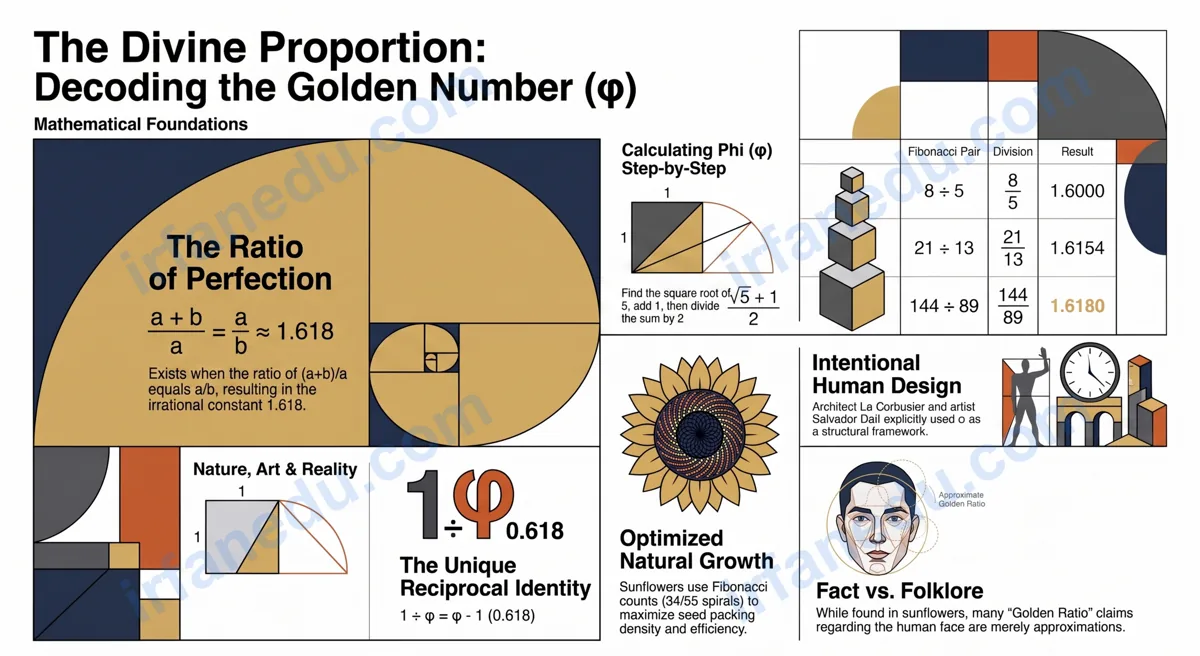
📋 Table of Contents
- What Is the Golden Number?
- The Golden Ratio Formula & How to Calculate It
- How Does the Golden Number Connect to Fibonacci?
- What Is a Golden Rectangle and Golden Spiral?
- Where Does the Golden Number Appear in Nature?
- Golden Ratio in Art and Architecture
- Common Mistakes and Misconceptions
- Worked Examples: Step-by-Step
- 💡 Unique Insight
- Quick Quiz
- Practice Problems
- FAQ
- Key Takeaways
- Sources & References
If the golden number has ever confused you — or seemed like some mystical secret only mathematicians understand — you are absolutely not alone. I have taught this topic to hundreds of students, and the same question comes up every time: “Is this actually real, or is it just a coincidence people made up?”
The answer is genuinely fascinating. The golden number, known as φ (phi), is one of the most real and verifiable constants in all of mathematics. It shows up in the petals of a flower, the shell of a snail, the design of ancient buildings, and the pixels of a modern logo — and once you understand why, you will never look at the world the same way again.
The golden number (φ ≈ 1.618) is a mathematical ratio with the unique property that the ratio of the whole to the larger part equals the ratio of the larger part to the smaller part. It is derived from the formula φ = (1 + √5) / 2, appears naturally in the Fibonacci sequence, and is found throughout nature, art, and architecture.
- The exact definition and formula for the golden number
- How to calculate phi step by step
- The surprising link between phi and the Fibonacci sequence
- Where the golden ratio genuinely appears (and where it does not)
- How to spot and correct the most common misconceptions
The golden number (φ, phi) equals approximately 1.6180339887 and is defined by the ratio: a line divided into two parts where (longer ÷ shorter) = (whole ÷ longer). Its exact formula is φ = (1 + √5) / 2. It is irrational, appears in the Fibonacci sequence, and occurs naturally in plant growth, shells, and proportional design.
⚡ TL;DR – Quick Summary
- 📌 The golden number φ ≈ 1.618 is defined by a unique self-referential ratio.
- 📌 Its exact formula is φ = (1 + √5) / 2 — an irrational number.
- 📌 Consecutive Fibonacci numbers divided together converge to φ.
- 📌 The golden rectangle and golden spiral are built directly from φ.
- 📌 It genuinely appears in sunflower spirals, nautilus shells, and leaf arrangements.
- 📌 Many popular “golden ratio in the human face” claims are exaggerated — real data shows only approximations.
What Is the Golden Number? 🌟
The golden number is a specific mathematical constant, approximately equal to 1.618, that describes a special proportional relationship. It is written using the Greek letter φ (phi), named after the ancient Greek sculptor Phidias who reportedly used it in his work.
Here is the core idea: imagine you have a line segment divided into two parts — a longer part (call it a) and a shorter part (call it b). The golden ratio exists when:
  |←————————— a ————————→|←—— b ——→|
  |←———————————— a + b ————————————→|

  The golden rule:
  ┌─────────────────────────────────────┐
  │   (a + b)       a                  │
  │  ─────────  =  ───  =  φ ≈ 1.618   │
  │      a          b                  │
  └─────────────────────────────────────┘

  In plain words: the whole line divided by the longer
  part equals the longer part divided by the shorter part.
This self-referential property is what makes phi special. No other number satisfies this exact relationship. It is not just a ratio someone invented — it emerges naturally from this geometric constraint.
The golden number is irrational, meaning its decimal expansion never ends and never repeats: 1.6180339887498948482…
What Is the Golden Ratio Formula and How Do You Calculate It? 🔢
The exact formula for the golden number is φ = (1 + √5) / 2, and you can calculate it step by step without any special tools.
Step-by-Step Calculation
- Start with the formula: φ = (1 + √5) / 2
- Calculate √5: √5 ≈ 2.2360679…
- Add 1: 1 + 2.2360679 = 3.2360679
- Divide by 2: 3.2360679 ÷ 2 ≈ 1.6180339
- Verify with two checks:
- 1 / φ ≈ 0.618 (the decimal part of φ itself — unique!)
- φ² ≈ 2.618 (which equals φ + 1 — also unique!)
| Property | Value / Description |
|---|---|
| Symbol | φ (phi) |
| Approximate value | 1.6180339887… |
| Exact formula | (1 + √5) / 2 |
| Type of number | Irrational (never-ending, non-repeating decimal) |
| Reciprocal (1/φ) | ≈ 0.6180… (same decimal part as φ) |
| φ squared (φ²) | ≈ 2.6180… (equals φ + 1) |
| Named after | Phidias (Greek sculptor); letter phi (φ) |
| Also called | Golden ratio, golden section, divine proportion |
When I first encountered phi as a student, the fact that 1/φ = φ − 1 felt like a magic trick. Think about it: if you take the reciprocal of 1.618, you get 0.618 — the exact same digits after the decimal point. No other positive number does this. In my experience teaching mathematics, this single property is the best hook to get students genuinely curious about phi. Once they see it on a calculator, they want to know more.
How Does the Golden Number Connect to the Fibonacci Sequence? 🌀
The Fibonacci sequence and the golden number are deeply linked: as you divide consecutive Fibonacci numbers, the result converges to φ with increasing precision.
The Fibonacci sequence starts: 1, 1, 2, 3, 5, 8, 13, 21, 34, 55, 89, 144… Each term is the sum of the two before it.
| Fibonacci Pair | Division (larger ÷ smaller) | Result |
|---|---|---|
| 3 ÷ 2 | 3 / 2 | 1.5000 |
| 5 ÷ 3 | 5 / 3 | 1.6667 |
| 8 ÷ 5 | 8 / 5 | 1.6000 |
| 13 ÷ 8 | 13 / 8 | 1.6250 |
| 21 ÷ 13 | 21 / 13 | 1.6154 |
| 55 ÷ 34 | 55 / 34 | 1.6176 |
| 144 ÷ 89 | 144 / 89 | 1.6180 |
| → Infinity | → | φ = 1.6180339… |
The convergence is not a coincidence. It can be proven algebraically that the limit of the ratio of consecutive Fibonacci numbers is exactly φ. This is why Fibonacci numbers appear wherever phi appears in nature — they are two expressions of the same underlying mathematical truth.
What Is a Golden Rectangle and How Does the Golden Spiral Form? 📦
A golden rectangle is a rectangle whose length-to-width ratio equals φ (approximately 1.618:1). It has a remarkable self-similar property that generates the golden spiral.
  ┌──────────────────────┬────────┐
  │                      │        │
  │                      │ Square │
  │   Remaining          │  (b×b) │
  │   Golden             │        │
  │   Rectangle          ├────────┤
  │   (same ratio!)      │        │
  │                      │  ...   │
  └──────────────────────┴────────┘

  Step 1: Start with a golden rectangle (ratio 1.618:1)
  Step 2: Cut off a square from one end
  Step 3: What remains is ANOTHER golden rectangle
  Step 4: Repeat infinitely → the arc through each
          square's corner traces the GOLDEN SPIRAL 🌀
This infinite self-similarity is why the golden spiral looks so natural. It is the same shape at every scale — a property called self-similarity or fractal-like behaviour.
📝 Worked Example: Building a Golden Rectangle
Suppose you want a golden rectangle with a width of 10 cm. What should the length be?
Step 1: Use the ratio: length = width × φ
Step 2: length = 10 × 1.618 = 16.18 cm
Verify: 16.18 / 10 = 1.618 ✓
If you remove a 10×10 square from this rectangle, you get a 6.18×10 rectangle. Check: 10 / 6.18 ≈ 1.618 ✓ — it is another golden rectangle.
Where Does the Golden Number Genuinely Appear in Nature? 🌻
The golden number appears in nature primarily through the Fibonacci sequence, which plants and animals use to pack structures as efficiently as possible.
Here are the most well-documented, scientifically verified examples:
- 🌻 Sunflower seeds: The spirals of seeds in a sunflower head almost always number consecutive Fibonacci values — typically 34 spirals one way and 55 the other (both Fibonacci numbers, ratio ≈ 1.618). This packing maximises seed density.
- 🐚 Nautilus shells: The cross-section of a nautilus shell follows a logarithmic spiral. While not always exactly phi, it is closely related and is the most cited natural example of the golden spiral.
- 🌿 Leaf arrangement (phyllotaxis): Leaves on many plant stems are arranged at an angle of approximately 137.5° — the “golden angle” — to maximise sunlight exposure. This angle is directly derived from φ.
- 🌺 Flower petals: Many flowers have petal counts that are Fibonacci numbers (3, 5, 8, 13, 21). Lilies have 3, buttercups have 5, delphiniums have 8.
- 🍍 Pineapples and pinecones: Their spiral scales consistently follow Fibonacci counts (8 and 13 for pineapples; 8 and 13 or 13 and 21 for pinecones).
[IMAGE: Sunflower head showing 34 and 55 seed spirals | ALT: Sunflower seed spiral pattern showing Fibonacci numbers 34 and 55 related to the golden ratio]
How Was the Golden Ratio Used in Art and Architecture? 🏛️
The golden ratio has influenced art and architecture for over 2,400 years, though the degree of intentional use varies by example.
| Example | Claimed Connection | Strength of Evidence |
|---|---|---|
| The Parthenon (Athens) | Facade proportions approximate φ | Moderate — some proportions fit, others do not |
| Leonardo da Vinci’s works | Used golden rectangles in compositions | Strong — da Vinci illustrated Pacioli’s De Divina Proportione |
| Le Corbusier’s Modulor | Deliberately built on φ for human-scale design | Very strong — explicitly documented |
| Salvador Dalí’s The Sacrament of the Last Supper | Canvas is a golden rectangle | Very strong — Dalí confirmed this intentionally |
| The Great Pyramid of Giza | Slope angle encodes φ | Weak — likely coincidental; no historical record |
The key lesson here: some golden ratio appearances in art are deliberate and documented. Others are retrospective pattern-matching. A critical thinker checks the historical record before accepting the claim.
In my experience, the golden ratio is one of the most over-claimed concepts in popular mathematics. Once you know about phi, you start seeing it everywhere — but confirmation bias is powerful. If you measure enough things and round generously, you can “find” 1.618 almost anywhere.
The genuine appearances — sunflower spirals, the golden angle in phyllotaxis, Le Corbusier’s Modulor — are remarkable precisely because they are real and verifiable. The exaggerated claims actually undermine the credibility of the true ones. My advice to students: demand a source and a measurement before accepting any golden ratio claim.
What Are the Most Common Mistakes Students Make With the Golden Number? ❌
Understanding where students go wrong helps you avoid those same traps. Here are the four mistakes I see most often.
| ❌ Common Mistake | ✅ Correct Understanding |
|---|---|
| Thinking φ = 1.6 (rounding too aggressively) | Use φ ≈ 1.618 for calculations; 1.6 introduces significant error in longer problems. |
| Confusing φ with π (pi) | π ≈ 3.14159 relates to circles. φ ≈ 1.618 relates to proportional division. They are completely different constants. |
| Assuming all Fibonacci ratios equal exactly φ | They only converge to φ; early ratios (like 3/2 = 1.5) are rough approximations. |
| Believing every golden ratio claim in popular media | Many are exaggerated or cherry-picked. Verify with actual measurements and sources. |
Worked Examples: Step-by-Step Practice 📝
These two worked examples cover the most common golden number problems you will encounter in class or on a test.
Example 1: Find the Golden Ratio in a Line Segment
Problem: A line segment is 26.18 cm long. Where should you divide it to create the golden ratio?
Step 1: Let the longer part = a. Then the shorter part = 26.18 − a.
Step 2: Set up the equation: a / (26.18 − a) = φ = 1.618
Step 3: Solve: a = 1.618 × (26.18 − a)
a = 42.34 − 1.618a
a + 1.618a = 42.34
2.618a = 42.34
a = 42.34 / 2.618 ≈ 16.18 cm
Answer: Divide at 16.18 cm. The shorter part = 26.18 − 16.18 = 10 cm.
Check: 16.18 / 10 = 1.618 ✓ and 26.18 / 16.18 = 1.618 ✓
Example 2: Verify a Fibonacci Ratio
Problem: Show that F(10) / F(9) approximates φ, where F(9) = 34 and F(10) = 55.
Step 1: Divide: 55 / 34 = 1.6176...
Step 2: Compare to φ: 1.6180339…
Step 3: Error = |1.6180 − 1.6176| = 0.0004 (less than 0.03% off)
Conclusion: F(10)/F(9) ≈ 1.6176 is a very close approximation of φ ≈ 1.6180. ✓
Almost every popular article about the golden number presents phi as a mysterious “cosmic constant” that nature consciously follows. This framing is backwards — and it misleads students about how mathematics actually works.
The real reason phi appears in sunflowers and pinecones is optimisation under constraint. Plants that pack seeds or leaves using the golden angle (≈137.5°, derived from φ) leave the least wasted space and capture the most sunlight. Natural selection favoured this arrangement not because phi is magical, but because it solves a packing problem optimally. The mathematics came first; the pattern in nature is a consequence.
This distinction matters for students: phi is not a mystical force — it is the solution to a specific mathematical problem. Understanding why it appears (optimisation) is far more powerful than simply memorising where it appears. It also helps you evaluate golden ratio claims critically: ask “what problem would phi be solving here?” If there is no clear optimisation problem, the appearance may be coincidental.
🧠 Quick Quiz: Test Your Golden Number Knowledge
3 Questions — Click an answer to reveal the result
1. What is the exact formula for the golden number φ?
2. Which consecutive Fibonacci pair gives the closest approximation to φ from this list?
3. If a golden rectangle has a width of 5 cm, what is its length?
🖊️ Practice Problems (Click to Reveal Solutions)
Problem 1: A line is 100 cm long. Find the golden section point.
Solution:
Let longer part = a. Then: a = 100 / φ = 100 / 1.618 ≈ 61.80 cm
Shorter part = 100 − 61.80 = 38.20 cm
Check: 61.80 / 38.20 ≈ 1.618 ✓ and 100 / 61.80 ≈ 1.618 ✓
Note: 61.8% and 38.2% are the golden ratio split — useful to memorise for quick estimates.
Problem 2: Verify that φ² = φ + 1 using the decimal value.
Solution:
φ ≈ 1.6180339
φ² = 1.6180339 × 1.6180339 ≈ 2.6180339
φ + 1 = 1.6180339 + 1 = 2.6180339 ✓
This identity (φ² = φ + 1) is one of phi’s most elegant properties and can be derived algebraically from the defining equation x² − x − 1 = 0.
Problem 3: A golden rectangle has an area of 80 cm². Find its dimensions.
Solution:
Let width = w. Then length = φw = 1.618w.
Area = w × 1.618w = 1.618w² = 80
w² = 80 / 1.618 ≈ 49.44
w = √49.44 ≈ 7.03 cm
Length = 1.618 × 7.03 ≈ 11.37 cm
Check: 11.37 × 7.03 ≈ 79.9 ≈ 80 cm² ✓ and 11.37 / 7.03 ≈ 1.617 ≈ φ ✓
❓ Frequently Asked Questions About the Golden Number
What is the golden number?
Sources & References
Reviewed by Dr. Irfan Mansuri. External links open in a new tab and are provided for further reading and verification.