
Compare and Contrast Text Structure: The Complete Guide (With Examples)
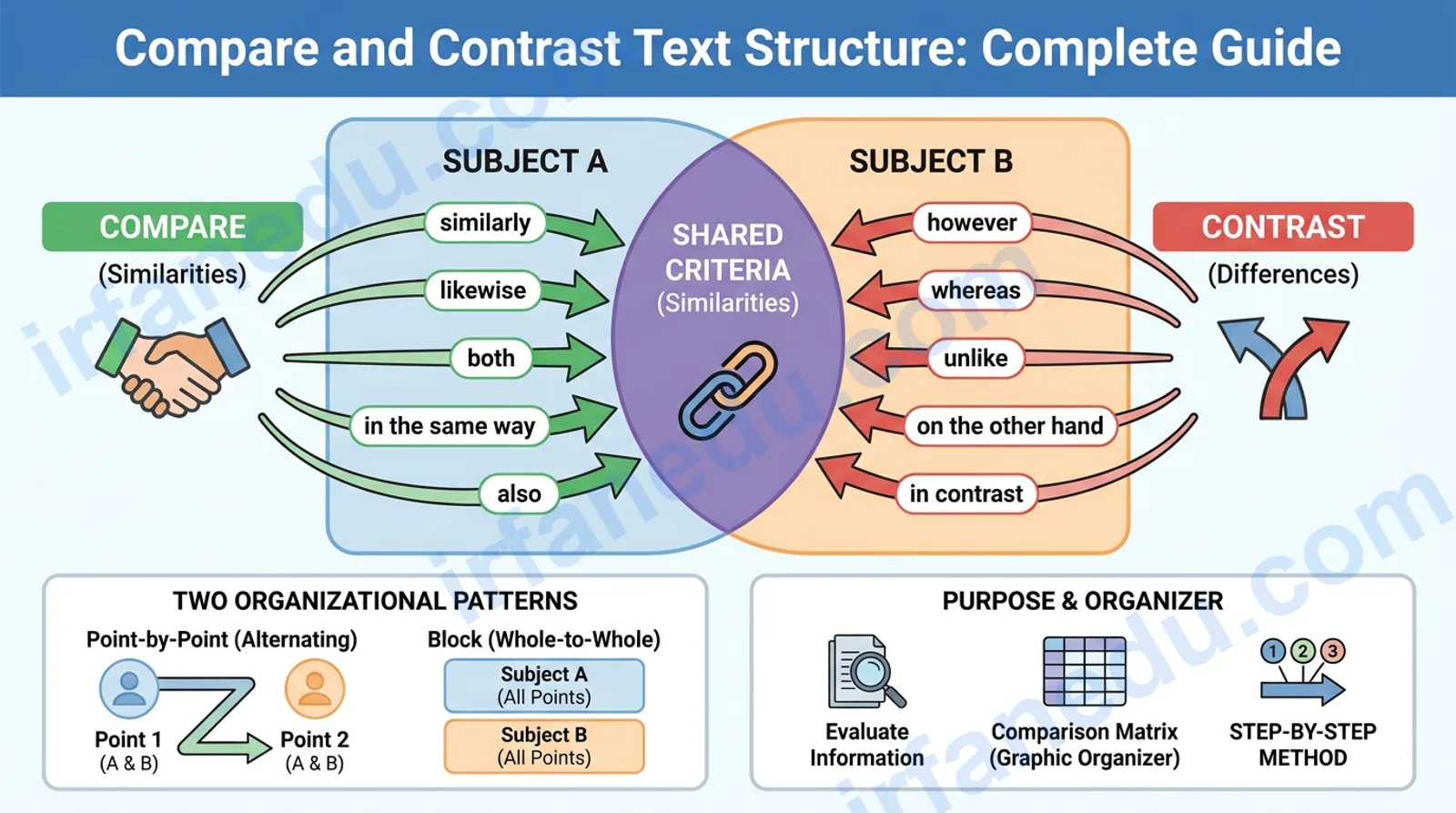
A product reviewer at a major consumer magazine once told me something that stuck: “Every review I write is secretly a compare-and-contrast essay.” She was right. Before she types a single word, she builds a grid — criteria down the left, products across the top — and fills every cell. That grid is compare and contrast text structure in its purest form, and it shows up everywhere from science textbooks to Supreme Court opinions.
Compare and contrast text structure is a writing pattern that organizes information by examining how two or more subjects are similar and how they differ. It is one of the five core informational text structures taught in schools, and it trains readers to evaluate, not just absorb, information.
- The exact definition of compare and contrast text structure
- Signal words that identify it in any passage
- The two organizational patterns (point-by-point vs. block)
- A step-by-step method for writing it yourself
- A fully worked example you can model
- The single most common mistake students make (and how to fix it)
Compare and contrast text structure is a way of organizing writing that shows how two or more subjects are similar (compare) and different (contrast). Writers use signal words like “similarly,” “however,” and “on the other hand” to guide readers. It appears in textbooks, essays, and news articles to help readers evaluate options and deepen understanding of both subjects.
What Is Compare and Contrast Text Structure?
Compare and contrast text structure is a method of organizing information so that two or more subjects are examined against the same set of criteria. “Compare” means finding similarities; “contrast” means finding differences. Used together, they give readers a complete picture of both subjects.
It is one of five informational text structures recognized in literacy research. The others are description, sequence, cause and effect, and problem and solution. Compare and contrast is unique because it requires the writer to hold two subjects in mind simultaneously and evaluate them fairly.
| Feature | Detail |
|---|---|
| Text structure type | Informational / expository |
| Purpose | Show similarities and differences between two or more subjects |
| Key signal words (compare) | similarly, likewise, both, also, in the same way |
| Key signal words (contrast) | however, whereas, unlike, on the other hand, in contrast |
| Main organizational patterns | Point-by-point (alternating) and Block (whole-to-whole) |
| Best graphic organizer | Venn diagram (overview) or comparison matrix (writing) |
| Common in | Textbooks, essays, science reports, product reviews, news analysis |
| Grade levels taught | Grades 4-12 (ELA and content-area literacy) |
What Are the Signal Words for Compare and Contrast?
Signal words are the reader’s roadmap — they announce whether the writer is about to show a similarity or a difference. Knowing them lets you identify compare and contrast structure in any passage within seconds.
- similarly — “Solar panels generate electricity; similarly, wind turbines convert energy into power.”
- likewise — “Frogs are amphibians; likewise, salamanders live both on land and in water.”
- both / both … and — “Both mammals and birds are warm-blooded.”
- in the same way — “A thesis statement guides an essay; in the same way, a hypothesis guides an experiment.”
- also / too / as well — “Copper conducts electricity well; aluminum is also a good conductor.”
- just as — “Just as a map needs a scale, a graph needs labeled axes.”
- however — “Sharks are fish; however, dolphins are mammals.”
- on the other hand — “Introverts recharge alone; on the other hand, extroverts gain energy from social interaction.”
- whereas / while — “Whereas a simile uses ‘like’ or ‘as,’ a metaphor makes a direct comparison.”
- unlike — “Unlike igneous rock, sedimentary rock forms from compressed layers.”
- in contrast — “The novel focuses on internal conflict; in contrast, the film emphasizes action.”
- yet / but — “The data supported the hypothesis, yet the sample size was too small to generalize.”
What Are the Two Main Organizational Patterns?
Every compare and contrast piece uses one of two organizational patterns: point-by-point or block. Choosing the right one before you write saves you from restructuring the whole piece later.
| Feature | Point-by-Point (Alternating) | Block (Whole-to-Whole) |
|---|---|---|
| How it works | Discuss one criterion, cover both subjects, then move to the next criterion | Cover all points about Subject A first, then all points about Subject B |
| Best for | Complex topics with many criteria; analytical essays | Shorter pieces; when one subject is already familiar to the reader |
| Reader experience | Easier to track differences criterion by criterion | Easier to get a full picture of each subject separately |
| Risk | Can feel choppy if transitions are weak | Reader may forget Subject A details by the time they reach Subject B |
| Paragraph structure | Each paragraph = one criterion, both subjects | First half = Subject A; second half = Subject B |
| Typical use in school | Middle school essays, AP-style analysis | Elementary reports, short-answer responses |
POINT-BY-POINT (Alternating)        BLOCK (Whole-to-Whole)
─────────────────────────────       ─────────────────────────────
Intro                               Intro
  |                                   |
Criterion 1                         ALL about Subject A
  ├── Subject A                        ├── Criterion 1
  └── Subject B                        ├── Criterion 2
                                        └── Criterion 3
Criterion 2
  ├── Subject A                     ALL about Subject B
  └── Subject B                        ├── Criterion 1
                                        ├── Criterion 2
Criterion 3                              └── Criterion 3
  ├── Subject A
  └── Subject B                     Conclusion
                                    (synthesis of both)
Conclusion
(synthesis of both)
How Do You Write a Compare and Contrast Paragraph or Essay?
Writing compare and contrast well is a six-step process. Skipping step three — the comparison matrix — is the single biggest reason student drafts fall apart.
- Choose two subjects with real common ground. Comparing a bicycle to a cloud produces nothing useful. Comparing a bicycle to a motorcycle — both personal transport, both have wheels, different power sources — gives you rich material.
- Select 3-5 specific criteria. Criteria are the categories you will evaluate for both subjects. For the bicycle vs. motorcycle example: cost, speed, environmental impact, physical effort, and maintenance.
- Build a comparison matrix before writing. Draw a table: criteria in rows, subjects in columns. Fill every cell. If a cell is empty, you either need more research or that criterion does not apply.
- Choose your organizational pattern. Point-by-point if you have many criteria or want tight analytical comparison. Block if the piece is short or one subject needs more background.
- Write with signal words. Each time you shift from one subject to the other, use a contrast signal. Each time you show a parallel, use a compare signal. These words do the structural work so your reader never gets lost.
- End with a synthesis sentence. This is the “so what.” It states what the comparison reveals — which subject is better suited for a specific purpose, or what the comparison teaches us about both. Without it, the structure is a list, not an argument.
Worked Example: Comparing Two Energy Sources
Here is a fully worked example using the point-by-point pattern. The topic: solar energy vs. wind energy. I chose this because it appears in middle school science and ELA classes worldwide and shows how compare and contrast structure works in content-area writing, not just English essays.
Step 1 — Subjects: Solar energy and wind energy.
Step 2 — Criteria: Energy source, cost to install, reliability, land use, and environmental impact.
Step 3 — Matrix:
| Criterion | Solar Energy | Wind Energy |
|---|---|---|
| Energy source | Sunlight (photovoltaic cells) | Moving air (turbine blades) |
| Installation cost | Moderate; rooftop panels widely available | Higher upfront; requires tall towers |
| Reliability | Depends on daylight hours and cloud cover | Depends on consistent wind speed |
| Land use | Can use rooftops; minimal extra land | Needs open land or offshore sites |
| Environmental impact | No emissions during operation; panel disposal is a concern | No emissions; risk to birds and bats |
Step 4 — Pattern chosen: Point-by-point.
Step 5 — Draft paragraph (one criterion, both subjects):
Solar panels generate electricity only during daylight hours, and cloud cover can reduce output by up to 25%. Wind turbines, on the other hand, can operate at night and in overcast conditions — but only where wind speeds stay above roughly 7 miles per hour. Whereas solar energy is more predictable in sunny climates, wind energy offers an advantage in coastal and open-plain regions where sunlight is inconsistent. Neither source is universally reliable, which is why most modern grids combine both.
Notice the signal words: “on the other hand,” “whereas.” They do the structural work. The final sentence is the synthesis — the “so what” that makes the paragraph purposeful rather than just a list of facts.
Common Mistakes Students Make (And How to Fix Them)
Most compare and contrast writing problems come from three specific errors. Fixing them transforms a mediocre draft into a strong one.
Mistake 1: Comparing Without Contrasting (or Vice Versa)
A passage that only lists similarities is a description, not a comparison. A passage that only lists differences is a contrast — useful, but incomplete. Genuine compare and contrast structure requires both. If your draft has no “however” or “similarly,” check which half you are missing.
Right: “Dogs and cats are both popular household pets that form strong bonds with their owners. However, dogs require daily outdoor exercise and direct training, whereas cats are more independent and adapt well to indoor-only environments.”
Mistake 2: Using Different Criteria for Each Subject
This is the most invisible mistake. A student writes three sentences about Subject A’s cost, then three sentences about Subject B’s appearance. The subjects are never actually compared — they just sit next to each other. Fix it by checking your matrix: every criterion must have a filled cell for both subjects.
Mistake 3: Forgetting the Synthesis Sentence
Many students end a compare and contrast paragraph with the last fact about Subject B. That leaves the reader asking, “So what?” The synthesis sentence answers that question. It does not repeat the facts — it draws a conclusion from them.
With synthesis (strong ending): “Because both sources carry distinct environmental trade-offs, the best energy strategy combines solar and wind rather than relying on either alone.”
In my experience reviewing student essays, the synthesis sentence is the single most neglected element in compare and contrast writing. Teachers mark it as “lacks analysis,” but the real problem is structural — students were never taught that the structure is incomplete without it. I now tell every student: your last sentence should answer the question “Which, when, or why?” If it does not, add one sentence that does. That single fix raises the analytical quality of the whole piece.
Most guides teach compare and contrast as a writing skill. But its deeper value is as a reading comprehension skill. When you recognize compare and contrast structure in a textbook or article, you can predict what information is coming next — and that prediction speeds up reading and improves retention. Research in reading comprehension (including work cited by the National Reading Panel) consistently shows that students who identify text structure before reading recall significantly more content than those who read without structural awareness. Teaching students to spot the structure is at least as important as teaching them to produce it — yet most classroom time goes to writing, not reading recognition. If you are a parent or teacher, try this: before your student reads a passage, ask them to scan for signal words and predict the structure. That 30-second pre-reading habit pays dividends across every subject.
Quick Quiz: Test Your Understanding
Select an answer to reveal whether you are correct.
1. Which signal word indicates a SIMILARITY between two subjects?
2. In point-by-point structure, how is each body paragraph organized?
3. A student writes about dogs and cats but only discusses their differences. What is missing?
Reveal-on-Click Practice Problems
Try each question yourself, then click to reveal the answer.
Practice 1: Identify the text structure. Read this passage and name the structure: “Both the American Revolution and the French Revolution were driven by Enlightenment ideals of liberty and equality. However, the American Revolution resulted in a stable constitutional republic, whereas the French Revolution descended into the Reign of Terror before eventually producing a republic.”
Answer: Compare and contrast text structure. Signal words: “Both” (compare), “However” and “whereas” (contrast). The passage examines two subjects (American and French Revolutions) across the same criteria (ideals and outcomes).
Practice 2: Fix the mistake. This paragraph uses different criteria for each subject. Rewrite it so both subjects are evaluated on the same criteria: “The iPhone has a sleek aluminum design. The Android phone has a large battery. The iPhone is expensive. The Android phone runs on the Google Play Store.”
Answer: Choose shared criteria — design, battery, price, and app store — and address both subjects on each one. Example: “Both the iPhone and Android phones offer polished designs, though the iPhone uses aluminum while many Android models use glass or plastic. In terms of battery, Android phones often provide larger capacity; however, the iPhone’s battery management software delivers comparable real-world life. The iPhone typically costs more upfront, whereas Android offers a wider price range. Both platforms have vast app stores, though the iPhone uses the App Store and Android uses Google Play.”
Practice 3: Write a synthesis sentence. You have compared electric cars and gasoline cars on cost, emissions, and range. Your last fact is: “Gasoline cars can travel 400+ miles on a full tank.” Write a synthesis sentence that draws a conclusion from the comparison.
Answer (sample): “Because electric cars offer lower emissions and operating costs while gasoline cars still lead on long-distance range, the best choice depends on your daily driving distance — electric for city commuters, gasoline or hybrid for frequent long-haul drivers.”
Frequently Asked Questions
What is compare and contrast text structure?
Compare and contrast text structure is a writing pattern that places two or more subjects side by side to show their similarities and differences. Writers use signal words like “similarly,” “however,” and “on the other hand” to guide readers through the comparison. It is one of the five core informational text structures and appears in textbooks, essays, science reports, and news articles.
What are the signal words for compare and contrast?
Compare signal words include: similarly, likewise, both, in the same way, also, and just as. Contrast signal words include: however, on the other hand, in contrast, unlike, whereas, while, yet, and but. Spotting these words in a passage is the fastest way to identify compare and contrast text structure during a reading test.
What are the two main organizational patterns for compare and contrast writing?
The two main patterns are point-by-point (alternating) and block (whole-to-whole). Point-by-point alternates between subjects for each criterion — each paragraph covers one criterion for both subjects. Block structure covers all points about Subject A first, then all points about Subject B. Point-by-point works better for complex, multi-criteria comparisons; block works better for shorter pieces.
How do you identify compare and contrast text structure in a passage?
Look for signal words like “similarly,” “however,” and “unlike.” Check whether the text discusses two or more subjects across the same set of criteria. If you can draw a Venn diagram or two-column chart that fits the content naturally, the passage uses compare and contrast structure. The presence of both similarity and difference language is the clearest indicator.
Is compare and contrast text structure only used in essays?
No. Compare and contrast structure appears in textbooks, science reports, news articles, product reviews, legal briefs, and oral presentations. Any time a writer evaluates two or more subjects against the same criteria, this structure is at work. Recognizing it in non-essay contexts — like a science textbook chapter on mitosis vs. meiosis — is a key reading comprehension skill.
What graphic organizer works best for compare and contrast?
A Venn diagram works well for a quick visual overview of similarities and differences. For writing, a comparison matrix (rows = criteria, columns = subjects) is more practical because it maps directly onto paragraph structure. Fill every cell of the matrix before you write a single sentence — this prevents the common mistake of using different criteria for each subject.
Key Takeaways
- Compare and contrast text structure shows how two or more subjects are similar and different.
- Signal words are your fastest tool for identifying this structure in any passage.
- Point-by-point alternates subjects per criterion; block covers each subject fully before switching.
- Build a comparison matrix before writing — it prevents the most common structural mistakes.
- Every compare and contrast piece needs a synthesis sentence that answers “so what?”
- Recognizing this structure while reading improves comprehension and recall — not just writing quality.
- Both compare (similarities) and contrast (differences) must appear; one alone is incomplete.
Sources & References
- Duke, N. K., & Pearson, P. D. (2002). Effective practices for developing reading comprehension. In A. E. Farstrup & S. J. Samuels (Eds.), What Research Has to Say About Reading Instruction. International Reading Association. — Foundational research on text structure instruction and reading comprehension.
- Khan Academy — Text Structure Review (Informational Texts). Covers the five informational text structures including compare and contrast with student-facing examples.
- Wikipedia — Expository Writing. Overview of expository text types, including compare and contrast as a rhetorical mode.
- National Reading Panel (2000). Teaching Children to Read: An Evidence-Based Assessment of the Scientific Research Literature on Reading and Its Implications for Reading Instruction. National Institute of Child Health and Human Development. — Cited for text structure awareness and comprehension outcomes.
Editorial note: This article was written and fact-checked by Dr. Irfan Mansuri. All examples are original. No