
Cause and effect text structure: the complete guide (with examples)
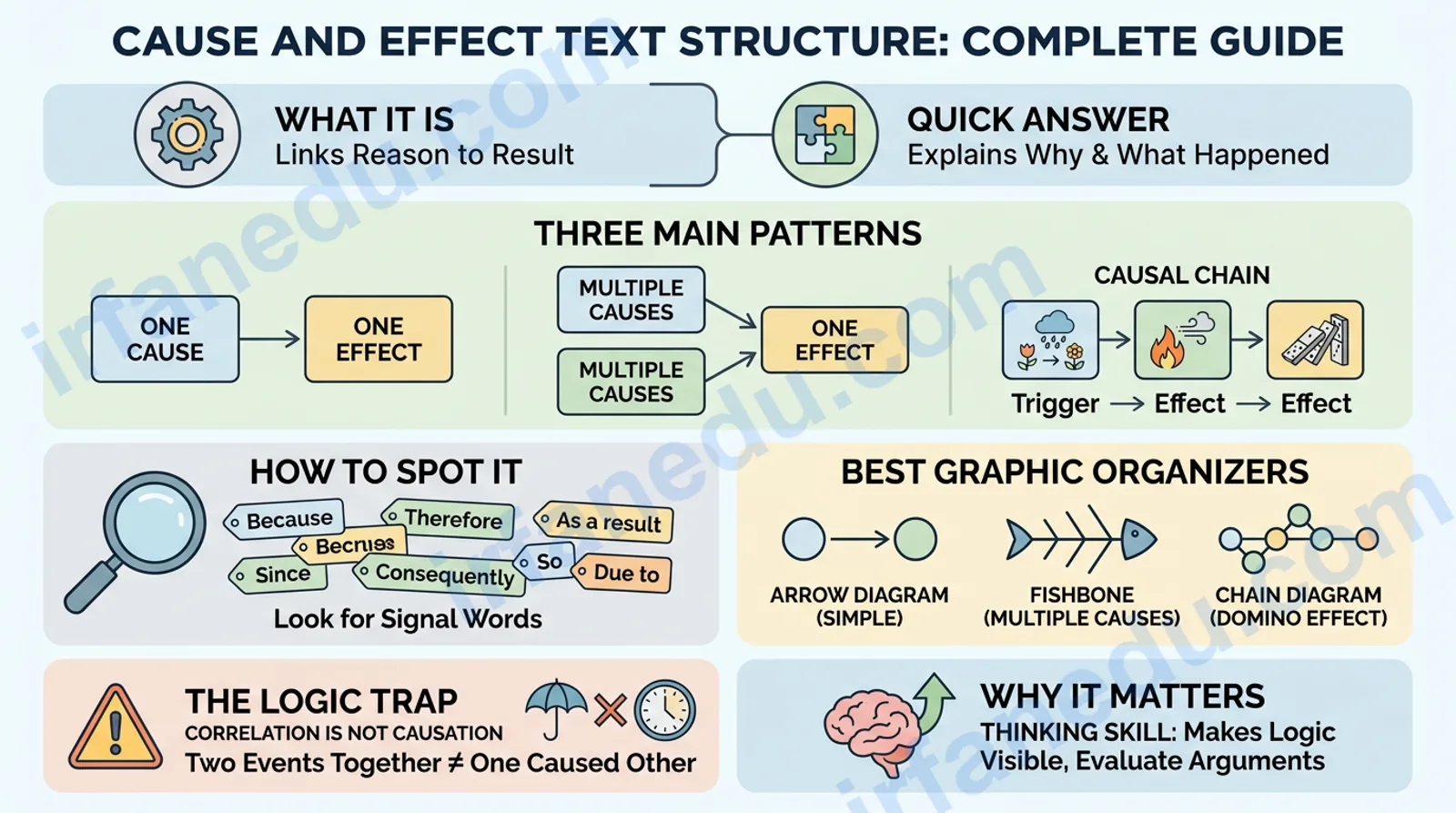
Cause & effect in 60 seconds
- What it is: a writing pattern that links a reason (cause) to a result (effect).
- Where you see it: science textbooks, history articles, news reports, lab reports.
- How to spot it: look for signal words — because, since, therefore, as a result, consequently.
- Three patterns: one cause → one effect | multiple causes → one effect | causal chain.
- The trap: correlation is not causation — two events happening together does not mean one caused the other.
- Best graphic organizer: arrow diagram (simple), fishbone (multiple causes), chain diagram (domino effects).
Cause and effect text structure is one of five major nonfiction text structures. It organizes information by showing a logical relationship between events or ideas: one thing happens, and that happening produces another. Recognizing this structure helps readers understand complex arguments, and using it well makes writing far more persuasive and clear.
If you have ever read a science article explaining why a species went extinct, or a history passage describing what led to a war, you have already encountered cause and effect text structure. The challenge is learning to see it reliably, use it in your own writing, and — critically — avoid the logic trap of confusing sequence with causation.
In this guide, I walk through everything: what the structure is, how to identify it, the signal words that flag it, the three main patterns it takes, how to write with it, and the one mistake that even strong readers make. I have taught this concept to hundreds of middle and high school students, and I will share the specific approach that works fastest.
- Identify cause and effect structure in any passage with confidence
- Use the right signal words when writing
- Distinguish the three cause-and-effect patterns
- Avoid the correlation-vs-causation trap
- Apply graphic organizers that match the pattern in the text
Key takeaway: Cause and effect text structure is not just a reading skill — it is a thinking skill. Authors who use it well make their logic visible. Readers who recognize it can evaluate arguments, not just absorb them.
What is cause and effect text structure?
Cause and effect text structure is a pattern of organization where a writer presents one or more causes and explains the effects that follow from them. The cause is the reason something happens; the effect is the result or outcome. This structure appears whenever a writer wants to explain why something occurred or what happened because of a particular event or condition.
It is one of five widely recognized nonfiction text structures, alongside description, sequence/chronological order, compare and contrast, and problem-solution. Each structure serves a different communicative purpose, but cause and effect is arguably the most analytical — it requires the writer to establish a logical relationship, not just list facts.
“The region experienced a severe drought (cause), which caused crop yields to fall by 40% (effect), leading to widespread food shortages (second-order effect).”
Notice how the example above shows a causal chain: the drought does not just produce one effect — it triggers a sequence. That chain structure is one of the three main patterns you will encounter, and I cover all three in detail below.
According to the Reading Rockets literacy resource (a project of WETA Public Media, funded by the U.S. Department of Education), teaching students to recognize text structure is one of the most effective comprehension strategies available. Cause and effect is consistently identified as the structure students find hardest to apply correctly — not because the concept is difficult, but because the logic trap of correlation is so easy to fall into.
What are the signal words for cause and effect?
Signal words are the linguistic markers that tell a reader which part of a sentence is the cause and which is the effect. They are the fastest way to identify cause and effect structure in a passage, and they are essential tools when writing in this pattern.
| Cause signal words | Effect signal words | Neutral connectors (can go either way) |
|---|---|---|
| because | therefore | so that |
| since | thus | which led to |
| due to | consequently | resulted in |
| as a result of | as a result | affected |
| caused by | for this reason | influenced |
| owing to | hence | contributed to |
| the reason is | so | brought about |
A practical tip I give students: cover the signal word and ask “why?” or “what happened next?” If “why?” fits, the signal word introduces a cause. If “what happened next?” fits, it introduces an effect. This two-question test works even when signal words are absent — which happens more often than most guides admit.
In my experience teaching this to middle schoolers, the word since causes the most confusion. Students know it as a time word (“since last Tuesday”), so they miss it as a cause marker (“since the temperature dropped, the pipes froze”). I always highlight since separately and show both uses side by side. That single distinction has cleared up more misidentifications than any other lesson I have taught on this topic.
What are the three main cause and effect patterns?
Not all cause and effect relationships look the same. Recognizing which pattern a text uses helps you map it accurately and write about it more precisely. There are three patterns that cover the vast majority of cases.
Pattern 1: One cause, one effect
The simplest pattern. One event or condition directly produces one outcome.
“She stayed up until 2 a.m. studying (cause), so she felt exhausted the next morning (effect).”
Pattern 2: Multiple causes, one effect
Several independent factors combine to produce a single outcome. This pattern is common in history and science writing.
“Poor soil quality, lack of rainfall, and overfarming (three causes) all contributed to the collapse of the harvest (one effect).”
Pattern 3: Causal chain (domino effect)
Each effect becomes the cause of the next event, creating a chain. This is the most complex pattern and the one most often tested in reading comprehension.
  [Cause 1]
  Factory releases pollutants into river
        |
        v  (because / which caused)
  [Effect 1 / Cause 2]
  Fish population declines
        |
        v  (as a result / leading to)
  [Effect 2 / Cause 3]
  Fishing industry loses income
        |
        v  (consequently)
  [Effect 3]
  Local unemployment rises
When you encounter a causal chain in a test passage, draw it out exactly like the diagram above. Students who map the chain visually almost never confuse which event is the cause and which is the effect at each link.
How do you identify cause and effect text structure in a passage?
Identifying cause and effect structure is a six-step process. Follow these steps in order, and you will rarely misidentify the structure — even in passages that hide their signal words.
- Scan for signal words. Read through the passage and highlight any cause or effect signal words from the table above.
- Ask “Why did this happen?” For each highlighted word, identify the cause. It is the answer to “why?”
- Ask “What happened as a result?” Identify the effect. It is the answer to “what happened next because of this?”
- Check for a logical link. Confirm the cause and effect are logically connected — not just happening in sequence. One must produce or contribute to the other.
- Identify the pattern type. Decide if the text uses one-to-one, many-to-one, or a causal chain.
- Draw a graphic organizer. Map the relationships using an arrow diagram, fishbone diagram, or chain diagram to confirm your analysis.
Sequence is not causation. “The sun rose, and then the rooster crowed” is a sequence. The sun rising did not cause the rooster to crow — they just happened in order. Cause and effect requires a logical, not just a temporal, relationship. This is the single most common error on reading comprehension tests.
Most guides teach signal words and stop there. But signal words can lie.
Here is the non-obvious problem: authors sometimes use cause-and-effect signal words in passages that are actually structured as problem-solution or compare-and-contrast. For example, a passage might say “Because renewable energy is cheaper, many countries are switching to solar” — but the author’s organizing purpose is to argue for a policy change (problem-solution), not to analyze causation. The signal word “because” is present, but the dominant text structure is different.
The test that actually works: ask what the author’s primary purpose is, not just what words appear. If the author’s goal is to explain a relationship between events, the structure is cause and effect. If the goal is to recommend an action, it is problem-solution even if cause-and-effect language appears throughout.
In my experience reviewing student essays, the students who score highest on text structure questions are the ones who ask “what is the author trying to do?” before they look for signal words — not after.
How does cause and effect compare to other text structures?
Cause and effect is one of five major nonfiction text structures. Knowing how they differ prevents misidentification — a common source of lost points on reading tests.
| Text structure | Author’s purpose | Key signal words | Graphic organizer |
|---|---|---|---|
| Cause and effect | Explain why something happened and what resulted | because, therefore, as a result, consequently | Arrow diagram, fishbone, chain |
| Description | Describe a topic using details and characteristics | for example, such as, including, characteristics | Web/spider diagram |
| Sequence / chronological | List events or steps in time order | first, next, then, finally, after | Timeline, numbered list |
| Compare and contrast | Show similarities and differences between two things | however, similarly, on the other hand, unlike | Venn diagram, T-chart |
| Problem and solution | Identify a problem and propose a fix | the problem is, one solution, as a result, in order to | Problem-solution chart |
Notice that problem-solution and cause-and-effect share some signal words. The distinction is purpose: cause-and-effect explains; problem-solution prescribes. Keep that in mind when a passage uses “as a result” but is clearly recommending an action.
How do you write using cause and effect text structure?
Writing in cause and effect structure means making your logical relationships explicit. Readers should never have to guess why you moved from one idea to the next. Here is how to do it well.
Step 1: Identify your cause-and-effect relationship clearly before you write
Write the relationship in one sentence before drafting: “X happened because of Y, and this led to Z.” If you cannot write that sentence, your relationship is not clear enough yet.
Step 2: Choose the right signal word for the direction
Use cause-introducing words (because, since, due to) when you state the cause first. Use effect-introducing words (therefore, as a result, consequently) when you state the effect first. Mixing them up is the most common writing error I see in student essays.
Step 3: Avoid over-chaining
A causal chain with more than three or four links becomes hard to follow. If your chain is longer, break it into two paragraphs, each with its own cause-and-effect relationship clearly stated.
Step 4: Distinguish correlation from causation in your own claims
Before you write “X caused Y,” ask yourself: could both X and Y be caused by a third factor? Could they just be correlated? Strong academic writing acknowledges this distinction. Phrases like “contributed to,” “was a factor in,” or “is associated with” are more defensible than flat causal claims when the evidence is not conclusive.
Weak version (correlation claimed as causation):
“Students who eat breakfast get better grades. Therefore, eating breakfast causes better grades.”
Stronger version (acknowledges complexity):
“Research suggests that students who eat breakfast tend to perform better on tests, likely because adequate nutrition supports concentration and memory. However, other factors — including sleep quality and study habits — also contribute to academic performance.”
The single writing upgrade that has the biggest impact on my students’ essays is replacing “caused” with “contributed to” or “was a key factor in” wherever the evidence is not airtight. It sounds like a small change, but it signals to the reader — and to the teacher grading the essay — that the writer understands the difference between correlation and causation. That distinction is what separates a B essay from an A essay at almost every level I have taught.
What do real-world cause and effect passages look like?
The best way to internalize cause and effect structure is to see it in authentic texts across different subjects. Below are three annotated examples — one from science, one from history, one from everyday news writing.
Science example
“Because greenhouse gases trap heat in the atmosphere [cause], average global temperatures have risen by approximately 1.1°C since pre-industrial times [effect], causing more frequent and intense extreme weather events [second-order effect].”
Blue = cause | Green = primary effect | Yellow = second-order effect
History example
“The assassination of Archduke Franz Ferdinand in 1914 [cause] triggered a chain of alliance obligations [effect 1], consequently pulling multiple European nations into conflict [effect 2] and resulting in the outbreak of World War I [effect 3].”
News writing example
“Due to a sudden surge in demand [cause], the price of the component rose sharply [effect], which led to production delays across the industry [second-order effect].”
In all three examples, the signal words do the heavy lifting of making the logical relationship visible. When you write, aim for the same clarity: the reader should be able to identify cause and effect without having to infer the relationship.
Which graphic organizer should you use for cause and effect?
The right graphic organizer depends on the pattern in the text. Using the wrong one forces the information into a shape it does not fit, which makes analysis harder, not easier.
| Pattern type | Best graphic organizer | When to use it |
|---|---|---|
| One cause → one effect | Two-box arrow diagram | Simple, direct relationships |
| Multiple causes → one effect | Fishbone (Ishikawa) diagram | History events, complex problems with many contributing factors |
| One cause → multiple effects | Branching tree diagram | Science: one event with wide-ranging consequences |
| Causal chain | Chain/domino diagram | Sequences where each effect becomes the next cause |
A note on the fishbone diagram: it was originally developed for quality control in manufacturing (the Ishikawa diagram), but it maps beautifully onto historical causation. I use it regularly when teaching students to analyze multi-factor events — it forces them to name each cause separately rather than lumping them together.
What are the most common mistakes students make with cause and effect?
After reviewing hundreds of student essays and test responses, I have identified four mistakes that come up again and again. Each one has a specific fix.
Confusing sequence with causation. Just because B follows A does not mean A caused B. Fix: always ask “would B have happened without A?” If yes, the relationship is sequence, not causation.
Reversing cause and effect. Students sometimes write the effect first and call it the cause. Fix: the cause always comes before the effect in time. If you are unsure, ask “which happened first?”
Identifying only one cause when multiple exist. Many real-world effects have several contributing causes. Fix: after identifying one cause, ask “what else contributed to this outcome?” Keep asking until you have found all the causes the text mentions.
Using signal words incorrectly in writing. Writing “because the temperature rose, therefore the ice melted” is redundant — “because” already signals the cause, so “therefore” is not needed. Fix: use one signal word per relationship, not two.
Quick check: test your understanding
Select an answer to see instant feedback.
1. “The river flooded because of heavy rainfall.” Which part is the cause?
2. Which signal word introduces an effect?
3. A passage describes how poor diet, lack of exercise, and stress all contributed to a patient’s high blood pressure. Which cause-and-effect pattern is this?
Frequently asked questions
What is cause and effect text structure?
What are the signal words for cause and effect?
What is the difference between cause and effect text structure and problem-solution?
Can a text have more than one cause or effect?
How do I identify cause and effect text structure in a passage?
Is cause and effect the same as sequence text structure?
How is cause and effect text structure used in science writing?
What graphic organizer works best for cause and effect?
Sources & references
- Reading Rockets / WETA Public Media — “Using Text Structure to Improve Comprehension”. A U.S. Department of Education-funded literacy resource covering all five nonfiction text structures and evidence-based strategies for teaching them.
- Purdue Online Writing Lab (OWL) — “Cause and Effect Essays”. Guidance on writing cause-and-effect arguments with clarity and logical precision.
- Khan Academy — “Text structure review”. Overview of the five text structures with examples for middle school readers.
Editorial note: This article was written and fact-checked by Dr. Irfan Mansuri. All examples are original. No statistics or quotes have been fabricated. External links were verified as live and accurate as of July 2026.