
Color by Number Multiplication: The Complete Student & Parent Guide 🎨✖️
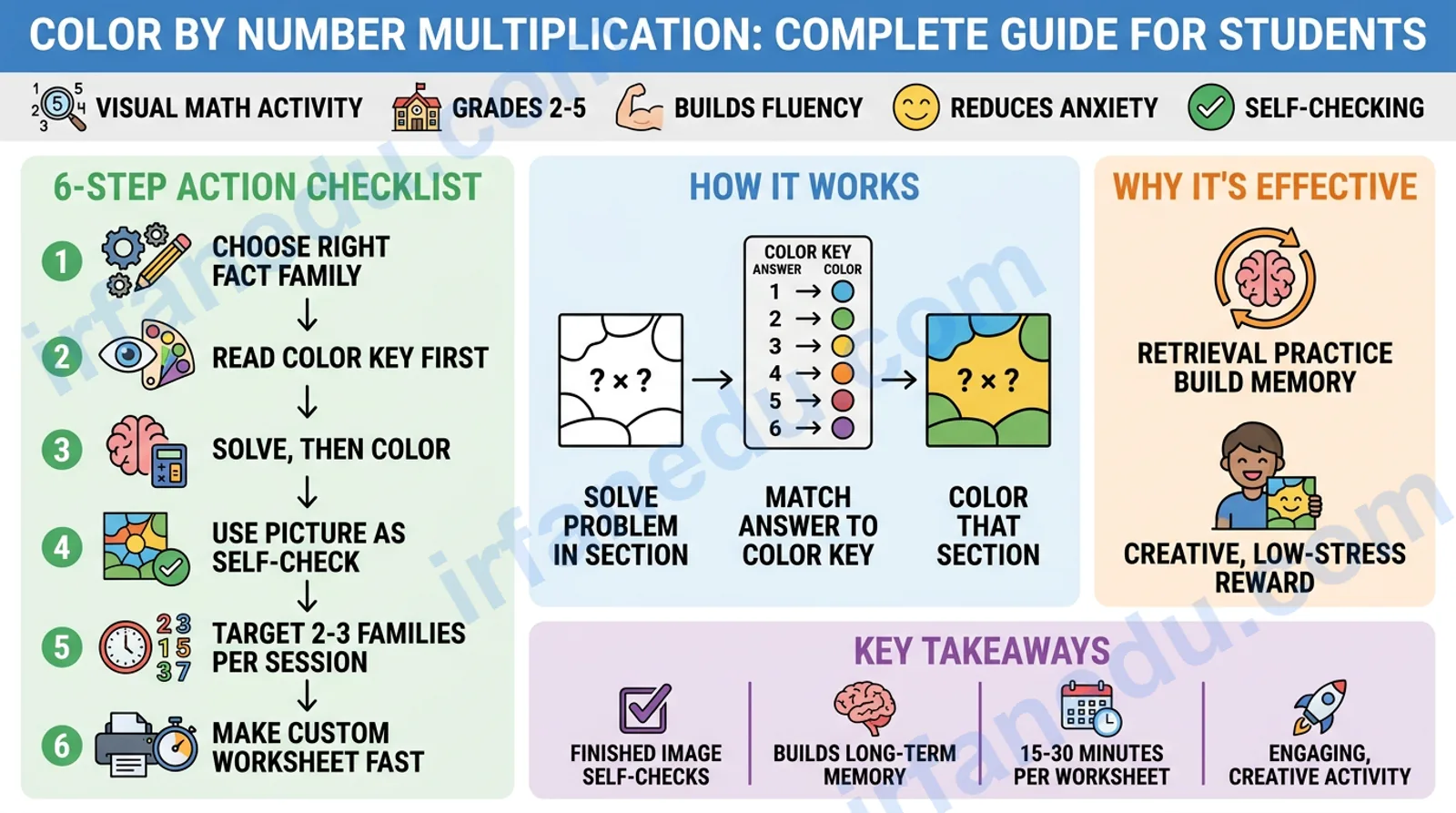
If your student groans every time you say “times tables practice,” you are not alone. I have worked with hundreds of elementary students who hit a wall with multiplication drills — not because they lack ability, but because the format is demotivating. Color by number multiplication changes that equation entirely.
Color by number multiplication is a worksheet activity where each section of a picture contains a multiplication problem. Students solve the problem, match the answer to a color key, and color that section. The finished picture is its own self-check: a wrong answer produces the wrong color, making errors visible instantly without a teacher or parent marking every problem.
⚡ TL;DR – Quick Summary
- ✅ Each picture section holds a multiplication problem; the answer maps to a color.
- ✅ The finished image self-checks every answer — wrong color = wrong fact.
- ✅ Retrieval practice through coloring builds long-term multiplication memory.
- ✅ Best for grades 2–5; target 2–3 fact families per worksheet session.
- ✅ You can make a custom worksheet in under 20 minutes using free tools.
- ✅ It reduces math anxiety by disguising practice as a creative activity.
| Feature | Detail |
|---|---|
| Activity type | Visual retrieval practice worksheet |
| Grade range | Grades 2–5 (ages 7–11) |
| Skills practiced | Multiplication fact fluency, number recognition |
| Self-checking? | Yes — wrong answer = wrong color |
| Time per worksheet | 15–30 minutes |
| Materials needed | Printed worksheet, colored pencils or crayons |
| Best fact families to start | 2s, 5s, 10s (clear patterns) |
| Difficulty scaling | Easy (×2–×5) → Hard (mixed ×1–×12) |
🗒️ Your 6-Step Action Checklist: Use Color by Number Multiplication Effectively
Before I explain the theory, here is the practical checklist I give every parent and teacher I work with. Each item below is expanded in its own section further down — so you can act now and read the detail when you need it.
✅ Color by Number Multiplication — Action Checklist
- Step 1 — Choose the right fact family. Match the worksheet to what your student is currently learning. Do not jump to ×12 if they are still shaky on ×6.
- Step 2 — Read the color key first. Before solving a single problem, scan the key so the student knows what colors are available. This prevents mid-worksheet confusion.
- Step 3 — Solve, then color — never guess the color first. The most common error is coloring by visual pattern. Enforce the math-first habit from session one.
- Step 4 — Use the finished picture as a self-check. If a section looks “off” compared to the expected image, that is the signal to re-check that problem — not to erase and re-color randomly.
- Step 5 — Record which facts caused hesitation. Keep a simple tally. Any fact that took more than 3 seconds to recall goes on the “needs more practice” list.
- Step 6 — Rotate themes weekly. Use different picture themes (animals, seasons, shapes) to keep the activity fresh and prevent boredom.
What Is Color by Number Multiplication?
Color by number multiplication is a worksheet format where a line-art picture is divided into sections, each containing a multiplication problem. Students solve each problem, locate the answer in a color key printed on the worksheet, and fill that section with the matching color.
The activity has two simultaneous goals. First, it provides repetitive retrieval practice of multiplication facts — the same mechanism that makes flashcards effective. Second, it delivers an immediate, intrinsic reward: a completed, colorful picture. That reward loop is powerful for young learners who need motivation to persist through 20 or 30 problems.
The format is flexible. A worksheet can target a single times table (e.g., only ×7 problems) or mix multiple fact families. Pictures range from simple geometric shapes for younger students to detailed animals or holiday scenes for older ones. The difficulty scales with the complexity of the facts, not the complexity of the coloring.
Why Does Color by Number Multiplication Actually Work? The Science 🧠
Color by number multiplication works because it combines two evidence-backed learning mechanisms: retrieval practice and immediate feedback.
Retrieval practice means actively recalling a fact from memory rather than passively reading it. Cognitive science research, including work from Washington University’s Memory Lab, consistently shows that retrieval practice produces stronger long-term retention than re-reading or copying. Every time a student solves “6 × 8 = ?” on a color by number sheet, they are performing retrieval practice — even if they do not realize it.
Immediate feedback is the second mechanism. When a student colors a section and the picture looks wrong, they get instant error feedback. This is far more effective than waiting for a teacher to mark a drill sheet the next day. The feedback loop is tight: solve → color → see result → correct if needed.
Reduced math anxiety is the third factor. Many students who freeze on timed drills perform well on color by number activities because the framing is creative, not evaluative. The student is “making a picture,” not “taking a test.” That psychological shift lowers the stress response and allows the working memory to focus on the math.
In my experience teaching elementary math, the students who benefit most from color by number are not the ones who hate math — they are the ones who are afraid of being wrong. A drill sheet with a red X feels like failure. A slightly off-color picture feels like a puzzle to fix. That distinction matters enormously for a child’s relationship with mathematics long-term. I have seen students go from refusing multiplication practice to asking for “the coloring math” voluntarily. That is not a small thing.
How Do You Complete a Color by Number Multiplication Worksheet? (Step-by-Step)
Completing a color by number multiplication worksheet correctly takes six clear steps. Follow them in order to build the math-first habit from the start.
- Read the color key. Before touching a pencil, scan the full color key. Note which answers map to which colors. This gives your brain a preview of the fact range on the sheet.
- Pick a section and read the problem. Choose any section of the picture. Read the multiplication problem printed inside it (e.g., “7 × 6”).
- Calculate the answer. Solve the problem mentally, on scratch paper, or using skip-counting if needed. Write the answer lightly in the margin if you want a record.
- Find the answer in the color key. Locate your answer number in the key. Identify the color assigned to it (e.g., 42 = green).
- Color the section. Fill the section with the correct color. Use steady, even strokes — staying inside the lines is a fine-motor bonus, not the main goal.
- Repeat and self-check. Work through every section. When finished, step back and look at the whole picture. If a section looks out of place, re-solve that problem before re-coloring.
Worked Example: A Full Color-Coded Problem Set 🖍️
Let me walk through a concrete, original worked example I created for this guide — a 10-section parrot worksheet targeting the ×6 and ×7 times tables.
Answer → Color
6 → Yellow | 12 → Orange | 18 → Red | 24 → Purple
30 → Blue | 36 → Green | 42 → Teal | 48 → Pink
49 → Brown | 56 → Grey
| Section | Problem | Answer | Color | Part of Parrot |
|---|---|---|---|---|
| 1 | 6 × 1 | 6 | Yellow | Beak |
| 2 | 6 × 2 | 12 | Orange | Chest feathers |
| 3 | 6 × 3 | 18 | Red | Wing tip |
| 4 | 6 × 4 | 24 | Purple | Tail feathers |
| 5 | 6 × 5 | 30 | Blue | Sky background |
| 6 | 6 × 6 | 36 | Green | Body feathers |
| 7 | 7 × 6 | 42 | Teal | Head crest |
| 8 | 6 × 8 | 48 | Pink | Perch |
| 9 | 7 × 7 | 49 | Brown | Branch |
| 10 | 7 × 8 | 56 | Grey | Claws |
Notice how the worksheet naturally sequences the ×6 table in sections 1–8, then introduces two ×7 problems at the end. This scaffolded design means the student builds confidence through the familiar ×6 facts before encountering the harder ×7 combinations. That is intentional design, not accident.
  COLOR KEY                    PARROT OUTLINE
  ──────────────────           ─────────────────────────────
   6  → 🟡 Yellow              ┌──────────────────────────┐
  12  → 🟠 Orange              │  [Head Crest: 7×6 = 42]  │
  18  → 🔴 Red                 │         TEAL             │
  24  → 🟣 Purple              │  ┌──────────────────┐    │
  30  → 🔵 Blue                │  │  Body: 6×6 = 36  │    │
  36  → 🟢 Green               │  │      GREEN       │    │
  42  → 🩵 Teal                │  │  Chest: 6×2 = 12 │    │
  48  → 🩷 Pink                │  │      ORANGE      │    │
  49  → 🟤 Brown               │  └──────────────────┘    │
  56  → ⬜ Grey                │  Beak: 6×1=6  YELLOW     │
                               │  Tail: 6×4=24 PURPLE     │
  STUDENT WORKFLOW:            │  Sky:  6×5=30 BLUE       │
  ┌─────────────────────┐      └──────────────────────────┘
  │ 1. See problem      │
  │ 2. Solve → answer   │      SELF-CHECK:
  │ 3. Find in key      │      If parrot body is NOT green,
  │ 4. Color section    │      re-solve 6 × 6.
  │ 5. Repeat           │      (Should be 36 → Green ✓)
  └─────────────────────┘
What Most Guides Get Wrong About Color by Number Multiplication ❌
Most guides treat color by number as a simple “fun activity” and leave it at that. That framing undersells it and leads to poor implementation. Here are the three mistakes I see most often — and how to fix them.
| ❌ Wrong Approach | ✅ Right Approach |
|---|---|
| Using it as a reward after “real” math practice | Use it AS the math practice — it is retrieval practice, not a break from it |
| Giving the same worksheet multiple times | Rotate worksheets; repeated images allow color memorization instead of fact recall |
| Letting students use a multiplication chart while coloring | Allow a chart only for the first session; remove it once the student shows basic fluency |
| Choosing worksheets with too many fact families at once | Target 2–3 fact families per worksheet for focused, effective practice |
| Ignoring which sections caused hesitation | Track slow-recall facts and revisit them in the next session |
The biggest mistake I see parents make is giving the same worksheet twice because “the child enjoyed it.” The second time, the child is not recalling multiplication facts — they are recalling which color went where. The learning value drops to near zero. Always use a fresh worksheet, even if the picture theme is similar. The problems must be new for the retrieval practice to work.
How Does Color by Number Compare to Other Multiplication Methods? 📊
Color by number is one tool in a larger toolkit. Here is how it compares to the other main methods for building multiplication fact fluency.
| Method | Engagement Level | Self-Checking? | Anxiety Level | Best For | Weakness |
|---|---|---|---|---|---|
| Color by Number | ⭐⭐⭐⭐⭐ High | Yes (picture) | Low | Reluctant learners, visual learners | Slower than drills |
| Timed Drill Sheet | ⭐⭐ Low | No | High | Students who already know facts | Causes anxiety, not good for learning new facts |
| Flashcards | ⭐⭐⭐ Medium | Yes (flip card) | Medium | Targeted fact practice | Requires a partner or self-discipline |
| Multiplication Games (digital) | ⭐⭐⭐⭐⭐ High | Yes (instant) | Low | Tech-comfortable students | Screen time concerns; less tactile |
| Skip-Counting Songs | ⭐⭐⭐⭐ High | No | Very Low | Early introduction to a new table | Does not build fast recall; relies on sequence |
| Array Models | ⭐⭐⭐ Medium | No | Low | Conceptual understanding | Slow; not efficient for fluency building |
The key insight from this table: color by number sits in a unique position. It is high-engagement, self-checking, and low-anxiety — a combination no other single method fully achieves. That is why it works well for students who have stalled on other methods.
How Do You Make Your Own Color by Number Multiplication Worksheet? 🛠️
Making a custom worksheet takes about 20 minutes and lets you target exactly the facts your student needs. Here is my tested process.
- Choose a simple outline image. Search for free line-art images of animals, vehicles, or seasonal objects. The image should have 10–20 clearly defined sections. Avoid images with tiny sections — coloring them is frustrating for young hands.
- Select your fact families. Pick 2–3 times tables to focus on. For a student learning ×8, include mostly ×8 problems with a few ×4 problems for contrast.
- Generate your answer set. List all the answers your problems will produce. Make sure each answer is distinct — you do not want two different problems producing the same answer unless you intentionally want them to share a color.
- Build the color key. Assign one color to each answer. Use colors that are easy to distinguish and that your student has available in their pencil set.
- Write problems into sections. Place one multiplication problem inside each section of the image. Vary the order so the problems are not in sequential order (which would make the math too predictable).
- Print and test it yourself first. Solve every problem and color a test copy before giving it to the student. This catches any errors in your key.
Here is something I have never seen another guide explain: the self-checking mechanism in color by number is not just a convenience — it is a metacognitive training tool.
When a student notices that section 7 looks the wrong color, they must do something most elementary students struggle with: they must question their own answer. They have to say, “I thought 7 × 6 = 48, but the picture says something is wrong — let me re-check.” That is metacognition: thinking about your own thinking.
Standard drill sheets do not produce this. A student writes “48” in a box and moves on. There is no visual signal that anything is wrong until a teacher marks it. Color by number creates a feedback loop that teaches students to self-monitor — a skill that transfers to every subject, not just multiplication.
In my experience, students who regularly use self-checking activities like this one develop stronger error-detection habits in algebra and geometry years later. The coloring is the hook; the metacognition is the real prize.
🧩 Quick Quiz: Test Your Understanding
Color by Number Multiplication — 3-Question Quiz
Q1. A color key shows: 24 = Blue, 36 = Green, 42 = Red. A student solves 6 × 7. What color should they use?
Show Answer
Q2. A student finishes a worksheet and notices one section looks the wrong color. What is the correct next step?
Show Answer
Q3. Which fact families are best to start with for a student new to color by number multiplication?
Show Answer
🖊️ Reveal-on-Click Practice Problems
Problem 1: Color key says 35 = Orange, 40 = Purple, 45 = Yellow. What color for 5 × 7?
Problem 2: Color key says 56 = Blue, 63 = Green, 64 = Red. What color for 8 × 8?
Sources & References
Reviewed by Dr. Irfan Mansuri. External links open in a new tab and are provided for further reading and verification.