
Equivalent Fractions of 1/2: Your 2-Minute Quick Win + Complete Mastery Guide
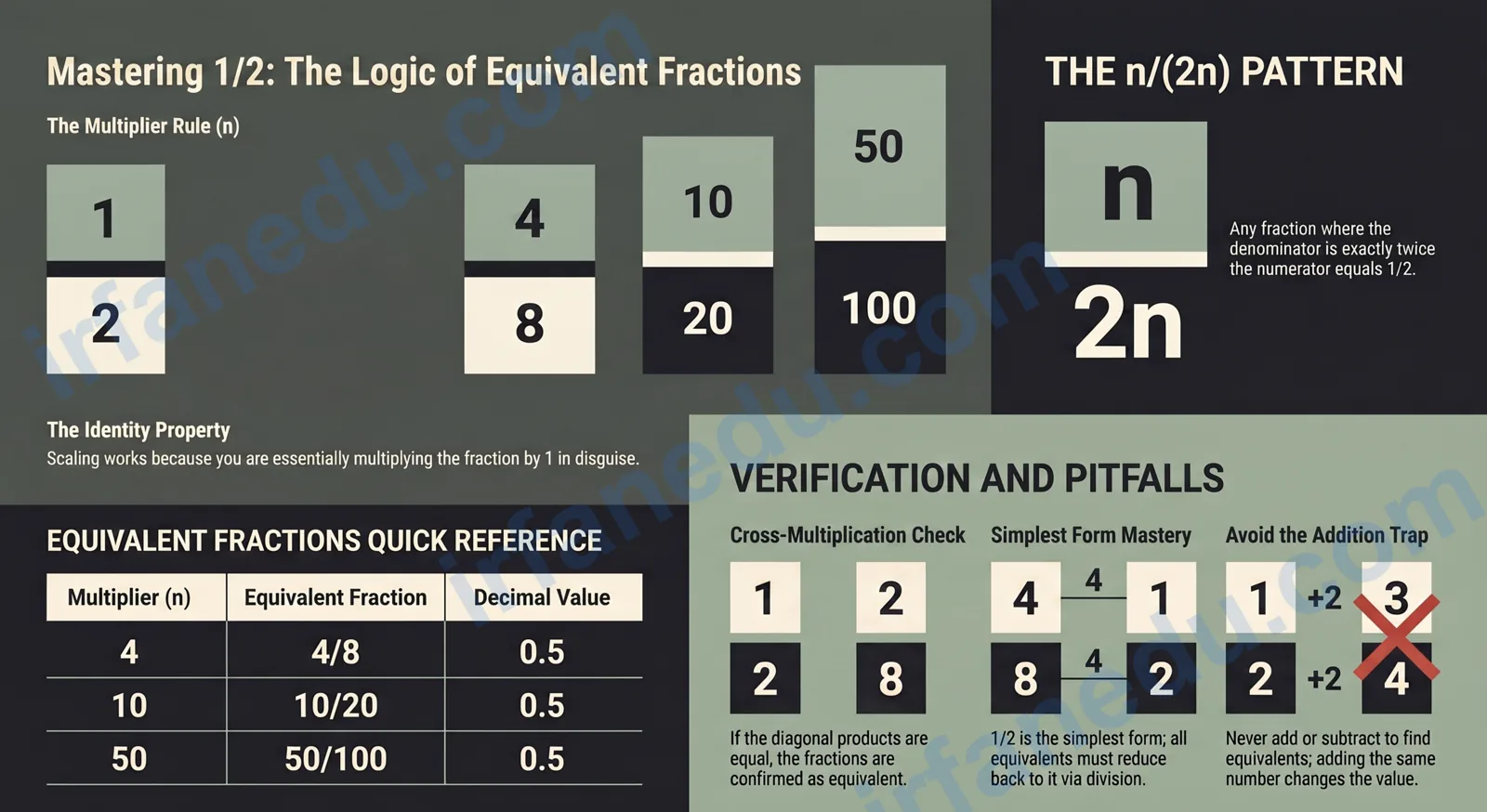
Here is the thing about equivalent fractions that most worksheets skip: you already use them every day. When you split a pizza into 4 slices and eat 2, you ate 2/4 — which is exactly the same as 1/2. That is the whole idea, and once it clicks, the rest is just practice.
Equivalent fractions of 1/2 are fractions that represent the same portion of a whole as one half. You create them by multiplying or dividing both the numerator and denominator of 1/2 by the same non-zero number. The resulting fractions — 2/4, 3/6, 4/8, 5/10, and so on — all sit at the exact same point on a number line.
- 🎯 Understand what “equivalent” means in plain language
- 🔢 Use the multiply/divide rule to generate any equivalent fraction
- ✅ Verify whether a given fraction equals 1/2 using cross-multiplication
- 📄 Practice with a free printable worksheet and answer key
The equivalent fractions of 1/2 are fractions that represent the same value as one half. Find them by multiplying both the numerator and denominator by the same number. Common examples: 2/4, 3/6, 4/8, 5/10, 6/12, 50/100. Any fraction in the form n/(2n) equals 1/2. You can verify any fraction by cross-multiplying — if the products are equal, the fractions are equivalent.
📥 Free Printable Worksheet: 12 problems, answer key included — ready to print right now.
⚡ TL;DR – Quick Summary
- ✅ Equivalent fractions of 1/2 include 2/4, 3/6, 4/8, 5/10, and infinitely more.
- ✅ Rule: multiply or divide both numerator and denominator by the same number.
- ✅ All equivalent fractions of 1/2 follow the pattern n/(2n).
- ✅ Cross-multiply to check: if products are equal, fractions are equivalent.
- ✅ 1/2 is already in simplest form — all others reduce back to it.
- ✅ Use the free worksheet below to lock in the skill with 12 practice problems.
| Multiplier (n) | Equivalent Fraction | Decimal Value | Simplest Form |
|---|---|---|---|
| 1 | 1/2 | 0.5 | 1/2 ✓ |
| 2 | 2/4 | 0.5 | 1/2 ✓ |
| 3 | 3/6 | 0.5 | 1/2 ✓ |
| 4 | 4/8 | 0.5 | 1/2 ✓ |
| 5 | 5/10 | 0.5 | 1/2 ✓ |
| 10 | 10/20 | 0.5 | 1/2 ✓ |
| 50 | 50/100 | 0.5 | 1/2 ✓ |
🍕 What Are Equivalent Fractions of 1/2?
Equivalent fractions of 1/2 are different-looking fractions that represent exactly the same amount — one half of a whole. The word “equivalent” comes from Latin meaning “equal value,” and that is precisely what these fractions share: the same value, just written with different numbers.
Think of a chocolate bar. If the bar has 2 pieces and you take 1, you have 1/2. If the same bar is broken into 4 pieces and you take 2, you still have exactly half — that is 2/4. Break it into 8 pieces and take 4 — that is 4/8. Same amount of chocolate, different fractions.
📌 Real-World Examples of 1/2 Equivalents
- A clock face: 30 minutes out of 60 minutes = 30/60 = 1/2 of an hour
- A dollar: 50 cents out of 100 cents = 50/100 = 1/2 of a dollar
- A sports game: halftime = 1 half out of 2 halves = 1/2
- A recipe: 3 tablespoons out of 6 tablespoons = 3/6 = 1/2 cup
The key insight is this: a fraction’s value does not change when you scale both its numerator and denominator by the same factor. You are changing the size of each piece and the number of pieces at the same time, so the total amount stays constant.
In my experience teaching fractions to students from Grade 3 through Grade 6, the biggest stumbling block is not the rule itself — it is the word “equivalent.” Students hear it and think it means “almost the same.” I always replace it with “identical twins in disguise.” 2/4 and 1/2 are identical twins: they look different, but they are the exact same amount. Once that image sticks, the concept clicks permanently.
🔢 How Do You Find Equivalent Fractions of 1/2?
You find equivalent fractions of 1/2 by multiplying or dividing both the numerator and the denominator by the same non-zero whole number. This is the one rule you need, and it works every time.
Here is the formal method as a step-by-step process:
-
Write down 1/2. Identify the numerator (top number = 1) and the denominator (bottom number = 2).
-
Choose any multiplier (n). Pick any whole number: 2, 3, 4, 5 — your choice. The larger the multiplier, the larger the denominator of your equivalent fraction.
-
Multiply BOTH the numerator AND the denominator by n. If n = 4: numerator = 1 × 4 = 4, denominator = 2 × 4 = 8. Result: 4/8.
-
Verify with cross-multiplication. Multiply diagonally: 4 × 2 = 8, and 1 × 8 = 8. Both products equal 8 — confirmed equivalent.
✏️ Worked Examples: Finding Equivalent Fractions of 1/2
Seeing the method applied to real numbers is the fastest way to make it stick. Here are three fully worked examples, moving from simple to slightly more challenging.
Example 1 — Multiply to Find an Equivalent Fraction
Question: Find an equivalent fraction of 1/2 with a denominator of 14.
Step 1: What do I multiply 2 by to get 14? Answer: 2 × 7 = 14, so n = 7.
Step 2: Multiply the numerator by the same number: 1 × 7 = 7.
Answer: 7/14
Check: 7 × 2 = 14 and 1 × 14 = 14. ✅ Equal — confirmed.
Example 2 — Divide to Simplify to 1/2
Question: Is 18/36 equivalent to 1/2?
Step 1: Find the GCF of 18 and 36. GCF = 18.
Step 2: Divide both: 18 ÷ 18 = 1, 36 ÷ 18 = 2.
Answer: Yes, 18/36 = 1/2. ✅
Example 3 — Cross-Multiply to Check an Unknown Fraction
Question: Is 7/15 equivalent to 1/2?
Step 1: Cross-multiply: 7 × 2 = 14.
Step 2: Other diagonal: 1 × 15 = 15.
Step 3: 14 ≠ 15.
Answer: No, 7/15 is NOT equivalent to 1/2. ❌ (It is slightly less than 1/2.)
📊 Visual: Fraction Bar Model for 1/2 Equivalents
A fraction bar model makes the concept visual and concrete. Each bar below represents one whole, divided into different numbers of equal parts, with exactly half shaded.
🔵 Fraction Bar Model — All Bars Show Exactly 1/2
Halves  (÷2):   [████████████|            ]   1/2
Quarters(÷4):   [██████|██████|      |      ]   2/4
Sixths  (÷6):   [████|████|████|    |    |    ]   3/6
Eighths (÷8):   [██|██|██|██|  |  |  |  ]   4/8
Tenths  (÷10):  [█|█|█|█|█|  |  |  |  |  ]   5/10

Legend: █ = shaded (counted)  |  = divider  space = unshaded

Key Pattern:
  1/2  →  numerator = 1,  denominator = 2
  2/4  →  numerator = 2,  denominator = 4  (both × 2)
  3/6  →  numerator = 3,  denominator = 6  (both × 3)
  4/8  →  numerator = 4,  denominator = 8  (both × 4)
  n/2n →  numerator = n,  denominator = 2n (both × n)
Notice the pattern: in every row, exactly half the bar is shaded. The bars look different because they are divided into more pieces, but the shaded area never changes. That is the visual proof that all these fractions are equivalent.
I have used fraction bar models in classrooms for years, and they consistently outperform abstract rule-memorization for younger students. When a child can see that 4 out of 8 shaded boxes covers the same space as 1 out of 2, the concept moves from a rule they follow to a truth they understand. That shift is the difference between a student who forgets fractions over summer and one who builds on them in algebra years later.
⚠️ Common Mistakes Students Make with Equivalent Fractions
These are the four errors I see most often — and each one has a simple fix.
| ❌ Wrong Approach | ✅ Correct Approach |
|---|---|
| Multiplying only the numerator: 1×3 / 2 = 3/2 | Multiply BOTH: (1×3)/(2×3) = 3/6 |
| Adding the same number: (1+3)/(2+3) = 4/5 | Multiply (not add): (1×3)/(2×3) = 3/6 |
| Thinking 1/3 = 1/2 because both have numerator 1 | Check the denominator: 1/3 ≠ 1/2 (cross-multiply: 1×2=2, 1×3=3; 2≠3) |
| Assuming 2/4 is “bigger” than 1/2 because the numbers are larger | Larger numbers do not mean larger value — 2/4 = 1/2 exactly |
💡 Unique Insight — What Most Guides Get Wrong About 1/2 Equivalents
Almost every worksheet site teaches the multiply-both-by-n rule and stops there. But here is something they miss: the rule works because you are multiplying by 1 in disguise.
When you multiply 1/2 by 3/3, you are multiplying by 3/3 = 1. Multiplying any number by 1 does not change its value — that is the Identity Property of Multiplication. So 1/2 × 3/3 = 3/6, and the value is unchanged by definition, not just by coincidence.
Why does this matter? Because it gives students a reason the rule works, not just a procedure to follow. In my experience, students who understand the “multiplying by 1” logic almost never confuse equivalent fractions with simplification — they see them as two sides of the same coin. This also directly connects to algebra: when you rationalize a denominator or find a common denominator, you are doing exactly this same operation.
📝 Practice Worksheet: Equivalent Fractions of 1/2
Use this on-page worksheet to practice right now. Print the PDF for offline use or classroom distribution. Problems run easy to challenging — work through them in order.
How to use this worksheet: Try each problem on paper first. Use the multiply/divide rule or cross-multiplication. When you finish, reveal the answer key below to self-check. For extra practice, download the printable PDF version.
- 1/2 = ?/4
- 1/2 = ?/6
- 1/2 = ?/10
- 1/2 = ?/16
- 1/2 = 6/?
- 1/2 = 9/?
- Is 4/9 equivalent to 1/2? Show why or why not.
- Simplify 10/20 to its simplest form. Is it equivalent to 1/2?
- 1/2 = ?/100
- A recipe needs 1/2 cup of sugar. You only have a 1/8 cup measure. How many 1/8 cups do you need?
- Order these from smallest to largest: 3/6, 2/5, 1/2, 4/7.
- True or False: Every fraction of the form n/(2n) is equivalent to 1/2.
👁 Show Answer Key
- 2
- 3
- 5
- 8
- 12
- 18
- No. Cross-multiply: 4×2=8, 1×9=9. 8≠9, so 4/9 ≠ 1/2.
- 10/20 = 1/2 (divide both by 10). Yes, equivalent.
- 50
- 4 (because 4/8 = 1/2)
- 2/5 < 1/2 = 3/6 < 4/7
- True. Dividing numerator and denominator by n always gives 1/2.
📥 Want a print-ready version? Download the PDF with all 12 problems and a separate answer key section.
🧠 Quick Quiz: Test Your Knowledge
3-Question Quiz — Equivalent Fractions of 1/2
Q1. Which of the following is equivalent to 1/2?
Q2. To find an equivalent fraction of 1/2 with denominator 18, what is the numerator?
Q3. A student writes (1+4)/(2+4) = 5/6 and claims it equals 1/2. Are they correct?
🔍 Bonus Practice Problems (Reveal Solutions)
Problem A: Find 3 equivalent fractions of 1/2 with even denominators.
Solution: Multiply both parts by 2, 4, and 6:
- 1×2 / 2×2 = 2/4
- 1×4 / 2×4 = 4/8
- 1×6 / 2×6 = 6/12
All three have even denominators and all equal 0.5.
Problem B: A class has 30 students. Half are girls. How many girls are there? Write this as an equivalent fraction of 1/2.
Solution: Half of 30 = 15. So 15 girls out of 30 students = 15/30.
Check: 15/30 = 1/2 (divide both by 15). ✅
15/30 is an equivalent fraction of 1/2 with denominator 30.
Problem C: Is 25/49 equivalent to 1/2? Use cross-multiplication to decide.
Solution: Cross-multiply: 25 × 2 = 50, and 1 × 49 = 49.
50 ≠ 49, so 25/49 is NOT equivalent to 1/2.
It is very close (25/49 ≈ 0.510) but not equal. This is a great example of why you always check rather than estimate.
❓ Frequently Asked Questions
What are the equivalent fractions of 1/2?
How do you find equivalent fractions of 1/2?
Sources & References
Reviewed by Dr. Irfan Mansuri. External links open in a new tab and are provided for further reading and verification.