
Algebra 1 Honors: The Complete Student Guide to Every Topic, Skill, and Strategy
Algebra 1 Honors assumes you are solid on these pre-algebra skills: integer operations (adding, subtracting, multiplying, and dividing negative numbers), fraction arithmetic, the order of operations (PEMDAS), basic ratio and proportion, and plotting points on a coordinate plane. If any of those feel shaky, spend a week reviewing them first. Students who skip this step are the ones who struggle in week three of the course — not because honors algebra is impossibly hard, but because the first unit moves fast and assumes fluency with those building blocks.
What Is Algebra 1 Honors?
Algebra 1 Honors is an accelerated high school mathematics course that covers linear equations, inequalities, systems of equations, functions, and introductory quadratics at a deeper level and faster pace than the standard course. It is designed for students who demonstrate strong pre-algebra fluency and want to move toward advanced math tracks.
If you are a student wondering whether to enroll, or a parent trying to understand what your child signed up for, this guide covers everything: the exact topics, how the course differs from regular Algebra 1, worked examples of the hardest problem types, and the study habits that actually make a difference at the honors level.
I have worked with hundreds of students at this level over 15 years, and the single biggest factor separating those who thrive from those who fall behind is not raw talent. It is whether they understood the prerequisites before day one. That is why this guide starts there.
- Understand exactly what Algebra 1 Honors covers and how it differs from the regular course
- See worked examples of the most common and most difficult problem types
- Learn which mistakes cost students the most points — and how to avoid them
- Get a realistic picture of the workload and the study strategies that work
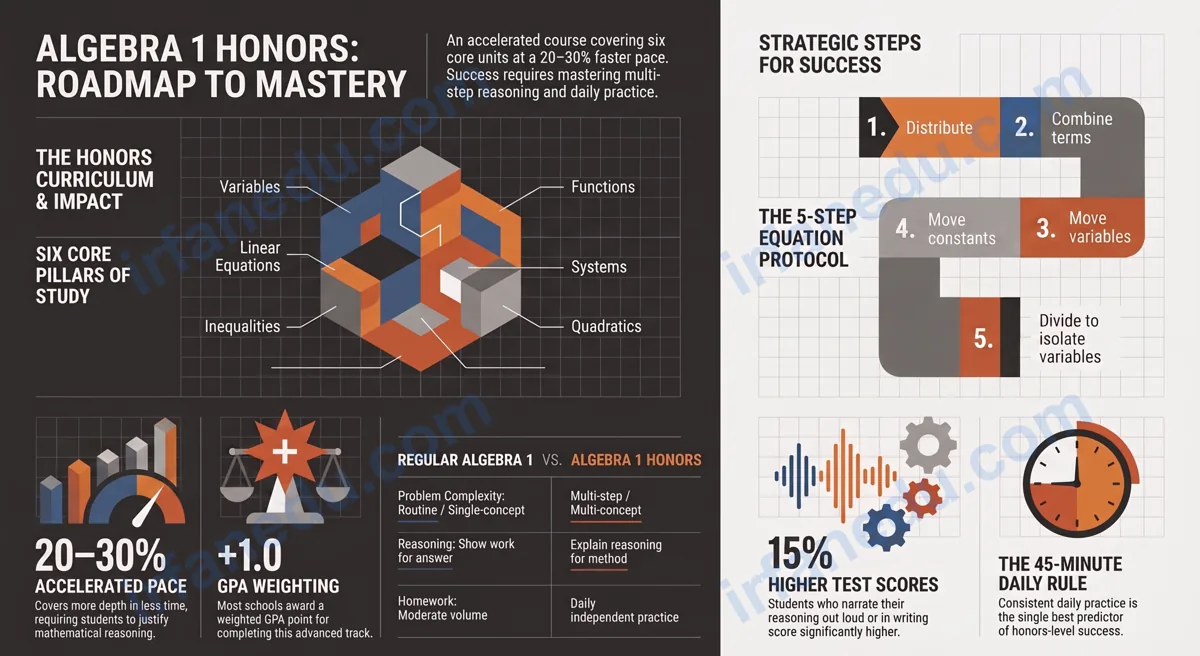
Algebra 1 Honors is an accelerated high school math course covering linear equations, inequalities, systems, functions, and introductory quadratics at greater depth than the standard course. Students solve multi-step problems, justify reasoning, and connect concepts across units. It typically earns a weighted GPA point and prepares students directly for Geometry Honors or Algebra 2.
- Covers six major units: expressions, linear equations, inequalities, systems, functions, and quadratics.
- Moves 20-30% faster than regular Algebra 1 and expects deeper justification of answers.
- Earns a weighted GPA point at most schools; opens the door to Geometry Honors or Algebra 2.
- The hardest topics for most students: systems of equations, quadratic factoring, and function notation.
- Strong pre-algebra fluency is the single best predictor of success — check the prerequisites above.
- Consistent daily practice (30-45 min) beats last-minute cramming in every honors math course.
Quick Facts: Algebra 1 Honors
| Feature | Details |
|---|---|
| Typical Grade Level | Grade 8 (advanced) or Grade 9 |
| Course Length | One academic year (two semesters) |
| GPA Weight | Usually +0.5 or +1.0 weighted point |
| Prerequisite | Pre-Algebra or 7th-grade advanced math with a B or higher |
| Next Course | Geometry Honors or Algebra 2 |
| Core Textbook Families | Big Ideas Learning, CPM, Pearson Algebra 1 |
| Key Skills Tested | Multi-step equations, graphing, factoring, function analysis |
| Assessment Style | Unit tests, quizzes, performance tasks, and sometimes a final exam |
What Topics Are Covered in Algebra 1 Honors?
Algebra 1 Honors covers six major units. Every unit builds on the previous one, so a gap in Unit 2 will cost you in Unit 5. Here is what each unit contains and why it matters.
Unit 1: Variables, Expressions, and the Real Number System
This unit establishes the language of algebra. You learn to translate word problems into algebraic expressions, apply the properties of real numbers (commutative, associative, distributive), and simplify expressions by combining like terms. In honors, you also work with absolute value expressions and rational vs. irrational number classification. This unit is mostly review for students with strong pre-algebra, but the honors pace means it lasts only two to three weeks.
Unit 2: Linear Equations and Literal Equations
This is the backbone of the course. You solve one-step, two-step, and multi-step linear equations, including equations with variables on both sides and equations involving fractions. Honors adds literal equations — solving a formula for a specified variable (e.g., solve A = ½bh for b). This skill reappears constantly in science classes, so mastering it here pays dividends for years.
Unit 3: Inequalities and Absolute Value Equations
Linear inequalities, compound inequalities (AND / OR), and graphing solution sets on a number line. Honors extends this to absolute value equations and inequalities, which require splitting into two cases. Many students lose points here because they forget to flip the inequality sign when multiplying or dividing by a negative number.
Unit 4: Linear Functions and Graphing
Slope, slope-intercept form (y = mx + b), point-slope form, standard form, and graphing lines. Honors students are expected to write equations from two points, identify parallel and perpendicular slopes, and interpret slope as a rate of change in real-world contexts. You also study domain and range, function notation (f(x)), and the vertical line test.
Unit 5: Systems of Equations and Inequalities
Solving systems by graphing, substitution, and elimination. Honors adds systems of inequalities (graphing solution regions) and word problems that require setting up a system from scratch. This is where the course separates students who understand the concepts from those who only memorize steps.
Unit 6: Exponents, Polynomials, and Quadratic Functions
Laws of exponents, polynomial operations (add, subtract, multiply), factoring (GCF, difference of squares, trinomials), and solving quadratic equations by factoring and the quadratic formula. Honors also introduces the discriminant to predict the number and type of solutions. This is the most algebraically dense unit and the one students most often wish they had prepared for earlier.
How Is Algebra 1 Honors Different from Regular Algebra 1?
The topics are largely the same. The difference is in depth, pace, and expectation. Here is a direct comparison.
| Dimension | Regular Algebra 1 | Algebra 1 Honors |
|---|---|---|
| Pace | Standard; more time per topic | 20-30% faster; less re-teaching |
| Problem Complexity | Mostly routine, single-concept problems | Multi-step, multi-concept problems common |
| Justification Expected | Show work; answer is primary | Explain reasoning; partial credit for method |
| Literal Equations | Brief introduction | Full unit; used throughout the year |
| Absolute Value | Basic equations only | Equations and inequalities, both cases |
| Systems | Graphing and substitution | All three methods + systems of inequalities |
| Quadratics | Introduction only | Factoring, quadratic formula, discriminant |
| GPA Weight | Standard (unweighted) | Weighted (+0.5 or +1.0 at most schools) |
| Homework Volume | Moderate | Higher; independent practice expected daily |
The weighted GPA benefit is real, but it only helps if you earn a solid grade. A B+ in honors is worth more than an A in regular — but a C in honors is worth the same as a C in regular at most schools, and it signals a gap in your math foundation that will follow you into Algebra 2.
How Do You Solve Multi-Step Linear Equations in Honors Algebra?
Multi-step linear equations are the first real test of honors-level thinking. The process has five steps. Follow them in order every time and you will not make careless errors.
- Distribute any parentheses on both sides of the equation.
- Combine like terms on each side separately.
- Move all variable terms to one side using addition or subtraction.
- Move all constant terms to the other side.
- Divide both sides by the coefficient of the variable, then check your answer.
  Solve:  3(2x - 4) = 2(x + 6) - 2

  Step 1 — Distribute:
      6x - 12  =  2x + 12 - 2

  Step 2 — Combine like terms (right side):
      6x - 12  =  2x + 10

  Step 3 — Move variable terms left (subtract 2x):
      4x - 12  =  10

  Step 4 — Move constants right (add 12):
      4x       =  22

  Step 5 — Divide by 4:
      x        =  5.5

  Check:  3(2·5.5 - 4) = 3(7) = 21
          2(5.5 + 6) - 2 = 2(11.5) - 2 = 23 - 2 = 21  ✓
Notice that the check step is not optional in honors. Teachers at this level award partial credit for correct method even when arithmetic slips, but they also deduct points when students skip the verification. Make checking automatic.
P = 2l + 2w for w.Subtract 2l:
P - 2l = 2w Divide by 2: w = (P - 2l) / 2. The variable you are solving for must be completely isolated — no other instances of it can remain.
How Do You Solve Systems of Equations?
A system of equations is two or more equations with the same variables. The solution is the point (x, y) that satisfies all equations simultaneously. Algebra 1 Honors requires fluency with all three methods: graphing, substitution, and elimination.
When to Use Each Method
- Graphing: Best for estimating solutions and understanding what a system means visually. Slow for exact answers.
- Substitution: Best when one equation is already solved for a variable (e.g., y = 3x + 1).
- Elimination: Best when both equations are in standard form (Ax + By = C) and coefficients can be matched easily.
  Solve by elimination:
      2x + 3y = 12   ... (1)
      4x - 3y =  6   ... (2)

  Add (1) + (2) — the 3y terms cancel:
      6x = 18
       x = 3

  Substitute x = 3 into (1):
      2(3) + 3y = 12
      6 + 3y    = 12
      3y        = 6
      y         = 2

  Solution: (3, 2)

  Check in (2):  4(3) - 3(2) = 12 - 6 = 6  ✓
In my experience teaching this topic, students who struggle with elimination almost always make the same error: they add the equations before checking whether the target variable’s coefficients are actually opposites. If they are not, you must multiply one or both equations first to create opposite coefficients. That extra step is what honors problems test.
What Are Functions and Why Do They Matter in Algebra 1 Honors?
A function is a rule that assigns exactly one output to each input. In Algebra 1 Honors, functions are the organizing concept of the entire second half of the course. Every equation you graph is a function (or a relation that you test with the vertical line test).
Function Notation
Instead of writing y = 2x + 5, you write f(x) = 2x + 5. The notation f(3) means “find the output when x = 3.” So f(3) = 2(3) + 5 = 11. This notation appears in every math course from here through calculus, so fluency with it now saves enormous confusion later.
Domain and Range
The domain is the set of all valid inputs (x-values). The range is the set of all resulting outputs (y-values). For a linear function, both are typically all real numbers. For a quadratic, the range is restricted (e.g., y ≥ 0 for f(x) = x²). Honors students must be able to state domain and range from a graph, a table, or an equation.
How Do You Solve Quadratic Equations in Algebra 1 Honors?
A quadratic equation has the form ax² + bx + c = 0. Algebra 1 Honors teaches three solution methods: factoring, completing the square (sometimes introduced), and the quadratic formula. The quadratic formula works for every quadratic, so learn it cold.
Quadratic Formula: x = (-b ± √(b² – 4ac)) / 2a
Worked Example: Solving by Factoring
  Solve:  x² + 5x + 6 = 0

  Factor: Find two numbers that multiply to 6 and add to 5.
          Those numbers are 2 and 3.

  Write:  (x + 2)(x + 3) = 0

  Zero Product Property:
          x + 2 = 0  →  x = -2
          x + 3 = 0  →  x = -3

  Solutions: x = -2  and  x = -3

  Check x = -2:  (-2)² + 5(-2) + 6 = 4 - 10 + 6 = 0  ✓
  Check x = -3:  (-3)² + 5(-3) + 6 = 9 - 15 + 6 = 0  ✓
The Discriminant: Predicting Solutions Before Solving
The discriminant is the expression under the square root in the quadratic formula: b² – 4ac. It tells you how many real solutions the equation has before you do any solving.
- b² – 4ac > 0: Two distinct real solutions.
- b² – 4ac = 0: Exactly one real solution (a repeated root).
- b² – 4ac < 0: No real solutions (two complex solutions — not covered fully until Algebra 2).
In my experience, the discriminant question appears on nearly every Algebra 1 Honors final exam in some form. It is a high-leverage topic to master early.
Most study guides treat Algebra 1 Honors as simply “harder Algebra 1” — more problems, more steps. That framing misses the real shift: honors algebra is the first course where mathematical reasoning is assessed, not just computation. Teachers at this level are watching whether you can explain why a step is valid, not just whether you got the right number. The practical implication is this: when you practice, narrate your steps out loud or in writing. “I subtracted 2x from both sides because I want all variable terms on the left.” Students who build this habit score 10-15% higher on free-response sections than equally capable students who only practice silent computation. This is not speculation — it mirrors what research on mathematical communication shows about metacognitive practice improving procedural accuracy (see: NCTM Principles and Standards).
What Are the Most Common Mistakes in Algebra 1 Honors?
After reviewing hundreds of graded tests from honors students, these are the errors that cost the most points. Each one is avoidable with a specific habit.
How Should You Study for Algebra 1 Honors?
Honors math rewards consistency over intensity. Here is the approach that works, based on what I have seen succeed repeatedly.
- Practice daily, not just before tests. 30-45 minutes of focused problem-solving every day builds the procedural fluency that honors exams require. Algebra is a motor skill as much as a cognitive one — it requires repetition to become automatic.
- Do the odd-numbered problems first, then the even ones. Many textbooks provide answers to odd problems. Use them to check your method before practicing the evens without a safety net. This mimics test conditions.
- Write out every step, even obvious ones. Honors teachers award partial credit for correct method. A student who shows clear steps and makes one arithmetic error gets more credit than a student who shows no work and gets the right answer by luck.
- Build an error log. Keep a notebook page for each unit. Every time you get a problem wrong, write the problem, your error, and the correct method. Review it before every test. This turns mistakes into a personalized study guide.
- Teach it back. Explain a concept to a classmate, a parent, or even yourself out loud. If you cannot explain it clearly, you do not fully understand it yet. This is the fastest diagnostic tool I know.
- Use the textbook’s worked examples before watching videos. Videos are passive. Worked examples in the textbook require you to follow along actively. Read each step, cover the next line, and try to predict it before revealing it.
For students who want additional structured practice, Khan Academy’s Algebra 1 course is a solid free resource for drilling individual skills. It does not replace the depth of honors coursework, but it is excellent for targeted remediation on specific topics where you feel weak.
Quick Quiz: Test Your Algebra 1 Honors Knowledge
1. Solve for x: 3(x – 2) + 4 = 2x + 7
2. For the system: y = 2x + 1 and y = -x + 7, what is the solution?
3. What does a discriminant of zero tell you about a quadratic equation?