
Inverse Functions Worksheet: Free PDF + Full Answer Key 🎓
✍ Written & fact-checked by Dr. Irfan Mansuri | Last Updated: August 2026
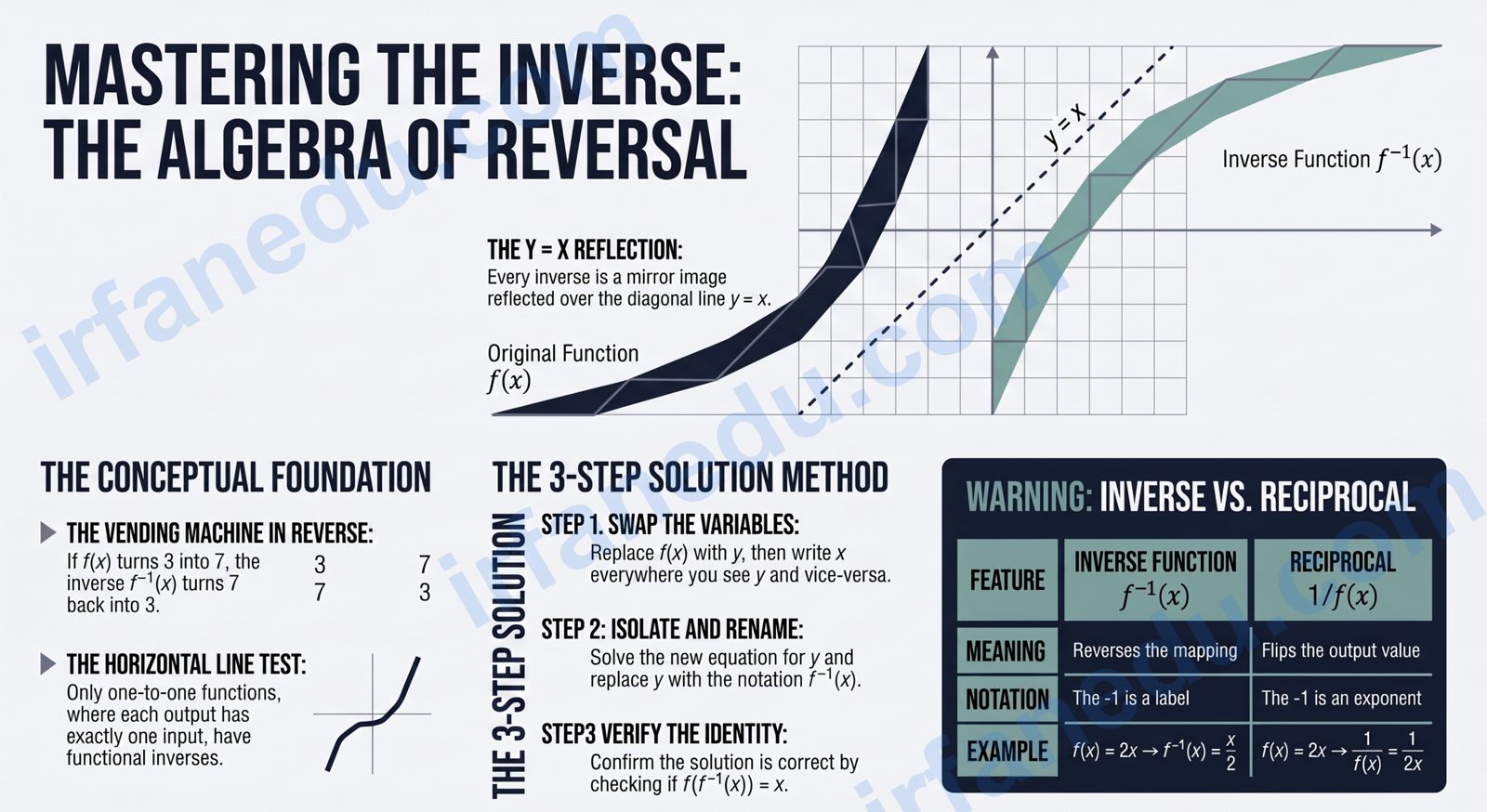
If the phrase “inverse functions” makes you want to close your textbook, I completely understand — it confused me the first time I taught it too. But here is the good news: once you see the core idea (just swap x and y, then solve), the whole topic clicks into place in about ten minutes.
An inverse function undoes what the original function did. If f(x) turns 3 into 7, then f⁻¹(x) turns 7 back into 3. Finding it is a two-step algebra move: swap x and y in the equation, then solve for y. That is the entire method — and this page walks you through it with worked examples, a printable worksheet, and a full answer key.
In this guided tour you will get:
- ✅ A clear plain-English lesson on what inverse functions are and why they matter
- ✅ A 5-step method with 3 fully worked examples (including a tricky one most guides skip)
- ✅ A comparison of inverse functions vs. reciprocal functions (a classic mix-up)
- ✅ A 10-problem printable worksheet with a full answer key
- ✅ A free downloadable PDF you can print right now
An inverse function reverses what the original function does: if f(x) maps x to y, then f⁻¹(x) maps y back to x. To find it, swap x and y in the equation, then solve for y. For example, if f(x) = 2x + 3, swap to get x = 2y + 3, then solve: f⁻¹(x) = (x − 3) / 2. Graphically, the inverse is a reflection of f(x) over the line y = x.
Download Free PDF Worksheet
🎯 The Short Version
- An inverse function reverses the original: f⁻¹(x) undoes f(x).
- Method: swap x and y, then solve for y — that is it.
- Only one-to-one functions have inverses that are also functions.
- f⁻¹(x) is NOT the same as 1/f(x) — a very common mistake.
- Verify any inverse by checking f(f⁻¹(x)) = x and f⁻¹(f(x)) = x.
- Graphically, f and f⁻¹ are mirror images across the line y = x.
📋 Table of Contents
- What Is an Inverse Function?
- How Do You Find an Inverse Function? (5-Step Method)
- Worked Examples: Easy to Challenging
- Visual: The y = x Reflection
- Inverse Function vs. Reciprocal: What Is the Difference?
- Common Mistakes and How to Fix Them
- 💡 Unique Insight
- On-Page Practice Worksheet
- Quick Quiz
- Frequently Asked Questions
- Key Takeaways
1. What Is an Inverse Function?
An inverse function is a function that reverses the action of the original. If f(x) takes an input x and produces an output y, then f⁻¹(x) takes that output y and gives back the original input x.
Think of it like a vending machine in reverse. The machine takes your money (input) and gives you a snack (output). The inverse would take the snack and give back your money. The notation f⁻¹(x) is read “f inverse of x” — the superscript −1 is NOT an exponent; it is just a label for the inverse.
Formal definition: f⁻¹ is the inverse of f if and only if f(f⁻¹(x)) = x for all x in the domain of f⁻¹, AND f⁻¹(f(x)) = x for all x in the domain of f.
Does every function have an inverse? No. Only one-to-one functions — where each output value comes from exactly one input — have inverses that are also functions. You test this on a graph with the horizontal line test: if any horizontal line crosses the graph more than once, the function is not one-to-one and its inverse is not a function.
2. How Do You Find an Inverse Function? (5-Step Method)
Finding an inverse function follows the same five steps every time. Master these and no problem can surprise you.
- Replace f(x) with y. This makes the algebra cleaner.
- Swap x and y. Write x everywhere you see y, and y everywhere you see x.
- Solve for y. Use inverse operations to isolate y on one side.
- Write the answer as f⁻¹(x) = … Replace y with f⁻¹(x).
- Verify. Confirm that f(f⁻¹(x)) = x. If it does, you are correct.
That is the complete method. The only real skill involved is Step 3 — solving for y — which is just algebra you already know.
3. Worked Examples: Easy to Challenging
Example 1 — Linear Function (Easy)
🟢 Problem
Find f⁻¹(x) if f(x) = 4x − 1.
Step 1: Write y = 4x − 1
Step 2: Swap: x = 4y − 1
Step 3: Solve for y: x + 1 = 4y → y = (x + 1)/4
Step 4: f⁻¹(x) = (x + 1) / 4
Step 5 — Verify: f(f⁻¹(x)) = 4 · (x+1)/4 − 1 = (x + 1) − 1 = x ✓
Example 2 — Fractional Function (Medium)
🟡 Problem
Find f⁻¹(x) if f(x) = (2x − 4) / 3.
Step 1: Write y = (2x − 4) / 3
Step 2: Swap: x = (2y − 4) / 3
Step 3: Multiply both sides by 3: 3x = 2y − 4 → 3x + 4 = 2y → y = (3x + 4) / 2
Step 4: f⁻¹(x) = (3x + 4) / 2
Step 5 — Verify: f(f⁻¹(x)) = (2 · (3x+4)/2 − 4) / 3 = (3x + 4 − 4) / 3 = 3x/3 = x ✓
Example 3 — Rational Function (Challenging)
🔴 Problem
Find f⁻¹(x) if f(x) = 1 / (x − 2), where x ≠ 2.
Step 1: Write y = 1 / (x − 2)
Step 2: Swap: x = 1 / (y − 2)
Step 3: Multiply both sides by (y − 2): x(y − 2) = 1 → xy − 2x = 1 → xy = 1 + 2x → y = (1 + 2x) / x
Simplify: y = 1/x + 2
Step 4: f⁻¹(x) = 1/x + 2, x ≠ 0
Step 5 — Verify: f(f⁻¹(x)) = 1 / ((1/x + 2) − 2) = 1 / (1/x) = x ✓
4. Visual: The y = x Reflection
Every inverse function is the mirror image of the original function, reflected over the diagonal line y = x. If the point (2, 5) is on f(x), then (5, 2) is on f⁻¹(x). The diagram below shows this for f(x) = 2x + 1 and its inverse.
  y
  |          /  f⁻¹(x) = (x−1)/2
  |        /  ·
  |      / · /  f(x) = 2x+1
  |    /·  /
  |  /·  /
  | /· /
  |/·/
  +·-----------  x
  ·
  ·  (dots = line y = x)

  Point (1, 3) on f(x)  ↔  Point (3, 1) on f⁻¹(x)
  Point (2, 5) on f(x)  ↔  Point (5, 2) on f⁻¹(x)
This reflection property is a powerful visual check: if you plot both curves and they look like mirror images across y = x, you found the inverse correctly.
In my experience teaching Algebra 2, the visual approach is what finally makes inverse functions stick. When students see the two curves as reflections of each other, the “swap x and y” step stops feeling like a magic trick and starts making geometric sense. I always draw the y = x mirror line first — before touching any algebra — and the lightbulb moment happens almost immediately. If you are a parent helping at home, try this: sketch any curve, draw y = x as a dashed line, and ask your student to draw the reflection. That intuition is worth more than ten practice problems done without it.
5. Inverse Function vs. Reciprocal: What Is the Difference?
The single most common mistake in this topic is confusing f⁻¹(x) with 1/f(x). They look similar but mean completely different things. Here is a clear side-by-side comparison.
| Feature | Inverse Function f⁻¹(x) | Reciprocal 1/f(x) |
|---|---|---|
| What it means | Reverses the function | Flips the output value |
| How to get it | Swap x & y, solve for y | Write 1 divided by f(x) |
| Example: f(x) = 2x | f⁻¹(x) = x/2 | 1/f(x) = 1/(2x) |
| f composed with it = x? | Yes: f(f⁻¹(x)) = x | No: f · (1/f(x)) = 1, not x |
| Notation risk | The −1 is NOT an exponent | The −1 IS an exponent here |
Bottom line: f⁻¹(x) and [f(x)]⁻¹ are written similarly but mean entirely different things. Context is everything.
6. Common Mistakes and How to Fix Them
✅ Fix: Remember the −1 in f⁻¹(x) is a notation label, not an exponent. The inverse of f(x) = 3x is f⁻¹(x) = x/3, not 1/(3x).
✅ Fix: For f(x) = x², you must specify x ≥ 0 (or x ≤ 0) before finding the inverse. Without a restriction, the inverse is not a function.
✅ Fix: Always check f(f⁻¹(x)) = x. It takes 30 seconds and catches algebra errors before they cost you marks.
✅ Fix: Every x becomes y and every y becomes x — including any x or y hidden inside a fraction or under a root. Swap all of them.
💡 Unique Insight: The Swap Step Is Not Arbitrary — Here Is Why It Works
Most worksheets tell you to “swap x and y” without explaining why. Here is the real reason: a function f is a set of ordered pairs (x, y). Its inverse is literally the same set of pairs with the coordinates reversed: (y, x). When you write the equation with x and y swapped, you are describing those reversed pairs algebraically. Solving for y then expresses the inverse as a proper function. This means you could also find an inverse by listing the (x, y) table for f and just flipping each pair — a method that works perfectly for discrete examples and helps students see the concept before touching algebra. I have used this table-flip approach in class as a first step, and it eliminates confusion about why the swap works every single time.
7. Practice Worksheet: 10 Problems (Easy to Hard) 📝
Work through these problems using the 5-step method above. Try each one before checking the answer key. Print the page or download the PDF below for a clean copy.
- f(x) = x + 7
- f(x) = x − 4
- f(x) = 3x
- f(x) = 2x + 5
- f(x) = 4x − 1
- f(x) = (x + 3) / 2
- f(x) = x² + 1, x ≥ 0
- f(x) = x³
- f(x) = (2x − 4) / 3
- f(x) = 1 / (x − 2), x ≠ 2
Show Answer Key
- f⁻¹(x) = x − 7
- f⁻¹(x) = x + 4
- f⁻¹(x) = x / 3
- f⁻¹(x) = (x − 5) / 2
- f⁻¹(x) = (x + 1) / 4
- f⁻¹(x) = 2x − 3
- f⁻¹(x) = sqrt(x − 1), x ≥ 1
- f⁻¹(x) = x^(1/3) (cube root of x)
- f⁻¹(x) = (3x + 4) / 2
- f⁻¹(x) = 1/x + 2, x ≠ 0
💡 How to use this worksheet: Print it out or work in a notebook. Cover the answer key, attempt every problem, then uncover and self-check. For any problem you got wrong, re-read the worked example at the same difficulty level and try again with fresh numbers.
Download Free PDF Worksheet
🧠 Quick Quiz: Test Yourself
Q1. What is f⁻¹(x) if f(x) = 5x − 10?
Q2. Which test tells you if a function’s inverse is also a function?
Q3. If f(3) = 8, what does f⁻¹(8) equal?
8. Frequently Asked Questions
What is an inverse function in simple terms?
Does every function have an inverse function?
What is the difference between f⁻¹(x) and 1/f(x)?
How do I verify that two functions are inverses of each other?
How do inverse functions appear on standardized tests like the ACT or SAT?
✅ Key Takeaways
- An inverse function reverses the original: if f maps x → y, then f⁻¹ maps y → x.
- The 5-step method: write y = f(x), swap x and y, solve for y, write f⁻¹(x), verify.
- Only one-to-one functions (passing the horizontal line test) have functional inverses.
- f⁻¹(x) is NOT the same as 1/f(x) — this is the most common mistake in this topic.
- Graphically, f and f⁻¹ are reflections of each other across the line y = x.
- Always verify: f(f⁻¹(x)) = x and f⁻¹(f(x)) = x must both hold.
- For f(x) = x² or other non-one-to-one functions, restrict the domain before inverting.
📐 Building your algebra skills further? My guide on
Complex Numbers: Complete Guide to Operations & Problem Solving
covers the next layer of Algebra 2 topics with the same worked-example approach.
📚 Sources & References
- Khan Academy — Introduction to Inverse Functions (Algebra 2). Khan Academy provides a foundational overview of inverse functions aligned with the US high school curriculum.
- Wikipedia — Inverse Function. Covers the formal mathematical definition, domain/range considerations, and the horizontal line test.
- MIT OpenCourseWare — Single Variable Calculus (18.01SC). Inverse functions appear in the early units as prerequisite material for differentiation of inverse trig and log functions.
Editorial note: This