
Craft and Structure SAT: The Complete Guide That Actually Explains the “Why”
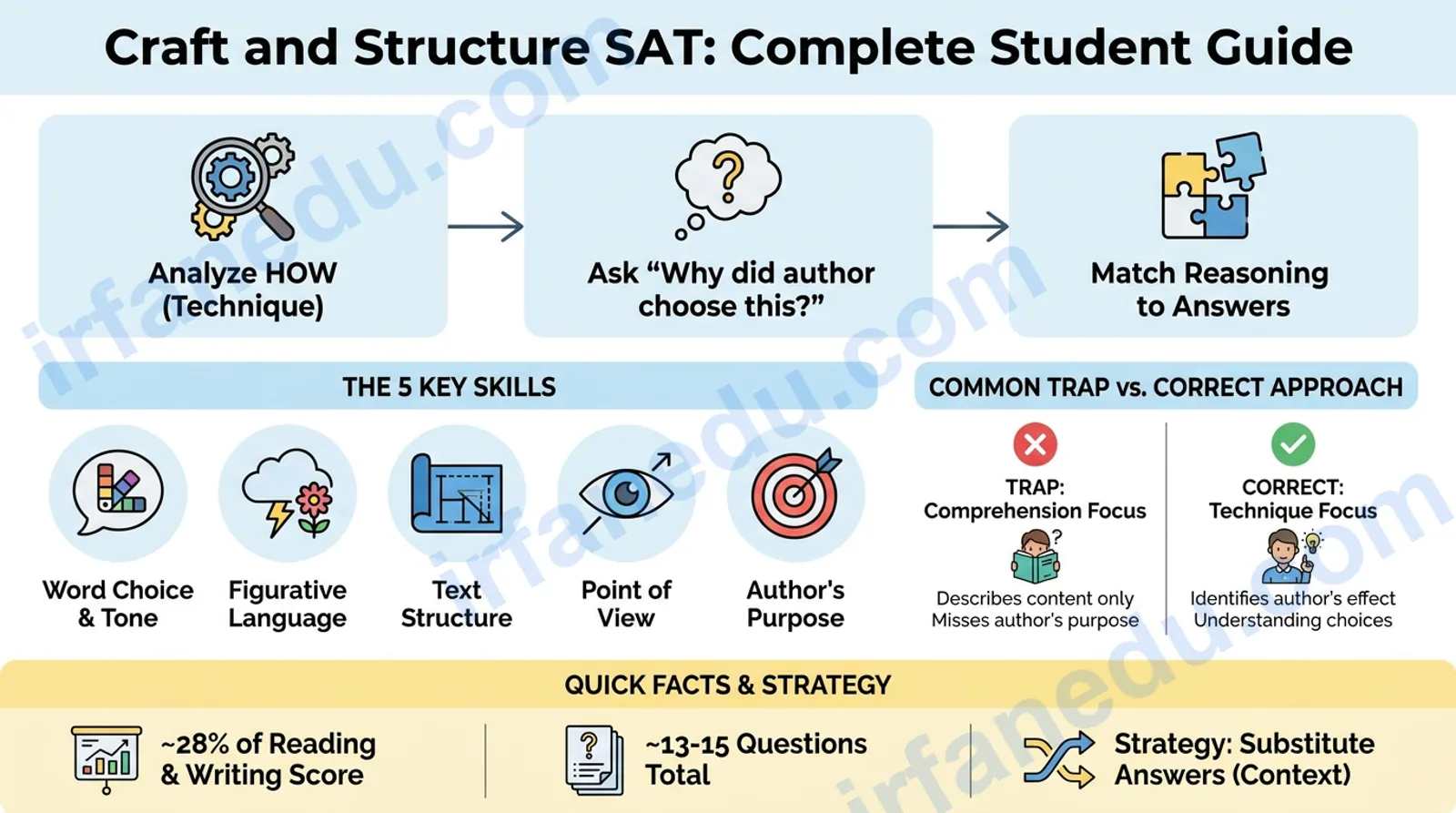
Craft and Structure is the SAT domain that trips up even strong readers — not because the passages are hard, but because the questions ask something most students never practice: analyzing how an author writes, not just what they write. Once you understand the five skills being tested and learn to ask “why did the author choose this?”, these questions become some of the most predictable on the entire test.
In my experience working with hundreds of SAT students, the single biggest mistake I see is treating Craft and Structure questions like comprehension questions. They are not. A student who reads carefully but never thinks about technique will consistently pick the trap answer — the one that accurately describes the passage’s content but misses the author’s purpose entirely.
This guide fixes that. You will get a clear breakdown of every skill type, a five-step answering method, fully worked examples with wrong-answer explanations, two comparison tables, and a practice quiz — all in one place.
- Understand exactly what Craft and Structure tests (and what it does not)
- Apply a reliable five-step method to any question type
- Avoid the three most common wrong-answer traps
- Recognize figurative language, tone shifts, and structural signals quickly
- Practice with realistic question formats before test day
Craft and Structure accounts for roughly 28% of your SAT Reading and Writing score — about 13 to 15 questions. Improving here is one of the fastest ways to raise your total score because the question types are highly predictable once you know the patterns.
Craft and Structure SAT questions ask you to analyze HOW an author writes, not just WHAT they write. They test five skills: word choice and tone, figurative language, text structure, point of view, and author’s purpose. These questions make up roughly 28% of the SAT Reading and Writing section. The key strategy is to ask yourself why the author chose a specific word, detail, or structure — then match that reasoning to the answer choices.
- 🟢 Craft and Structure = analyzing technique, not content — always ask “why did the author choose this?”
- 🟢 Five skill areas: word choice, figurative language, text structure, point of view, author’s purpose
- 🟢 About 13-15 questions on the SAT; worth ~28% of Reading and Writing score
- 🟢 Word-in-context questions: substitute each answer back into the sentence to test fit
- 🟢 Biggest trap: answers that correctly describe the passage’s content but ignore the author’s technique
- 🟢 Figurative language questions: identify the literal comparison, then connect it to the author’s larger point
What Is Craft and Structure on the SAT?
Craft and Structure is one of four content domains in the SAT Reading and Writing section, alongside Information and Ideas, Expression of Ideas, and Standard English Conventions. It specifically tests your ability to understand and analyze the choices an author makes to achieve a particular effect or communicate a particular meaning.
The College Board groups three distinct skill types under this domain:
- Words in Context: Understanding the precise meaning and tone of a word or phrase as it is used in a specific passage
- Text Structure and Purpose: Identifying how a text is organized and why the author made specific structural choices
- Cross-Text Connections: Comparing how two authors approach the same topic differently (appears in paired-passage questions)
Notice what is NOT in that list: summarizing the main idea, identifying evidence, or evaluating an argument. Those belong to other domains. Craft and Structure is purely about technique and intent.
Quick Facts: Craft and Structure SAT at a Glance
| Feature | Detail |
|---|---|
| SAT Section | Reading and Writing (both modules) |
| Domain Name | Craft and Structure |
| % of Reading & Writing Score | ~28% (approx. 13-15 questions out of 54) |
| Skill Types Tested | Words in Context, Text Structure & Purpose, Cross-Text Connections |
| Passage Types | Literary fiction, informational, argumentative, paired passages |
| Typical Question Stems | “As used in the text…”, “The main purpose of the passage is…”, “The author uses [phrase] primarily to…” |
| Hardest Skill (by student error rate) | Author’s Purpose / Cross-Text Connections |
| Easiest Entry Point | Words in Context (most predictable with substitution method) |
| Test Format | Digital adaptive (Bluebook app); short passages of 25-150 words each |
The Five Core Skills Craft and Structure Tests
The College Board’s three official skill categories actually break into five practical question types you will encounter on test day. Knowing each one by name helps you shift into the right mental mode the moment you read the question stem.
1. Word Choice and Tone
These questions give you a word or short phrase from the passage and ask what it means “as used in the text.” The trap is choosing the word’s most common dictionary meaning instead of the meaning that fits the passage’s specific context and tone.
“As used in the text, what does the word grave most nearly mean?”
The passage describes a scientist’s expression during a difficult experiment. Here, grave means serious — not a burial site. The surrounding context (a tense lab scene) rules out the literal meaning instantly.
2. Figurative Language
Figurative language questions ask what a metaphor, simile, personification, or other figure of speech means in context — or why the author used it. The SAT does not ask you to name the device. It asks you to interpret its effect.
The reliable approach: identify the two things being compared, state the comparison in plain language, and then ask what that comparison adds to the author’s point. A simile comparing a city to a beehive does not just mean “the city is busy” — it implies organized, purposeful, collective activity. That nuance is what the correct answer will capture.
3. Text Structure
Structure questions ask how a passage or paragraph is organized. Common structures the SAT uses include: problem-solution, cause-effect, compare-contrast, chronological narrative, and claim-evidence-elaboration. The question might ask why the author begins with an anecdote, why a paragraph ends with a question, or how the second paragraph relates to the first.
4. Point of View and Purpose
Point of view questions ask whose perspective shapes the text and how that perspective influences what is included or emphasized. Purpose questions ask why the author wrote the passage — to inform, to persuade, to critique, to celebrate, to warn.
In my experience teaching SAT prep, students lose the most points here because they confuse the author’s purpose with the passage’s topic. “To describe the history of jazz” is a topic summary. “To argue that jazz’s improvisational structure reflects a broader cultural shift toward individual expression” is a purpose statement. The SAT rewards the second type of answer.
5. Cross-Text Connections
These questions pair two short passages on the same topic and ask how the authors’ approaches, tones, or conclusions differ. They are the most complex Craft and Structure questions but also the most predictable: the correct answer almost always identifies a genuine point of contrast between the two texts, not just a difference in topic.
Craft and Structure vs. Information and Ideas: Know the Difference
One of the most common errors on the SAT is misidentifying a question’s domain. Here is a direct comparison to help you tell them apart instantly.
| Feature | Craft and Structure | Information and Ideas |
|---|---|---|
| Core Question | HOW and WHY did the author write this? | WHAT does the text say? |
| Typical Stem | “The author uses [phrase] primarily to…” | “According to the text…” |
| What You Analyze | Word choice, tone, structure, technique | Facts, claims, evidence, data |
| Wrong-Answer Trap | Answer that describes content accurately but ignores technique | Answer that goes beyond what the text states |
| Key Mental Shift | Think like a literary critic | Think like a careful reader |
| % of Section | ~28% | ~26% |
How Do You Answer SAT Craft and Structure Questions? (5-Step Method)
This five-step method works for every Craft and Structure question type. I have tested it with students across all score ranges, and it consistently prevents the most common errors.
-
Read the question stem first. Before touching the passage, identify which skill type the question targets: word choice, figurative language, structure, point of view, or purpose. This primes your brain to look for the right signals.
-
Read the full surrounding context. For word-in-context questions, read at least two sentences before and after the highlighted word. For structure and purpose questions, read the entire paragraph — sometimes the entire passage if it is short.
-
Ask “why did the author choose this?” Before looking at the answer choices, form your own answer in plain language. Even a rough paraphrase protects you from being seduced by a well-worded wrong answer.
-
Eliminate answers that describe content, not craft. Any answer that tells you what the passage is about — rather than how or why the author wrote it that way — is almost certainly wrong for a Craft and Structure question.
-
Substitute and verify for word-in-context questions. Replace the original word with each answer choice and read the full sentence aloud. The correct answer must preserve both the meaning and the tone of the original sentence.
┌─────────────────────────────────────────────────────────────┐
│          CRAFT & STRUCTURE: 5-STEP DECISION FLOW            │
└─────────────────────────────────────────────────────────────┘

  READ STEM FIRST
       │
       ▼
  Which skill type?
  ┌──────────┬──────────────┬───────────┬──────────┬──────────┐
  │Word/Tone │  Figurative  │ Structure │  POV /   │ Cross-   │
  │in Context│  Language    │           │ Purpose  │ Text     │
  └────┬─────┴──────┬───────┴─────┬─────┴────┬─────┴────┬─────┘
       │            │             │          │          │
       ▼            ▼             ▼          ▼          ▼
  Substitute   Identify the   Name the   Ask: to    Find the
  each answer  comparison +   pattern    inform,    contrast,
  back in      its effect     (C/E, P/S) persuade,  not the
  the sentence                           warn?      similarity

       └──────────────────────────────────────────────────────┐
                                                              ▼
                                              ELIMINATE content-only answers
                                                              │
                                                              ▼
                                              PICK the answer that names
                                              the TECHNIQUE or PURPOSE
└─────────────────────────────────────────────────────────────┘
  C/E = Cause-Effect  |  P/S = Problem-Solution
Worked Examples: Craft and Structure SAT Questions Solved
The best way to internalize the method is to watch it applied to realistic questions. Below are three fully worked examples — one for each major skill cluster — with wrong-answer explanations included.
Example 1: Words in Context
“The committee’s proposal was met with a tepid response from the board, who neither endorsed it enthusiastically nor rejected it outright.”
Question: As used in the text, what does the word tepid most nearly mean?
A) Warm B) Unenthusiastic C) Hostile D) Confused
Step-by-step solution: The surrounding context tells us the board “neither endorsed it enthusiastically nor rejected it outright.” That is a neither-here-nor-there reaction — lukewarm, not warm, not cold, not hostile, not confused. Substitute each answer: “warm response” contradicts the lack of enthusiasm. “Hostile” contradicts “did not reject outright.” “Confused” is not supported. “Unenthusiastic” fits perfectly — it captures the absence of strong feeling in either direction.
Correct answer: B) Unenthusiastic. The word tepid literally means lukewarm (of liquid temperature), but in this context it means lacking enthusiasm — a figurative extension of the literal meaning that the substitution method confirms.
Example 2: Figurative Language
“For the young researcher, the archive was a mineshaft — dark, disorienting, but full of buried treasure for those patient enough to dig.”
Question: The author compares the archive to a mineshaft primarily to suggest that:
A) Archives are physically dangerous to navigate.
B) Valuable discoveries in archives require persistent effort in difficult conditions.
C) The researcher felt frightened by the size of the archive.
D) Archival research is more rewarding than other types of research.
Step-by-step solution: The comparison highlights three qualities: dark (difficult), disorienting (confusing), and full of buried treasure for the patient. The author is not making a literal safety claim (eliminates A). The researcher’s fear is not mentioned — only disorientation (eliminates C). No comparison to other research types exists (eliminates D). Answer B captures all three elements of the metaphor: difficulty, disorientation, and the reward that patience brings.
Correct answer: B. Notice that the correct answer does not just say “it is rewarding” — it includes the condition (persistence in difficult conditions), which is exactly what the metaphor emphasizes.
Example 3: Author’s Purpose
“The first paragraph describes a child’s delight at discovering a caterpillar. The second paragraph explains the biological process of metamorphosis. The third paragraph returns to the child, now watching a butterfly emerge.”
Question: The overall structure of the passage primarily serves to:
A) Contrast a child’s emotional experience with a scientist’s analytical perspective.
B) Use a personal narrative to frame and humanize a scientific explanation.
C) Argue that children learn science more effectively through observation than instruction.
D) Describe the life cycle of a butterfly in chronological order.
Step-by-step solution: The passage does not contrast — it integrates (eliminates A). It does not argue a learning theory (eliminates C). The life cycle is not the structural purpose — it is the content of one paragraph (eliminates D). The structure moves personal → scientific → personal again, which is a classic “frame narrative” technique that uses human experience to make a scientific concept feel meaningful.
Correct answer: B. This is a purpose question where the correct answer names the structural technique (framing) and its effect (humanizing the science).
Most prep resources teach Craft and Structure as a vocabulary exercise. They tell you to “learn context clues” and “look at surrounding sentences.” That advice is fine for Words in Context — but it completely misses the harder question types.
Here is the non-obvious truth: the SAT’s hardest Craft and Structure questions are not about understanding the passage — they are about understanding the author’s rhetorical choices. A student who fully comprehends a passage can still miss a purpose question if they have never been taught to think about why an author structures an argument a particular way.
In my experience, the students who jump from the 600s to the 700s on Reading and Writing are not the ones who read more carefully — they are the ones who start reading like writers. They ask: “Why did the author open with an anecdote instead of a statistic? Why does this paragraph end with a rhetorical question? Why is this word negative when the rest of the sentence is neutral?” That shift in reading stance is the actual skill Craft and Structure tests, and almost no prep guide names it this clearly.
Practical takeaway: after every passage you read for practice — not just SAT passages — spend 60 seconds asking “what structural or stylistic choice did this author make, and why?” That habit, built over weeks, is what moves the needle.
The Three Craft and Structure Question Types: A Side-by-Side Guide
The College Board officially names three skill types within Craft and Structure. Here is how they differ in what they ask, what they reward, and where students go wrong.
| Skill Type | What It Asks | Correct Answer Pattern | Most Common Wrong Answer |
|---|---|---|---|
| Words in Context | What does this word/phrase mean as used here? | Fits the tone AND meaning of the surrounding sentences when substituted back in | The word’s most common dictionary definition, ignoring context |
| Text Structure & Purpose | Why did the author structure it this way? What is the passage’s main purpose? | Names a technique (framing, contrast, analogy) AND its effect on the reader | A summary of the passage’s content that ignores how or why it was written |
| Cross-Text Connections | How do these two authors’ approaches differ? | Identifies a genuine contrast in tone, method, or conclusion between the two texts | An answer that notes a difference in topic rather than a difference in approach |
What Are the Most Common Craft and Structure Mistakes?
Knowing the wrong-answer patterns is just as important as knowing the right strategies. Here are the three traps the SAT sets most reliably.
This answer accurately describes something in the passage but does not answer the question being asked. For a purpose question, it summarizes the content. For a figurative language question, it explains the literal meaning. Always ask: “Does this answer explain the technique or just the content?”
“To inform the reader about [topic]” is almost never the correct answer for a purpose question. The SAT rewards specific, nuanced purpose statements. If two answer choices both start with “to inform,” look for the one that specifies what the author wants the reader to understand or feel — not just what topic is covered.
For Words in Context questions, the SAT deliberately includes the word’s most common meaning as a wrong answer. The correct answer is always the meaning that fits the passage’s specific context and tone. If the passage is formal and serious, a word that usually means “light and playful” will not be the right answer even if it technically fits the sentence structure.
🧠 Quick Practice Quiz: Craft and Structure SAT
Select an answer to see instant feedback.
Q1. A student reads: “The scientist’s findings were incendiary, sparking fierce debate across the field.” As used in the text, incendiary most nearly means:
Q2. A passage opens with a personal story about a student failing an exam, then explains the neuroscience of test anxiety, then closes with the same student using a breathing technique successfully. The structure primarily serves to:
Q3. Text 1 argues that social media harms teenage mental health using clinical studies. Text 2 argues that social media provides vital community for isolated teenagers, citing personal testimonials. A Cross-Text question asks how the authors’ approaches differ. The best answer is:
Frequently Asked Questions: Craft and Structure SAT
What is Craft and Structure on the SAT?
How many Craft and Structure questions are on the SAT?
Sources & References
Written and fact-checked by Dr Irfan Mansuri. External links open in a new tab and are provided for further reading and verification.