
Rules of the Road Practice Test
What is in this test
Tap an option and the page marks it and opens the explanation. Nothing is timed and nothing is stored, so you can work through it in one sitting or come back to it. If you would rather not tap through, every answer is also listed in the answer key at the bottom.
| Subject | Questions |
|---|---|
| Rules of the road | 36 |
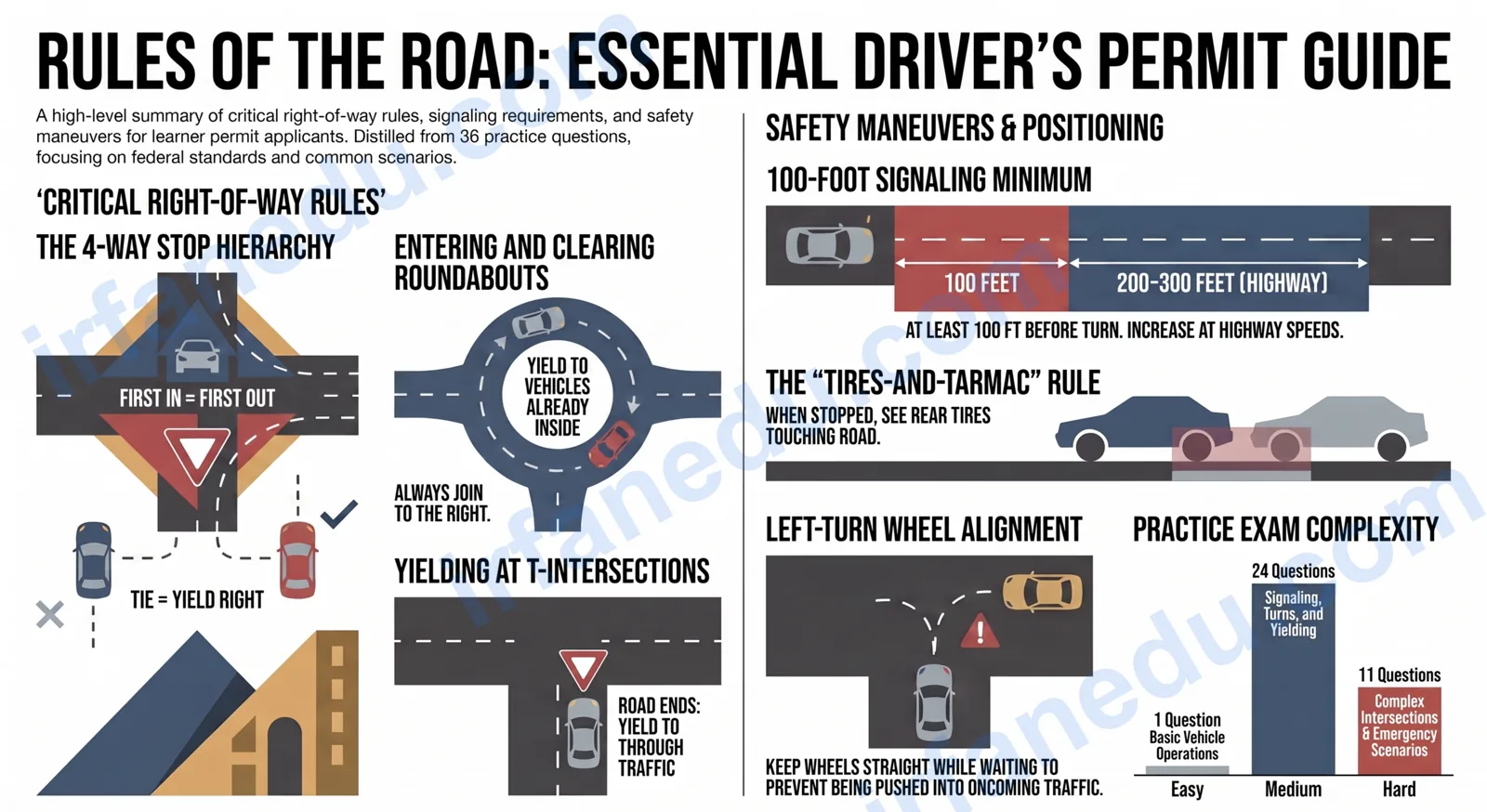
Difficulty mix: 1 easy, 24 medium, 11 hard. The questions run easiest first.
The 36 questions
Before backing your vehicle you should:
Show the answer
Correct answer: D. Check behind the vehicle on foot if the view is blocked, then turn and look back while reversing slowly
There is a large blind zone directly behind every vehicle, and it hides small children. Walk around the vehicle first if you cannot see, then reverse slowly while looking through the rear window, using mirrors and any camera as support rather than as your only check.
You are turning left at an intersection with a green light and no green arrow. You must:
Show the answer
Correct answer: B. Yield to oncoming traffic and pedestrians, then turn when there is a safe gap
A solid green light permits the turn but grants no priority. Oncoming traffic going straight and pedestrians in the crosswalk go first. Wait behind the crosswalk line with your wheels straight so you are not pushed into oncoming traffic if you are struck from behind.
You want to turn right on a red light. In most states you may do so after:
Show the answer
Correct answer: B. Coming to a complete stop and yielding, unless a sign prohibits the turn
Right on red is generally permitted after a full stop, yielding to pedestrians and cross traffic, but only where no sign prohibits it. Some intersections and some cities ban it outright, so always look for a NO TURN ON RED sign.
Where must you not stop, stand, or park?
Show the answer
Correct answer: A. Within a marked crosswalk or an intersection
Parking within a crosswalk or an intersection blocks pedestrians and hides them from turning drivers. It is prohibited everywhere, along with parking on a sidewalk, on a bridge, or in a tunnel.
You intend to turn right at an intersection. You should position your vehicle:
Show the answer
Correct answer: B. Close to the right-hand edge of the roadway before the turn
Move into the right-most lane or as near to the right curb as practical before turning. Swinging wide invites a cyclist or another vehicle to slip up your right side, and a wide right turn can cross into the oncoming lane.
How far in advance should you normally signal before turning or changing lanes?
Show the answer
Correct answer: A. At least 100 feet before the turn in town, and further at highway speeds
Most states require a signal at least 100 feet before turning on ordinary streets, and many require 200 to 300 feet at highway speeds. Signal early enough that other drivers can adjust, and cancel it after the maneuver.
A funeral procession with lights on is crossing an intersection where you have a green light. You should:
Show the answer
Correct answer: C. Wait and allow the procession to pass
Most states allow a funeral procession to stay together through an intersection once the lead vehicle has entered legally. Do not cut into the line or pass on the right, and let the procession clear.
You may pass another vehicle on the right when:
Show the answer
Correct answer: D. The vehicle ahead is turning left and there is a clear, paved lane to its right
Passing on the right is permitted on a multi-lane road, or when the vehicle ahead is making or preparing for a left turn and there is room in a lawful lane. Passing on the unpaved shoulder is never permitted.
You are stopped at a red light behind another car. The light turns green but the car ahead does not move. You should:
Show the answer
Correct answer: C. Wait a moment, then check whether it is safe to go around if the driver still does not move
Give the driver a moment; they may be yielding to a pedestrian or an emergency vehicle you cannot see. The horn is a warning device, not a way to express impatience.
You are in a roundabout and an emergency vehicle approaches with lights and siren. You should:
Show the answer
Correct answer: B. Continue to your exit, then pull over clear of the roundabout
Stopping inside a roundabout blocks every approach, including the one the emergency vehicle needs. Exit first, then pull to the right once you are clear of the circle.
A pedestrian steps off the curb against the signal, directly into your path. You must:
Show the answer
Correct answer: A. Yield and avoid the collision if you can do so safely
Every driver has a duty to use due care to avoid hitting a pedestrian, even one crossing unlawfully. Being legally in the right does not excuse a collision you could have prevented.
You are turning left from a one-way street onto another one-way street. You should end up in:
Show the answer
Correct answer: A. The left-most lane of the new street
Turn from the left lane into the left lane. Keeping the turn tight leaves the other lanes free and avoids swinging across traffic that is turning beside you.
Two vehicles arrive at a T-intersection at the same time. Who yields?
Show the answer
Correct answer: A. The vehicle on the road that ends at the intersection
Traffic on the terminating road must yield to traffic on the through road, unless signs or signals say otherwise.
A steady yellow light appears when you are already too close to stop safely. You should:
Show the answer
Correct answer: A. Continue through the intersection with care
Slamming on the brakes invites a rear-end collision and can still leave you inside the intersection. If you cannot stop comfortably behind the line, keep going and clear it.
You want to pass a vehicle on a two-lane road. Before pulling out you must be sure that:
Show the answer
Correct answer: C. You can complete the pass before any oncoming vehicle arrives, and the line on your side is broken
Passing needs enough clear distance to pull out, overtake, and return to your lane without forcing anyone to slow. A solid line on your side means the sight distance is inadequate.
You are approaching a stopped school bus from behind and its yellow lights begin flashing. This means:
Show the answer
Correct answer: D. The bus is preparing to stop, so slow down and be ready to stop behind it
Yellow flashers are the warning that red flashers are coming. Slow down and hang back rather than trying to squeeze past before the stop arm swings out.
You are stopped at a red light and want to turn right, but a cyclist is waiting in the bike lane beside you. You should:
Show the answer
Correct answer: B. Let the cyclist go first, or wait until you can turn without crossing their path
A cyclist beside you will move off when the light changes, straight into the space your turn crosses. Yield to them, and where the law allows, merge into the bike lane before turning.
At an intersection with a green light and a crosswalk signal counting down, a pedestrian is still crossing. You are turning right. You should:
Show the answer
Correct answer: D. Wait until they have cleared the lane you are turning into
A countdown does not end a pedestrian’s right-of-way. Wait until the path you are turning across is genuinely clear, allowing for anyone moving slowly.
You are driving in a lane marked with a diamond symbol during posted hours. This lane is:
Show the answer
Correct answer: A. Reserved for high-occupancy vehicles, buses, and sometimes motorcycles
The diamond marks an HOV or transit lane. Check the posted sign for the hours and the minimum number of occupants, and only cross a solid line where a dashed opening is provided.
When you park on the roadway at night outside a lit area, you should:
Show the answer
Correct answer: D. Move as far off the roadway as possible and use parking or hazard lights if you must stay
Getting the vehicle off the traveled way is the priority. High beams blind approaching drivers, and parking against the flow is illegal on a two-way road.
You are merging onto a freeway and the lane you are entering is full. You should:
Show the answer
Correct answer: C. Adjust speed to find a gap, and if none appears, use the full length of the acceleration lane
The acceleration lane exists so you can match speed and slot into a gap. Stopping at the end of a ramp is one of the most dangerous things a driver can do on a freeway.
You are stopped behind another vehicle on an uphill grade at a red light. You should leave:
Show the answer
Correct answer: B. Enough space to see the rear tires of the vehicle ahead touching the road
The tires-and-tarmac rule leaves room to pull out if the vehicle ahead rolls back or stalls, and it keeps you clear of the crumple zone if you are struck from behind.
Which of these vehicles must you always expect to stop at a railroad crossing, even when no train is visible?
Show the answer
Correct answer: D. School buses and vehicles carrying hazardous materials
School buses and hazmat carriers are required to stop, open the door or window, look, and listen. Leave extra following distance behind them near any crossing.
You want to enter a road from a parking lot, but parked vehicles block your view. You should:
Show the answer
Correct answer: C. Edge forward slowly until you can see, then enter when it is genuinely clear
Creep forward in small increments so any approaching driver sees your nose before you are in their path, and so you gain sight lines without committing the vehicle.
A flashing yellow light above an intersection where the cross street has a flashing red means:
Show the answer
Correct answer: A. You may proceed with caution; the cross street must stop
Flashing yellow means slow down and proceed carefully, while flashing red is a stop sign for the other approach. Do not assume the other driver knows the difference.
Two vehicles meet on a narrow mountain road where neither can pass. Which one should back up?
Show the answer
Correct answer: C. The vehicle going downhill
The vehicle heading downhill must yield and reverse, because a driver going uphill has less control when backing and may lose traction or roll. The downhill driver also has a better view of the road behind them.
A traffic officer is directing traffic at an intersection where the signal shows green. You should:
Show the answer
Correct answer: A. Follow the officer’s directions, which override the signal
The order of authority runs: a police officer or flagger first, then traffic signals, then signs, then pavement markings. Always follow the person directing traffic even when it contradicts the light.
Traffic is stopped and blocking the intersection ahead. Your light is green. You should:
Show the answer
Correct answer: D. Wait behind the line until there is room to clear the intersection completely
Entering an intersection you cannot clear is gridlocking, and it is a violation in most states. Wait behind the line so cross traffic can still move when its light turns green.
You are on a three-lane one-way street and want to turn left at the next intersection. You should be in:
Show the answer
Correct answer: B. The left lane
On a one-way street you turn from the lane closest to the direction of the turn: left lane for a left turn, right lane for a right turn.
You are following a vehicle that signals a right turn but slows and pulls slightly left first. This most likely means:
Show the answer
Correct answer: C. It is a long vehicle that needs extra room to swing into the turn
Trucks and buses swing wide to bring the trailer around. Never try to pass on the right of a large vehicle that is turning right, because that is exactly the space it needs.
You have started to pass and realize an oncoming vehicle is closer than you thought. The safest action is usually to:
Show the answer
Correct answer: B. Brake and drop back into your original lane behind the vehicle you were passing
Dropping back needs far less road than completing the pass, and the gap behind the vehicle you were overtaking is usually still open. Check your mirror as you tuck back in.
Traffic in your lane is stopped for a pedestrian, but the next lane is moving. What must you not do?
Show the answer
Correct answer: B. Change lanes and pass the stopped vehicle
Passing a vehicle stopped at a crosswalk is prohibited and causes some of the worst pedestrian collisions, because the stopped vehicle hides the person from you until the last moment.
You are approaching an intersection where a police officer waves you through against a red light. You should:
Show the answer
Correct answer: A. Follow the officer’s direction
A person directing traffic outranks signals, signs, and markings. Follow them promptly and predictably so the drivers behind you can read your intention.
A driver behind you flashes their headlights repeatedly on a two-lane road. The safest response is to:
Show the answer
Correct answer: C. Maintain a steady speed and let them pass when it is safe
Do not respond to provocation. Hold your line, keep space in front of you so you are not forced to brake hard, and let them by at the first safe opportunity.
You are in the left lane of a four-lane road and need to exit right in half a mile. You should:
Show the answer
Correct answer: C. Change lanes one at a time, well before the exit
One lane at a time, with a signal and a shoulder check each time, gives other drivers something predictable to react to. Crossing several lanes together is a leading cause of sideswipes.
You are the second vehicle waiting to turn left on a green light. The vehicle ahead turns as the light changes to yellow. You should:
Show the answer
Correct answer: D. Only turn if you were already in the intersection and can complete the turn safely
If you have not yet entered the intersection when the light turns yellow, stop. Following the car ahead through on a changing light is a common cause of severe side-impact crashes.
Answer key
Every answer in one place, in question order.
| No. | Ans | The correct option |
|---|---|---|
| 1 | D | Check behind the vehicle on foot if the view is blocked, then turn and look back while reversing slowly |
| 2 | B | Yield to oncoming traffic and pedestrians, then turn when there is a safe gap |
| 3 | B | Coming to a complete stop and yielding, unless a sign prohibits the turn |
| 4 | A | Within a marked crosswalk or an intersection |
| 5 | B | Close to the right-hand edge of the roadway before the turn |
| 6 | A | At least 100 feet before the turn in town, and further at highway speeds |
| 7 | C | Wait and allow the procession to pass |
| 8 | D | The vehicle ahead is turning left and there is a clear, paved lane to its right |
| 9 | C | Wait a moment, then check whether it is safe to go around if the driver still does not move |
| 10 | B | Continue to your exit, then pull over clear of the roundabout |
| 11 | A | Yield and avoid the collision if you can do so safely |
| 12 | A | The left-most lane of the new street |
| 13 | A | The vehicle on the road that ends at the intersection |
| 14 | A | Continue through the intersection with care |
| 15 | C | You can complete the pass before any oncoming vehicle arrives, and the line on your side is broken |
| 16 | D | The bus is preparing to stop, so slow down and be ready to stop behind it |
| 17 | B | Let the cyclist go first, or wait until you can turn without crossing their path |
| 18 | D | Wait until they have cleared the lane you are turning into |
| 19 | A | Reserved for high-occupancy vehicles, buses, and sometimes motorcycles |
| 20 | D | Move as far off the roadway as possible and use parking or hazard lights if you must stay |
| 21 | C | Adjust speed to find a gap, and if none appears, use the full length of the acceleration lane |
| 22 | B | Enough space to see the rear tires of the vehicle ahead touching the road |
| 23 | D | School buses and vehicles carrying hazardous materials |
| 24 | C | Edge forward slowly until you can see, then enter when it is genuinely clear |
| 25 | A | You may proceed with caution; the cross street must stop |
| 26 | C | The vehicle going downhill |
| 27 | A | Follow the officer’s directions, which override the signal |
| 28 | D | Wait behind the line until there is room to clear the intersection completely |
| 29 | B | The left lane |
| 30 | C | It is a long vehicle that needs extra room to swing into the turn |
| 31 | B | Brake and drop back into your original lane behind the vehicle you were passing |
| 32 | B | Change lanes and pass the stopped vehicle |
| 33 | A | Follow the officer’s direction |
| 34 | C | Maintain a steady speed and let them pass when it is safe |
| 35 | C | Change lanes one at a time, well before the exit |
| 36 | D | Only turn if you were already in the intersection and can complete the turn safely |
More permit test practice
Everything on this site tagged DMV lives in the DMV category.
Sources