
Dual Enrollment vs College Courses: Which Is Actually Right for You?
Real cost numbers, credit transfer risks, and a clear decision framework — everything US high school students need before making this choice.
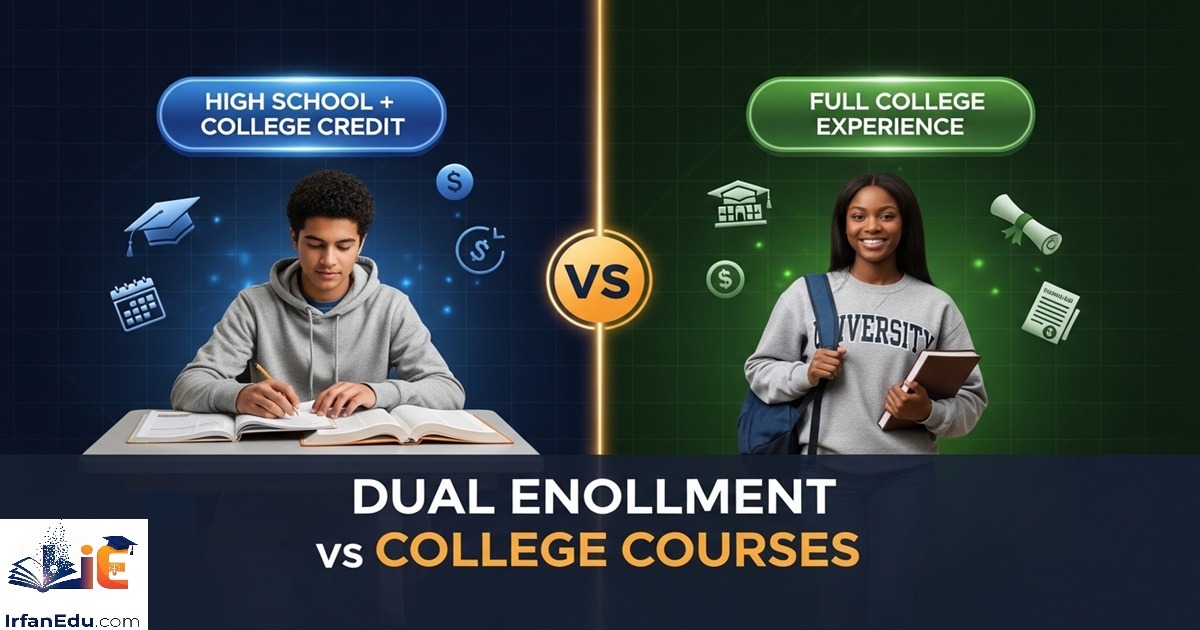
Here is a fact that surprises most high school students: the average American family can save between $10,000 and $30,000 in college tuition simply by making the right choice between dual enrollment and traditional college courses during high school. Yet most students make this decision without understanding the real differences — and some end up with credits that do not transfer to their dream school at all.
Dual enrollment vs college courses is one of the most consequential decisions a high school student can make. Dual enrollment allows students to earn college credit while still in high school — typically at low or no cost. Traditional college courses are taken after graduation as a full college student at standard tuition rates. The right choice depends on your target college, intended major, state funding availability, and academic readiness.
This guide gives you the full picture — real numbers, real risks, and a clear framework to make the right call for your specific situation.
What Is Dual Enrollment?
Dual enrollment (also called concurrent enrollment in some states) is a program that allows high school students — typically in grades 9 through 12 — to take college-level courses and earn college credit before graduating high school. The “dual” in the name refers to earning credit toward both your high school diploma and your college degree simultaneously.
Courses can be delivered in three ways: on your high school campus (taught by a college-approved instructor), on a college campus (you commute or take a bus), or fully online. Most dual enrollment partnerships are between high schools and local community colleges, though some four-year universities also offer dual enrollment programs.
According to ACT.org research on college readiness, students who participate in dual enrollment programs show higher college persistence rates and stronger first-year GPA performance compared to students who did not participate in any accelerated high school coursework. ACT identifies dual enrollment as one of the most effective evidence-based strategies for improving college readiness among high school students.
Dual enrollment is currently available in all 50 US states, though funding structures, eligibility requirements, and program quality vary significantly by state. States like Florida, Georgia, Tennessee, and Washington offer fully funded programs where students pay nothing out of pocket. Other states offer partial subsidies or require families to cover some costs.
What Are Traditional College Courses?
Traditional college courses are courses taken after high school graduation as a matriculated (fully enrolled) college student. You apply to a college or university, are admitted, and then enroll in courses as part of your degree program. You pay the institution’s standard tuition rate — whether that is a community college, a public university, or a private institution.
This is the path most students default to — finish high school, apply to college, start freshman year. It is the traditional four-year (or two-year) college experience. You have full access to campus resources, housing, clubs, networking, and the full college environment from day one.
College credit earned while still in high school. Typically through a community college partnership. Low or no cost in many states. Credit appears on a real college transcript. Available grades 9–12.
Courses taken after high school as a full college student. Standard tuition applies. Full campus experience. Credits are native to that institution and transfer according to standard articulation agreements.
Dual Enrollment vs College Courses: Side-by-Side Comparison
Let us put both options next to each other across every dimension that matters to a high school student making this decision.
| Factor | 🏫 Dual Enrollment | 🎓 Traditional College | Winner |
|---|---|---|---|
| Average Cost Per Course | $0–$400 (often state-funded) | $1,200–$4,000+ per course | DE Wins |
| Total Potential Savings | $10,000–$30,000 | Standard tuition applies | DE Wins |
| Credit Transfer — In-State Public | Generally accepted | Native credits — no transfer needed | Tie |
| Credit Transfer — Private/Selective | Often NOT accepted or limited | Native credits always count | CC Wins |
| Academic Rigor | Varies by program and instructor | Consistent institutional standards | Depends |
| GPA Impact | Affects both HS and college GPA | Affects college GPA only | Risk: DE |
| College Application Boost | Strong signal of college readiness | N/A — taken after admission | DE Wins |
| Campus Experience | Limited or none | Full immersive college experience | CC Wins |
| Time to Degree Completion | Can reduce by 1–2 years | Standard 4-year timeline | DE Wins |
| Eligibility Requirements | GPA 2.5–3.0+, varies by state | High school diploma or GED | CC Wins |
| Financial Aid Eligibility | Limited (some state grants) | Full federal aid available (FAFSA) | CC Wins |
Real Cost Breakdown: Dual Enrollment vs College Courses
Cost is where dual enrollment wins most convincingly — but the numbers vary dramatically by state. Here is what real families actually pay in 2026.
A student who completes 30 dual enrollment credits (one full year of college) at $0 cost in Florida saves approximately $10,940 in tuition alone at a public in-state university — and up to $39,400 if they would have attended a private college. Over two years of dual enrollment, total savings can exceed $25,000 before accounting for room and board.
State-by-State Funding Snapshot
Funding structures differ dramatically across the US. Before enrolling, check your specific state program:
| State | Funding Model | Student Cost | Key Program Name |
|---|---|---|---|
| Florida | Fully state-funded | $0 | Dual Enrollment Program (FLDOE) |
| Georgia | Fully state-funded | $0 | Move On When Ready (MOWR) |
| Tennessee | Grant-funded | $0–$100 | Dual Enrollment Grant Program |
| Texas | Partial subsidy | $50–$300 | Dual Credit Program (TEA) |
| California | Partial — community college | $0–$200 | College and Career Access Pathways |
| New York | District-dependent | $0–$500 | Varies by district |
| Ohio | Capped state funding | $0–$150 | College Credit Plus (CCP) |
| Illinois | School district pays | $0 | Dual Credit (ISBE) |
Funding rules change annually. Always verify your state’s current dual enrollment funding policy directly through your high school counselor or your state’s Department of Education website before assuming any course is free. Some programs have enrollment deadlines as early as March for the following fall semester.
Credit Transferability: The Risk Nobody Talks About
This is the section most students skip — and it is the one that matters most. Earning dual enrollment credits is only valuable if those credits actually count toward your college degree. And that is far from guaranteed.
The hard truth: dual enrollment credits do not automatically transfer to every college. Transfer acceptance depends entirely on the policies of the college you eventually attend — not the college that issued the credits.
How Credit Transfer Actually Works
When you complete a dual enrollment course, the credits appear on a transcript from the issuing community college or university. When you later apply to and enroll at another college, that new institution decides — on its own terms — whether to accept those credits, and if so, how to apply them to your degree requirements.
| College Type | Transfer Likelihood | How Credits Typically Apply | Risk Level |
|---|---|---|---|
| In-state public university | High (80–95%) | Core requirements or electives | Low Risk |
| Out-of-state public university | Moderate (50–75%) | Often as elective credit only | Medium Risk |
| Private nonprofit university | Low (30–60%) | May not fulfill core requirements | High Risk |
| Highly selective / Ivy League | Very Low (10–30%) | Rarely accepted; elective only if at all | Very High Risk |
| Community college (same state) | Very High (95–100%) | Direct equivalency in most cases | Minimal Risk |
If you are planning to apply to selective private universities, Ivy League schools, or out-of-state institutions, contact their admissions or registrar office directly and ask: “Will dual enrollment credits from [specific community college] transfer and fulfill core degree requirements?” Get the answer in writing. Do not assume — assumptions about credit transfer have cost students thousands of dollars and an extra semester of college.
The “Elective Credit Only” Problem
Even when a college accepts your dual enrollment credits, they may only count as free elective credits — meaning they do not fulfill any specific degree requirement. You still have to take the equivalent course at your new college. This means you paid nothing for the dual enrollment course, but you also gained no real time or cost savings toward your degree. This is the most common and most frustrating outcome for students who did not research transfer policies in advance.
Who Should Choose Dual Enrollment — And Who Should Not
There is no universally correct answer. The right choice depends on your specific academic profile, target colleges, and personal circumstances. Here is a clear breakdown.
- Plan to attend an in-state public university where credits are likely to transfer
- Are academically strong with a GPA of 3.0 or higher
- Want to save money and potentially graduate college early
- Live in a state with free or heavily subsidized dual enrollment (FL, GA, TN, OH)
- Are considering a community college transfer pathway
- Want to strengthen your college application with college-level coursework
- Are comfortable managing both high school and college workloads simultaneously
- Have a specific major in mind and can take directly relevant courses
- Are targeting highly selective or Ivy League schools where credits rarely transfer
- Are still academically finding your footing — a poor grade follows you permanently
- Want the full freshman college experience without skipping ahead
- Are unsure about your major and do not want to take courses that may not count
- Live in a state with no funding and cannot afford the out-of-pocket costs
- Already have a heavy extracurricular or AP course load that would be compromised
- Are planning to attend college out of state where transfer policies are uncertain
- Prefer to focus on ACT/SAT scores and GPA for admissions over college credits
A 6-Step Decision Framework for High School Students
Use this step-by-step process to make a clear, informed decision — not a guess based on what your friends are doing.
Identify Your Target Colleges
List the 3–5 colleges you are most likely to attend. Are they in-state public universities, private schools, or highly selective institutions? This single factor determines whether dual enrollment credits will actually be useful to you.
Research Transfer Policies at Each Target School
Visit each target college’s registrar or transfer credit website. Search for their dual enrollment or transfer credit equivalency guide. If you cannot find clear information, call the admissions office directly and ask about credits from your specific community college partner.
Check Your State’s Funding Structure
Contact your high school counselor and ask: “What dual enrollment funding is available in our state and district?” If courses are free or heavily subsidized, the cost-benefit calculation shifts dramatically in favor of dual enrollment — even if only some credits transfer.
Honestly Assess Your Academic Readiness
Dual enrollment grades appear on a permanent college transcript. Ask yourself: Am I genuinely ready for college-level coursework in this subject? Do I have the time management skills to handle both high school and college responsibilities? If there is any doubt, wait — a poor grade in a dual enrollment course can hurt your college application and your college GPA simultaneously.
Choose Courses Strategically
If you decide to pursue dual enrollment, choose courses that are most likely to transfer as core requirements — not obscure electives. English Composition, College Algebra, Statistics, Introduction to Psychology, and US History are among the most universally accepted dual enrollment courses across US colleges and universities.
Make the Decision — Then Commit Fully
Once you enroll in a dual enrollment course, treat it exactly like a college course — because it is one. Attend every class, submit every assignment on time, and take every exam seriously. The permanent transcript record means there is no “just seeing how it goes” — you are building your college academic record from day one.
Success Tips for Dual Enrollment Students
Students who thrive in dual enrollment programs share a set of consistent habits. These are not generic study tips — they are specific to the unique challenges of being a high school student in a college course environment.
-
Build a unified schedule from day one. Map out every deadline for both your high school classes and your dual enrollment course on a single calendar. Dual enrollment professors do not coordinate with your high school schedule — midterms and finals may land during the same week as your high school exams. Knowing this in advance is the difference between thriving and drowning.
-
Introduce yourself to your professor in the first week. College professors are not required to check in on you the way high school teachers do. Visit office hours in week one — not when you are already struggling. Professors who know your name and see your initiative are more likely to provide guidance, extensions when genuinely needed, and strong recommendation letters later.
-
Read the syllabus completely on day one. The course syllabus is a contract. It tells you exactly how your grade is calculated, what the late policy is, and what is expected of you. Most dual enrollment students who struggle do so because they did not read the syllabus — they missed a policy that cost them points they could not recover.
-
Use the college’s tutoring and writing center resources. Your dual enrollment tuition (even if $0) gives you access to the college’s academic support resources — tutoring centers, writing labs, library databases, and academic advisors. Most dual enrollment students never use these. The students who do consistently outperform those who do not.
-
Connect with other students in the course. Form a study group in the first two weeks. College courses move faster than high school courses, and having peers to review material with, share notes, and hold you accountable dramatically improves performance. This is especially important for online dual enrollment courses where isolation is a real risk.
-
Know your grade at all times — do not wait for surprises. Calculate your running grade after every graded assignment. Do not wait for a midterm grade report to discover you are in trouble. If your grade drops below a B, act immediately — visit office hours, contact the professor, and adjust your study approach before the situation becomes unrecoverable.
-
Request an official transcript as soon as you complete the course. Do not wait until senior year or college application season to request your dual enrollment transcript. Request an official copy immediately after your final grade posts. Keep both a digital and physical copy. Transcript processing delays are common and can hold up college credit evaluations at your future institution.
Common Myths About Dual Enrollment vs College Courses — Debunked
Misinformation about dual enrollment is widespread — from school hallways to parent Facebook groups. Here are the most common myths, corrected with facts.
“Dual enrollment credits transfer everywhere, so I can take any course I want.”
Dual enrollment credits do NOT automatically transfer to all colleges. Selective private universities and out-of-state schools frequently reject or limit dual enrollment credits. Always verify transfer policies at your specific target schools before enrolling in any dual enrollment course.
“Dual enrollment is easier than AP courses, so it’s the better choice.”
Dual enrollment and AP courses have different risk profiles. A low AP exam score simply means no college credit — it does not appear on any transcript. A low dual enrollment grade appears permanently on your college transcript and can lower your college GPA before you even set foot on campus. Neither is universally “easier.”
“Taking dual enrollment courses will hurt my high school GPA.”
In most states, dual enrollment courses are weighted on the high school transcript — similar to AP or honors courses. A strong grade in a dual enrollment course can actually boost your weighted GPA. The risk is a poor grade, which can hurt both your high school GPA and your college transcript simultaneously.
“Dual enrollment looks better on college applications than AP courses.”
College admissions officers at selective schools generally view AP courses and dual enrollment comparably as evidence of academic challenge. For highly selective schools, a strong performance in rigorous AP courses — especially with high exam scores — may actually be viewed more favorably than dual enrollment from a community college, because AP is a nationally standardized curriculum.
“Dual enrollment is only for advanced or gifted students.”
While academic readiness is important, dual enrollment is not exclusively for top-ranked students. Many states specifically design dual enrollment programs to expand access for first-generation college students and students from lower-income families. Eligibility requirements vary — some programs accept students with a 2.5 GPA, and some states have open-access dual enrollment policies.
“All dual enrollment courses are the same quality.”
Dual enrollment course quality varies significantly by program, institution, and instructor. A dual enrollment course taught on your high school campus by a high school teacher (with adjunct college status) may be less rigorous than the same course taught on a college campus by a full-time college professor. Research the specific program and ask about instructor qualifications before enrolling.
Our Verdict: Dual Enrollment Wins — With Conditions
For most US high school students planning to attend in-state public universities, dual enrollment is one of the smartest financial and academic decisions available. The cost savings are real, the college readiness benefits are documented by ACT.org research, and the ability to potentially graduate a year early can save tens of thousands of dollars.
But dual enrollment is not the right choice for everyone. If you are targeting highly selective private universities, are unsure about your academic readiness, or live in a state without funding support, the risks may outweigh the rewards. The key is doing your research before enrolling — not after.
You are attending an in-state public university, courses are free or low-cost, you have verified credit transfer, and you are academically ready for college-level work.
You are targeting selective private schools, transfer policies are unclear, you are already stretched thin academically, or you are in a state with no funding support.
Frequently Asked Questions About Dual Enrollment vs College Courses
What is the difference between dual enrollment and college courses?
Dual enrollment allows high school students to take college-level courses while still enrolled in high school, earning both high school and college credit simultaneously. Traditional college courses are taken after high school graduation as a full college student. Dual enrollment courses are typically offered through a community college partnership and are usually significantly cheaper — or even free — compared to regular college tuition. The key difference is timing, cost, and the risk profile of grades on your permanent transcript.
Does dual enrollment credit transfer to all colleges?
No — dual enrollment credit does not automatically transfer to all colleges. Transfer acceptance depends entirely on the receiving institution’s policies. Most public universities within the same state generally accept dual enrollment credits from accredited community colleges. However, many selective private universities and Ivy League schools may not accept dual enrollment credits, or may only accept them as elective credit rather than fulfilling core degree requirements. Always check the specific transfer policy of your target college before enrolling in any dual enrollment course.
How much does dual enrollment cost compared to regular college?
Dual enrollment is dramatically cheaper than regular college courses. The average dual enrollment cost ranges from $0 (fully state-funded programs in Florida, Georgia, and Tennessee) to approximately $400 per course, with a national average around $100–$300 per credit hour for self-pay programs. By contrast, the average community college costs $3,800 per year and four-year public universities average $10,940 per year in tuition alone. A student completing 30 dual enrollment credits for free can save over $10,000 compared to taking those same courses in college.
Is dual enrollment worth it for high school students?
Dual enrollment is worth it for most academically motivated high school students planning to attend in-state public universities. Benefits include significant cost savings of $10,000–$30,000 in tuition, the ability to graduate college early, exposure to college-level academic expectations, and a stronger college application. However, students should verify credit transfer policies at their specific target schools and honestly assess whether they can handle the increased academic workload before enrolling. A poor grade in a dual enrollment course appears permanently on your college transcript.
What does ACT.org say about dual enrollment?
According to ACT.org research on dual enrollment and college readiness, students who participate in dual enrollment programs demonstrate higher college readiness scores and are more likely to persist through their first year of college compared to non-participants. ACT’s research indicates that dual enrollment participation is associated with improved academic preparation, higher college GPA in the first year, and better overall college completion rates. ACT identifies dual enrollment as one of several evidence-based strategies for improving college readiness among US high school students.
Can dual enrollment hurt your GPA or college application?
Yes — dual enrollment grades can appear on both your high school transcript and your permanent college transcript. A poor grade in a dual enrollment course can negatively impact your high school GPA, your college application, and your college academic record simultaneously. Unlike AP exams where a low score simply means no college credit, a failing or low grade in a dual enrollment course is a permanent academic record that follows you throughout your college career. Students should only enroll in dual enrollment courses they are genuinely prepared and motivated to succeed in.
What GPA do you need for dual enrollment?
Most dual enrollment programs require a minimum GPA of 2.5 to 3.0 on a 4.0 scale, though requirements vary significantly by state and institution. Some programs also require minimum ACT or SAT scores, teacher recommendations, or completion of prerequisite courses. Selective dual enrollment programs at four-year universities may require a GPA of 3.0 or higher. Check with your specific high school counselor and the partnering college for exact eligibility requirements in your state — requirements can differ even between districts within the same state.

📎 Sources & References
- ACT.org. “The Condition of College and Career Readiness 2025 — Dual Enrollment Research.” Retrieved from act.org
- National Center for Education Statistics (NCES). “Dual Enrollment: Participation and Characteristics.” Retrieved from nces.ed.gov
- College Board. “AP vs. Dual Enrollment: Credit and Placement Policies at US Colleges.” Retrieved from apcentral.collegeboard.org
- Education Commission of the States. “50-State Comparison: Dual and Concurrent Enrollment Policies.” Retrieved from ecs.org
- US Department of Education. “College Affordability and Transparency — Tuition and Fee Data 2025–2026.” Retrieved from collegecost.ed.gov
📋 Editorial Standards: This article was written and reviewed by Dr. Irfan Mansuri (Ph.D. Education, College Prep Advisor). All statistics have been verified against current federal education data and ACT.org research. Last verified: March 7, 2026. IrfanEdu is committed to providing accurate, unbiased, and genuinely useful college preparation guidance for US high school students and their families.