
Timpani Drum: The Complete Student Guide to the Orchestral Kettledrum
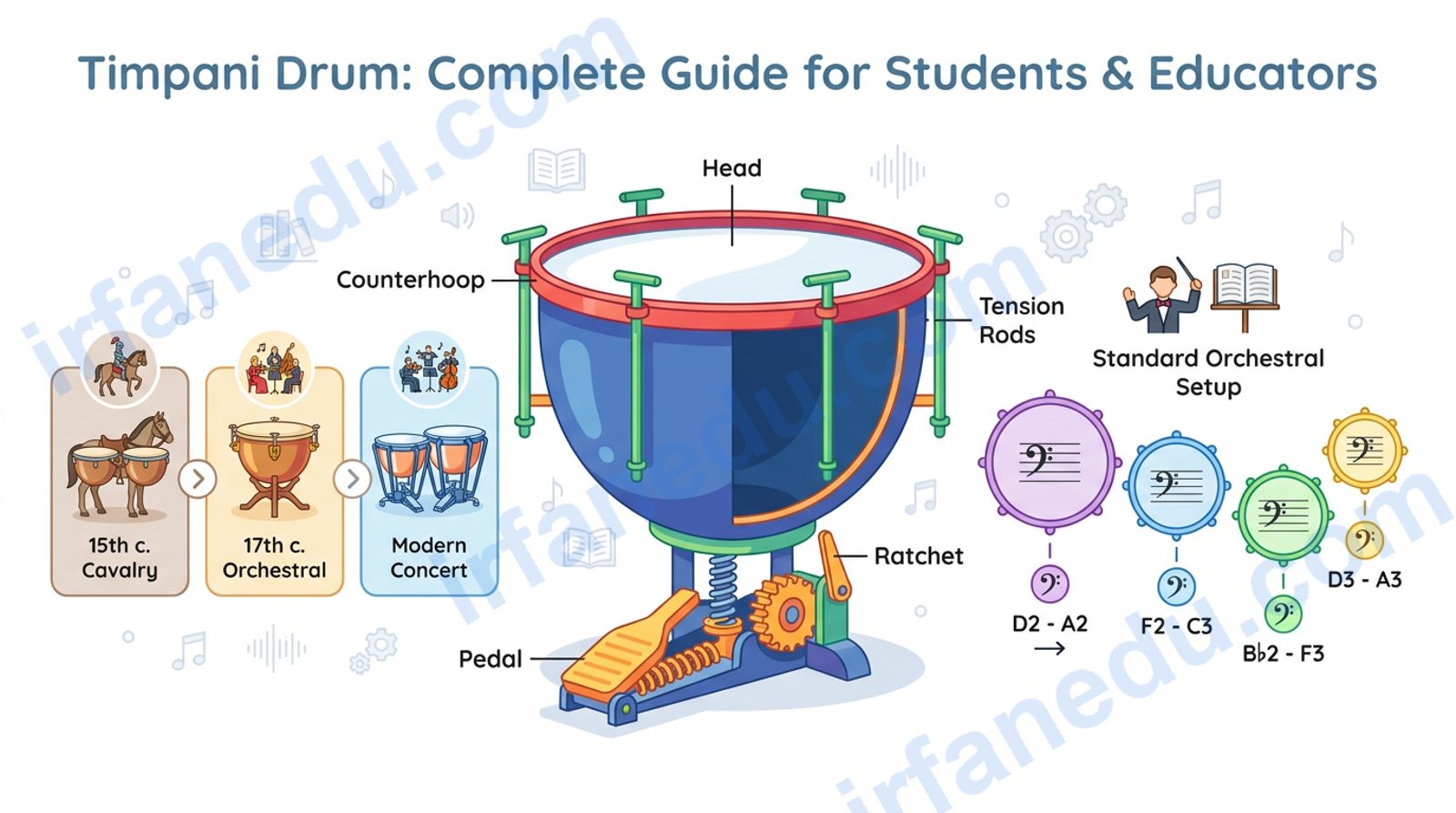
Most people hear a timpani and feel it before they understand it. That deep, resonant boom at the climax of a symphony is not just dramatic effect — it is a precisely tuned musical pitch, controlled in real time by a foot pedal while the player reads a full orchestral score. The timpani drum is the only standard drum in a Western orchestra that plays actual notes on the musical scale.
A timpani drum is a large, bowl-shaped percussion instrument with a tunable drumhead. It produces a definite musical pitch — unlike snare or bass drums — because its copper or fiberglass bowl resonates at specific frequencies. The player changes pitch mid-performance using a foot pedal, making timpani both a rhythmic and melodic instrument.
By the end of this guide, you will understand:
- What a timpani drum is and how it physically works
- How the pedal tuning system changes pitch in real time
- The history of kettledrums from cavalry battlefields to concert halls
- How to read a timpani part and what playing technique looks like
- How timpani compare to other orchestral percussion instruments
A timpani drum (also called a kettledrum) is a large bowl-shaped percussion instrument made of copper or fiberglass, covered by a tunable drumhead. Unlike most drums, it produces a definite musical pitch. The player changes pitch by pressing a foot pedal that tightens or loosens the head. Timpani are the backbone of the orchestral percussion section and appear in ensembles worldwide.
- Timpani are the only standard orchestral drums that play specific musical pitches.
- A foot pedal tightens or loosens the drumhead to change pitch in real time.
- The bowl shape (copper or fiberglass) is what makes pitch definition possible.
- A standard orchestral setup uses four timpani covering roughly two octaves.
- Timpani originated as cavalry military drums in the Middle East and Central Asia.
- Playing well requires both rhythmic precision and trained musical ear.
Quick Facts: Timpani at a Glance
| Fact | Detail |
|---|---|
| Instrument family | Membranophones (percussion) |
| Also called | Kettledrum, Pauke (German), Timpano (Italian, singular) |
| Pitch type | Definite pitch (tunable) |
| Bowl material | Copper (professional), fiberglass (student/marching) |
| Head material | Calfskin (traditional) or plastic (modern) |
| Standard set size | 4 drums (23″, 26″, 29″, 32″) |
| Pitch range (4-drum set) | Approx. D2 to C4 (two octaves) |
| Tuning method | Foot pedal + ratchet/clutch mechanism |
| Typical orchestral position | Back of the orchestra, center-left |
| Origin | Middle East / Central Asia, ~13th century |
What Is a Timpani Drum, Exactly?
A timpani drum is a large hemispherical bowl — open at the bottom, covered at the top by a stretched drumhead — that produces a clear, tunable musical pitch when struck. This is the defining feature that separates timpani from every other common drum: you can play a melody on them, or at least the bass notes of a melody.
The bowl acts as a resonating chamber. When the player strikes the head, the bowl amplifies the fundamental frequency of the vibrating membrane while suppressing the inharmonic overtones that give other drums their indefinite, “thud” quality. The result is a note with a recognizable pitch — the same way a piano string in a wooden case produces a clear note rather than a slap.
The head is held in place by a metal ring called the counterhoop. Tension rods connect the counterhoop to the pedal mechanism. When the pedal moves, the rods pull or push the counterhoop, stretching or relaxing the head uniformly around its entire circumference. That uniform tension is critical — if one side is tighter than the other, the drum produces two different pitches at once (called a “false” or “split” tone), which is a common beginner mistake.
  ┌─────────────────────────────────────────┐
  │          TIMPANI DRUM — ANATOMY         │
  └─────────────────────────────────────────┘

         ┌──────────────────────────┐
         │       DRUMHEAD           │  ← Struck ~3–4" from edge
         │  (calfskin or plastic)   │
  ───────┤──────────────────────────├───────
         │      COUNTERHOOP         │  ← Metal ring holding head
         │   (tension rods below)   │
         │                          │
         │    COPPER / FIBERGLASS   │
         │         BOWL             │  ← Resonating chamber
         │                          │
         │       (open base)        │
         └──────────┬───────────────┘
                    │
              PEDAL LINKAGE
              (rods + clutch)
                    │
            ┌───────┴───────┐
            │  FOOT PEDAL   │
            │  Toe ↓ = ↑ pitch
            │  Heel ↓ = ↓ pitch
            └───────────────┘
The History of Timpani Proves They Were Always More Than Drums
Timpani did not begin in concert halls — they began on battlefields. The earliest kettledrums were small paired drums called naqqara, used by cavalry forces across the Middle East and Central Asia from at least the 13th century. Mounted on horseback, they communicated military commands across the noise of battle: specific rhythmic patterns meant advance, retreat, or hold.
European armies adopted them during the Crusades and the Ottoman wars. By the 15th century, kettledrums were a symbol of royal and military prestige across Europe. Only nobility could own them — in some German states, unauthorized use of kettledrums was a criminal offense. This exclusivity is why, when composers like Handel and Bach wrote for them in the 17th and 18th centuries, the drums carried an automatic sense of grandeur and power.
The mechanical pedal tuning system — the feature that makes modern timpani genuinely musical instruments rather than just rhythm machines — was developed in the late 19th century. Dresden-based instrument maker Carl Pittrich is credited with an early practical pedal design around 1871. Before that, players had to retune by hand between movements, which limited composers to writing in only one or two keys per piece.
Once pedal tuning became standard, composers like Béla Bartók and Hector Berlioz began writing glissandi — slides between pitches — and rapid retuning passages that were simply impossible before. The instrument went from a military signal device to a fully chromatic orchestral voice in roughly 400 years.
How Timpani Tuning Works: A Step-by-Step Explanation
Tuning a timpani is a mechanical and auditory skill that takes years to master, but the underlying principle is simple: tighter head = higher pitch, looser head = lower pitch.
Here is how a player tunes a modern pedal timpani:
- Strike the head near the edge (about 3–4 inches from the rim) to hear the current pitch clearly.
- Compare to the target pitch using the built-in tuning gauge (a dial on the side of the drum) or by ear against another instrument.
- Press the pedal forward (toe down) to engage the ratchet and tighten the head — this raises the pitch.
- Pull the pedal back (heel down) to loosen the head — this lowers the pitch.
- Strike again and compare. Fine-tune by small pedal movements.
- Lock the pedal using the ratchet or clutch so it does not drift during playing.
In a live performance, a timpanist may need to retune silently during a rest of only a few beats. Professional players develop the ability to hear their target pitch internally, move the pedal by feel, and confirm the new pitch with a ghost stroke (a very soft tap) — all without looking down or interrupting the musical flow.
Most guides say timpani tuning is “just about the pedal.” That misses the harder half.
In my experience teaching percussion, the pedal is the easy part — students learn the mechanics in one session. The genuinely difficult skill is head equalization: making sure every tension rod applies equal pressure around the circumference of the head. A drum that is mechanically in tune at the pedal can still sound out of tune if one side of the head is tighter than the other. Professional timpanists check equalization by tapping lightly at each tension rod point and listening for matching pitches around the head — a technique almost never mentioned in beginner resources. If your timpani sounds “wobbly” or produces two pitches at once, uneven head tension is almost always the cause, not the pedal.
Timpani vs. Other Orchestral Percussion: A Direct Comparison
Students often confuse timpani with other large drums, especially the bass drum. The table below clarifies the key differences.
| Feature | Timpani | Bass Drum | Snare Drum | Marimba |
|---|---|---|---|---|
| Pitch type | Definite (tunable) | Indefinite | Indefinite | Definite (fixed) |
| Can change pitch mid-performance? | Yes (pedal) | No | No | No (bars are fixed) |
| Bowl / resonator shape | Hemispherical bowl | Cylindrical shell | Cylindrical shell | Wooden bars + tubes |
| Primary role in orchestra | Pitch + rhythm + dynamics | Accent + dynamics | Rhythm + texture | Melody + harmony |
| Typical written notation | Bass clef, specific notes | Unpitched staff line | Unpitched staff line | Treble/bass clef, specific notes |
| Standard orchestral quantity | 4 drums, 1 player | 1 drum, 1 player | 1 drum, 1 player | 1 instrument, 1–2 players |
The key takeaway: timpani occupy a unique hybrid role. They are rhythmic instruments like other drums, but they also carry harmonic information — the bass note under a chord, the tonic of a key, the tension of a tritone. No other standard drum does that.
In my experience, the biggest mistake music students make when studying timpani is treating it as “just a big drum.” That framing leads them to focus only on rhythm and miss the ear training component entirely. I have seen students who are excellent snare drummers struggle badly on timpani because they have never had to match a pitch in real time. If I were designing a school music curriculum, I would pair timpani study with basic ear training from day one — specifically interval recognition and singing back pitches. The physical technique is learnable in weeks; the ear takes months of deliberate practice.
Timpani Playing Technique: What Good Technique Actually Looks Like
Good timpani technique is built on three foundations: stroke mechanics, mallet choice, and dampening. Each one directly affects tone quality and musical expression.
Stroke Mechanics
The player strikes the head approximately 3–4 inches from the rim — not the center. Striking the center produces a dull, unfocused tone because the center of the head has the least resonance. The stroke should be a loose, rebounding motion from the wrist and forearm, not a push-and-hold. Holding the mallet against the head after impact (called “burying” the mallet) kills the resonance immediately.
Mallet Choice
Timpanists carry multiple pairs of mallets with different hardnesses. Hard felt mallets produce a bright, articulate attack — useful for fast passages or when the timpani needs to cut through a loud orchestra. Soft felt mallets produce a warm, round tone — ideal for quiet passages or when blending with low strings and brass. Wooden mallets (rare) produce a sharp, almost percussive crack used for special effects. Choosing the right mallet for the musical context is a significant part of the timpanist’s interpretive role.
Dampening
Because timpani resonate for several seconds after a stroke, the player must often stop the sound deliberately. This is done by pressing the fingertips of the non-dominant hand lightly against the drumhead. In orchestral scores, a “+” symbol or the word secco (dry) indicates that the note should be dampened immediately after striking.
[IMAGE: Close-up of a timpanist’s hands showing correct mallet grip and striking position | ALT: Timpani mallet grip technique showing wrist position and striking zone on drumhead]
Explore More Educational Guides on IrfanEdu
How Timpani Are Used in Famous Orchestral Works
Timpani appear in virtually every major orchestral work written after 1700, but a few examples show the full range of what the instrument can do.
Beethoven’s 9th Symphony (1824): In the second movement (Scherzo), Beethoven writes a timpani solo — an almost unheard-of choice at the time. The drums play an octave interval (F–F) in a rhythmic dialogue with the full orchestra. This was the moment composers began treating timpani as a solo voice, not just a background accent.
Berlioz’s Symphonie Fantastique (1830): Berlioz scored the work for four timpani played by two players simultaneously, tuned to specific chords. In the final movement (“Dream of a Witches’ Sabbath”), the drums play a chord — multiple pitches at once — something that was technically new at the time.
Bartók’s Music for Strings, Percussion and Celesta (1936): Bartók uses the timpani for glissandi — sliding between pitches using the pedal while the head is vibrating. The result is an eerie, pitch-bending effect that sounds almost electronic. This is only possible on pedal timpani.
These three examples span 112 years and show the instrument evolving from a rhythm-and-accent role to a fully expressive melodic and harmonic voice.
Common Mistakes Students Make with Timpani (and How to Fix Them)
After working with percussion students at multiple levels, I have seen the same errors appear repeatedly. Here are the most common, with direct corrections.
Mistake 1: Striking the center of the head. The center produces a dull, unfocused tone. Fix: always strike 3–4 inches from the rim.
Mistake 2: Burying the mallet. Holding the mallet against the head after impact kills the resonance. Fix: use a loose, rebounding wrist stroke — the mallet should bounce off naturally.
Mistake 3: Ignoring head equalization. Tuning the pedal without checking that tension is even around the head produces split tones. Fix: tap lightly at each tension rod point and listen for matching pitches.
Mistake 4: Relying only on the tuning gauge. Tuning gauges drift over time and vary between instruments. Fix: always confirm pitch by ear against a reference pitch, not just the gauge needle.
Mistake 5: Not dampening when required. Letting notes ring when the score calls for a short, dry sound muddies the texture. Fix: practice placing fingertips on the head immediately after the stroke as a deliberate technique, not an afterthought.
Check Your Understanding: Practice Questions
Question 1: A timpanist presses the pedal forward (toe down). Does the pitch go up or down? Why?
Question 2: Why does a timpani produce a definite pitch while a bass drum does not?
Question 3: A student’s timpani sounds like it is playing two pitches at once. What is the most likely cause?
1. What is the primary material used for the bowl of a professional timpani?
Show Answer
2. Where on the drumhead should a timpanist strike for the best tone?
Show Answer
3. Which composer wrote a famous timpani glissando passage using the pedal mechanism?
Show Answer
Frequently Asked Questions About Timpani Drums
What is a timpani drum?
How does a timpani produce different pitches?
What is the pitch range of a standard timpani set?
What is the difference between timpani and a regular drum?
What are timpani mallets called, and how do they differ?
How many timpani are in a standard orchestra?
Why are timpani called kettledrums?
Can a student learn timpani without prior drum experience?
- Timpani are the only standard orchestral drums that produce a definite, tunable musical pitch.
- The hemispherical bowl resonates specific frequencies, creating a clear note rather than an indefinite thud.
- A foot pedal tightens or loosens the head to change pitch — tighter = higher, looser = lower.
- Even head tension around the counterhoop is essential; uneven tension produces split tones.
- A standard orchestral set uses four drums (23″–32″) covering roughly two octaves.
- Timpani originated as cavalry military drums and entered the orchestra by the 17th century.
- Pedal tuning (developed ~1871) allowed composers to write glissandi and rapid retuning passages.
- Good technique requires stroke mechanics, correct mallet choice, and deliberate dampening.
- Learning timpani well requires both rhythmic precision and trained musical ear — treat it as a pitched instrument first.
Related Articles
Sources & References
- Encyclopaedia Britannica — Kettledrum (Timpani): authoritative overview of the instrument’s history, construction, and orchestral role.
- Wikipedia — Timpani: comprehensive reference covering etymology, mechanics, historical development, and notable repertoire.
- MusicTheory.net: free interactive lessons on reading music notation, including percussion notation used in timpani parts.
Editorial note: This article was written and fact-checked by Dr. Irfan Mansuri. All historical claims are sourced to the references above. No statistics or quotes have been fabricated. Last reviewed: August 2026.