
Photosynthesis Explained for Students: Light & Dark Reactions 🌿
Every breath of oxygen you take right now exists because a plant — or an ancient ancestor of one — ran a chemical reaction powered by sunlight. That reaction is photosynthesis, and once you understand it, you will never look at a leaf the same way again.
In my experience teaching biology to thousands of students, photosynthesis is the topic where most people get confused at the same two spots: what exactly happens in the light reactions versus the dark reactions, and why chlorophyll is so central to the whole process. This guide fixes both problems with clear steps, a visual diagram, and real exam-style examples.
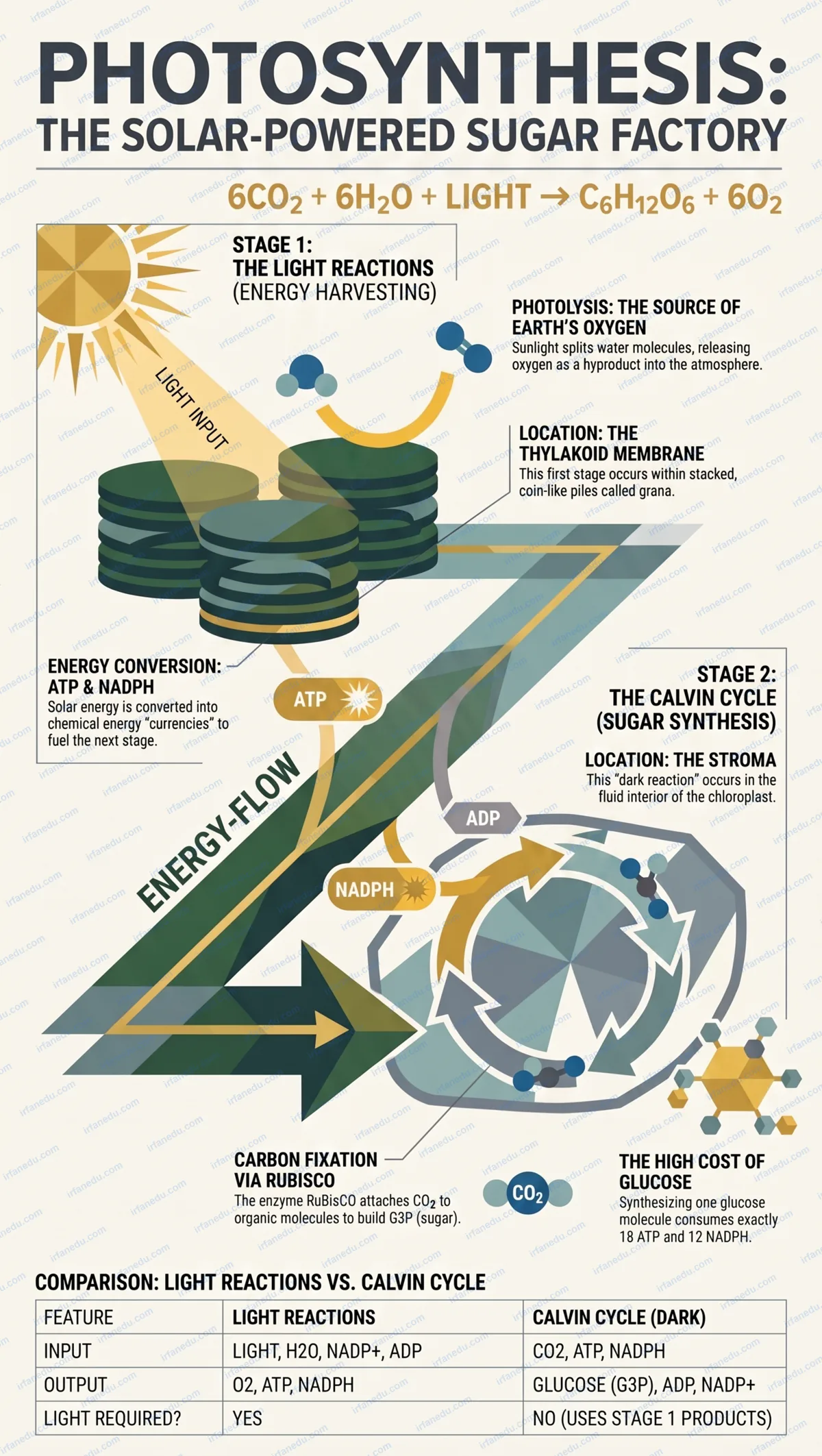
Photosynthesis is the process by which green plants, algae, and some bacteria convert sunlight, water (H₂O), and carbon dioxide (CO₂) into glucose (C₆H₁₂O₆) and oxygen (O₂). It occurs in two linked stages inside chloroplasts: the light reactions (in the thylakoid membranes) and the dark reactions / Calvin cycle (in the stroma). Chlorophyll is the key pigment that captures light energy to drive the entire process.
By the end of this guide, you will be able to:
- Write and explain the overall equation for photosynthesis
- Describe the role of chlorophyll in absorbing light
- Trace the step-by-step flow of the light reactions
- Explain how the Calvin cycle fixes CO₂ into glucose
- Compare light and dark reactions in a table
- Identify and correct the most common student mistakes
⚡ TL;DR – Quick Summary
- 🌞 Photosynthesis converts sunlight + CO₂ + H₂O into glucose + O₂
- 🟢 Chlorophyll absorbs red and blue light; reflects green light
- ⚡ Light reactions produce ATP, NADPH, and O₂ in thylakoid membranes
- 🔄 Calvin cycle uses ATP and NADPH to fix CO₂ into glucose in the stroma
- 🌍 Photosynthesis is the foundation of nearly all food chains on Earth
- 📉 Light, CO₂, temperature, and water are the four main limiting factors
| Fact | Detail |
|---|---|
| Overall equation | 6CO₂ + 6H₂O + light energy → C₆H₁₂O₆ + 6O₂ |
| Location | Chloroplasts (in plant cells and algae) |
| Stage 1 | Light reactions — thylakoid membranes |
| Stage 2 | Calvin cycle (dark reactions) — stroma |
| Key pigment | Chlorophyll a and b |
| Outputs | Glucose (C₆H₁₂O₆) and Oxygen (O₂) |
| Energy currency produced | ATP and NADPH (in light reactions) |
| Key enzyme (Calvin cycle) | RuBisCO |
🌿 What Is Photosynthesis?
Photosynthesis is a biological process that converts light energy into chemical energy stored in glucose. It is carried out by plants, algae, and cyanobacteria — collectively called photoautotrophs (organisms that feed themselves using light).
The word itself tells you everything: photo = light, synthesis = building. So photosynthesis literally means “building with light.” The plant takes simple raw materials — carbon dioxide from the air and water from the soil — and uses solar energy to assemble them into glucose, a rich energy molecule that fuels growth, reproduction, and every other life process.
The process takes place inside chloroplasts, specialized organelles found mainly in leaf cells. Each chloroplast has a double outer membrane, a fluid interior called the stroma, and a system of folded internal membranes called thylakoids — stacked into coin-like piles called grana. These two compartments host the two stages of photosynthesis.
[IMAGE: Cross-section diagram of a chloroplast showing grana, thylakoids, and stroma | ALT: chloroplast structure diagram for photosynthesis students]
🧪 The Overall Equation for Photosynthesis
The single most important thing to memorize is the overall chemical equation. It summarizes the entire process in one line.
📌 The Photosynthesis Equation
6CO₂ + 6H₂O + Light Energy → C₆H₁₂O₆ + 6O₂
Carbon dioxide + Water + Light → Glucose + Oxygen
Let me break down what each part means:
- 6CO₂ — Six molecules of carbon dioxide absorbed from the air through tiny pores called stomata
- 6H₂O — Six molecules of water drawn up from the roots through the stem
- Light energy — Solar energy captured by chlorophyll
- C₆H₁₂O₆ — One molecule of glucose, the energy-rich product
- 6O₂ — Six molecules of oxygen released as a by-product into the air
Notice that photosynthesis is the reverse of cellular respiration. Where respiration burns glucose to release energy, photosynthesis uses energy to build glucose. The two processes are complementary and together cycle carbon and oxygen through Earth’s biosphere.
🟢 Chlorophyll: The Star Pigment
Chlorophyll is the green pigment that makes photosynthesis possible. Without it, plants could not capture light energy at all. It sits embedded in the thylakoid membranes, organized into protein complexes called photosystems (Photosystem I and Photosystem II).
There are two main types: chlorophyll a (blue-green) and chlorophyll b (yellow-green). Both absorb light, but at slightly different wavelengths, which broadens the range of light a plant can use.
What wavelengths does chlorophyll absorb?
- 🔴 Red light (~680 nm) — strongly absorbed by chlorophyll a
- 🔵 Blue light (~450 nm) — strongly absorbed by both chlorophyll a and b
- 🟢 Green light (~550 nm) — mostly reflected, which is why plants appear green
Chlorophyll’s molecular structure includes a porphyrin ring with a magnesium ion at its center — this ring is the actual light-absorbing part. A long hydrophobic tail anchors the molecule into the thylakoid membrane.
► MY POV: In my experience, students often memorize “chlorophyll absorbs light” without truly understanding why that matters. Here is the key insight I always share: chlorophyll does not just detect light like a solar panel passively — it uses the absorbed photon’s energy to physically eject an electron from its own structure. That ejected electron is the starting gun for the entire light reaction chain. Once you picture that single excited electron racing down a protein chain, the rest of photosynthesis clicks into place.
⚡ Light Reactions — Step by Step
The light reactions are the first stage of photosynthesis. They happen in the thylakoid membranes and have one job: capture light energy and convert it into chemical energy (ATP and NADPH) while releasing oxygen.
Step 1 — Light Absorption by Photosystem II (PSII)
Sunlight hits the chlorophyll molecules in Photosystem II. The energy excites electrons to a higher energy level, effectively “charging” them. This is the entry point of solar energy into the biological world.
Step 2 — Water Splitting (Photolysis)
To replace the electrons lost from chlorophyll, water molecules are split in a reaction called photolysis:
2H₂O → 4H⁺ + 4e⁻ + O₂
The oxygen released here is the O₂ that enters the atmosphere. Every breath you take traces back to this single reaction.
Step 3 — Electron Transport Chain (ETC)
The energized electrons travel down a series of proteins embedded in the thylakoid membrane — the electron transport chain. As they move, they pump hydrogen ions (H⁺) across the membrane, building a concentration gradient.
Step 4 — ATP Synthesis (Chemiosmosis)
H⁺ ions flow back through an enzyme called ATP synthase, and that flow powers the production of ATP (adenosine triphosphate) — the cell’s universal energy currency. This process is called chemiosmosis.
Step 5 — Photosystem I (PSI) and NADPH Production
Electrons reach Photosystem I, get re-energized by another photon, and are used to reduce NADP⁺ to NADPH. NADPH is a high-energy electron carrier that the Calvin cycle will use next.
🔄 Dark Reactions (Calvin Cycle) — Step by Step
The dark reactions — more accurately called the Calvin cycle — happen in the stroma of the chloroplast. Despite the name “dark reactions,” they do not require darkness; they simply do not directly use light. They run during the day using the ATP and NADPH produced by the light reactions.
Stage 1 — Carbon Fixation
CO₂ from the air is attached to a 5-carbon molecule called RuBP (ribulose bisphosphate) by the enzyme RuBisCO. This produces an unstable 6-carbon compound that immediately splits into two 3-carbon molecules called 3-PGA (3-phosphoglycerate).
Stage 2 — Reduction
ATP and NADPH (from the light reactions) are used to convert 3-PGA into G3P (glyceraldehyde-3-phosphate). G3P is the first stable organic molecule produced — it is the building block for glucose and all other organic compounds the plant needs.
Stage 3 — Regeneration of RuBP
Most of the G3P molecules are used to regenerate RuBP, using more ATP. This keeps the cycle running continuously. Only one G3P molecule out of every six produced exits the cycle to be used for glucose synthesis.
📊 Calvin Cycle Accounting (per 1 glucose molecule)
- CO₂ molecules fixed: 6
- ATP consumed: 18
- NADPH consumed: 12
- G3P molecules produced: 12 (2 exit to form 1 glucose; 10 regenerate RuBP)
- RuBP molecules regenerated: 6
► MY POV: The biggest misconception I see on exams is students writing that the Calvin cycle “does not need energy.” That is wrong — it consumes enormous amounts of ATP and NADPH. The cycle is not passive; it is an energy-hungry construction process. Think of light reactions as the power plant and the Calvin cycle as the factory floor that runs on that power.
🖼️ Visual Diagram of Photosynthesis
Here is an ASCII diagram showing how the two stages connect inside a chloroplast. Use this to visualize the flow of energy and materials.
╔══════════════════════════════════════════════════════════════════╗
║ CHLOROPLAST ║
║ ║
║ ┌─────────────────────────────────────────────────────────┐ ║
║ │ THYLAKOID MEMBRANE (Light Reactions) │ ║
║ │ │ ║
║ │ ☀️ LIGHT │ ║
║ │ │ │ ║
║ │ ▼ │ ║
║ │ [PSII] ──── H₂O splits ──→ O₂ released 🌬️ │ ║
║ │ │ (into air) │ ║
║ │ ▼ │ ║
║ │ [Electron Transport Chain] │ ║
║ │ │ │ ║
║ │ ▼ │ ║
║ │ [ATP Synthase] ──→ ATP ⚡ │ ║
║ │ │ │ ║
║ │ ▼ │ ║
║ │ [PSI] ──→ NADPH 🔋 │ ║
║ └──────────────────┬────────────────────────────────────┘ ║
║ │ ATP + NADPH flow into stroma ║
║ ▼ ║
║ ┌─────────────────────────────────────────────────────────┐ ║
║ │ STROMA (Calvin Cycle / Dark Reactions) │ ║
║ │ │ ║
║ │ CO₂ (from air) ──→ [RuBisCO + RuBP] │ ║
║ │ │ │ ║
║ │ ▼ │ ║
║ │ 3-PGA (3-carbon) │ ║
║ │ │ ATP + NADPH used │ ║
║ │ ▼ │ ║
║ │ G3P (glyceraldehyde-3-phosphate) │ ║
║ │ / \ │ ║
║ │ exits cycle regenerates RuBP │ ║
║ │ │ │ ║
║ │ ▼ │ ║
║ │ 🍬 GLUCOSE (C₆H₁₂O₆) │ ║
║ └─────────────────────────────────────────────────────────┘ ║
╚══════════════════════════════════════════════════════════════════╝
📊 Light Reactions vs. Dark Reactions: Comparison Table
This table is one of the most exam-tested comparisons in biology. Study it carefully — questions often ask you to distinguish between the two stages.
| Feature | Light Reactions | Dark Reactions (Calvin Cycle) |
|---|---|---|
| Location | Thylakoid membranes | Stroma of chloroplast |
| Requires direct light? | Yes ☀️ | No (but needs products of light reactions) |
| Inputs | H₂O, light energy, ADP, NADP⁺ | CO₂, ATP, NADPH |
| Outputs | ATP, NADPH, O₂ | Glucose (G3P), ADP, NADP⁺ |
| Key molecules | Chlorophyll, ATP synthase | RuBisCO, RuBP, G3P |
| Oxygen produced? | Yes (from water splitting) | No |
| Energy transformation | Light → Chemical (ATP, NADPH) | Chemical → Stored (glucose) |
| Also called | Photo-phosphorylation stage | Carbon fixation / Calvin cycle |
🌍 Why Photosynthesis Matters for All Life
Photosynthesis is not just a plant biology topic — it is the engine of life on Earth. Its importance reaches into every ecosystem, every food chain, and every breath you take.
1. It produces the oxygen we breathe
Nearly all the oxygen in Earth’s atmosphere comes from photosynthesis. Before photosynthetic organisms evolved roughly 2.7 billion years ago, Earth’s atmosphere had almost no free oxygen. Every animal alive today depends on this ancient process for every breath.
2. It is the base of every food chain
Plants are primary producers. They convert solar energy into chemical energy (glucose), which herbivores eat, which carnivores then eat. Remove photosynthesis, and the entire food web collapses within weeks.
3. It regulates atmospheric CO₂
Photosynthesis absorbs billions of tonnes of CO₂ from the atmosphere every year. Forests, phytoplankton in the ocean, and grasslands act as carbon sinks, slowing the buildup of greenhouse gases. This makes photosynthesis central to climate regulation.
4. It is the source of fossil fuels
Coal, oil, and natural gas are the compressed remains of ancient organisms that once performed photosynthesis. The energy you use to charge your phone originally came from sunlight captured by plants millions of years ago.
📉 Limiting Factors That Affect the Rate of Photosynthesis
The rate of photosynthesis is not constant — it depends on environmental conditions. A limiting factor is any variable that, when increased, speeds up photosynthesis (up to a maximum). Understanding these is critical for both exams and real-world agriculture.
1. Light Intensity
More light means more photons for chlorophyll to absorb, so the rate increases. Beyond a saturation point, other factors become limiting and the rate plateaus.
2. Carbon Dioxide Concentration
CO₂ is the raw material for the Calvin cycle. Higher CO₂ levels speed up carbon fixation by RuBisCO. Greenhouses often pump in extra CO₂ to boost crop yields.
3. Temperature
Photosynthesis involves enzymes (especially RuBisCO). Warmer temperatures speed up enzyme activity up to an optimum (~25–35°C for most plants). Above this, enzymes denature and the rate drops sharply.
4. Water Availability
Water is a direct reactant in the light reactions (photolysis). Severe water shortage causes stomata to close, which also cuts off CO₂ supply — a double limiting effect.
❌ Common Student Mistakes — Wrong vs. Right
These are the errors I see most often in student answers. Fixing them can directly improve your score.
| ❌ Wrong | ✅ Right |
|---|---|
| “Dark reactions happen at night” | Dark reactions happen during the day — they just don’t directly use light. They run on ATP and NADPH from the light reactions. |
| “Plants only photosynthesize, not respire” | Plants do both — they photosynthesize AND respire. During the day, photosynthesis dominates; at night, only respiration occurs. |
| “Oxygen comes from CO₂” | The oxygen released in photosynthesis comes from the splitting of water (H₂O), not from CO₂. This was proven with isotope labeling experiments. |
| “Calvin cycle needs no energy” | The Calvin cycle consumes 18 ATP and 12 NADPH per glucose molecule. It is highly energy-dependent. |
| “Chlorophyll absorbs green light” | Chlorophyll reflects green light (which is why plants look green) and absorbs red and blue wavelengths. |
🧠 Quick Knowledge Check — 3-Question Quiz
Select the correct answer for each question. Results appear instantly!
Q1. Where do the light reactions of photosynthesis take place?
Q2. Which gas is released as a by-product of the light reactions?
Q3. What is the role of RuBisCO in the Calvin cycle?
📝 Practice Problems — Click to Reveal Solutions
Problem 1: Balanced Equation — How many water molecules are needed to produce 3 glucose molecules?
Solution:
The equation for 1 glucose: 6CO₂ + 6H₂O → C₆H₁₂O₆ + 6O₂
For 3 glucose molecules, multiply everything by 3:
18CO₂ + 18H₂O + light energy → 3C₆H₁₂O₆ + 18O₂
Answer: 18 water molecules are needed.
Problem 2: Limiting Factors — A plant is given maximum light and water, but its photosynthesis rate is still low. What is the most likely limiting factor?
Solution:
If light and water are at maximum but the rate is still low, the limiting factor is most likely CO₂ concentration (or possibly temperature if it is too low or too high).
CO₂ is the carbon source for the Calvin cycle. Without enough CO₂, RuBisCO cannot fix carbon, and glucose production stalls regardless of how much light is available.
Answer: Low CO₂ concentration (or suboptimal temperature).
Problem 3: Chlorophyll — A scientist shines only green light on a plant. What happens to the rate of photosynthesis and why?
Solution:
Chlorophyll reflects green light rather than absorbing it. Therefore, very little light energy is captured by the plant’s photosystems.
The rate of photosynthesis will drop dramatically — nearly to zero — because the energy needed to drive the light reactions is not being absorbed. The plant cannot split water, produce ATP/NADPH, or run the Calvin cycle effectively.
Answer: Rate drops to near zero because chlorophyll does not absorb green light.
Problem 4: Tracing Atoms — Where does the carbon in glucose come from?
Solution:
The carbon in glucose comes entirely from carbon dioxide (CO₂) absorbed from the atmosphere through the stomata. During the Calvin cycle, RuBisCO attaches CO₂ molecules to RuBP, and these carbon atoms are eventually incorporated into G3P and then into glucose.
This was confirmed by Melvin Calvin using radioactive carbon-14 (¹⁴C) isotope tracing experiments in the 1950s.
Answer: All carbon in glucose comes from CO₂ (carbon dioxide).
❓ Frequently Asked Questions About Photosynthesis
What is photosynthesis in simple terms?
Photosynthesis is the process by which green plants, algae, and some bacteria use sunlight, water, and carbon dioxide to produce glucose (sugar) and oxygen. It happens mainly in the chloroplasts of plant cells and is the foundation of almost all food chains on Earth. Think of it as a solar-powered sugar factory built into every leaf.
What is the overall equation for photosynthesis?
The overall equation is: 6CO₂ + 6H₂O + light energy → C₆H₁₂O₆ + 6O₂. Six molecules of carbon dioxide and six of water, powered by light, produce one glucose molecule and six oxygen molecules. This equation summarizes both the light reactions and the Calvin cycle together.
What is the role of chlorophyll in photosynthesis?
Chlorophyll is the green pigment inside chloroplasts that absorbs light energy — mainly red and blue wavelengths — and reflects green light. It captures photons and uses that energy to eject electrons, which then drive the electron transport chain. This produces ATP and NADPH and splits water to release oxygen. Without chlorophyll, the entire light reaction stage cannot begin.
What is the difference between light reactions and dark reactions?
Light reactions happen in the thylakoid membranes and require direct sunlight to split water, produce ATP and NADPH, and release oxygen. Dark reactions (the Calvin cycle) occur in the stroma and use the ATP and NAD
Sources & References
Written and fact-checked by Dr. Irfan Mansuri. External links open in a new tab and are provided for further reading and verification.