
10th Class Online: The Complete Guide Every Student and Parent Needs
If the idea of 10th class online has ever felt overwhelming — for you as a student or for you as a parent — you are absolutely not alone. The jump from a physical classroom to a screen-based learning environment raises real questions: Will the education be good enough? Will my child stay motivated? Will colleges accept these credits?
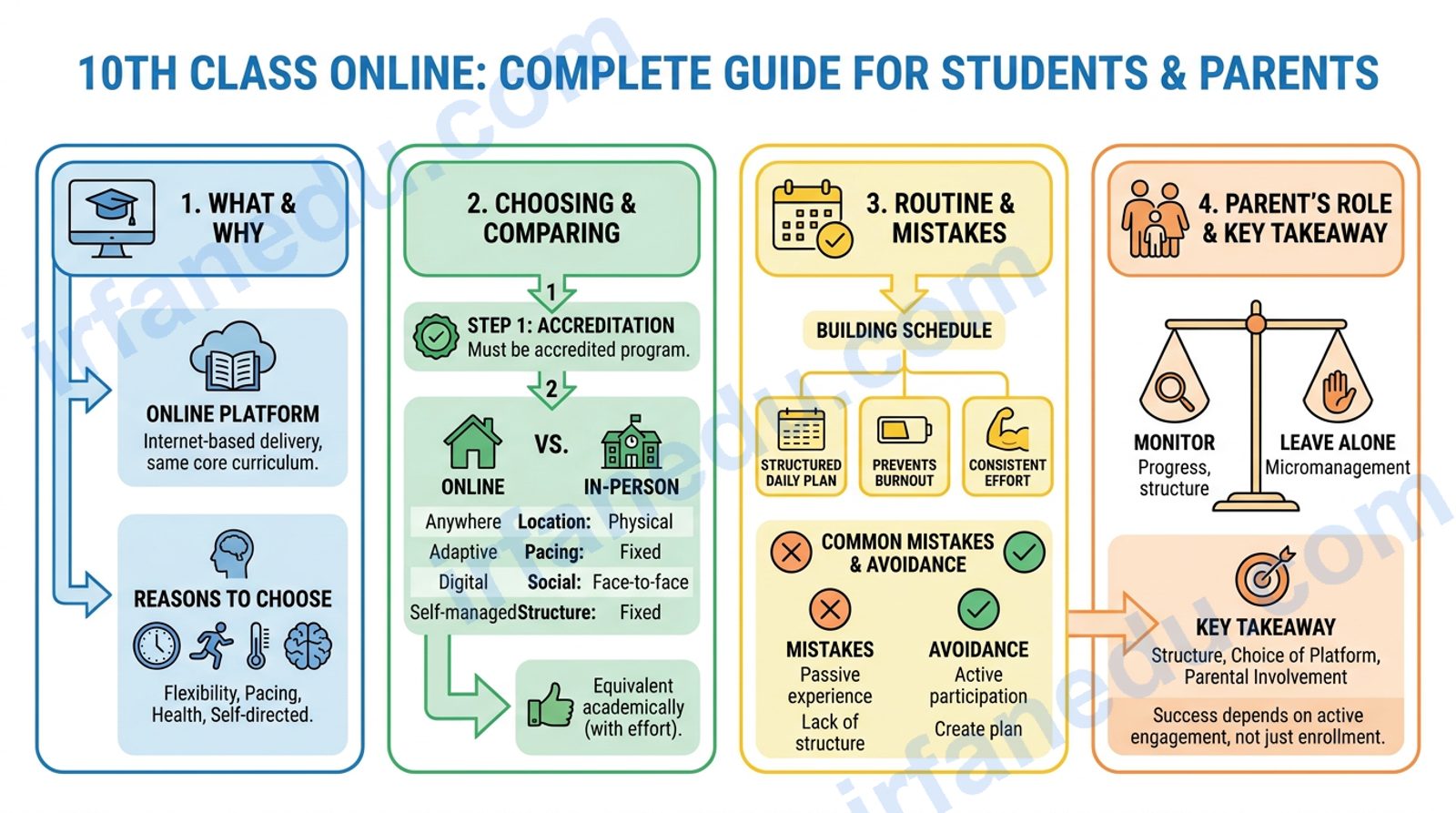
10th class online is a fully structured Grade 10 education delivered through internet-based platforms. Students follow the same core curriculum as traditional schools — math, science, English, history — but attend lessons through video, interactive modules, and digital assignments. When done through an accredited program, online 10th grade is academically equivalent to in-person schooling.
In my 15+ years of working with students at every level, I have seen online learning transform outcomes for students who struggled in traditional classrooms — and I have also seen it fail students who treated it like a passive experience. The difference almost always comes down to structure, choice of platform, and parental involvement. This guide gives you everything you need to get it right.
- What 10th class online actually looks like day to day
- How to pick an accredited, high-quality platform
- A proven daily schedule that prevents burnout
- The five most common mistakes and how to sidestep them
- What parents should monitor — and what they should leave alone
Why Do Students Choose 10th Class Online?
Students choose online 10th grade for a wide range of reasons, and most of them are completely valid. The most common motivators I hear from families include scheduling flexibility for athletes or performers, the need to learn at a different pace, health-related absences, or simply a preference for self-directed learning.
Flexibility is the headline benefit, but it is not the only one. Online programs often allow students to move through material they already understand quickly and spend more time on topics that challenge them. That kind of adaptive pacing is very hard to achieve in a class of 30 students.
In my experience, the students who thrive in online 10th grade are not necessarily the “best” students academically. They are the ones who have a clear reason for being there. A student who chose online school because it lets her train for competitive swimming six hours a day has a built-in motivation engine. A student who ended up online because it seemed easier rarely lasts the semester without serious intervention. Before enrolling, ask yourself — or your child — the honest question: Why online, and why now?
Online 10th grade also removes geographic barriers. A student in a rural area with limited advanced-course options can access AP-level coursework through an accredited online school that a local school simply cannot offer. That is a genuine equity advantage.
How to Choose the Right Online 10th Grade Platform
The single most important decision in 10th class online is choosing an accredited program. Accreditation is the quality signal that colleges, employers, and other schools use to evaluate your transcript. Without it, credits may not transfer and diplomas may not be recognized.
- Verify accreditation first. Look for regional accreditation (e.g., AdvancED/Cognia in the US) or national accreditation. Check the accrediting body’s website directly — do not rely on the school’s own claims.
- Check the curriculum alignment. Confirm the courses align with your state’s or country’s Grade 10 standards so credits transfer without issues.
- Evaluate teacher access. Good online programs offer real, credentialed teachers — not just automated modules. Look for live office hours, email response guarantees, and student-to-teacher ratios.
- Test the technology before committing. Most reputable platforms offer a free trial or demo. Run it on your actual home device and internet connection to check for lag, compatibility issues, or confusing navigation.
- Read independent reviews. Check forums, parent groups, and third-party review sites — not just testimonials on the school’s own website.
Well-known platforms that serve 10th grade students include Khan Academy (free supplemental content), Connections Academy, K12.com, and Coursera’s high school partnerships. Each has different structures, costs, and levels of teacher involvement — compare them carefully against the five criteria above.
Online vs. In-Person 10th Grade: Side-by-Side Comparison
Neither format is universally better — the right choice depends on the student’s learning style, home environment, and goals. This table gives you an honest, balanced comparison.
| Factor | 10th Class Online | Traditional In-Person School |
|---|---|---|
| Schedule flexibility | ✅ High — self-paced or asynchronous options | ❌ Fixed daily timetable |
| Social interaction | ⚠️ Limited — requires deliberate effort outside school | ✅ Built-in daily peer interaction |
| Curriculum depth | ✅ Equal (if accredited) — sometimes broader elective choices | ✅ Equal — depends on school quality |
| Teacher access | ⚠️ Varies by platform — check office hours policy | ✅ Face-to-face, immediate feedback |
| Self-discipline required | ❌ Very high — student must self-manage time | ✅ Structure is externally provided |
| Cost | ⚠️ Free (public virtual school) to $$$ (private programs) | ✅ Free (public) to $$$ (private) |
| College acceptance | ✅ Yes — if accredited | ✅ Yes — standard |
| Lab / hands-on work | ⚠️ Virtual labs or mail-in kits — less hands-on | ✅ Full physical lab access |
The social interaction gap is real and worth planning for. I always recommend that online 10th graders join at least one in-person activity — a sport, a club, a community class — to maintain the peer connections that online school cannot replicate.
How to Build a Daily Study Schedule for 10th Class Online
A daily schedule is the backbone of online learning success. Without the external structure of a school bell, students drift — and drifting in 10th grade, when coursework gets genuinely demanding, leads to falling behind fast.
- 8:00 – 8:50 AM: Math (most cognitively demanding subject first, when focus is sharpest)
- 8:50 – 9:00 AM: Break — stand up, stretch, no screens
- 9:00 – 9:50 AM: Science (Biology or Chemistry)
- 9:50 – 10:00 AM: Break
- 10:00 – 10:50 AM: English / Language Arts
- 10:50 – 11:30 AM: Lunch and physical activity
- 11:30 AM – 12:20 PM: History / Social Studies
- 12:20 – 12:30 PM: Break
- 12:30 – 1:20 PM: Elective or review / catch-up time
- 1:20 – 2:00 PM: Assignment completion and email to teachers
Most online learning guides tell students to “study when you feel most productive.” That advice sounds freeing, but in practice it causes most 10th graders to delay starting until the afternoon, then rush through material. I recommend treating the online school day like a physical school day: same start time, same end time, every weekday. The routine itself reduces the mental friction of getting started. After two weeks, it becomes automatic.
What Subjects Are Covered in 10th Grade Online?
A standard 10th grade online curriculum covers five core subject areas, each with specific skills and content that build on 9th grade foundations. Here is what students typically encounter:
┌─────────────────────────────────────────────────────────┐
│              10TH GRADE ONLINE CURRICULUM               │
├──────────────────┬──────────────────────────────────────┤
│ SUBJECT          │ KEY TOPICS                           │
├──────────────────┼──────────────────────────────────────┤
│ 📐 Math          │ Algebra 2, Geometry, Trigonometry    │
│ 🔬 Science       │ Biology, Chemistry (intro), Physics  │
│ 📖 English       │ Literature analysis, Essay writing   │
│ 🌍 Social Studies│ World History, Geography, Civics     │
│ 🌐 Electives     │ Foreign language, Art, Computer Sci  │
├──────────────────┴──────────────────────────────────────┤
│  All courses follow Grade 10 state/national standards   │
└─────────────────────────────────────────────────────────┘
Math is where most 10th graders hit their first serious wall online. Algebra 2 and Geometry require practice — not just watching video lessons. I recommend spending at least 20 minutes per day on active problem-solving in math, separate from the lesson itself. Khan Academy’s free exercise sets are excellent for this, even if your main school is a paid platform.
📐 Get the Complete Geometry Formula Sheet →
Science courses in online 10th grade often use virtual lab simulations. These are genuinely good for understanding concepts, but they do not replace the tactile experience of physical labs. If your program offers optional in-person lab days, attend them. The hands-on experience deepens understanding in ways a simulation cannot fully replicate.
Common Mistakes Students Make in 10th Class Online (And How to Fix Them)
After working with hundreds of online learners, I have seen the same five mistakes appear again and again. Knowing them in advance puts you ahead of 80% of your peers.
Mistake 1: Treating Recorded Lessons as Background Noise
Many students play video lessons while doing something else, then wonder why nothing sticks. Active watching — pausing to take notes, rewinding confusing sections, and summarizing each lesson in two sentences — triples retention compared to passive viewing.
Mistake 2: Skipping the “Easy” Assignments
Short quizzes and discussion posts feel trivial, but they are often 20-30% of the final grade. Missing several “small” assignments is the most common reason students fail online courses despite understanding the material.
Mistake 3: Waiting Until the Deadline to Ask for Help
In a physical classroom, a confused look gets a teacher’s attention immediately. Online, you have to initiate. Email your teacher the day you get confused — not the day before the test. Most online teachers respond within 24 hours and genuinely appreciate proactive students.
Mistake 4: Isolating Completely from Peers
Online school removes the automatic social layer of education. Students who make no effort to connect with classmates through discussion boards, study groups, or extracurricular activities report significantly higher rates of burnout and dropout. Schedule at least one virtual study session per week with a classmate.
Mistake 5: Not Tracking Progress Until It Is Too Late
Check your grades and assignment completion every Friday. A small gap in understanding compounds quickly in subjects like math and chemistry. Catching a problem in week 3 takes one afternoon to fix. Catching it in week 10 takes two weeks of backtracking.
The mistake I see hurt students the most is not any of the five above — it is the belief that online school is easier than traditional school. It is not. It is different. The content is the same. The exams are the same. What changes is that the responsibility for showing up, staying organized, and asking for help shifts almost entirely onto the student. That is empowering when you are ready for it, and overwhelming when you are not. Be honest with yourself about which category you are in before the semester starts.
What Parents Need to Know and Do for 10th Class Online
Parents play a crucial supporting role in online 10th grade — but the most effective support looks very different from what most parents expect. The goal is to be present without being controlling.
- Set up the physical environment. Provide a dedicated, distraction-free study space with a proper desk, good lighting, and reliable internet. This is the highest-impact thing a parent can do.
- Review the platform together at the start. Spend one hour with your child exploring the platform, finding the grade portal, and locating the teacher contact page. Knowing where things are removes early friction.
- Do a weekly 10-minute check-in. Ask to see the grade portal together every Friday. Not to judge — to spot problems early and problem-solve together.
- Stay in contact with the teacher. Introduce yourself by email in week one. A teacher who knows a parent is engaged pays slightly more attention — that is just human nature.
- Protect study time. Do not schedule appointments, errands, or family activities during the designated school hours. Treat those hours as seriously as you would a physical school day.
Here is something almost no online learning guide tells you: the biggest predictor of 10th grade online success is not intelligence, not the platform, and not even the schedule. It is what researchers call “self-efficacy” — a student’s belief that their own effort actually changes their outcome.
In traditional school, external structures (teachers, bells, peer pressure) prop up motivation even when self-efficacy is low. Online school removes those props. Students who believe “I can figure this out if I try” navigate setbacks and confusion without spiraling. Students who believe “I’m just not a math person” or “I’m bad at writing” hit one hard lesson and disengage.
The practical implication: before worrying about which platform to choose or what schedule to follow, spend time building your child’s (or your own) belief that effort leads to improvement. Concrete wins early in the semester — finishing a hard assignment, getting a better score after reviewing feedback — do more for long-term success than any study technique.
🧠 Quick Knowledge Check
Select your answer — the result reveals instantly.
1. What is the most important factor to check before enrolling in an online 10th grade program?
2. How many hours of active study per day does a standard online 10th grade program expect?
3. According to this guide, what is the biggest predictor of online 10th grade success?
Reveal-on-Click Practice Problems 📝
These scenarios test your understanding of the key decisions in 10th class online. Think through each one, then reveal the answer.
Scenario 1: Maria enrolled in an online school that claims to be “nationally accredited.” A local community college says it will not accept her credits. What likely went wrong?
Answer: Maria’s school is probably accredited by a national accrediting body not recognized by regional universities. National accreditation is typically designed for vocational or career schools, not college-prep programs. She should have verified that the accrediting body is recognized by the colleges she plans to attend. The fix: contact Cognia.org or the regional accreditor for her state to find an equivalent regionally accredited program.
Scenario 2: James is in week 6 of online 10th grade. He understands the material but his grade is a C. What is the most likely cause?
Answer: James is probably missing small assignments — short quizzes, discussion posts, or homework submissions — that he considers unimportant. In most online programs, these “minor” tasks make up 20-35% of the grade. The fix: James should audit every assignment in the grade portal, identify all missing or low-scoring items, and contact his teacher about late submission policies immediately.
Scenario 3: A parent wants to support their 10th grader in online school but is not sure how involved to be. What is the right level of involvement?
Answer: The right level is structured independence. The parent should set up the study environment, do a weekly 10-minute grade check-in together, and stay in email contact with teachers — but should not sit through lessons or complete assignments for the student. The goal is accountability without dependency. A 10th grader who cannot manage their own schedule with light oversight will struggle in college regardless of where they went to high school.
Frequently Asked Questions About 10th Class Online
Is 10th class online as good as in-person school?
Yes, when done through an accredited program with a structured schedule and active participation. Research from the U.S. Department of Education shows online learners can perform as well as or better than traditional students when the program is high quality and the student stays engaged. The key variables are accreditation, teacher access, and student self-discipline — not the delivery format itself.
What subjects are covered in 10th class online?
A standard 10th grade online curriculum covers English/Language Arts, Algebra 2 or Geometry, Biology or Chemistry, World History or Geography, and electives such as a foreign language or computer science. Accredited online schools follow state or national standards, so the coursework is academically equivalent to a physical school’s Grade 10 program.
How many hours a day should a 10th grader study online?
Most online 10th grade programs expect 5 to 6 hours of active study per day, split across subjects. This mirrors a standard school day. Breaks every 45-50 minutes using the Pomodoro method help maintain focus and prevent burnout. Studying more than 7 hours without breaks is counterproductive — quality of attention matters more than raw hours.
Do colleges accept online 10th grade credits?
Yes, as long as the online school is regionally or nationally accredited by a body recognized by universities. Colleges evaluate the transcript and the accrediting body, not the delivery method. Always verify your online school’s accreditation status before enrolling. When in doubt, call the admissions office of a target college and ask directly whether they accept transcripts from that specific program.
What equipment does a student need for 10th class online?
A student needs a reliable laptop or desktop (not just a smartphone), a stable broadband internet connection, a webcam for live sessions, and a quiet dedicated study space. Some programs also require a printer for worksheets and mail-in lab kits for science courses. A second monitor, while not required, significantly improves productivity by allowing lesson videos and note-taking to appear side by side.
How do online 10th grade exams work?
Most online schools use proctored exams delivered through a secure browser or a third-party proctoring service like ProctorU or Honorlock. Some programs use open-book project-based assessments instead. High-stakes standardized tests are usually taken at an approved testing center. Ask your specific program about its exam policy before enrolling so there are no surprises.
Can a student switch from online 10th grade back to a physical school?
Yes. If your online school is accredited, the credits are transferable. Inform the receiving school early, provide official transcripts, and ask about any credit-evaluation process. Some schools may require placement tests for math or science to confirm grade level. The transition is smoother when you keep detailed records of all completed coursework, grades, and course descriptions throughout your online enrollment.