
Timpani drums: the complete student guide to the orchestra’s pitched powerhouse
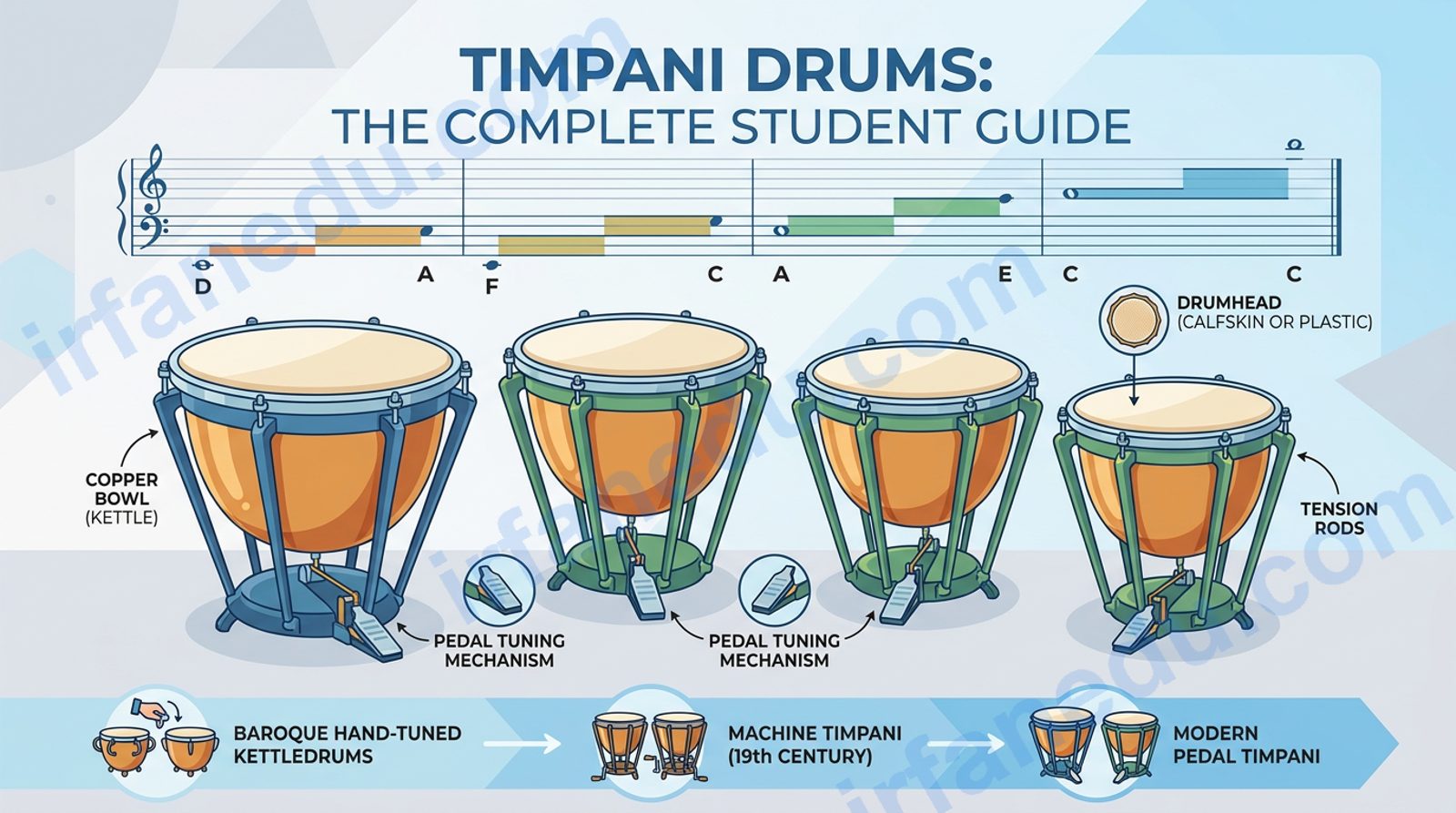
Most people picture drums as pure rhythm machines — you hit them, they make a thud, and that is the end of the musical story. Timpani drums break that rule completely. They are the only standard orchestral drums that play actual, tunable musical notes, and a skilled timpanist can change pitch mid-performance with a single foot movement.
Timpani drums are large, bowl-shaped percussion instruments with a copper or fiberglass shell covered by a stretched drumhead. A foot pedal changes the head’s tension to raise or lower the pitch. They are the pitched percussion foundation of the symphony orchestra and have been central to Western classical music since the Baroque era.
In this guide you will learn exactly what timpani drums are, how every part works, how tuning happens step by step, what technique produces the best tone, and why these instruments matter far beyond the percussion section. Whether you are a student preparing for a music exam, a parent helping your child choose an instrument, or simply curious after hearing that deep, resonant boom in a concert hall — this is the guide I wish I had found first.
- Understand the anatomy and function of every part of a timpani drum.
- Follow a clear, step-by-step explanation of how pedal tuning works.
- See how timpani differ from all other drums in one comparison table.
- Learn the playing techniques that produce different tonal colors.
- Discover the one thing most guides get wrong about timpani pitch.
Timpani drums (also called kettledrums) are large, bowl-shaped percussion instruments made of copper or fiberglass, covered with a stretched drumhead. Unlike most drums, they produce a definite musical pitch that can be changed mid-performance using a foot pedal. A standard orchestral set covers four drums tuned from low D2 up to high C4, making them the only drums that play actual melody-supporting notes in an orchestra.
- Timpani are pitched drums — they play real musical notes, unlike snare or bass drums.
- A foot pedal changes head tension to retune the drum mid-performance.
- A standard orchestra uses four timpani covering roughly D2 to C4.
- The copper bowl shape is what makes the pitch clear and resonant.
- Mallet hardness controls tone color: soft = warm, hard = bright and cutting.
- Timpani have been in orchestras since the late 1600s — one of the oldest standard instruments.
Timpani vs regular drums — what is the real difference?
The single most important distinction between timpani and every other common drum is pitch. Timpani produce a definite pitch — a clear, identifiable musical note. A snare drum, bass drum, or tom-tom produces an indefinite pitch — a sound with no clear note that a listener can name or a musician can match to a scale.
That one difference changes everything: how the instrument is written for, how it is played, and what role it fills in an ensemble. The table below maps out the full comparison so you can see exactly where timpani sit among percussion instruments.
| Feature | Timpani | Snare drum | Bass drum | Marimba / Xylophone |
|---|---|---|---|---|
| Pitch type | Definite (tunable) | Indefinite | Indefinite | Definite (fixed bars) |
| Tuning method | Foot pedal (mid-performance) | Tension rods (before play) | Tension rods (before play) | Fixed — cannot retune |
| Shell shape | Hemispherical bowl (kettle) | Cylinder | Cylinder | Flat bars over resonators |
| Shell material | Copper or fiberglass | Wood, metal, or acrylic | Wood | Rosewood, synthetic, or metal |
| Typical pitch range | D2 – C4 (set of four) | No specific pitch | No specific pitch | C4 – C8 (marimba varies) |
| Orchestral role | Harmonic + rhythmic foundation | Rhythmic accent / military | Low rhythmic accent | Melodic / harmonic color |
| Written in score | On a pitched staff (treble or bass clef) | On a single-line or unpitched staff | On a single-line or unpitched staff | On a pitched staff |
| Standard ensemble size | 2 – 4 drums per player | 1 drum per player | 1 drum per player | 1 instrument per player |
Notice that timpani are written on a pitched staff in an orchestral score — just like a violin or trumpet part. That is something no other standard drum can claim. When you see a timpani part in a score, it looks like a melody line, not a rhythm notation.
Quick facts about timpani drums
| Fact | Detail |
|---|---|
| Also called | Kettledrums, timps |
| Family | Membranophones (percussion) |
| Shell material | Copper (professional), fiberglass (student/marching) |
| Head material | Calfskin (traditional) or plastic (modern) |
| Standard set | 4 drums: 32″, 29″, 26″, 23″ diameter |
| Pitch range (set of 4) | D2 to C4 (approx.) |
| Tuning mechanism | Pedal (Dresden or Berlin style) |
| Mallets | Felt, flannel, or wood head on a shaft |
| First orchestral use | Late 1600s (Lully, Purcell era) |
| Weight (32″ drum) | Approx. 30 – 40 kg |
What are timpani drums?
Timpani drums are large, bowl-shaped percussion instruments that produce a definite musical pitch. The name comes from the Italian word timpano (plural: timpani), which itself derives from the Latin tympanum and Greek tympanon, both meaning drum or tambourine.
The defining feature of a timpani is its hemispherical shell — the “kettle” — which acts as a resonating chamber. When the drumhead vibrates, the air inside the bowl amplifies and focuses specific frequencies, producing a clear, pitched tone rather than a diffuse thud. This is the physics reason why a timpani sounds like a note and a snare drum does not: the enclosed bowl selects a dominant frequency and reinforces it.
In my experience explaining this to students, the easiest analogy is a wine glass. Tap a full wine glass and it rings at a clear pitch. Tap an open cardboard box and it thuds. The timpani’s copper bowl works like the wine glass — it gives the vibration a shape to resonate in.
Timpani are classified as membranophones — instruments that produce sound through a vibrating membrane (the drumhead). Within that family, they are specifically pitched membranophones, a category shared with instruments like the tabla and boobam but not with standard drum-kit components.
Anatomy of a timpani drum: every part explained
Understanding each component helps you understand how the instrument works as a system. Every part has a specific acoustic or mechanical function.
        ┌─────────────────────────────────────┐
        │           DRUMHEAD (membrane)       │  ← calfskin or plastic
        │  ·  ·  ·  ·  ·  ·  ·  ·  ·  ·  ·  │
        └──┬──────────────────────────────┬───┘
           │  COUNTERHOOP (metal ring)    │  ← holds head in place
           │  ─────────────────────────  │
           │  TENSION RODS (6–8 bolts)   │  ← even tension around rim
           │  │  │  │  │  │  │  │  │    │
           │  └──────────────────────────┘
           │
        ┌──┴──────────────────────────────────┐
        │                                     │
        │      COPPER BOWL (the kettle)       │  ← resonating chamber
        │                                     │
        └──────────────────┬──────────────────┘
                           │
              ┌────────────┴────────────┐
              │   PEDAL MECHANISM       │  ← raises/lowers pitch
              │   (Dresden or Berlin)   │
              └────────────┬────────────┘
                           │
              ┌────────────┴────────────┐
              │   FRAME / LEGS          │  ← supports drum at playing height
              └─────────────────────────┘

  Striking zone: ~4 cm from the rim (not the center)
  Tuning gauge: mounted on the bowl's side, shows current pitch
The kettle (bowl)
The hemispherical copper bowl is the soul of the instrument. Copper is used because it is dense enough to reflect sound waves efficiently, yet workable enough to be shaped into a precise bowl. Fiberglass bowls are lighter and cheaper, making them common in schools and marching bands, but they produce a slightly less resonant tone.
The drumhead
Modern timpani heads are almost universally made from a clear or white plastic film (typically Mylar/PET). Traditional calfskin heads are still used by some professional players for their warmer tone, but they are sensitive to humidity and temperature changes — a real problem in outdoor performances.
The pedal mechanism
This is what makes timpani unique among drums. Pressing the pedal forward tightens the drumhead (raises pitch); releasing it loosens the head (lowers pitch). Two main pedal systems exist: the Dresden pedal (heel-operated, common in Europe) and the Berlin pedal (toe-operated, common in North America). Both achieve the same result through different mechanical linkages.
The tuning gauge
A small indicator mounted on the bowl’s side shows the approximate pitch as the pedal moves. Experienced players use the gauge as a starting point, then verify by ear — the gauge is a guide, not a guarantee.
A brief history of timpani
Timpani have one of the longest continuous histories of any orchestral instrument. Their story spans military battlefields, royal courts, and concert halls across four centuries.
Medieval and Renaissance origins (before 1600): Kettledrums arrived in Europe from the Middle East and Central Asia, brought back by Crusaders and traders. They were called nakers (from the Arabic naqqara) and were small, hand-carried instruments used in military signaling.
Baroque era (1600 – 1750): Larger kettledrums became standard in cavalry regiments and royal courts. Composers like Jean-Baptiste Lully and Henry Purcell began writing for them in orchestral scores. At this stage, tuning required loosening or tightening individual tension rods by hand — a slow process that meant the pitch was essentially fixed for an entire movement.
Classical era (1750 – 1820): Haydn, Mozart, and Beethoven used timpani prominently. Beethoven’s Ninth Symphony (1824) includes some of the most dramatic timpani writing in the repertoire — a solo passage in the second movement that was considered shocking at the time for its rhythmic and dynamic intensity.
Invention of the pedal mechanism (mid-1800s): The development of the pedal tuning system transformed the instrument. Suddenly, a player could change pitch in seconds rather than minutes. This opened up a new world of compositional possibilities — glissandi (sliding pitch changes), rapid retuning between phrases, and harmonic support that tracked the orchestra’s key changes.
Modern era: Today’s professional timpani are precision instruments with fine-tuned pedal mechanisms, synthetic heads for weather resistance, and gauges calibrated in exact semitones. The instrument’s fundamental design, however, has not changed dramatically since the late 19th century.
How timpani tuning works: a step-by-step explanation
Timpani tuning is the skill that separates a beginner from an advanced player. The physics is straightforward, but the execution requires trained ears and muscle memory.
The physics of pitch on a drumhead
Pitch on a stretched membrane is determined by three factors: tension, mass per unit area, and the diameter of the membrane. For a fixed-size drum with a fixed head, only tension changes. Higher tension = faster vibration = higher pitch. Lower tension = slower vibration = lower pitch. The pedal controls tension; everything else stays constant.
Step-by-step: how to tune a pedal timpani
- Identify the target pitch. Read the score or receive instruction from the conductor. For example, the target might be A3 (the A below middle C, 220 Hz).
- Check the tuning gauge. Look at the gauge mounted on the drum’s side. Move the pedal until the indicator points to your target note.
- Tap and listen. Lightly tap the drumhead about 4 cm from the rim — not the center. Listen carefully to the tone produced.
- Compare to a reference pitch. Use a chromatic tuner, a piano note, or a pitch pipe to compare. Your ear is the final judge.
- Fine-tune with the pedal. Make small pedal adjustments — forward to raise pitch, back to lower it — until the tone matches your reference exactly.
- Lock the pedal (if available). Engage the pedal lock so the pitch does not drift during performance.
Always tap near the rim, not the center. The center of a timpani head produces a dull, unclear tone because multiple vibration modes cancel each other out there. The sweet spot — about 4 cm from the rim — is where the fundamental pitch rings most clearly. This is one of the first things I teach any new timpani student.
Worked example: retuning during a performance
Imagine a piece moves from D major to G major between two sections. The timpanist’s 29-inch drum is tuned to D3 for the first section. During a four-bar rest, the player must silently retune to G3 (a perfect fourth higher). Here is what that looks like in practice:
- The player presses the pedal forward about halfway, watching the gauge move from D to G.
- With one finger, they lightly touch the head near the rim and listen for the G pitch.
- A tiny pedal adjustment brings it exactly in tune.
- The player is ready before the rest ends — all without making a sound the audience can hear.
This kind of silent, rapid retuning is a core timpani skill. It requires both physical coordination and a well-trained ear working simultaneously.
Playing technique: how to strike a timpani correctly
Striking a timpani correctly is not simply hitting it hard. Technique determines tone quality, dynamic range, and whether the pitch speaks clearly or gets muddied.
Mallet choice and tone color
Timpani mallets come in a range of head hardnesses. The choice directly affects the sound:
- Soft felt mallets: Produce a warm, round, full tone. Used for lyrical passages and pianissimo playing.
- Medium felt mallets: The standard all-purpose choice. Clear pitch, balanced tone.
- Hard felt or flannel mallets: Brighter, more articulate sound. Used for fast passages where clarity matters.
- Wood mallets: Produce a sharp, dry, cutting attack. Used for special effects or very loud, accented passages.
Stroke technique
The standard timpani stroke uses a relaxed wrist motion rather than an arm swing. The mallet head should rebound off the drumhead immediately after contact — a “dead stroke” (where the mallet stays on the head) kills the resonance and produces a dull thud instead of a ringing tone.
The striking zone is always 4 cm from the rim. Playing closer to the center produces a hollow, unfocused sound. Playing exactly on the rim produces a harsh, metallic click.
Rolls
A timpani roll is produced by alternating strokes between two mallets at a speed fast enough to create a continuous sound. Unlike a snare drum roll (which uses a single-stroke or buzz technique), a timpani roll is always an alternating single-stroke roll. The speed needed depends on the dynamic level — a loud roll needs faster strokes to fill the sound; a soft roll can be slower because the resonance sustains longer.
Many beginners strike the center of the drumhead, thinking that is where the loudest sound comes from. It is not. The center produces a dull, pitchless thud because the fundamental mode of vibration is suppressed there. Always strike 4 cm from the rim for a clear, resonant, pitched tone.
Role of timpani in the orchestra
Timpani occupy a unique dual role in the symphony orchestra: they are simultaneously a rhythmic instrument and a harmonic one. No other standard percussion instrument does both.
On the rhythmic side, timpani provide the low-end pulse and dramatic accents that give orchestral music its physical impact. The opening of Beethoven’s Fifth Symphony is a famous example — those four-note motifs are reinforced by the timpani in a way that makes the whole orchestra feel like it is striking the floor.
On the harmonic side, timpani are typically tuned to the tonic and dominant of the key the orchestra is playing in. When the harmony changes, the timpanist retunes to match. This means the timpani are actively tracking the harmonic structure of the piece, not just providing rhythm. In Romantic and 20th-century music, composers began writing more complex harmonic roles for timpani — chromatic passages, dissonant pedal tones, and even melodic solos.
Seating position matters too. Timpani sit at the back of the orchestra, directly behind the brass section. This placement is deliberate: the low frequencies of the timpani and the brass blend together before reaching the audience, creating the full, powerful orchestral sound that defines the symphonic experience.
[IMAGE: Orchestra seating diagram showing timpani position behind brass section | ALT: orchestra seating chart with timpani drums highlighted at back of percussion section]
Beethoven’s Violin Concerto opens with four solo timpani strokes — one of the most famous orchestral openings ever written. Bartok’s Music for Strings, Percussion, and Celesta gives the timpani a leading melodic role. Berlioz’s Symphonie Fantastique uses multiple timpanists simultaneously for the first time in orchestral history.
Almost every beginner resource describes timpani as “drums that can be tuned.” That is true but incomplete — and the gap matters. The real reason timpani produce a clear pitch while other drums do not is the shape of the resonating chamber, not just the tension of the head. A cylindrical drum shell (like a snare or bass drum) allows too many competing vibration modes to coexist, so no single frequency dominates and you hear an indefinite pitch. The hemispherical copper bowl of a timpani acts as a Helmholtz resonator: it selects and amplifies the fundamental frequency while suppressing the competing overtones that would muddy the pitch. This means that even if you put a pedal tuning mechanism on a snare drum, it would still not produce a clear musical note — because the shell shape is wrong. The bowl is not just a structural choice; it is the acoustic engine of the instrument.
Quick quiz: test your timpani knowledge
1. What makes timpani different from a snare drum?
2. Where should you strike a timpani head for the clearest pitch?
3. What does pressing the foot pedal forward do to a timpani’s pitch?
Frequently asked questions about timpani drums
What are timpani drums?
Timpani drums are large, bowl-shaped percussion instruments with a copper or fiberglass shell (the kettle) covered by a stretched drumhead. They produce a definite musical pitch, making them unique among drums. A foot pedal changes the tension of the head and therefore the pitch, allowing the player to retune mid-performance. They are the pitched percussion foundation of the symphony orchestra.
How many timpani drums are in a standard orchestra?
A standard professional orchestra uses four timpani drums, covering a combined pitch range from roughly D2 to C4. Smaller ensembles may use two or three drums. Some modern scores call for five or even six drums to extend the range further. Each drum is a different diameter: typically 32″, 29″, 26″, and 23″.
How do you tune a timpani drum?
Press the foot pedal forward (toward the drum) to raise the pitch by tightening the drumhead, or pull it back to lower the pitch by loosening it. A tuning gauge on the drum shows the approximate note. Players verify the pitch by lightly touching the head near the edge and listening to the tone produced. Final tuning is always done by ear, using the gauge only as a starting reference.
What is the difference between timpani and regular drums?
Regular drums (snare, bass drum, tom-toms) produce an indefinite pitch — a sound with no clear musical note. Timpani produce a definite pitch and can be retuned to specific notes. This makes timpani melodic percussion instruments, not just rhythmic ones. The hemispherical bowl shape is the acoustic reason: it selects and amplifies a dominant frequency, while cylindrical drum shells allow too many competing frequencies to coexist.
What are timpani sticks called?
Timpani sticks are called mallets or timpani beaters. They have a long wooden or fiberglass shaft with a padded felt, flannel, or wood head. Harder heads produce a brighter, more cutting tone; softer felt heads produce a warm, round tone. Composers sometimes specify which type to use in the score. A typical professional timpanist carries six to ten different mallets for different musical contexts.
- Timpani drums produce a definite musical pitch — the only standard orchestral drums that do.
- The hemispherical copper bowl is the acoustic engine: it selects the fundamental frequency and suppresses competing overtones.
- A foot pedal changes head tension to retune the drum mid-performance — a skill central to orchestral playing.
- A standard set of four drums covers D2 to C4, written on a pitched staff in the score.
- Always strike 4 cm from the rim, never the center, for a clear and resonant tone.
- Mallet hardness controls tone color: soft for warmth, hard for brightness and articulation.
- Timpani serve a dual role in the orchestra: rhythmic foundation and harmonic support.
Sources & references
- Encyclopaedia Britannica — Timpani: authoritative overview of the instrument’s history, construction, and orchestral role.
- Wikipedia — Timpani: comprehensive reference covering acoustics, tuning systems, and repertoire history.
- Khan Academy — Instruments of the Orchestra: Percussion: accessible introduction to orchestral percussion including timpani for students.
Editorial note: This article was written and fact-checked by Dr