
Factor Calculator: Find All Factors of Any Number
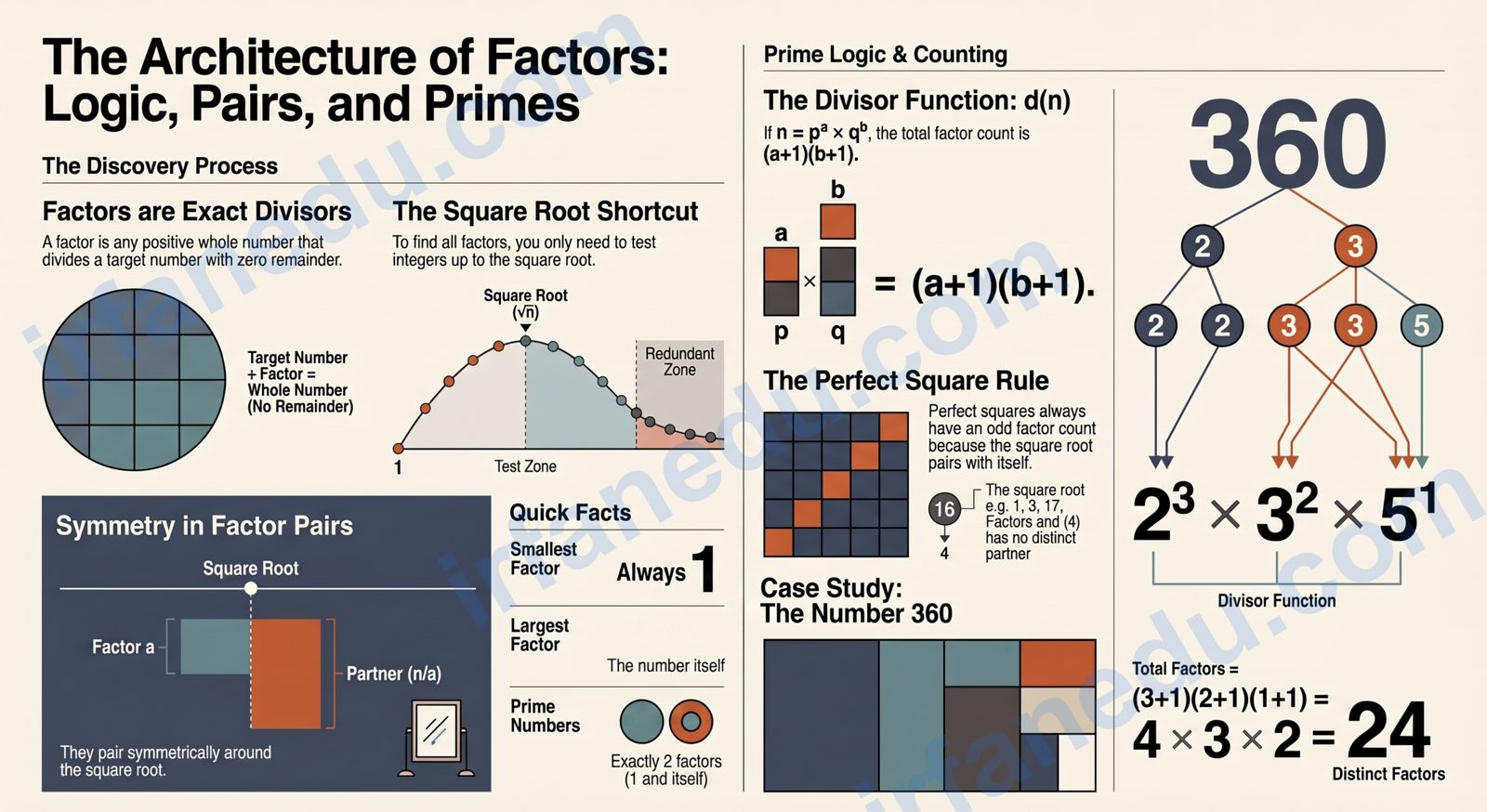
Whether you are a student who just learned what a factor is, or an advanced learner who needs prime factorization for number theory, this tool does the heavy lifting for you. Type any positive whole number below and get every factor, every factor pair, and the full prime factorization — with numbered steps so you can follow the logic, not just copy the answer.
Factor Calculator
Finds all factors, factor pairs & prime factorization instantly
How to Use This Calculator
- Type any positive whole number from 1 to 1,000,000 into the input field.
- Click Find Factors or press Enter.
- Read the full factor list (shown as green chips), the prime factorization, and the factor pairs.
- Scroll through the numbered steps to see exactly how each factor was found — useful for checking your own working.
- Click Reset to clear everything and try a new number.
Quick Facts
| Fact | Detail |
|---|---|
| Smallest factor of any number | Always 1 |
| Largest factor of any number | The number itself |
| Number of factors of a prime | Exactly 2 (1 and itself) |
| Number of factors of 1 | Exactly 1 (just 1) |
| Formula for total factor count | If n = pa qb rc… then count = (a+1)(b+1)(c+1)… |
| Perfect square factors | Perfect squares always have an odd number of factors |
| Calculator range | 1 to 1,000,000 |
What Is a Factor?
A factor of a whole number n is any positive integer that divides n exactly — that is, the division produces a whole-number result with zero remainder. The complete set of factors of n always includes 1 and n itself, plus any integers in between that divide evenly.
Think of factors as the numbers that “fit into” another number without any leftover. If you can share 24 apples equally among 6 people, then 6 is a factor of 24. If you try 7, you get 3 remainder 3 — so 7 is not a factor.
Factors always come in pairs. If a is a factor of n, then n/a is also a factor. This pairing is why you only need to test up to the square root of n — the calculator above uses exactly this shortcut.
The Formula and Method Explained
Trial Division (The Core Method)
To find all factors of n, test every integer i from 1 up to √n. If n mod i = 0 (no remainder), then both i and n/i are factors. This works because factors pair up symmetrically around the square root.
Variables & Symbols
| Symbol | Meaning | Example (n = 36) |
|---|---|---|
| n | The number being factored | 36 |
| i | Trial divisor (1 to √n) | 1, 2, 3, 4, 5, 6 |
| n mod i | Remainder after dividing n by i | 36 mod 4 = 0 (factor) |
| n/i | The paired factor | 36/4 = 9 |
| d(n) | Total number of factors (divisor function) | d(36) = 9 |
Counting Factors Without Listing Them
Once you have the prime factorization n = p1a × p2b × p3c…, the total number of factors is:
For 360 = 23 × 32 × 51: d(360) = (3+1)(2+1)(1+1) = 4 × 3 × 2 = 24 factors. You can verify this with the calculator above.
Worked Examples
Example 1 — Beginner: Factors of 48
Test every integer from 1 to √48 ≈ 6.93, so test 1 through 6:
- 48 ÷ 1 = 48 (exact) → pair (1, 48)
- 48 ÷ 2 = 24 (exact) → pair (2, 24)
- 48 ÷ 3 = 16 (exact) → pair (3, 16)
- 48 ÷ 4 = 12 (exact) → pair (4, 12)
- 48 ÷ 5 = 9.6 (not exact) → skip
- 48 ÷ 6 = 8 (exact) → pair (6, 8)
All factors of 48: 1, 2, 3, 4, 6, 8, 12, 16, 24, 48 — ten factors total.
Prime factorization: 48 = 24 × 3. Factor count check: (4+1)(1+1) = 10. Correct.
Example 2 — Advanced: Factors of 360
Test 1 through √360 ≈ 18.97, so test 1 through 18. Exact divisors: 1, 2, 3, 4, 5, 6, 8, 9, 10, 12, 15, 18 — each gives a partner on the other side of the square root.
All 24 factors: 1, 2, 3, 4, 5, 6, 8, 9, 10, 12, 15, 18, 20, 24, 30, 36, 40, 45, 60, 72, 90, 120, 180, 360.
Prime factorization: 360 = 23 × 32 × 5. Factor count: (3+1)(2+1)(1+1) = 24. Confirmed.
         360
        /   \
       2    180
           /   \
          2     90
               /  \
              2    45
                  /  \
                 3    15
                     /  \
                    3     5

Prime factorization: 2³ × 3² × 5
Factor count: (3+1)(2+1)(1+1) = 24 factors
Factors vs. Multiples vs. Divisors
These three terms confuse students at every level. The table below separates them clearly.
| Term | Definition | Example (n = 12) | Size Relative to n |
|---|---|---|---|
| Factor | Divides n exactly | 1, 2, 3, 4, 6, 12 | ≤ n |
| Multiple | n multiplied by an integer | 12, 24, 36, 48… | ≥ n |
| Divisor | Same as factor (interchangeable in most contexts) | 1, 2, 3, 4, 6, 12 | ≤ n |
| Prime factor | A factor that is also a prime number | 2, 3 | ≤ n |
In my experience teaching this topic, the factor/multiple confusion is the single most common error on tests. A quick memory trick: factors are few and fit inside; multiples multiply and grow.
Common Mistakes When Finding Factors
| Mistake | Wrong | Correct |
|---|---|---|
| Stopping at half the number instead of the square root | Testing 1–18 for n=36 (misses nothing here but wastes time for large n) | Test only 1–6 for n=36; pairs handle the rest |
| Thinking 1 is prime | “1 is a prime factor of every number” | 1 is neither prime nor composite; it is not a prime factor |
| Missing the number itself as a factor | Factors of 15: 1, 3, 5 | Factors of 15: 1, 3, 5, 15 |
| Confusing factor pairs with just one factor | 48 ÷ 6 = 8, so only 6 is a factor | Both 6 and 8 are factors — they form a pair |
| Listing a factor twice when n is a perfect square | Factors of 25: 1, 5, 5, 25 | Factors of 25: 1, 5, 25 — the square root (5) appears once |
In my experience teaching number theory, the “stop at half the number” habit is the biggest time-waster I see. Students test 1 through 50 for a number like 100, when they only need to test 1 through 10. The square-root shortcut is not just a trick — it is the reason the calculator above is fast even for numbers close to 1,000,000. Once students internalize why it works (factors pair up around the square root), they never go back to the slow method.
Most factor guides teach you how to list factors but never explain why perfect squares always have an odd number of factors. Every factor of a non-square number pairs with a distinct partner (e.g., 2 pairs with 6 for n=12). But for a perfect square, the square root pairs with itself — it is its own partner — so one factor is unpaired, making the total count odd. This is why 36 has 9 factors (odd) and 12 has 6 (even). Knowing this lets you instantly sanity-check your factor list: if n is a perfect square and you listed an even number of factors, you made an error.
Factor-Counting Methods Compared
| Method | Best For | Speed | Gives Prime Factorization? |
|---|---|---|---|
| Trial division (1 to √n) | Any number; beginner-friendly | Fast for n < 10,000 | Yes (as a byproduct) |
| Factor tree | Visual learners; classroom use | Moderate | Yes (primary output) |
| Divisor formula d(n) | Counting factors without listing | Very fast once PF is known | Requires PF first |
| Sieve of Eratosthenes | Finding all primes up to a limit | Fast for bulk work | Indirectly |
Practice Problems
Try each problem yourself, then click to reveal the full solution.
Problem 1 (Beginner): List all factors of 30.
Test 1 to √30 ≈ 5.47, so test 1–5.
- 30 ÷ 1 = 30 → pair (1, 30)
- 30 ÷ 2 = 15 → pair (2, 15)
- 30 ÷ 3 = 10 → pair (3, 10)
- 30 ÷ 4 = 7.5 → skip
- 30 ÷ 5 = 6 → pair (5, 6)
Factors of 30: 1, 2, 3, 5, 6, 10, 15, 30 — 8 factors.
Prime factorization: 2 × 3 × 5. Count check: (1+1)(1+1)(1+1) = 8. Correct.
Problem 2 (Intermediate): How many factors does 144 have?
Prime factorization of 144: 144 = 24 × 32.
Factor count: (4+1)(2+1) = 5 × 3 = 15 factors.
Note: 144 = 122, a perfect square — so it has an odd number of factors (15). This confirms the insight above.
Full list: 1, 2, 3, 4, 6, 8, 9, 12, 16, 18, 24, 36, 48, 72, 144.
Problem 3 (Advanced): Find the smallest number with exactly 12 factors.
We need d(n) = 12. Write 12 as a product of integers ≥ 2 in all ways, then map to prime factorizations:
Sources & References
Written and fact-checked by Dr Irfan Mansuri. External links open in a new tab and are provided for further reading and verification.