
How do you calculate profit — and are you actually making money? 💰
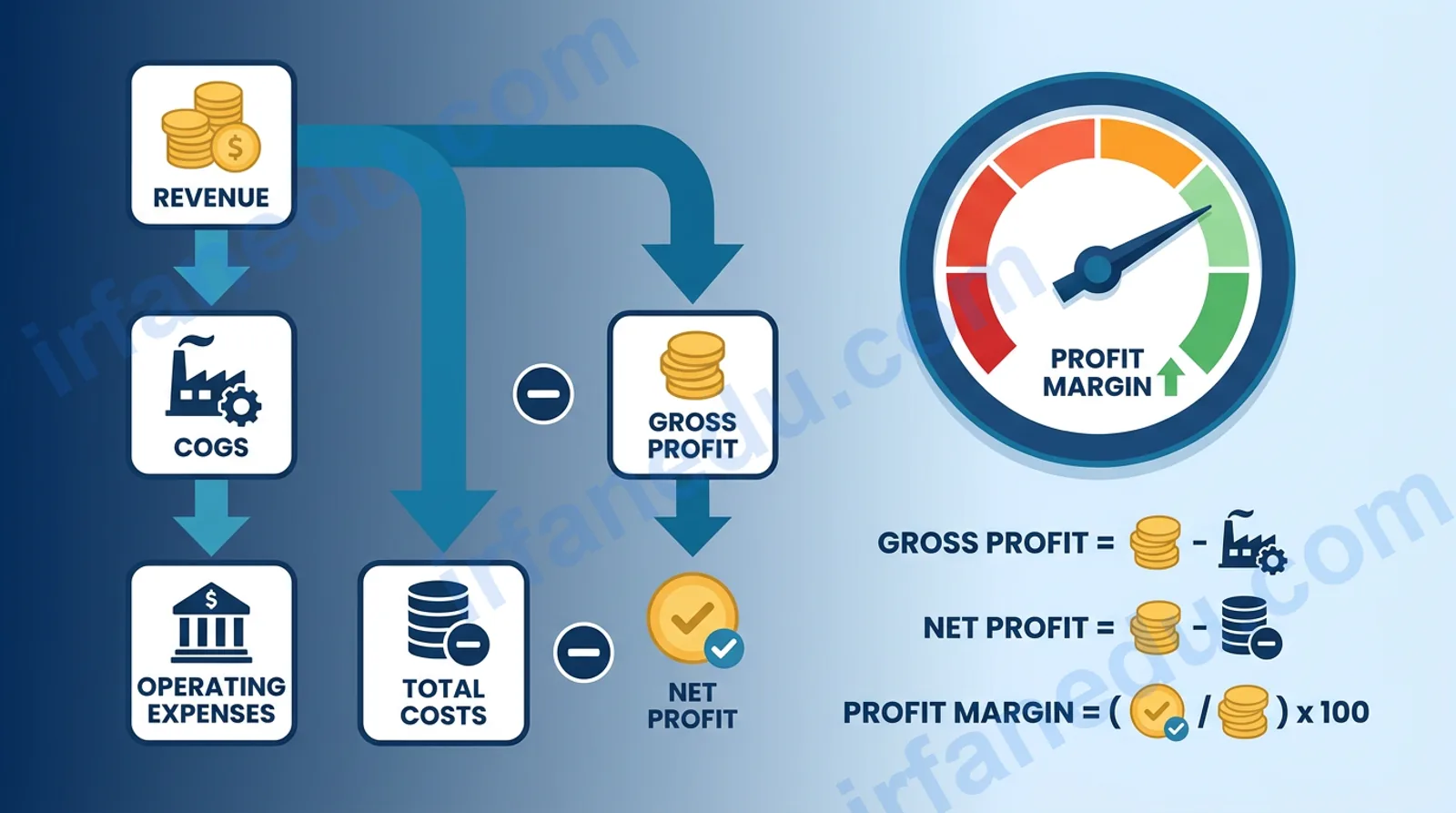
Think of your revenue as a bucket of water and your costs as holes in the bucket. Profit is what stays in the bucket. The profit calculator below measures exactly how much water you’re keeping — whether you’re running a side hustle, a retail shop, or a growing small business in the US.
Most people confuse gross profit with net profit, or mix up margin with markup. Those mix-ups lead to real pricing mistakes — I’ve seen business owners underprice products by 15-20% simply because they used markup math when they needed margin math. This guide fixes that, and the calculator does the heavy lifting for you.
⚡ TL;DR
- 📌 Gross profit = Revenue minus cost of goods sold (COGS) only.
- 📌 Net profit = Revenue minus every cost, including taxes.
- 📌 Profit margin % = (Net Profit ÷ Revenue) × 100.
- 📌 Markup and margin are NOT the same — confusing them costs you money.
- 📌 A 10%+ net margin is healthy for most US small businesses.
- 📌 Use the calculator below — enter revenue, COGS, expenses, and taxes.
| Metric | Formula | What it tells you |
|---|---|---|
| Gross Profit ($) | Revenue − COGS | Efficiency of production/purchasing |
| Net Profit ($) | Revenue − All Costs | True bottom-line earnings |
| Gross Margin (%) | (Gross Profit ÷ Revenue) × 100 | % of revenue left after direct costs |
| Net Margin (%) | (Net Profit ÷ Revenue) × 100 | % of revenue kept as profit |
| Markup (%) | (Profit ÷ Cost) × 100 | Premium over cost — NOT the same as margin |
| Break-Even Point | Fixed Costs ÷ (Price − Variable Cost) | Units needed to cover all costs |
Profit Calculator
Gross profit · Net profit · Profit margin
US Dollars ($)
US Dollars ($)
Rent, salaries, utilities, marketing ($)
US Dollars ($) — enter 0 if unknown
How to use this profit calculator
- Pick a mode. Choose Net Profit (full picture), Gross Profit (production efficiency), or Find Margin % (if you already know your net profit).
- Enter your revenue. This is your total sales dollars before any deductions.
- Enter COGS. The direct cost to make or buy what you sold — materials, inventory, manufacturing labor.
- Add operating expenses (Net Profit mode only): rent, salaries, utilities, insurance, and marketing.
- Add taxes paid (Net Profit mode only): enter 0 if you want a pre-tax estimate.
- Click Calculate. The result card shows your profit in dollars, your margin %, and a numbered step-by-step breakdown you can screenshot or share.
What is profit, exactly?
Profit is the financial gain remaining after all costs are subtracted from revenue. It is the single most important number in any business because it determines whether the business is viable, growing, or burning cash.
According to the Investopedia definition of profit, there are three key layers: gross profit, operating profit, and net profit. Each layer strips away more costs to give you a progressively clearer picture of true earnings.
The profit formulas explained
  REVENUE
     │
     ▼
  − COGS (direct costs)
     │
     ▼
  = GROSS PROFIT
     │
     ▼
  − Operating Expenses (rent, salaries, marketing)
  − Taxes
     │
     ▼
  = NET PROFIT  ←  the real bottom line

  Profit Margin % = (Net Profit ÷ Revenue) × 100
| Symbol | Meaning | Unit |
|---|---|---|
| R | Revenue (total sales) | US Dollars ($) |
| C | Cost of Goods Sold (COGS) | US Dollars ($) |
| OE | Operating Expenses | US Dollars ($) |
| T | Taxes paid | US Dollars ($) |
| GP | Gross Profit = R − C | US Dollars ($) |
| NP | Net Profit = R − C − OE − T | US Dollars ($) |
| PM | Profit Margin = (NP ÷ R) × 100 | Percentage (%) |
Worked examples that match the calculator's output
📦 Example 1 — Online retail seller (Net Profit mode)
A seller on an online marketplace generates $18,000 in monthly revenue. COGS (product cost + shipping) = $9,000. Operating expenses (platform fees, ads, software) = $4,500. Taxes = $900.
- Gross Profit = $18,000 − $9,000 = $9,000
- Total Costs = $9,000 + $4,500 + $900 = $14,400
- Net Profit = $18,000 − $14,400 = $3,600
- Net Margin = ($3,600 ÷ $18,000) × 100 = 20%
🍕 Example 2 — Food truck (Gross Profit mode)
A food truck earns $5,200 at a weekend event. Ingredients and packaging (COGS) cost $1,820.
- Gross Profit = $5,200 − $1,820 = $3,380
- Gross Margin = ($3,380 ÷ $5,200) × 100 = 65%
Note: this is gross profit only. After paying the truck driver, fuel, and permit fees, net profit will be lower.
💼 Example 3 — Freelance consultant (Find Margin % mode)
A freelance consultant invoices $12,000 in a quarter and reports a net profit of $8,400 after self-employment taxes and software costs.
- Profit Margin = ($8,400 ÷ $12,000) × 100 = 70%
Service businesses with low overhead routinely hit 60-70% margins — a key reason consulting is financially attractive.
Common profit mistakes — and how to fix them
| Concept | Formula | Based on | Example (Cost $60, Price $100) |
|---|---|---|---|
| Profit Margin | (Profit ÷ Revenue) × 100 | Revenue | ($40 ÷ $100) × 100 = 40% |
| Markup | (Profit ÷ Cost) × 100 | Cost | ($40 ÷ $60) × 100 = 66.7% |
Setting prices using markup math but then reporting margin to investors or the IRS. A 50% markup sounds great — but your actual profit margin is only 33.3%. If your target is a 40% margin, you need a 66.7% markup. The calculator above always reports margin, not markup.
| Metric | What it includes | Best used for | Typical US benchmark |
|---|---|---|---|
| Gross Profit | Revenue minus COGS only | Pricing and production efficiency | Retail: 20-50%; SaaS: 70-80% |
| Net Profit | Revenue minus all costs + taxes | True business viability | Healthy: 10%+; Excellent: 20%+ |
In my experience working with small business owners across the US, the single most damaging habit is tracking revenue without tracking net profit. I've spoken with shop owners celebrating a record $80,000 sales month — only to discover their net profit was under $2,000 after expenses. Revenue is vanity; profit is sanity. Run this calculator every month, not just at tax time. A 10-minute habit can change the trajectory of your business.
Your profit margin and your cash flow are not the same thing — and confusing them can sink a profitable business.
A business can show a healthy 20% net profit margin on paper and still run out of cash. How? If customers pay on 60-day terms but your suppliers demand payment in 30 days, you're profitable but cash-starved. This is called a cash flow gap, and it's one of the top reasons profitable US small businesses fail.
Most profit calculators — and most guides — stop at the margin number. The real question is: when does that profit hit your bank account? Track both metrics. Profit tells you if your model works; cash flow tells you if you survive long enough to prove it.
🧠 Quick Quiz — Test Your Profit Knowledge
Q1. A store has $50,000 revenue and $30,000 COGS. What is the gross profit?
Q2. Net profit is $5,000 on $25,000 revenue. What is the profit margin?
Q3