
Roth IRA Calculator: See Your Tax-Free Growth 📈
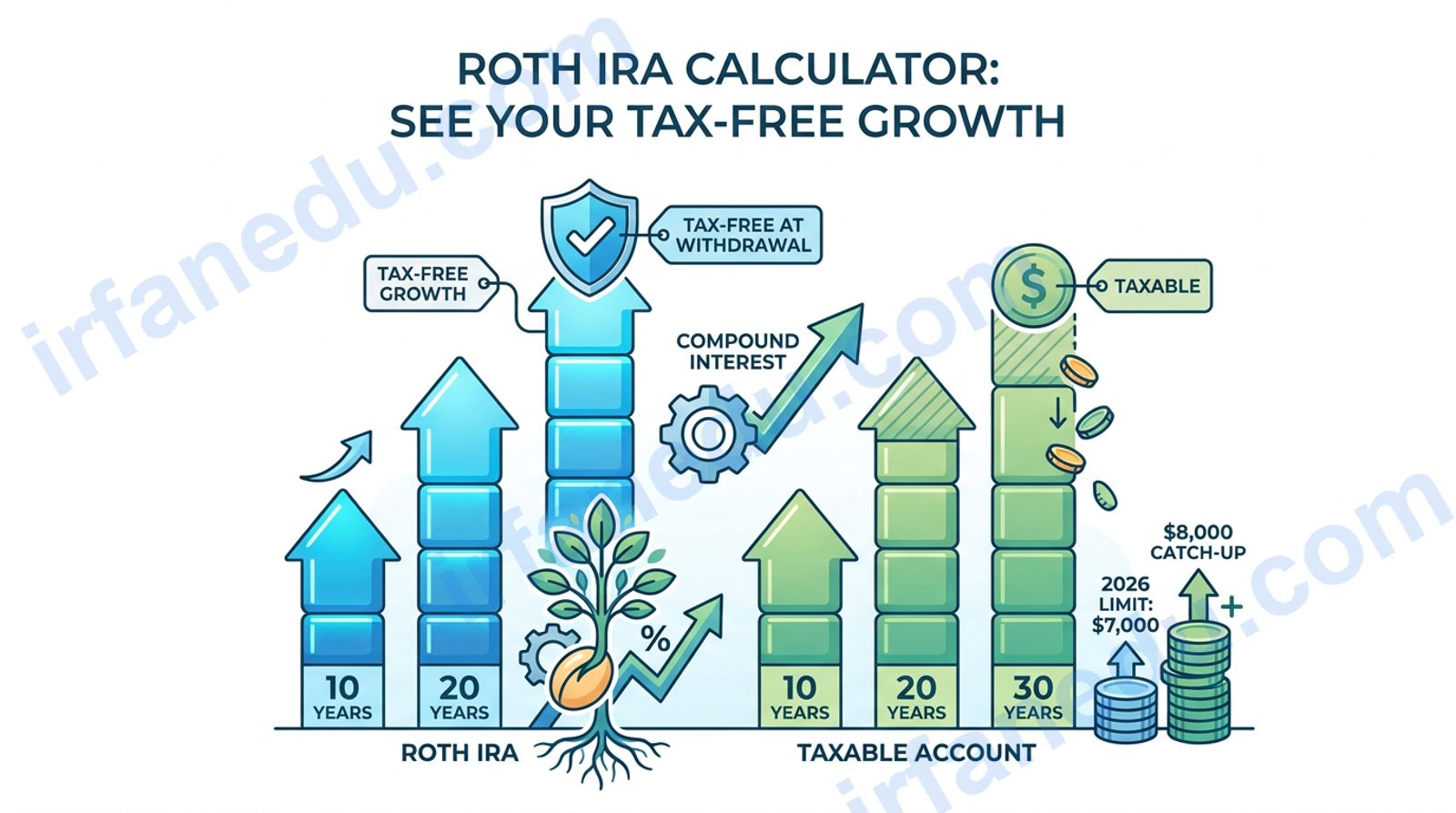
Most people know a Roth IRA is a great retirement account. But here is the painful part: without seeing the actual numbers, it is almost impossible to feel motivated to contribute consistently. You put in $500 this month and think — does that even matter? It does. Enormously. The problem is that compound interest is invisible until you calculate it.
That is exactly what this tool fixes. Enter your age, contribution, and return rate below, and you will see your projected tax-free balance in seconds — with a full step-by-step breakdown so you understand every dollar.
⚡ TL;DR
- 💰 Roth IRA contributions are after-tax; all growth and withdrawals are tax-free.
- 📐 Formula used: FV = PMT × [(1+r)^n − 1] / r plus existing balance growth.
- 🗓️ 2026 contribution limit: $7,000/year ($8,000 if age 50+).
- 📈 Starting at 25 vs 35 can more than double your final balance.
- 🧮 Use 6–8% annual return for a realistic long-term projection.
Roth IRA Calculator
Project your tax-free retirement balance instantly
years
years
USD / year (max $7,000; $8,000 if 50+)
% per year
USD (enter 0 if starting fresh)
How to use this Roth IRA calculator
The calculator takes five inputs and delivers a projected tax-free balance with a full step-by-step solution. Here is how to fill it in correctly:
- Enter your current age — this is your starting point.
- Enter your retirement age — typically 59½ or later for penalty-free Roth withdrawals. Most people use 65.
- Enter your annual contribution — the 2026 IRS limit is $7,000 (or $8,000 if you are 50 or older). You can enter any amount up to the limit.
- Enter your expected annual return rate — 7% is a widely used conservative estimate for a diversified index-fund portfolio.
- Enter your existing Roth IRA balance — if you already have money in the account, include it here. Enter 0 if you are starting fresh.
- Click Calculate. Your projected balance, total contributions, and tax-free growth appear instantly with a numbered solution.
What is a Roth IRA?
A Roth IRA (Individual Retirement Account) is a tax-advantaged retirement savings account where contributions are made with after-tax dollars, and all qualified withdrawals in retirement are completely free of federal income tax.
Unlike a traditional IRA — where you get a tax deduction now but pay taxes on withdrawal — a Roth IRA flips the deal: you pay tax upfront, then never again. This makes it especially powerful for younger savers who expect to be in a higher tax bracket at retirement.
The IRS sets annual contribution limits and income phase-outs. For 2026, the limit is $7,000 per year ($8,000 if you are age 50 or older). Contributions phase out for single filers earning above $150,000 and married filers above $236,000 (2026 figures — always verify at IRS.gov).
The formula explained: how the calculator works
The calculator uses two standard time-value-of-money formulas combined into one result.
FV_contributions = PMT × [(1 + r)^n − 1] / r
Future Value of Existing Balance (lump sum):
FV_existing = PV × (1 + r)^n
Total Projected Balance:
Total = FV_contributions + FV_existing
| Symbol | Meaning | Unit / Notes |
|---|---|---|
| PMT | Annual contribution amount | USD per year |
| r | Annual return rate (decimal) | e.g. 7% → 0.07 |
| n | Number of years until retirement | Retirement age − Current age |
| PV | Present value (existing balance) | USD |
| FV | Future value (projected balance) | USD |
The formula assumes end-of-year contributions (a standard conservative assumption). If you contribute monthly, the actual result will be slightly higher because money is invested earlier in the year.
Worked examples
📘 Example 1 — Starting at 25, contributing $6,000/year at 7%
Inputs: Current age = 25, Retirement age = 65, PMT = $6,000, r = 7% (0.07), Existing balance = $0
n = 65 − 25 = 40 years
FV_contributions = $6,000 × [(1.07)^40 − 1] / 0.07
= $6,000 × [14.9745 − 1] / 0.07 = $6,000 × 199.635 = $1,197,811
Total contributed: $6,000 × 40 = $240,000. Tax-free growth: $957,811.
📘 Example 2 — Starting at 35 with $10,000 existing balance, contributing $7,000/year at 7%
Inputs: Current age = 35, Retirement age = 65, PMT = $7,000, r = 7% (0.07), Existing balance = $10,000
n = 65 − 35 = 30 years
FV_contributions = $7,000 × [(1.07)^30 − 1] / 0.07 = $7,000 × 94.461 = $661,226
FV_existing = $10,000 × (1.07)^30 = $10,000 × 7.6123 = $76,123
Total = $661,226 + $76,123 = $737,349
Notice: starting 10 years later with a higher contribution still yields roughly 38% less. Time is the most powerful variable.
  Roth IRA Balance at Age 65 — $6,000/yr, 7% return
  ─────────────────────────────────────────────────
  Start age 25  ████████████████████████████  $1,197,811
  Start age 35  ████████████                   $566,765
  ─────────────────────────────────────────────────
  Difference:   ████████████████               $631,046
  (10 extra years of compounding = +111% more)
Roth IRA vs traditional IRA: which grows more?
Both accounts use identical investment growth math. The difference is entirely in the tax treatment — and that changes the real-world outcome significantly.
| Feature | Roth IRA | Traditional IRA |
|---|---|---|
| Contributions | After-tax (no deduction) | Pre-tax (tax deductible) |
| Growth | Tax-free | Tax-deferred |
| Withdrawals in retirement | 100% tax-free | Taxed as ordinary income |
| Required Minimum Distributions | None (Roth IRA) | Yes, starting at age 73 |
| Best for | Younger savers, lower tax bracket now | Higher earners wanting deduction now |
| 2026 contribution limit | $7,000 / $8,000 (50+) | $7,000 / $8,000 (50+) |
In my experience helping students understand personal finance, the Roth IRA wins for most people under 40 — because paying a lower tax rate now and never paying tax on decades of compound growth is almost always the better deal.
Most calculators (and most guides) assume end-of-year contributions — but contributing at the start of the year can add tens of thousands of dollars to your final balance. If you contribute $7,000 on January 1 each year instead of December 31, each contribution earns one extra full year of compounding. Over 30 years at 7%, that single habit shift adds roughly $50,000–$70,000 to your projected balance. The formula for beginning-of-year contributions is FV = PMT × [(1 + r)^n − 1] / r × (1 + r) — notice the extra (1 + r) multiplier. No mainstream Roth IRA article I have reviewed explains this distinction clearly.
Common mistakes when using a Roth IRA calculator
| ❌ Common mistake | ✅ Correct approach |
|---|---|
| Using 10–12% return rate (optimistic) | Use 6–8% for a realistic long-term estimate; 10% is the historical S&P 500 average before inflation |
| Forgetting income phase-outs | Check IRS income limits — high earners may need a backdoor Roth IRA strategy |
| Assuming contributions are pre-tax | Roth IRA contributions are always after-tax; the tax benefit comes at withdrawal |
| Not including an existing balance | Always enter your current balance — it compounds separately and can add significantly to the total |
| Treating the result as guaranteed | The projection is an estimate; actual returns vary year to year |
In my experience teaching financial literacy, the single biggest mistake I see is people waiting to open a Roth IRA because the annual contribution feels “too small to matter.” The worked examples above show exactly why that thinking is costly. A $6,000 annual contribution started at 25 produces over $1.1 million by 65. The same contribution started at 35 produces roughly half that. The calculator is not just a math tool — it is a motivation tool. Run the numbers for yourself, then open the account today.
Quick quiz: test your Roth IRA knowledge 🎯
1. What is the 2026 Roth IRA contribution limit for someone under age 50?
2. Roth IRA withdrawals in retirement are:
3. In the formula FV = PMT × [(1+r)^n − 1] / r, what does “n” represent?