
NJSLA Practice Test: The Complete 2026 Student Guide
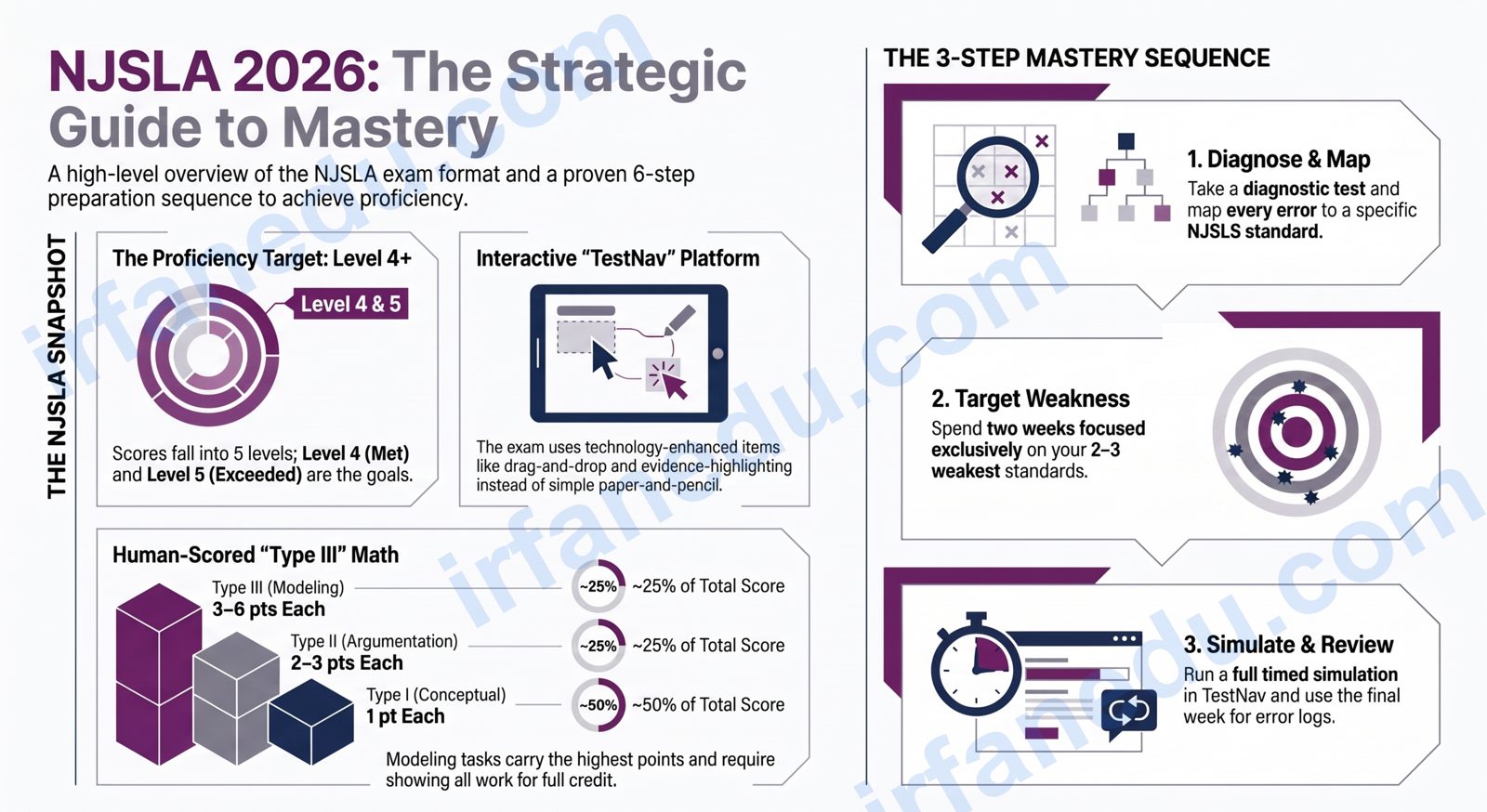
Here’s the part most people miss about NJSLA prep: the official practice tests are not just for “getting used to the format.” They contain released items that closely mirror the actual exam’s difficulty distribution. Students who use them strategically — not just passively — consistently outperform those who rely on third-party prep books alone.
The NJSLA (New Jersey Student Learning Assessments) measures student proficiency in ELA and mathematics for grades 3–8 and high school. Free official practice tests are available through the New Jersey Department of Education. Effective prep means taking a diagnostic first, mapping errors to specific standards, then targeting weak areas with unit-level practice before running a full timed simulation.
- Understand exactly what the NJSLA tests at each grade level
- Find free, official practice materials (not just third-party guesses)
- Follow a proven, step-by-step prep sequence
- Avoid the three most common prep mistakes that cost students points
The NJSLA is New Jersey’s annual standardized test for grades 3–8 and high school, covering ELA and math. Free official practice tests are available at the NJSLA/PARCC portal and through the TestNav platform. To prepare effectively: take a diagnostic test first, map your errors to specific standards, target weak units, and run at least one full timed simulation before test day.
🎯 The Short Version
- NJSLA tests ELA (grades 3–10) and math (grades 3–8 plus high school courses).
- Official released item sets are the best practice material — use them before any third-party book.
- Scores fall into five performance levels; Level 4+ means meeting grade-level expectations.
- The biggest prep mistake is random practice — always map errors to specific standards first.
- Run one full timed simulation at least two weeks before the real test.
- ELA constructed-response questions carry significant weight — practice writing with the rubric in hand.
What Is the NJSLA?
The NJSLA — New Jersey Student Learning Assessments — is the state’s primary annual academic assessment program. It replaced the PARCC assessments in New Jersey starting in 2021 and is administered by the New Jersey Department of Education (NJDOE) in partnership with Cambium Assessment.
The test measures how well students have mastered the New Jersey Student Learning Standards (NJSLS) in English Language Arts and mathematics. Results are used by schools, districts, and families to understand where a student stands relative to grade-level expectations.
The NJSLA is a computer-based test delivered through the TestNav platform. It uses a mix of question types: multiple choice, multi-select, drag-and-drop technology-enhanced items, short constructed response, and extended constructed response. That variety is important — passive reading practice alone will not prepare a student for the interactive item types.
In my experience working with students across multiple state assessments, the NJSLA’s technology-enhanced items trip up students who have only practiced on paper. The drag-and-drop and evidence-highlighting tasks feel unfamiliar under timed conditions if you have never practiced them in TestNav itself. I always recommend at least one full session on the actual platform before the real test — not just a printed practice sheet.
Quick Facts About the NJSLA
| Feature | Detail |
|---|---|
| Full Name | New Jersey Student Learning Assessments |
| Subjects Tested | English Language Arts (ELA) and Mathematics |
| Grade Levels | ELA: Grades 3–10 | Math: Grades 3–8 + Algebra I, Geometry, Algebra II |
| Test Delivery | Computer-based via TestNav platform |
| Number of Sessions | 2–3 sessions per subject depending on grade |
| Approximate Duration | 2–3 hours total per subject |
| Performance Levels | 5 levels (Level 1 = Did Not Yet Meet; Level 5 = Exceeded) |
| Passing Threshold | Level 4 (Met Expectations) or Level 5 (Exceeded) |
| Administered By | New Jersey Department of Education (NJDOE) |
| Testing Window | Typically April–May each school year |
What Does the NJSLA Test Format Look Like?
The NJSLA uses several question types across both subjects, and knowing the format before you sit down is half the battle. Each question type demands a different skill, so your practice should include all of them.
ELA Question Types
- Literary and Informational Text passages — students read one or two passages and answer comprehension, inference, and vocabulary questions.
- Evidence-Based Selected Response (EBSR) — a two-part question where Part A asks for a conclusion and Part B asks you to select the text evidence that supports it. Both parts must be correct to earn full credit.
- Technology-Enhanced Constructed Response (TECR) — drag-and-drop, highlight, or reorder tasks within the text.
- Narrative / Informational / Opinion Writing — extended writing tasks scored on a multi-point rubric covering development, organization, and language conventions.
Math Question Types
- Type I (Conceptual Understanding) — multiple choice or multi-select questions testing core concepts.
- Type II (Written Argumentation) — short constructed-response items asking students to show work and explain reasoning.
- Type III (Modeling and Application) — multi-part problems applying math to real-world contexts; these carry the highest point values.
┌─────────────────────────────────────────────────────────┐
│  NJSLA MATH — APPROXIMATE POINT DISTRIBUTION (Gr. 7)    │
├──────────────────────┬──────────────┬───────────────────┤
│  Item Type           │  Points Each │  % of Total Score │
├──────────────────────┼──────────────┼───────────────────┤
│  Type I  (MC/Multi)  │     1 pt     │      ~50%         │
│  Type II (Short CR)  │    2–3 pts   │      ~25%         │
│  Type III (Modeling) │    3–6 pts   │      ~25%         │
└──────────────────────┴──────────────┴───────────────────┘
  Takeaway: Mastering Type III items can move your scale
  score more than getting every Type I correct.
Where to Find Free NJSLA Practice Tests
The best NJSLA practice materials are the official ones released by the NJDOE and its testing partner. Third-party books can supplement, but they cannot replicate the exact item types, rubrics, and platform behavior of the real test.
Official Sources (Use These First)
- NJDOE Assessment Portal — The New Jersey Department of Education publishes released item sets, practice tests, and scoring guides at its official assessment pages. Search “NJSLA released items” on the NJDOE website.
- TestNav Practice Site — Cambium Assessment provides a TestNav tutorial and practice test environment at trynow.testnav.com. This is the actual software used on test day — practicing here eliminates platform surprises.
- PearsonAccess Next / Cambium ADAM — Teachers and students may access additional released items through the district’s testing management system.
- Khan Academy — While not NJSLA-specific, Khan Academy’s grade-level math and ELA exercises align closely with the NJSLS standards the NJSLA tests. It is especially useful for targeted standard-by-standard review.
Most NJSLA prep guides tell you to “take practice tests and review wrong answers.” That advice is incomplete in a specific way: the NJSLA is a standards-referenced test, not a norm-referenced one. That distinction changes how you should prep.
On a norm-referenced test (like a percentile-ranked IQ test), your score depends on how you perform relative to other students. On a standards-referenced test like the NJSLA, your score depends entirely on how many standards you demonstrate mastery of. This means one weak standard can suppress your performance level even if you ace everything else.
The practical implication: after every practice test, do not just count wrong answers — identify which specific NJSLS standard each wrong answer maps to (the released item sets include this information in the answer key). Then spend focused time on that standard, not on general review. In my experience, students who target two or three specific weak standards for two weeks before the test see a full performance-level jump more reliably than students who do broad review.
How to Prepare for the NJSLA Step by Step
This six-step sequence is the one I recommend to every student I work with. It is built around the official materials and the standards-referenced nature of the test.
- Take a Diagnostic Test First. Complete one full released NJSLA practice test under timed conditions before doing any targeted studying. This gives you a real baseline — not a guess about where you are weak.
- Map Every Error to a Standard. Use the released item answer key to identify which NJSLS standard each wrong answer tests. Group your errors into categories (e.g., “Ratios and Proportional Relationships,” “Informational Text: Central Idea”).
- Target Your Two or Three Weakest Standards. Spend the first two weeks of prep exclusively on those standards using unit-level released item sets and Khan Academy exercises. Depth beats breadth here.
- Practice Evidence-Based Writing Weekly. For ELA, write at least two full constructed-response answers per week. Score them yourself using the official rubric. This is the fastest way to improve your ELA writing score.
- Run a Full Timed Simulation. Two weeks before the real test, complete a full practice test in one sitting, in TestNav, under real timing. This builds stamina and reveals pacing problems you will not notice in short practice sessions.
- Final Week: Error Log Only. In the last seven days, review only your error log from previous practice. Do not start new material. Prioritize sleep — research consistently shows that sleep consolidates memory more effectively than last-minute cramming.
ELA vs. Math: What the Practice Looks Like
The two subjects require different practice approaches. This comparison table shows the key differences so you can allocate your prep time correctly.
| Feature | ELA Practice | Math Practice |
|---|---|---|
| Core Skill | Reading comprehension + evidence-based writing | Procedural fluency + conceptual reasoning |
| Highest-Value Item Type | Extended writing task (up to 10 pts) | Type III modeling task (3–6 pts) |
| Best Practice Method | Read passages, answer EBSR pairs, write full responses | Work multi-step problems showing all work |
| Common Mistake | Selecting evidence that “sounds right” instead of directly supporting Part A | Getting the right answer but skipping the explanation step |
| Rubric Available? | Yes — official ELA scoring rubrics released by NJDOE | Yes — math constructed-response rubrics in released item sets |
| Platform Practice Needed? | Yes — highlighting and TECR items require TestNav familiarity | Yes — equation editor and graphing tools differ from paper |
How Is the NJSLA Scored?
The NJSLA reports scores in two ways: a numeric scale score and a performance level. Understanding both helps you interpret your results and set a realistic prep target.
Performance Levels
| Level | Label | What It Means |
|---|---|---|
| Level 1 | Did Not Yet Meet Expectations | Significant gaps in grade-level standards |
| Level 2 | Partially Met Expectations | Some proficiency but below grade level |
| Level 3 | Approached Expectations | Near grade level; minor gaps remain |
| Level 4 | Met Expectations | Proficient at grade level — the target |
| Level 5 | Exceeded Expectations | Above grade level; strong command of standards |
Scale scores are vertically scaled within each subject, meaning a grade 5 math score of 750 and a grade 6 math score of 750 represent similar relative performance within their grade bands. The scale score range varies by grade and subject.
Practice Problems: Try These Before Test Day
Work through each problem on your own, then click to reveal the full solution and the NJSLS standard it targets.
Math Problem 1 (Grade 7 — Ratios & Proportional Relationships): A recipe uses 3 cups of flour for every 2 cups of sugar. How many cups of flour are needed if you use 5 cups of sugar?
Set up the proportion: flour/sugar = 3/2
Let flour = x when sugar = 5.
x/5 = 3/2
x = (3 × 5) / 2 = 15/2 = 7.5 cups of flour
NJSLS Standard: 7.RP.A.2 — Recognize and represent proportional relationships between quantities.
What raters look for: The proportion set-up, the cross-multiplication step, and the labeled answer. A bare “7.5” with no work shown earns partial credit only.
ELA Problem 1 (Grade 6 — Evidence-Based Selected Response): Part A: What is the central idea of the passage? Part B: Which sentence from the passage best supports your answer to Part A?
1. Read Part A first and identify the central idea in your own words before looking at the answer choices.
2. Eliminate Part A choices that are too broad (“the passage is about nature”) or too narrow (a detail, not a central idea).
3. For Part B, only the evidence that directly supports your Part A answer is correct — not evidence that is interesting or related but tangential.
4. If your Part B answer does not clearly connect to your Part A answer, reconsider Part A.
NJSLS Standard: RI.6.2 — Determine a central idea of a text and how it is conveyed through particular details.
Common mistake: Students pick Part B evidence that “sounds important” rather than evidence that logically proves the Part A answer. The two parts must form a logical argument.
Math Problem 2 (Grade 8 — Functions): Is the relationship shown in this table a function? Table: x = {1, 2, 3, 2}, y = {4, 5, 6, 7}. Explain your reasoning.
No, this is not a function.
A function requires that each input (x-value) maps to exactly one output (y-value).
In this table, x = 2 maps to both y = 5 and y = 7. That is two different outputs for the same input, which violates the definition of a function.
NJSLS Standard: 8.F.A.1 — Understand that a function is a rule that assigns to each input exactly one output.
Rubric note: A correct “No” with no explanation earns 0 points on a Type II item. The explanation citing the repeated x-value is what earns credit.
I have seen students score well on untimed practice and then drop a full performance level on the real test. The reason is almost always pacing, not knowledge. The NJSLA is not designed to be a race, but it does require consistent forward movement — spending 12 minutes on a single Type I math item is a pacing failure, not a knowledge gap. My rule: if you cannot answer a question within 2–3 minutes, mark it, move on, and return at the end. Practice this discipline during your timed simulation, not for the first time on test day.
Common NJSLA Prep Mistakes and How to Fix Them
These three mistakes account for the majority of preventable score losses I see among students preparing for the NJSLA.
Mistake 1: Using Only Third-Party Prep Books
Third-party books vary widely in quality and often include item types that do not match the NJSLA format. The official released item sets are free, accurate, and directly representative of the real test. Use them first. Supplement with other resources only for standard-specific practice.
Mistake 2: Skipping the Writing Rubric
ELA writing tasks are scored on a rubric that evaluates development, organization, and language conventions separately. Students who practice writing without the rubric often improve their fluency but not their score. Download the official NJSLA ELA writing rubric from the NJDOE site and use it every time you write a practice response.
Mistake 3: Practicing on Paper Only
The NJSLA is computer-based. The equation editor, text-highlighting tool, and drag-and-drop items behave differently from paper. Students who have never used TestNav before test day lose time figuring out the interface. Log into the TestNav practice environment at least twice before the real test.
Frequently Asked Questions About the NJSLA Practice Test
Where can I find free official NJSLA practice tests?
What grades take the NJSLA?
How is the NJSLA scored?
How long is the NJSLA test?
Sources & References
- New Jersey Department of Education — NJSLA Assessment Overview and Released Materials (official state assessment portal)
- Cambium Assessment / TestNav — TestNav Practice Environment (official test platform for student practice)
- Khan Academy — Grade-Level Math Practice aligned to Common Core / NJSLS standards
- New Jersey Student Learning Standards — published by the NJDOE; the standards framework the NJSLA is built on.
Editorial note: This article was written and fact-checked by Dr. Irfan Mansuri. All external links point to official or high-authority sources. No statistics or quotes were fabricated. Last reviewed August 2026.