
AP Micro Practice Test: 10 Questions, Easiest to Hardest
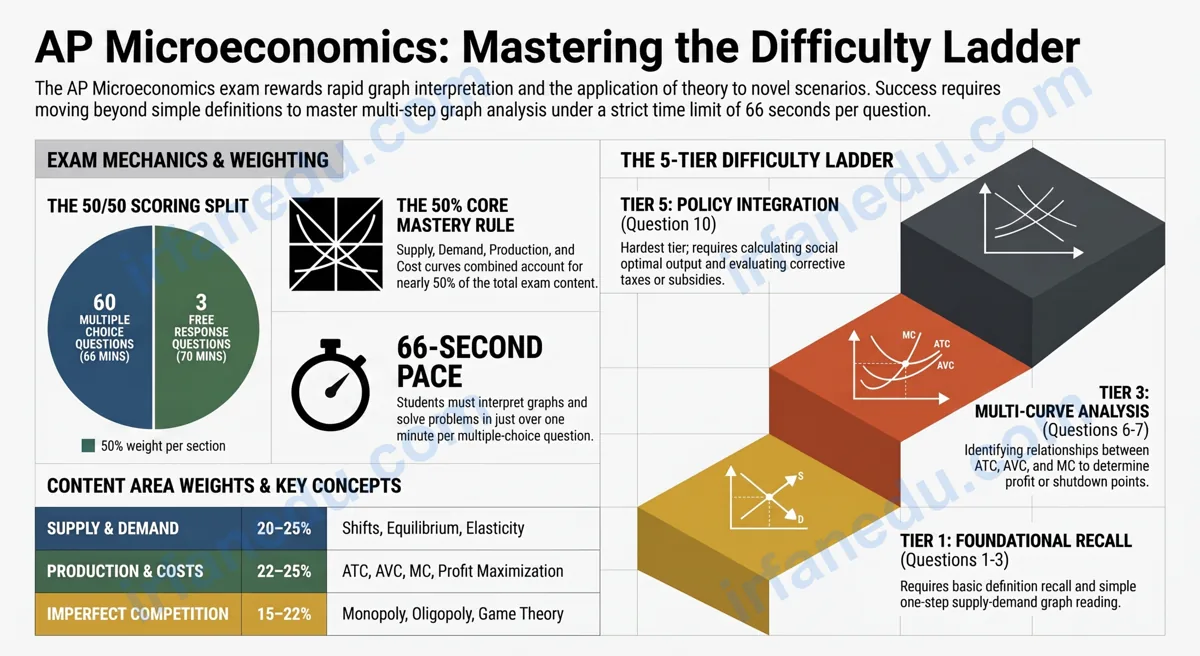
Most AP Micro practice tests dump 60 questions at you with no structure. That approach wastes your study time. In my experience coaching students through AP exams, the fastest improvement comes from working through questions in order of difficulty — building confidence on the easy ones, then stress-testing your reasoning on the hard ones.
This AP Micro practice test ranks 10 multiple-choice questions from easiest to hardest, covering every major topic on the real exam: supply and demand, elasticity, costs, market structures, factor markets, and externalities. Each question includes instant feedback and a full explanation so you understand the why, not just the answer.
- Understand the AP Micro exam format and scoring
- Identify which difficulty tier you struggle with most
- Practice applying economic reasoning under timed conditions
- Correct the most common misconceptions before exam day
⚡ TL;DR – Quick Summary
- AP Micro has 60 MCQs (66 min) + 3 FRQs (70 min), each worth 50%.
- Core topics: supply/demand, elasticity, costs, market structures, factor markets.
- This test ranks 10 questions from easiest (basic definitions) to hardest (multi-graph analysis).
- Graphs appear in nearly every question — practice drawing them, not just reading them.
- The biggest mistake students make: confusing a shift in the curve with movement along it.
- Score a 3+ by mastering the 5 “must-draw” graphs before exam day.
| Fact | Detail |
|---|---|
| Exam Name | AP Microeconomics |
| MCQ Section | 60 questions / 66 minutes (50% of score) |
| FRQ Section | 3 questions / 70 minutes (50% of score) |
| Passing Score | 3 out of 5 |
| Top Score Rate (2025) | ~19% score a 5; ~60% score 3 or higher |
| Key Topics | Supply/Demand, Elasticity, Costs, Market Structures, Factor Markets, Externalities |
| Calculator Allowed? | No |
| Hardest Section | Market structures + factor markets (most graph-intensive) |
The Difficulty Ladder: What Each Tier Tests
Before you attempt the questions, understand what separates easy from hard on AP Micro. The exam does not just test recall — it tests your ability to reason through a scenario. Here is what each tier demands.
Recall a concept (opportunity cost, scarcity, law of demand) or read a simple supply-demand graph. One step of reasoning required. Most students answer these correctly.
Apply the elasticity formula. Requires plugging numbers into PED = %ΔQd / %ΔP and interpreting the result. One calculation, one interpretation.
Identify ATC, AVC, MC relationships; determine profit/loss from a graph; find the shutdown point. Requires reading multiple curves simultaneously.
Find profit-maximizing output for a monopolist (MR = MC), identify deadweight loss, or analyze a labor market with a minimum wage. Multi-step graph analysis.
Identify market failure, calculate the socially optimal output, and evaluate a corrective tax or subsidy. Requires integrating multiple concepts in one scenario.
AP Micro Exam Structure at a Glance
The AP Microeconomics exam tests six major content areas. Knowing the weight of each area helps you prioritize your study time.
| Content Area | Exam Weight | Key Concepts | Difficulty |
|---|---|---|---|
| Basic Economic Concepts | 12–15% | Scarcity, opportunity cost, PPC, comparative advantage | Easy |
| Supply & Demand | 20–25% | Shifts, equilibrium, price controls, elasticity | Easy–Medium |
| Production, Cost & Perfect Competition | 22–25% | ATC, AVC, MC, profit maximization, shutdown rule | Medium |
| Imperfect Competition | 15–22% | Monopoly, monopolistic competition, oligopoly, game theory | Medium–Hard |
| Factor Markets | 10–18% | MRP, MRC, labor demand, minimum wage | Hard |
| Market Failure & Role of Government | 8–13% | Externalities, public goods, taxes, subsidies | Hard |
Full 10-Question AP Micro Practice Test
Work through these questions in order. Select your answer, then click to reveal the explanation. Do not skip ahead — the progressive difficulty is intentional.
Question 1 Easy — Basic Concepts
A student gives up a part-time job paying $200/week to attend school full-time. The $200 is best described as:
Question 2 Easy — Supply & Demand
The price of coffee beans (an input) rises sharply. In the market for brewed coffee, this will most likely:
Question 3 Easy — Consumer/Producer Surplus
A price ceiling set below the equilibrium price in a competitive market will:
Question 4 Easy–Medium — Elasticity
When the price of a good rises from $10 to $12, quantity demanded falls from 100 to 90 units. The price elasticity of demand (using the midpoint method) is approximately:
Question 5 Easy–Medium — Elasticity & Revenue
A firm raises its price and total revenue increases. This tells you that demand for the firm’s product is:
Question 6 Medium — Cost Curves
At a firm’s current output level, marginal cost (MC) is below average total cost (ATC). This means:
Question 7 Medium — Perfect Competition
A perfectly competitive firm is producing where P = $15, ATC = $18, and AVC = $12. In the short run, the firm should:
Question 8 Hard — Monopoly
A monopolist faces a downward-sloping demand curve. Compared to a perfectly competitive market with the same costs, the monopolist will produce:
Question 9 Hard — Factor Markets
A firm hires labor in a competitive labor market. It will hire workers up to the point where:
Question 10 Hard — Externalities & Policy
A factory produces steel and generates pollution. Without government intervention, the market will produce steel at a quantity where:
► MY POV
In my experience reviewing hundreds of AP Micro answer sheets, Questions 6 and 7 (the cost-curve questions) cause the most preventable errors. Students know the shutdown rule in theory but freeze when they see actual numbers. My fix: before the exam, practice writing out “P vs AVC, P vs ATC” as a two-step checklist for every cost question. That single habit is worth 3–4 correct answers on exam day.
What Most AP Micro Study Guides Get Wrong
Most AP Micro prep materials focus on memorizing definitions. That approach works for about 30% of the exam — the easy questions. The remaining 70% requires applying concepts to graphs and novel scenarios.
Here are three specific errors I see in popular study guides:
- Treating “change in demand” and “change in quantity demanded” as the same thing. They are not. A change in demand is a shift of the entire curve (caused by income, preferences, prices of related goods, expectations, or number of buyers). A change in quantity demanded is a movement along the existing curve caused only by a price change. Many guides use these terms interchangeably — which will cost you points.
- Skipping the MR = MC rule for monopolistic competition. Most guides cover monopoly thoroughly but rush through monopolistic competition. On the AP exam, monopolistic competition questions appear regularly, and students who only memorized the monopoly graph get them wrong because they forget that in the long run, monopolistic competitors earn zero economic profit (P = ATC, not P > ATC).
- Ignoring the connection between factor markets and product markets. The MRP = W rule in factor markets is just the MR = MC rule applied to labor. Guides that teach these as separate topics miss the underlying logic that unifies them.
How to Quickly Identify Market Structure Questions
Market structure questions are the most graph-intensive on the exam. The fastest way to answer them correctly is to identify the structure in the first 5 seconds, then apply the correct graph.
| Structure | Number of Firms | Price Control | Long-Run Profit | Key Graph Feature |
|---|---|---|---|---|
| Perfect Competition | Many | None (price taker) | Zero economic profit | Horizontal demand (P = MR = AR) |
| Monopolistic Competition | Many | Some (differentiated product) | Zero economic profit | Downward-sloping demand; tangent to ATC |
| Oligopoly | Few | Significant (interdependent) | Positive (barriers to entry) | Kinked demand curve or game theory payoff matrix |
| Monopoly | One | Full (price maker) | Positive (high barriers) | MR below demand; P > MC; deadweight loss triangle |
Visual: Supply-Demand Shift Cheat Sheet
Nearly every AP Micro exam includes at least one question that requires you to shift a supply or demand curve and identify the new equilibrium. Use this cheat sheet to answer those questions in under 30 seconds.
Visual Solution — Supply & Demand Shift Outcomes
Sources & References
Written and fact-checked by Dr Irfan Mansuri. External links open in a new tab and are provided for further reading and verification.