
CNA Practice Test: Complete Study Guide to Pass in 2026
The CNA exam stops more qualified candidates than it should, not because the content is impossibly hard, but because most study guides skip the terminology and exam structure that make every practice question make sense. In my experience working with nursing assistant students, the ones who pass on the first attempt are the ones who understand what the exam is actually testing before they answer a single practice question.
A CNA practice test is a simulated version of the Certified Nursing Assistant certification exam. It covers the same content domains as the real test: physical care, psychosocial care, safety, communication, and legal/ethical principles. Regular practice testing is the single most effective preparation strategy because it builds both knowledge recall and exam-day confidence.
By the end of this guide, you will know exactly how the exam is structured, which domains carry the most weight, how to work through practice questions strategically, and how to prepare for the clinical skills test that trips up even well-prepared candidates.
- The exact structure of both the written and skills sections of the CNA exam
- A domain-by-domain breakdown with question weights
- A step-by-step study plan you can start today
- Worked practice questions with answer explanations
- The most common reasons candidates fail, and how to avoid them
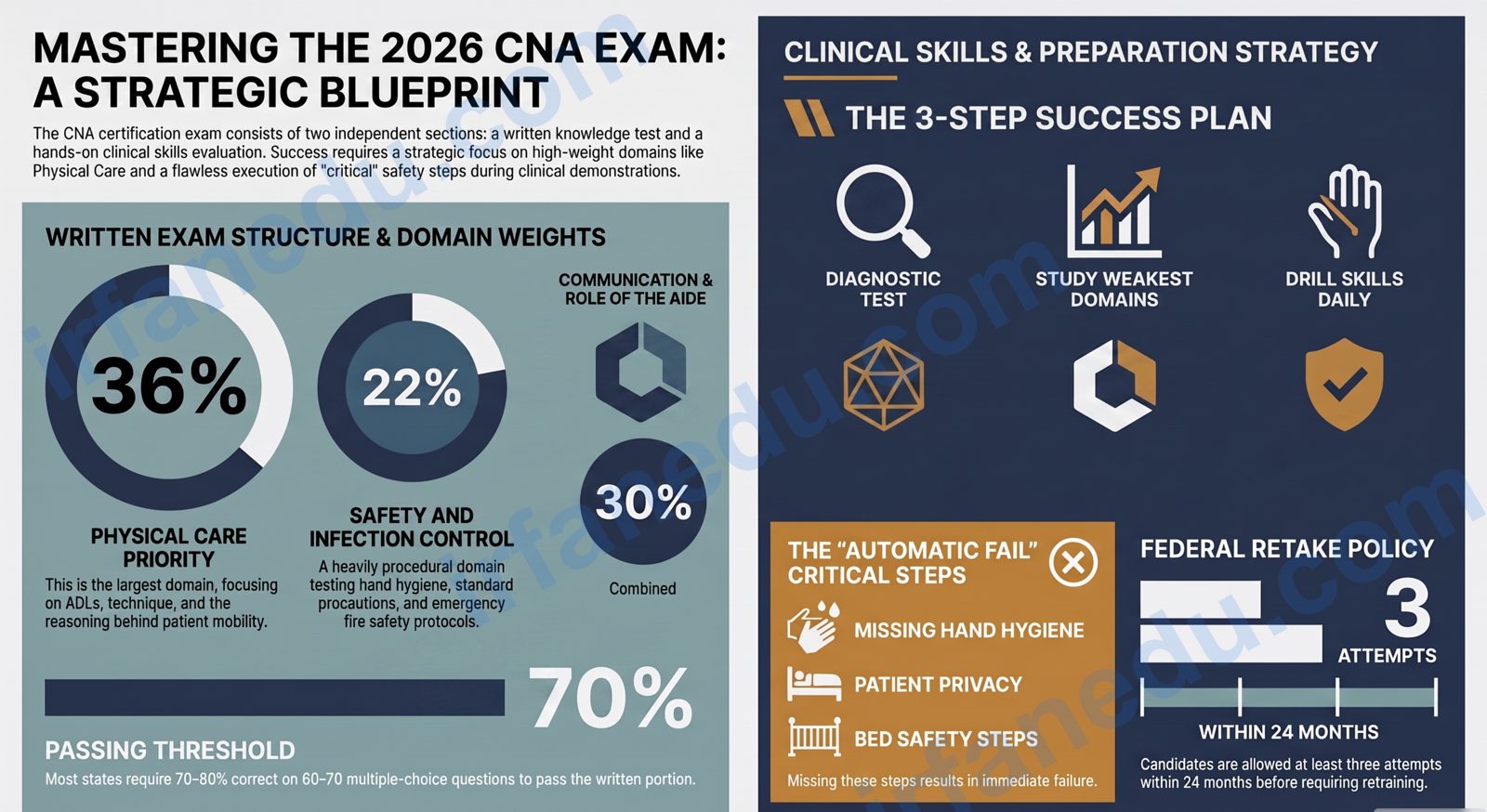
A CNA practice test is a simulated version of the Certified Nursing Assistant certification exam, covering a written section of roughly 60 to 70 multiple-choice questions and a hands-on clinical skills evaluation. Passing both sections earns state registry listing as a Certified Nursing Assistant. Most candidates need 70 to 80% correct on the written portion, though exact cut scores vary by state testing vendor.
CNA Exam Terminology Primer
Read this first. Every term below appears in practice questions and official study materials. Knowing these definitions before you study saves hours of confusion.
| Term | What It Means in the CNA Context |
|---|---|
| NNAAP | Nurse Aide Assessment Program — the national framework most states use to design their CNA exam content and skills list. |
| Written (Knowledge) Test | 60 to 70 multiple-choice questions answered on a computer or paper, testing your understanding of nursing assistant duties across five content domains. |
| Skills (Performance) Test | A hands-on evaluation where a trained evaluator watches you perform 3 to 5 randomly selected clinical skills from an official list of roughly 25 to 30 skills. |
| Content Domain | A category of knowledge the exam tests. The five main domains are: Physical Care Skills, Psychosocial Care Skills, Role of the Nurse Aide, Safety and Infection Control, and Communication and Documentation. |
| Cut Score | The minimum percentage of correct answers needed to pass. Typically 70%, though some states use scaled scores or set a higher threshold. |
| Prometric / Pearson VUE | The two testing vendors that administer CNA exams in most U.S. states. Each publishes a candidate handbook with the official content outline and skills list. |
| Nurse Aide Registry | A state-maintained database of individuals who have passed the CNA exam. Employers verify CNA credentials here. Being listed is the end goal of the entire certification process. |
| Pilot Questions | Unscored experimental questions embedded in the written test. You cannot identify them, so treat every question as if it counts. |
How the CNA Exam Is Structured
The CNA certification exam has two separate sections, and you must pass both to earn your credential. Failing one section does not fail the other — you can retake each section independently.
The written test presents 60 to 70 multiple-choice questions. You have approximately 90 minutes to complete it. Each question has four answer choices, and only one is correct. There are no trick questions, but several questions are written to test whether you understand priority — what a nursing assistant should do first in a given situation.
The skills test is a live performance evaluation. An evaluator assigns you 3 to 5 skills from the official list. You perform each skill on a mannequin or a volunteer, and the evaluator marks a checklist. Every critical step must be completed correctly. Missing a critical step on any single skill is an automatic fail for that skill.
| Feature | Written Test | Skills Test |
|---|---|---|
| Format | Multiple-choice (4 options) | Live performance observation |
| Number of Items | 60 to 70 questions | 3 to 5 skills drawn randomly |
| Time Allowed | ~90 minutes | ~30 minutes total |
| Passing Standard | ~70% correct (varies by state) | All critical steps on every skill |
| Retake Policy | Up to 3 attempts in 24 months | Up to 3 attempts in 24 months |
| Testing Vendor | Prometric or Pearson VUE | Prometric or Pearson VUE |
The Five Content Domains and Their Question Weights
The written exam draws questions from five content domains. Knowing the weight of each domain tells you where to focus your study time. Physical Care Skills is by far the largest domain, accounting for roughly 36% of all scored questions.
CNA Written Exam — Domain Weight Breakdown
==========================================

Physical Care Skills           |||||||||||||||||||  ~36%
Safety & Infection Control     ||||||||||||         ~22%
Role of the Nurse Aide         |||||||              ~14%
Psychosocial Care Skills       ||||||               ~12%
Communication & Documentation  ||||||               ~16%

Key: each | = ~2% of scored questions
(Source: NNAAP Nurse Aide Candidate Handbook framework)
Physical Care Skills covers activities of daily living (ADLs): bathing, dressing, grooming, feeding, toileting, and mobility. Questions test both the correct technique and the reasoning behind it — for example, why you always move a patient toward their stronger side.
Safety and Infection Control covers hand hygiene, standard precautions, fall prevention, restraint use, emergency procedures, and fire safety. This domain is heavily procedural: the correct order of steps matters.
Role of the Nurse Aide covers scope of practice, legal and ethical responsibilities, residents’ rights, and the nursing assistant’s relationship with the nursing team. Many candidates underestimate this domain and lose easy points.
Psychosocial Care Skills covers emotional support, mental health awareness, cultural sensitivity, and supporting patients through loss and end of life. Questions here test empathy and appropriate communication responses.
Communication and Documentation covers verbal and written reporting, medical terminology, and the nursing assistant’s role in the care plan. Accurate documentation is a patient safety issue, and the exam treats it that way.
How to Pass the CNA Exam: A 6-Step Study Plan
This plan works whether you have two weeks or six weeks before your exam date. The key is to start with a diagnostic practice test so you study what you actually need, not what you already know.
- Download the official content outline. Get the candidate handbook from Prometric or Pearson VUE (whichever your state uses). This document lists every topic that can appear on your exam. It is free and takes five minutes to find.
- Take a full-length practice test cold. Before you open a textbook, answer 60 questions under timed conditions. Your score tells you which domains need the most work. This is your baseline.
- Study your weakest domains first. Spend the first half of your prep time on your two lowest-scoring domains. Use your training program notes, not random internet summaries.
- Drill clinical skills daily. Practice each skill from start to finish, including hand hygiene at the beginning and end. Say the steps out loud. Muscle memory is built through repetition, not reading.
- Take timed practice tests every 3 days. Simulate real conditions: 60 to 70 questions, 90 minutes, no phone. Review every wrong answer immediately after — do not just note the correct answer, understand why it is correct.
- Do a final skills run-through 24 hours before exam day. Perform each skill once the day before to lock in the sequence. Do not cram new content the night before. Sleep is more valuable than one more practice session.
Most CNA practice tests measure the wrong thing. The majority of free online CNA practice tests are built around factual recall (“What is the normal adult respiratory rate?”). But the actual exam is weighted toward priority and judgment questions: “A resident is coughing during feeding — what should the nurse aide do first?” These two question types require completely different thinking. When you practice, actively seek out scenario-based questions that ask “what should the aide do first” or “which action is most appropriate.” If your practice test is mostly definition questions, you are preparing for the wrong exam.
Worked Practice Questions with Explanations
The best way to understand how CNA exam questions work is to walk through real examples. Each question below mirrors the style and difficulty of the actual written test.
Practice Question 1: A resident refuses to take a bath. What should the nurse aide do first?
Correct Answer: Respect the refusal and report it to the charge nurse.
A nursing assistant must respect a resident’s right to refuse care. The aide cannot force or pressure the resident. The correct first action is to acknowledge the refusal calmly, document it, and report it to the supervising nurse so the care plan can be adjusted. This question tests the “Role of the Nurse Aide” domain and residents’ rights.
Why the other options are wrong: Waiting until later and trying again without reporting violates documentation requirements. Asking a family member to convince the resident bypasses the resident’s autonomy. Proceeding with the bath anyway is a violation of the resident’s rights and potentially constitutes abuse.
Practice Question 2: When should a nurse aide perform hand hygiene?
Correct Answer: Before and after every resident contact, after removing gloves, and after touching any potentially contaminated surface.
Hand hygiene is the single most effective infection control measure. The exam tests this in multiple ways: the correct moments to perform it, the correct technique (20 seconds minimum with soap and water, or alcohol-based rub when hands are not visibly soiled), and the fact that gloves do not replace hand hygiene. This falls under the “Safety and Infection Control” domain.
Key exam trap: Many candidates select “after removing gloves” as the only correct moment. The exam expects you to know all the moments, not just one.
Practice Question 3: A resident’s call light has been on for 10 minutes. The aide is busy with another resident. What is the best action?
Correct Answer: Inform a colleague or the charge nurse so someone can respond promptly.
This question tests prioritization and teamwork. A nursing assistant cannot abandon a current resident mid-care, but also cannot ignore a call light for an extended period. The correct action is to delegate the response by alerting a colleague or the nurse. This demonstrates understanding of both patient safety and the aide’s role within the care team.
Why “finish your current task and then respond” is wrong: Ten minutes is already a long wait. The question signals urgency. The correct answer addresses both residents simultaneously through communication.
Practice Question 4: What is the correct body mechanics technique when lifting a resident?
Correct Answer: Bend at the knees (not the waist), keep the load close to your body, keep your back straight, and use your leg muscles to lift.
Body mechanics questions appear in the Physical Care Skills domain. The exam tests both the technique and the reason: proper mechanics protect both the aide and the resident from injury. Common wrong answers include bending at the waist (which strains the lower back) and twisting the torso while lifting (which causes rotational spinal injury).
In my experience, the candidates who fail the CNA exam on their first attempt almost always made the same mistake: they studied content in isolation and never practiced under timed, exam-like conditions. They could define “standard precautions” perfectly but froze when a scenario question asked them to choose between four plausible actions. The fix is simple — treat every practice session as the real exam. Set a timer, sit at a desk, and do not look anything up mid-test. The discomfort of that simulation is exactly what builds exam-day confidence.
How to Prepare for the CNA Clinical Skills Test
The skills test is where well-prepared candidates still fail. The reason is almost always procedural: a missed step, not a knowledge gap. The evaluator follows a printed checklist, and every critical step must be checked off.
The Steps That Evaluators Check on Nearly Every Skill
Certain steps appear on the checklist for almost every skill you might be assigned. Missing any of these is an automatic critical error on that skill.
- Knock and introduce yourself before entering the resident’s space.
- Explain the procedure to the resident before beginning.
- Wash hands (or use alcohol-based rub) before and after the skill.
- Provide privacy by closing the curtain, door, or drape.
- Raise the bed to a safe working height before performing the skill.
- Lower the bed and ensure safety (side rails, call light within reach) after the skill.
- Wash hands again and thank the resident before leaving.
The Most Commonly Assigned Skills
While the skills assigned on exam day are random, some appear far more frequently than others based on candidate reports and testing vendor documentation. Prioritize these in your practice:
- Hand washing (often assigned as a standalone skill)
- Partial bed bath / perineal care
- Oral hygiene (conscious and unconscious patient)
- Ambulation with a gait belt
- Transfer from bed to wheelchair
- Measuring and recording vital signs (pulse, respirations, blood pressure)
- Positioning a resident (lateral/side-lying, supine)
- Applying and removing personal protective equipment (PPE)
What Most CNA Exam Guides Get Wrong About Preparation
Most CNA study guides tell you to memorize the five content domains and work through as many practice questions as possible. That advice is not wrong, but it leaves out two things that actually determine whether you pass.
First, the order of operations matters more than knowledge depth. On the skills test, you can know exactly what perineal care involves and still fail if you perform the steps in the wrong sequence. The evaluator is not grading your knowledge — they are grading your procedure. Study the steps in order, not as a list of facts.
Second, the written test is a reasoning test, not a memory test. The questions that separate passing candidates from failing ones are the priority questions: “what should the aide do first,” “which action is most appropriate,” “what is the aide’s best response.” These questions cannot be answered by memorizing definitions. They require you to understand the underlying principle — resident rights, safety hierarchy, scope of practice — and apply it to a novel scenario.
In my experience, spending 30% of your study time on content review and 70% on practice questions (especially scenario-based ones) produces better results than the reverse.
Key Takeaways
- The CNA exam has two parts: a 60 to 70 question written test and a hands-on clinical skills evaluation.
- Physical Care Skills is the largest written domain at roughly 36% of questions.
- You must pass both sections independently; a fail on one does not fail the other.
- The skills test is pass/fail per skill — missing a critical step on any skill fails that skill.
- Hand hygiene and bed safety steps appear on nearly every skills checklist; practice them until they are automatic.
- Scenario-based “what should the aide do first” questions are the hardest and most common on the written test.
- Federal policy allows at least three exam attempts within 24 months of completing training.
Frequently Asked Questions About the CNA Practice Test
How many questions are on the CNA written exam?
What score do you need to pass the CNA exam?
How many times can you retake the CNA exam?
What is the hardest part of the CNA exam?
Are CNA practice tests accurate to the real exam?
How long does it take to prepare for the CNA exam?
Sources & References
- Prometric. Nurse Aide Candidate Handbook. Prometric Testing. Accessed August 2026.
- National Council of State Boards of Nursing (NCSBN). Nurse Aide Resources and NNAAP Framework. NCSBN. Accessed August 2026.
- U.S. Centers for Medicare & Medicaid Services (CMS). Nurse Aide Training and Competency Evaluation Program. CMS.gov. Accessed August 2026.
Editorial note: This article was written and fact-checked by Dr. Irfan Mansuri. All exam structure details reflect the NNAAP framework and publicly available Prometric/Pearson VUE candidate handbooks as of August 2026. State-specific cut scores and skill counts may vary; always verify with your state’s nurse aide registry.