
AP CSP exam: the complete guide to format, scoring & a top score 🎯
You signed up for AP Computer Science Principles because it sounded more approachable than AP CS A. Now the exam is closer than you’d like, and you’re staring at a syllabus that mentions “algorithms,” “the internet,” and something called a “Create Performance Task” — and you’re not sure where to start. 😟
That uncertainty is expensive. Students who walk into AP CSP without understanding the two-part structure, the scoring rubric, or the weight of the Create Task often leave points on the table — not because the content is too hard, but because the exam’s format surprised them.
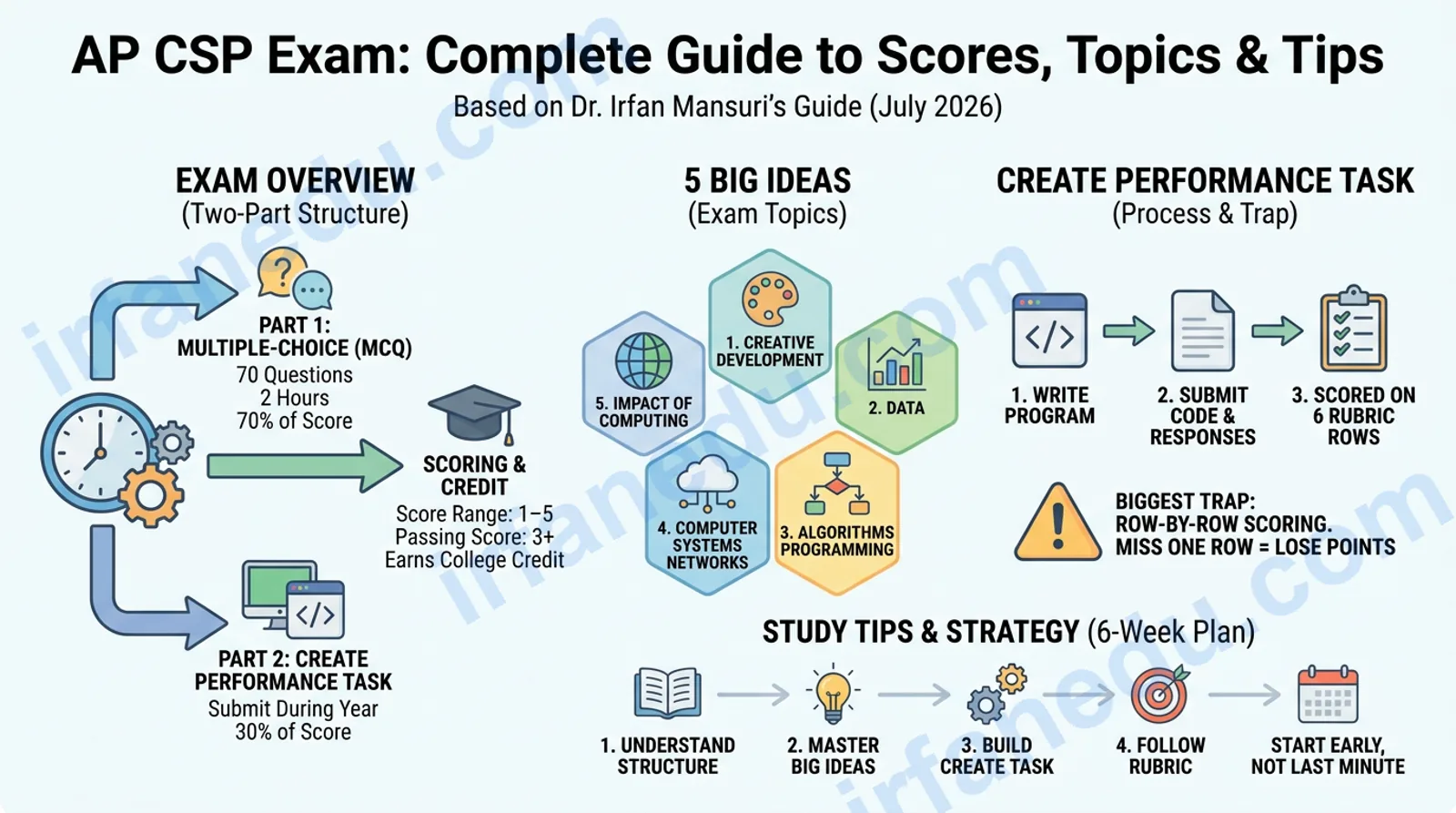
The AP CSP exam tests Computer Science Principles across two components: a 70-question multiple-choice section (2 hours, worth 70% of your score) and a Create Performance Task submitted during the school year (worth 30%). The exam covers five Big Ideas — Creative Development, Data, Algorithms & Programming, Computer Systems & Networks, and Impact of Computing. A score of 3–5 earns college credit at most institutions.
In this guide, I break down every part of the exam — the format, the scoring, the five Big Ideas, the Create Task, and the study strategies that actually move the needle. I’ve also included a non-obvious insight about where most students lose Create Task points that I haven’t seen covered clearly anywhere else.
- Understand the exact two-part structure and time allocation
- Know what each of the 5 Big Ideas covers (and which ones appear most on the MCQ)
- Build a Create Performance Task that scores all 6 rubric rows
- Use a realistic 6-week study plan to hit a 4 or 5
The AP CSP exam is a College Board Advanced Placement test covering Computer Science Principles. It has two parts: 70 multiple-choice questions (worth 70% of your score) and a Create Performance Task submitted before the exam (worth 30%). The exam section lasts 2 hours. A score of 3 or higher out of 5 typically earns college credit at participating institutions.
- 🖥️ AP CSP = 70 MCQ (2 hrs, 70%) + Create Performance Task (30%)
- 📚 Five Big Ideas: Creative Development, Data, Algorithms, Networks, Impact
- 🛠️ Create Task: write a program, submit code + written responses — done during the school year
- 🎯 Score 3–5 earns college credit; ~67% of 2024 test-takers passed
- 📅 Start your Create Task at least 6 weeks before the deadline — not the night before
- 🚫 Biggest trap: the Create Task rubric is row-by-row — missing one row costs you even if the rest is perfect
Quick facts at a glance
| Detail | Information |
|---|---|
| Full name | AP Computer Science Principles |
| Administered by | College Board |
| Exam format | 70 MCQ + Create Performance Task |
| MCQ time | 2 hours |
| MCQ weight | 70% of final score |
| Create Task weight | 30% of final score |
| Score range | 1–5 |
| Passing score (typical) | 3 or higher |
| 2024 pass rate (3+) | ~67% |
| Prerequisites | None (no prior coding required) |
| Programming language | Any (pseudocode used on exam) |
| Exam window | May each year |
What is the AP CSP exam?
The AP Computer Science Principles exam is a College Board Advanced Placement assessment that tests students on the foundational ideas of computing — not just coding. It was designed to be accessible to students without a programming background, making it one of the fastest-growing AP courses in the country.
Unlike AP Computer Science A (which focuses on Java programming), AP CSP takes a broader view. It asks: how does the internet work? What is data and why does it matter? How do algorithms shape the world around us? What are the ethical responsibilities of people who build technology?
AP CSP uses a pseudocode notation on the multiple-choice exam — not Python, Java, or any specific language. Students who panic about “not knowing the right language” are worrying about the wrong thing. The exam tests logical thinking, not syntax.
The course and exam were developed with input from computer science education researchers and are aligned with the K–12 CS Framework. According to College Board, over 180,000 students took AP CSP in 2024, making it one of the most popular AP STEM exams.
What does the AP CSP exam look like?
The AP CSP exam has two distinct parts, and understanding both is the first step to a strong score.
Part 1: Multiple-choice section
The MCQ section contains 70 questions answered in 2 hours. That gives you roughly 1 minute 43 seconds per question — tight, but manageable with practice. Questions come in two types:
- Single-select MCQ — one correct answer out of four choices
- Multi-select MCQ — two correct answers out of four choices (both must be selected for credit)
Multi-select questions trip up unprepared students. There is no partial credit — you must identify both correct answers. In my experience reviewing student results, multi-select questions are where the score gap between a 3 and a 4 most often appears.
Part 2: Create Performance Task
The Create Task is completed during the school year — not on exam day. Students write a program of their choice, then submit:
- The program code (as a PDF)
- A video of the program running (max 1 minute, max 30 MB)
- Written responses to three prompts (max 750 words total)
The Create Task is scored by College Board readers using a 6-row rubric. Each row is scored independently — 0 or 1 point per row — for a maximum of 6 points, which maps to 30% of your final AP score.
┌─────────────────────────────────────────────────────────────┐
│                    AP CSP EXAM OVERVIEW                     │
├──────────────────────────┬──────────────────────────────────┤
│  PART 1: MCQ             │  PART 2: CREATE TASK             │
│  ─────────────────────   │  ──────────────────────────────  │
│  70 questions            │  Done during school year         │
│  2 hours                 │  No time limit on exam day       │
│  70% of final score      │  30% of final score              │
│                          │                                  │
│  Single-select: ~57 Qs   │  Deliverables:                   │
│  Multi-select:  ~13 Qs   │  • Program code (PDF)            │
│                          │  • Video (≤ 1 min)               │
│  No calculator needed    │  • Written responses (≤750 wds)  │
│                          │                                  │
│  Score: 0–70 pts         │  Score: 0–6 pts (6-row rubric)   │
└──────────────────────────┴──────────────────────────────────┘
  Combined → Converted to AP score of 1, 2, 3, 4, or 5
What are the 5 Big Ideas in AP CSP?
The entire AP CSP curriculum — and every MCQ question — maps to one of five Big Ideas. Knowing which Big Idea a question targets helps you apply the right mental framework fast.
| Big Idea | Short label | What it covers | Approx. MCQ share |
|---|---|---|---|
| 1. Creative Development | CRD | Collaboration, program design, testing, documentation | ~10–13% |
| 2. Data | DAT | Binary, compression, data analysis, visualization | ~17–22% |
| 3. Algorithms & Programming | AAP | Variables, conditionals, loops, lists, procedures, searching/sorting | ~30–35% |
| 4. Computer Systems & Networks | CSN | The internet, protocols, fault tolerance, parallel computing | ~17–21% |
| 5. Impact of Computing | IOC | Digital divide, bias, privacy, cybersecurity, legal/ethical issues | ~16–20% |
Algorithms & Programming (AAP) is the single largest Big Idea — it accounts for roughly a third of the MCQ section. If you’re short on study time, prioritize AAP first, then Data, then Impact of Computing.
In my experience working with AP CSP students, the biggest surprise is always Big Idea 5 — Impact of Computing. Students assume it’s easy “opinion” content and skip it. It isn’t. Questions about bias in algorithms, data privacy laws, and the digital divide require specific, precise answers. I’ve seen students drop a full score point here. Treat IOC like a technical topic, not a free-response essay.
How does the Create Performance Task work?
The Create Task is your chance to earn 30% of your AP score before you ever sit down for the exam — and it’s also where the most preventable point losses happen.
What you need to build
You must create a program that uses at least one algorithm you developed yourself. The program must include: sequencing, selection (an if/else), and iteration (a loop). It must also use a list (or other collection type) in a meaningful way — not just to store data that’s never processed.
The 6-row scoring rubric
College Board scores the Create Task using exactly 6 rows. Each row is worth 1 point. Here’s what each row targets:
- Program Purpose and Function — video shows the program running; written response explains what it does and its purpose
- Data Abstraction — code shows a list being used; written response explains how the list manages complexity
- Managing Complexity — written response explains how the list (or abstraction) makes the program easier to develop or understand
- Procedural Abstraction — code shows a student-developed procedure with a parameter; written response explains what it does
- Algorithm Implementation — the procedure contains sequencing, selection, and iteration; written response explains the algorithm in detail
- Testing — written response describes two different test calls with different arguments and explains the results
Rows 2 and 3 both require a list — but they ask different questions. Row 2 asks you to show the list in code and describe what it stores. Row 3 asks you to explain why the list reduces complexity. Students who write the same answer for both rows score 0 on Row 3. They are separate rows with separate criteria.
Step-by-step: how to approach the Create Task
- Choose a program idea you genuinely care about — motivation matters over 4–6 weeks of work.
- Plan your data structure first. Decide what list you’ll use and how it reduces complexity before writing a single line of code.
- Write a procedure with at least one parameter that includes a loop and an if/else inside it.
- Record your video showing the program running with visible input and output — keep it under 1 minute.
- Write your responses using the rubric rows as a checklist — address each row explicitly, not implicitly.
- Have a classmate read your written responses against the rubric before you submit. Fresh eyes catch missing rows.
How is the AP CSP exam scored?
The AP CSP score combines your MCQ performance and your Create Task score into a composite, which College Board converts to a 1–5 scale.
- MCQ section: 70 questions × 1 point each = 70 raw points → scaled to 70% of composite
- Create Task: 6 rubric rows × 1 point each = 6 raw points → scaled to 30% of composite
There is no penalty for wrong answers on the MCQ section. Always answer every question — never leave one blank.
| AP Score | Meaning | % of students (2024) |
|---|---|---|
| 5 | Extremely well qualified | ~13% |
| 4 | Well qualified | ~22% |
| 3 | Qualified | ~32% |
| 2 | Possibly qualified | ~22% |
| 1 | No recommendation | ~11% |
Roughly 67% of students scored a 3 or higher in 2024, making AP CSP one of the higher pass-rate AP exams. The mean score was approximately 3.1.
AP CSP vs AP Computer Science A: which should you take?
This is the question I get most from parents and students. The two AP Computer Science courses are genuinely different — not just in difficulty, but in purpose.
| Feature | AP CSP | AP CS A |
|---|---|---|
| Focus | Concepts, society, data, impact | Java programming, OOP, data structures |
| Coding required? | Yes, but any language; pseudocode on exam | Yes — Java specifically |
| Prior coding needed? | No | Strongly recommended |
| Performance task? | Yes — Create Task (30%) | No (removed in 2025) |
| Exam length | 2 hours (MCQ only on exam day) | 3 hours (MCQ + FRQ) |
| 2024 pass rate (3+) | ~67% | ~63% |
| Best for | Students exploring CS, any major | Students pursuing CS/engineering majors |
| College credit weight | Often 1 intro CS credit | Often CS1 equivalent (more credit) |
My recommendation: if you’re planning to major in computer science or software engineering, take AP CS A. If you want a rigorous but accessible introduction to computing that counts toward a breadth requirement, AP CSP is the smarter choice — and you can always take AP CS A afterward.
How do you study for the AP CSP exam?
A structured 6-week plan beats a last-minute cram every time. Here’s the approach I recommend based on the exam’s actual weight distribution.
6-week study plan
- Week 1 — Audit your Big Ideas: Take a 20-question diagnostic (College Board has free released MCQs). Identify which Big Ideas you score lowest on. That’s your priority list.
- Week 2 — Algorithms & Programming deep dive: AAP is 30–35% of the MCQ. Work through every pseudocode construct: variables, conditionals, loops, lists, procedures, recursion basics. Practice reading code, not just writing it.
- Week 3 — Data + Networks: Study binary representation, data compression (lossy vs lossless), how the internet routes packets (TCP/IP, DNS, HTTP), and parallel vs sequential computing.
- Week 4 — Impact of Computing + Creative Development: Review digital divide, algorithmic bias, privacy laws (GDPR basics), cybersecurity threats, and program documentation principles.
- Week 5 — Create Task polish: If your Create Task isn’t submitted yet, finalize it this week using the 6-row rubric as a checklist. If it’s already submitted, review the scoring guidelines so you understand what you earned.
- Week 6 — Full practice exam + review: Take a timed 70-question practice test. Review every wrong answer by Big Idea. Focus the last 3 days on your two weakest areas only.
The single highest-leverage thing a student can do for AP CSP is read the College Board’s own scoring commentary on released Create Tasks. College Board publishes annotated student samples with scores and explanations. Spending 90 minutes reading those samples — especially the ones that scored 0 on a row — teaches you more about the rubric than any textbook. Most students never look at them. That’s a free advantage sitting on the table.
Best free resources
- College Board AP Classroom — official practice questions, progress checks, and released exams
- Khan Academy AP CSP course — strong on Big Ideas 2 and 3; free, well-structured
- Code.org AP CSP curriculum — excellent for visual learners; covers all 5 Big Ideas
- AP Central (collegeboard.org) — the only source for official scoring guidelines and sample Create Tasks
The Create Task rubric is deliberately “row-independent” — and most guides don’t explain what that actually means for your strategy.
College Board readers score each of the 6 rows in isolation. They do not read your entire submission and then decide a holistic score. This means a technically impressive program with a missing or vague written response for Row 6 (Testing) scores 5/6 — not 6/6 — regardless of how good the rest is. The implication: your written responses are not supporting material for your code. They are the primary scored artifact. I’ve seen students with genuinely sophisticated programs score 4/6 because their written responses didn’t explicitly address the rubric language. The fix: after writing each response, paste the rubric row’s exact criteria next to it and ask, “Does my response directly satisfy this criterion?” If you can’t point to the sentence that does it, rewrite that sentence.
Common mistakes that cost students points
These are the patterns I see repeatedly — and every one of them is fixable before exam day.
On the MCQ section
Skipping multi-select questions. Students see “select TWO answers” and guess randomly. Multi-select questions are not harder — they just require you to evaluate each answer choice independently. Treat them as four separate true/false questions, then pick the two that are true.
Confusing “undecidable” with “unsolvable.” AP CSP asks about undecidable problems — problems for which no algorithm can always determine a yes/no answer. Students confuse this with problems that are merely hard or slow. An undecidable problem has no algorithm that works for all inputs. A hard problem (like sorting a billion items) just takes time.
Misreading pseudocode direction. College Board’s pseudocode uses specific notation (e.g., REPEAT n TIMES, FOR EACH item IN list). Practice reading this notation specifically — don’t assume it works like Python or JavaScript.
On the Create Task
Using a list that doesn’t reduce complexity. If your list stores three items that you could just as easily store in three separate variables, it doesn’t demonstrate meaningful data abstraction. The list must make your program simpler or more scalable than it would be without it.
Submitting a video that doesn’t show input and output. Row 1 requires the video to show the program running with visible input and a corresponding output. A video that only shows a static screen or menu fails this row. Record the full interaction.
Frequently asked questions about the AP CSP exam
What is the AP CSP exam?
How long is the AP CSP exam?
What score do you need to pass the AP CSP exam?
Is the AP CSP exam hard?
Sources & References
- College Board — AP Computer Science Principles (official course page)
- Khan Academy — Computing course
Written and fact-checked by Dr Irfan Mansuri. External links open in a new tab and are provided for further reading and verification.