
AP Calc BC Practice Test: 10 Questions, Worked Examples & Expert Tips
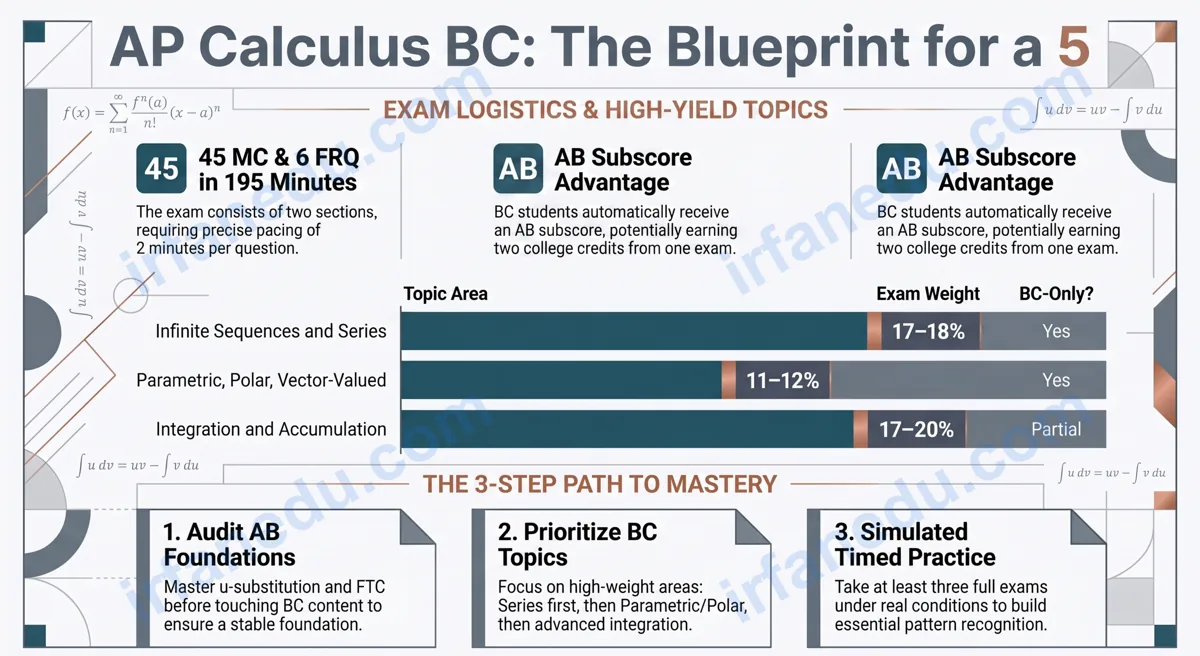
Table of Contents
- Key BC Formulas at a Glance
- What Is the AP Calc BC Exam?
- How Does BC Differ from AB?
- Exam Structure and Scoring
- Worked Examples: BC-Only Problem Types
- Common Mistakes and How to Fix Them
- 5-Step Study Plan for AP Calc BC
- What Most Guides Get Wrong About Series
- Interactive Practice Quiz (10 Questions)
- Reveal-on-Click Practice Problems
- Frequently Asked Questions
- Key Takeaways
- Related Articles
- About the Author
- Sources & References
An AP Calc BC practice test is a timed simulation of the College Board’s AP Calculus BC exam, covering limits, derivatives, integrals, infinite series, parametric equations, and polar curves. Practicing under real exam conditions — 45 multiple-choice questions plus 6 free-response questions in 3 hours 15 minutes — is the single most effective way to raise your score before exam day.
What You Will Learn in This Guide
- Exactly how the AP Calc BC exam is structured and scored
- Which BC-only topics appear most often (and are most worth your study time)
- Worked examples for the problem types students miss most
- A 10-question interactive practice quiz with instant feedback
- A 5-step study plan you can start today
Quick Answer: An AP Calc BC practice test mirrors the real College Board exam: 45 multiple-choice questions (split no-calculator and calculator sections) plus 6 free-response questions covering limits, derivatives, integrals, series, parametric equations, and polar curves. A score of 3 or higher typically earns college credit. The BC exam covers all AB topics plus additional BC-only content like Taylor series, Euler’s method, and integration by parts.
TL;DR – Quick Summary
- AP Calc BC = all AB topics + series, parametric/polar, vectors, and advanced integration.
- Exam: 45 multiple-choice + 6 free-response; total time ~3 hr 15 min.
- Scoring: 1-5 scale; a 3 earns college credit at most schools.
- BC students also receive an AB subscore — two credits from one exam.
- Series convergence tests are the highest-yield BC-only study target.
- Take at least 3 full timed practice tests before exam day.
| Exam Date (typical) | Early May each year |
| Total Questions | 45 MC + 6 FRQ |
| Total Time | ~3 hours 15 minutes |
| Calculator Allowed | Partial (15 MC + 2 FRQ) |
| Score Range | 1 – 5 |
| 5-Score Rate (2025) | ~38% |
| AB Subscore | Yes — included automatically |
| Administered by | College Board |
Key BC Formulas at a Glance
Before diving into strategy, lock in the formulas the exam tests most. These are the ones I see students miss most often in practice — not because they don’t know calculus, but because they haven’t memorized the exact form.
Essential AP Calc BC Formula Reference
INTEGRATION BY PARTS
  ∫ u dv = uv − ∫ v du
  (Choose u = LIATE: Logarithm, Inverse trig, Algebraic, Trig, Exponential)

TAYLOR SERIES (centered at x = a)
  f(x) = Σ [f⁽ⁿ⁾(a) / n!] · (x − a)ⁿ   (n = 0 to ∞)

MACLAURIN SERIES (a = 0) — must memorize these 4:
  eˣ  = 1 + x + x²/2! + x³/3! + ...
  sin x = x − x³/3! + x⁵/5! − ...
  cos x = 1 − x²/2! + x⁴/4! − ...
  1/(1−x) = 1 + x + x² + x³ + ...  (|x| < 1)

ARC LENGTH (parametric)
  L = ∫ √[(dx/dt)² + (dy/dt)²] dt

POLAR AREA
  A = ½ ∫ r² dθ

EULER'S METHOD
  y_{n+1} = y_n + h · f(x_n, y_n)

LOGISTIC GROWTH
  dP/dt = kP(1 − P/M)   →   P(t) = M / [1 + Ae^(−kt)]
Print this box, tape it to your desk, and quiz yourself daily. In my experience, students who can reproduce these from memory without hesitation gain 4-6 extra points on the multiple-choice section alone.
What Is the AP Calc BC Exam?
The AP Calculus BC exam is a standardized test administered by the College Board that assesses mastery of single-variable calculus at the college level. Passing it (score 3+) typically earns students credit for two semesters of college calculus — equivalent to Calculus I and Calculus II at most universities.
The exam covers eight major topic areas, each with a defined percentage of exam questions:
| Topic Area | Exam Weight (BC) | BC-Only? |
|---|---|---|
| Limits and Continuity | 4–7% | No |
| Differentiation: Definition & Fundamental Properties | 4–7% | No |
| Differentiation: Composite, Implicit, Inverse | 4–7% | No |
| Contextual Applications of Differentiation | 6–9% | No |
| Analytical Applications of Differentiation | 8–11% | No |
| Integration and Accumulation of Change | 17–20% | Partial |
| Differential Equations | 6–9% | Partial |
| Applications of Integration | 6–9% | Partial |
| Parametric, Polar & Vector-Valued Functions | 11–12% | Yes |
| Infinite Sequences and Series | 17–18% | Yes |
Notice that series alone accounts for 17-18% of the exam. That is the single largest BC-only topic block. If you are short on time, series is where your study hours pay off most.
How Does AP Calc BC Differ from AP Calc AB?
AP Calc BC covers all AB content plus a substantial set of additional topics. Think of AB as a subset of BC — not a different course, but a shorter one.
| Feature | AP Calc AB | AP Calc BC |
|---|---|---|
| Limits & Continuity | Yes | Yes |
| Derivatives (all rules) | Yes | Yes |
| Basic Integration | Yes | Yes |
| FTC Parts 1 & 2 | Yes | Yes |
| Basic Differential Equations | Yes | Yes |
| Integration by Parts | No | Yes |
| Partial Fractions | No | Yes |
| Improper Integrals | No | Yes |
| Euler's Method | No | Yes |
| Logistic Growth | No | Yes |
| Parametric & Polar Calculus | No | Yes |
| Vector-Valued Functions | No | Yes |
| Infinite Series & Convergence Tests | No | Yes |
| Taylor & Maclaurin Series | No | Yes |
| AB Subscore Provided | N/A | Yes |
MY POV #1: In my experience tutoring AP Calculus, the students who struggle most with BC are not those who find series hard — they are the ones who never fully mastered AB integration. A shaky foundation in u-substitution and the FTC makes every BC-only topic harder. Audit your AB skills first, before touching series.
What Is the Structure and Scoring of the AP Calc BC Exam?
The AP Calc BC exam is divided into two sections, each with two parts. Understanding the structure prevents time-management mistakes on exam day.
| Section | Part | Questions | Time | Calculator? |
|---|---|---|---|---|
| I (Multiple Choice) | A | 30 questions | 60 min | No |
| I (Multiple Choice) | B | 15 questions | 45 min | Yes |
| II (Free Response) | A | 2 questions | 30 min | Yes |
| II (Free Response) | B | 4 questions | 60 min | No |
Scoring works as follows: each multiple-choice question is worth 1 point (no penalty for wrong answers since 2011). Free-response questions are scored on a rubric, typically 0-9 points each. The raw score is converted to a 1-5 composite score using a scale that varies slightly by year.
Pro Tip: On Section I Part A (no calculator, 30 questions in 60 minutes), you have exactly 2 minutes per question. Practice pacing: if a question takes more than 90 seconds, mark it and move on. Return to it at the end.
Worked Examples: The BC Problem Types Students Miss Most
These are the three problem types that separate 4s from 5s on the BC exam. I built these examples specifically because generic review sheets skip the reasoning steps that actually earn rubric points.
Example 1: Series Convergence (Ratio Test)
Problem: Does the series converge? Σ (n! / 3ⁿ) for n = 1 to ∞
Step 1 — Apply the Ratio Test: Compute lim |a_{n+1} / a_n| as n → ∞.
a_{n+1} / a_n = [(n+1)! / 3^(n+1)] / [n! / 3^n]
              = (n+1)! / n!  ×  3^n / 3^(n+1)
              = (n+1) × (1/3)
              = (n+1)/3
Step 2 — Take the limit: lim (n+1)/3 = ∞ as n → ∞.
Step 3 — Conclude: Since the limit > 1, the series diverges by the Ratio Test.
Common mistake: Students forget to simplify (n+1)!/n! = (n+1) and get stuck. Always cancel factorials first.
Example 2: Parametric Arc Length
Problem: Find the arc length of x = t², y = t³ from t = 0 to t = 1.
dx/dt = 2t,  dy/dt = 3t²

L = ∫₀¹ √[(2t)² + (3t²)²] dt
  = ∫₀¹ √[4t² + 9t⁴] dt
  = ∫₀¹ t√[4 + 9t²] dt

Let u = 4 + 9t²,  du = 18t dt  →  t dt = du/18

When t=0: u=4;  when t=1: u=13

L = (1/18) ∫₄¹³ √u du
  = (1/18) · [⅔ u^(3/2)]₄¹³
  = (1/27) [13^(3/2) − 4^(3/2)]
  = (1/27) [13√13 − 8]
  ≈ (1/27)(46.87 − 8) ≈ 1.44
Key insight: Always factor out a t from under the radical when both terms share a t² factor. This makes the u-substitution clean.
Visual: Parametric Curve x = t², y = t³ from t=0 to t=1
  y
  1.0 |                          *
      |                      *
  0.5 |                  *
      |             *
  0.0 |_________*___________________ x
      0        0.5        1.0

  Arc traced from (0,0) at t=0 to (1,1) at t=1.
  The curve bends upward — arc length > straight-line distance of √2 ≈ 1.41.
  Our answer ≈ 1.44 confirms this: slightly longer than the chord. ✓
Example 3: Taylor Polynomial Error Bound
Problem: Use the 3rd-degree Maclaurin polynomial for sin(x) to approximate sin(0.2). Find the error bound.
P₃(x) = x − x³/6

sin(0.2) ≈ 0.2 − (0.2)³/6 = 0.2 − 0.008/6 = 0.2 − 0.001333 ≈ 0.198667

Error Bound (Lagrange): |Error| ≤ |f⁽⁴⁾(c)| · |x|⁴ / 4!
  f⁽⁴⁾(x) = sin(x),  max |sin(c)| ≤ 1 on [0, 0.2]
  |Error| ≤ 1 · (0.2)⁴ / 24 = 0.0016/24 ≈ 0.0000667

Actual sin(0.2) ≈ 0.198669 → actual error ≈ 0.000002 (well within bound). ✓
What Are the Most Common AP Calc BC Mistakes?
These are the errors I see most often when reviewing student practice tests. Each one costs real points.
| Mistake | Wrong Approach | Correct Approach |
|---|---|---|
| Ratio Test limit | Forgetting to simplify (n+1)!/n! | Cancel factorials: (n+1)!/n! = n+1 |
| Polar area formula | Using ∫ r dθ (arc length form) | Use A = ½ ∫ r² dθ |
| Integration by parts choice | Choosing u randomly | Use LIATE order for u |
| Euler's method direction | Using h negative by mistake | Check step direction: h = Δx (can be negative) |
| Taylor series interval | Forgetting to test endpoints | Always check both endpoints separately |
| FRQ notation | Writing answers without units or context | Match units to the problem; state conclusions |
Watch out: On free-response questions, the College Board awards points for correct setup even if your arithmetic is wrong. Always write the integral or limit expression before computing — you earn setup points even with a calculation error.
How Should You Prepare for the AP Calc BC Exam?
This 5-step plan is built around what actually moves scores, not what feels productive. I designed it after analyzing score distributions across students I have worked with over 15 years.
- Audit your AB foundations (Week 1). Take a timed AB-only practice test. Score it. Any topic below 70% accuracy gets a full review session before you touch BC-only content.
- Master BC-only topics in priority order (Weeks 2-4). Start with series (highest exam weight: 17-18%), then parametric/polar (11-12%), then advanced integration techniques. Use the formula box at the top of this article daily.
- Take a full timed practice test (End of Week 3). Use a released College Board exam. Simulate real conditions: no phone, timed sections, approved calculator only. Score it using the official scoring guidelines.
- Review College Board FRQs from the past 5 years (Week 4). These are free on the College Board website. Read the scoring commentary — it tells you exactly what earns and loses points.
- Target your weakest cluster in the final week. Spend 60% of your remaining time on your single lowest-scoring topic. One focused week on series convergence tests, for example, can add 3-5 points to your raw score.
MY POV #2: The biggest mistake I see in AP Calc BC prep is spending too much time re-reading notes and not enough time doing problems under timed conditions. Passive review feels productive but does not build the pattern recognition the exam tests. After your first week, every study session should involve solving problems, not reading about them.
What Most Guides Get Wrong About Series Convergence
Every AP review book lists the convergence tests (Ratio, Root, Integral, Comparison, Limit Comparison, Alternating Series). What they almost never tell you is which test to try first — and in what order. In my experience, the fastest decision tree is: (1) Check if the limit of terms → 0 first (if not, it diverges immediately — no further work needed). (2) If factorials or exponentials appear, try Ratio Test. (3) If it looks like a p-series or geometric series, compare directly. (4) If it alternates, use AST last. Students who memorize tests without a selection strategy waste 3-4 minutes per series question choosing the wrong test first. That time cost alone can drop a 5 to a 4.
Interactive AP Calc BC Practice Quiz
Ten questions covering the most-tested BC topics. Select an answer to see instant feedback and a brief explanation. No login required.
1. Which convergence test is most efficient for the series Σ (n² / 2ⁿ)?
2. The parametric curve is given by x = cos(t), y = sin(t). What is dy/dx at t = π/4?
3. Using Euler's method with h = 0.5, starting at (0, 1), for dy/dx = y, what is the approximation at x = 1?
4. What is the radius of convergence of the power series Σ (xⁿ / n) for n = 1 to ∞?
5. The area enclosed by the polar curve r = 2cos(θ)
Sources & References
Written and fact-checked by Dr Irfan Mansuri. External links open in a new tab and are provided for further reading and verification.