
🪨 Gravel Calculator: Volume, Weight & Cost Estimator
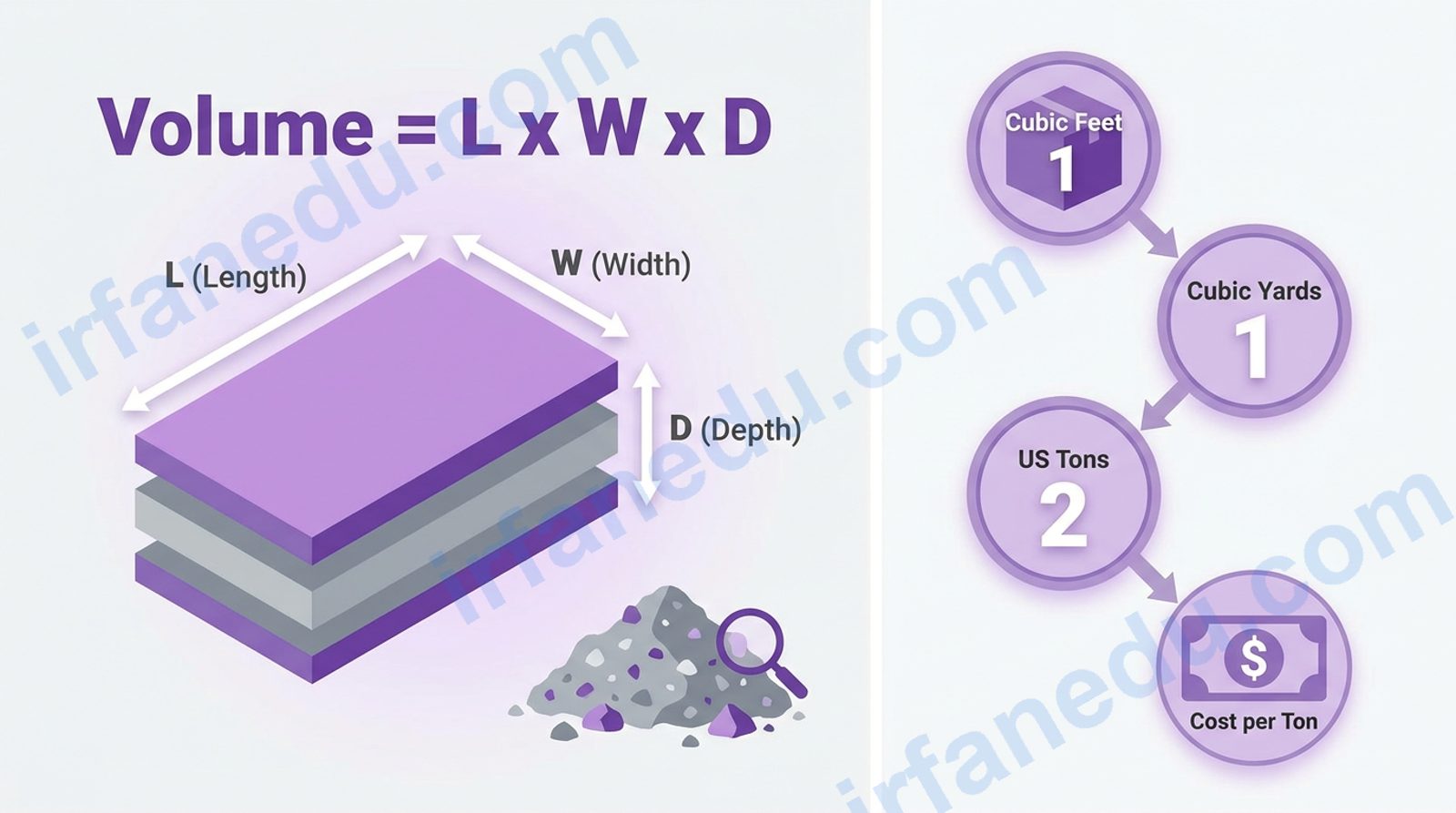
To calculate how much gravel you need, multiply length (ft) × width (ft) × depth (ft) to get cubic feet, then divide by 27 for cubic yards. Multiply cubic yards by 1.4 to convert to US tons. A 10 ft × 20 ft area at 3 inches deep needs roughly 2.22 cubic yards or about 3.1 tons. Add a 10% buffer for settling and waste before ordering.
⚡ TL;DR
- 📌 Volume (cu ft) = Length × Width × Depth (all in feet).
- 📌 Divide by 27 to convert cubic feet to cubic yards.
- 📌 Multiply cubic yards by 1.4 to get US tons (standard gravel).
- 📌 Always add 10% extra for compaction and waste.
- 📌 Circular areas: use π × radius² × depth instead of L × W.
If I could teach you one thing about planning a gravel project, it is this: getting the quantity wrong is the most expensive mistake you can make. Order too little and you pay a second delivery fee. Order too much and you are left with a pile of stone you cannot return. I have seen both happen — and both are completely avoidable with a 30-second calculation.
A gravel calculator estimates the volume (in cubic yards or cubic metres) and weight (in US tons or metric tonnes) of gravel needed to fill a rectangular or circular area to a specified depth. It uses the formula: Volume = Length × Width × Depth, then converts to the unit your supplier uses for pricing.
Use the interactive calculator below right now, then read on for the formula, two fully worked examples, and the mistakes that trip up most first-time buyers.
Gravel Calculator
Volume • Weight • Cost — Rectangular & Circular
✅ Result
📝 Step-by-Step Solution
How to Use This Gravel Calculator
- Choose your area shape — click “Rectangular Area” for a driveway, path, or bed; click “Circular Area” for a round garden feature.
- Enter dimensions in feet — length and width for rectangular, or diameter for circular.
- Enter the depth in inches — typical values: 2 in for a decorative top-dressing, 4 in for a driveway surface layer, 6 in for a base layer.
- Select your gravel type — this sets the density multiplier used to convert volume to weight.
- Add a price per ton (optional) to get an instant cost estimate.
- Click Calculate — the result card shows cubic yards, cubic metres, US tons, metric tonnes, and a recommended order quantity with a 10% buffer built in.
What Is a Gravel Volume Calculation?
A gravel volume calculation tells you how much material you need to fill a defined area to a set depth. It is the essential first step before ordering from any supplier, because gravel is sold by volume (cubic yards or cubic metres) or by weight (US tons or metric tonnes), and converting between them incorrectly is the single biggest source of ordering errors.
Gravel is any loose rock material used for drainage, driveways, paths, landscaping, or construction bases. Its density varies by type — from about 1.2 tons per cubic yard for lightweight decorative stone to 1.5 tons per cubic yard for dense granite. The calculator above accounts for this with the density selector.
The Gravel Formula Explained
Rectangular Area:
Volume (ft³) = Length (ft) × Width (ft) × Depth (ft)
Volume (yd³) = Volume (ft³) ÷ 27
Weight (US tons) = Volume (yd³) × Density (t/yd³)
Circular Area:
Volume (ft³) = π × (Diameter ÷ 2)² × Depth (ft)
| Symbol | Meaning | SI Unit |
|---|---|---|
| L | Length of the area | feet / metres |
| W | Width of the area | feet / metres |
| D | Depth of gravel layer | inches / cm |
| r | Radius (for circular areas) | feet / metres |
| V | Volume of gravel needed | cubic yards / m³ |
| ρ | Bulk density of gravel | US tons per cubic yard |
| m | Mass (weight) of gravel | US tons / metric tonnes |
Unit note: 1 cubic yard = 27 cubic feet = 0.7646 cubic metres. 1 US ton = 0.9072 metric tonnes. Depth is almost always given in inches by suppliers; divide by 12 to convert to feet before multiplying.
Gravel Density by Type
| Gravel Type | Density (t/yd³) | Best Use |
|---|---|---|
| Pea Gravel / Crushed Stone | 1.40 | Driveways, paths, drainage |
| Granite / Dense Crushed Rock | 1.50 | Heavy-duty base layers |
| River Rock / Rounded Gravel | 1.35 | Decorative landscaping |
| Lightweight Decorative Gravel | 1.20 | Garden beds, top dressing |
Worked Examples
Project: A driveway 40 ft long, 12 ft wide, at 4 inches deep using standard crushed stone (1.4 t/yd³).
- Convert depth: 4 in ÷ 12 = 0.3333 ft
- Volume (ft³): 40 × 12 × 0.3333 = 160 ft³
- Volume (yd³): 160 ÷ 27 = 5.93 yd³
- Weight: 5.93 × 1.4 = 8.30 US tons
- Order with 10% buffer: 9.13 US tons
Order: ~9.1 US tons of crushed stone.
Project: A circular gravel bed, 14 ft diameter, at 2 inches deep using river rock (1.35 t/yd³).
- Radius: 14 ÷ 2 = 7 ft
- Convert depth: 2 in ÷ 12 = 0.1667 ft
- Volume (ft³): π × 7² × 0.1667 = 3.14159 × 49 × 0.1667 = 25.66 ft³
- Volume (yd³): 25.66 ÷ 27 = 0.95 yd³
- Weight: 0.95 × 1.35 = 1.28 US tons
- Order with 10% buffer: 1.41 US tons
Order: ~1.4 US tons of river rock.
  RECTANGULAR AREA — VISUAL BREAKDOWN
  ┌─────────────────────────────────────────┐
  │  Length (L) = 40 ft                     │
  │  ┌──────────────────────────────────┐   │
  │  │                                  │   │
  │  │   Area = L × W = 480 ft²         │ W │
  │  │                                  │ = │
  │  │   ↕ Depth = 4 in = 0.333 ft      │12 │
  │  └──────────────────────────────────┘ft │
  └─────────────────────────────────────────┘

  Volume = 480 ft² × 0.333 ft = 160 ft³
         = 160 ÷ 27 = 5.93 yd³
  Weight = 5.93 × 1.4 = 8.30 US tons
  +10%   → ORDER: 9.13 US tons ✔
Common Mistakes to Avoid
The most common error I see: entering depth as “4” and treating it as feet, not inches. A 4-foot-deep driveway would need 48 times more gravel than a 4-inch one. Always divide your inch measurement by 12 first.
Not all gravel weighs the same. Using 1.4 t/yd³ for granite (which is actually 1.5) means you will under-order by about 7%. Always ask your supplier for the specific bulk density of the product you are buying.
- Gravel compacts when walked or driven on, reducing the visible depth.
- Irregular ground means some spots need more material than your flat calculation suggests.
- Spillage and waste during spreading are real. Always order at least 10% extra.
Wrong vs. Right: Side-by-Side Comparison
| Situation | ❌ Wrong Approach | ✅ Right Approach |
|---|---|---|
| Depth input | Enter 4 (treating as feet) | Enter 4 inches, divide by 12 = 0.333 ft |
| Density | Use 1.4 for all gravel types | Select the correct type from the density table |
| Order quantity | Order exact calculated amount | Add 10% buffer before ordering |
| Circular area | Use L × W (overestimates ~27%) | Use π × r² × depth |
| Unit conversion | Assume 1 yd³ = 1 ton | Multiply yd³ by density (1.2–1.5) |
In my experience helping students and homeowners with practical maths, the gravel calculation is one of those real-world problems where a tiny unit error causes a very expensive
Sources & References
Written and fact-checked by Dr Irfan Mansuri. External links open in a new tab and are provided for further reading and verification.