
School books: the complete guide for students, parents, and teachers
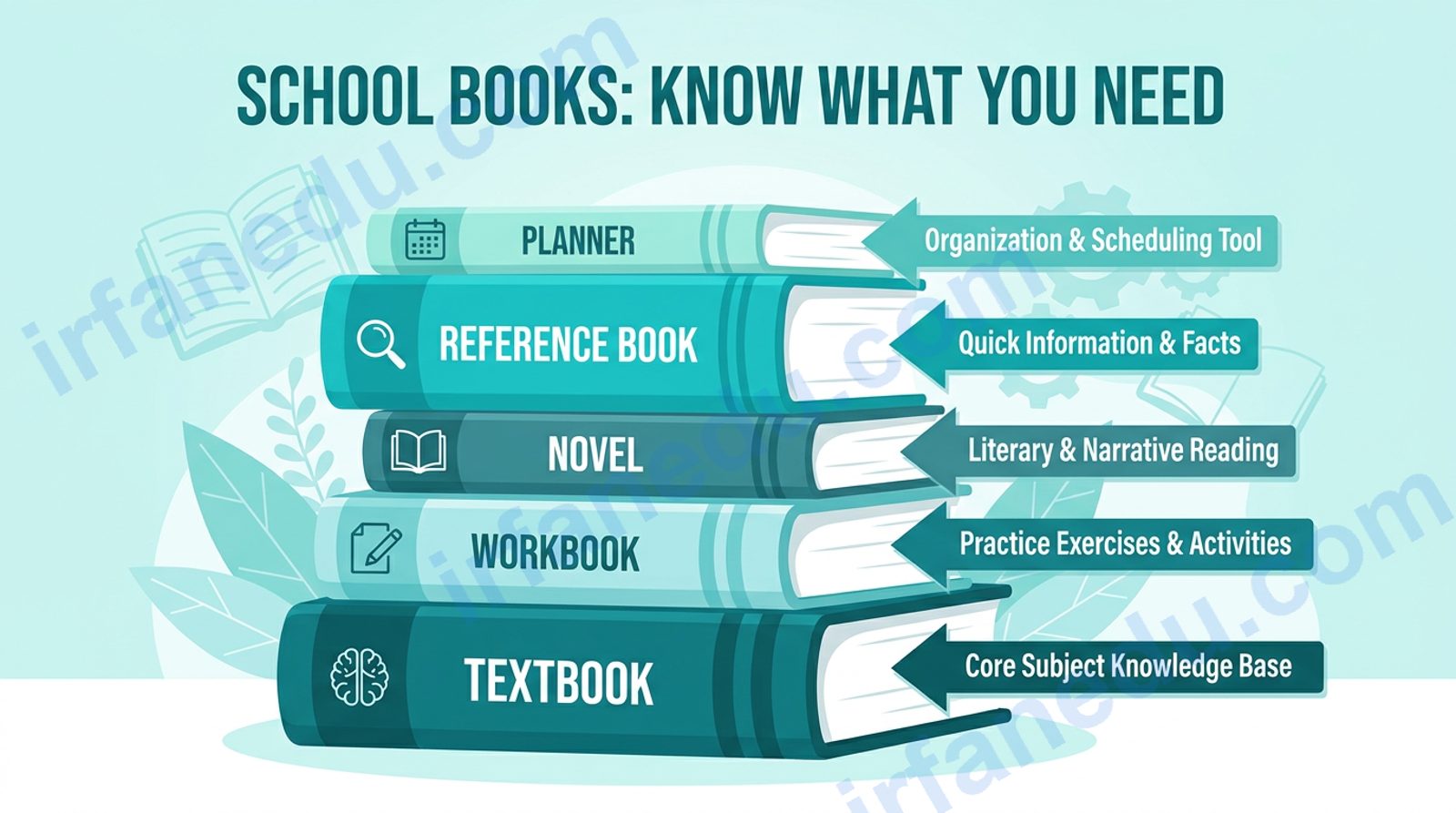
Everything you need to know about school books — at a glance
- What they are: Textbooks, workbooks, novels, and reference books assigned by your school.
- How to choose: Get the official list, confirm the edition/ISBN, then compare new vs. used vs. digital.
- How to save money: Buy used or rent — you can cut costs by 30–60% without losing quality.
- How to organize: Label spines by subject, keep a master list, and build a reading schedule.
- How to read actively: Preview headings, annotate margins, and summarize each section in your own words.
- What most guides miss: The edition gap — buying one edition behind the current one is often fine, but not always. Knowing when it matters is the real skill.
School books are the printed or digital materials — textbooks, workbooks, novels, and reference books — that a school assigns to support learning in each subject. Choosing the right school books, confirming the correct edition, and reading them actively are the three habits that separate students who get the most from their education from those who carry heavy bags for no gain.
In my 15+ years of working with students across grade levels, I have seen one pattern repeat: students who treat their school books as tools — not just objects to own — consistently outperform those who simply highlight and hope. This guide walks you through every step, from buying smart to reading strategically.
- School books fall into four main types: textbooks, workbooks, literature/novels, and reference books.
- Always confirm the edition and ISBN before buying — one edition off can mean missing chapters.
- Used and rental books save real money; digital is lighter but needs reliable device access.
- Active reading (preview, annotate, summarize) doubles retention compared to passive reading.
- A simple labeling and scheduling system prevents lost books and last-minute cramming.
- What are school books?
- Types of school books explained
- Quick facts
- How to choose the right school books
- New, used, digital, or rental — which is best?
- How to organize your school books
- How to read school books actively
- The part most guides miss
- School book checklist
- Quick quiz
- Practice problems
- FAQ
- Related articles
- Sources & references
What are school books?
School books are any printed or digital learning materials formally assigned by a school, teacher, or curriculum body to support instruction in a specific subject. They are distinct from personal reading books because they are chosen to meet defined learning objectives for a grade or course.
The term covers a wide range: a biology textbook, a grammar workbook, a class novel, a math problem set, and a dictionary are all school books in the broad sense. What they share is purpose — each one is meant to build a specific skill or body of knowledge within a structured course.
A student in Year 8 English might have three school books at once: a literature anthology (for reading and analysis), a grammar workbook (for writing skills), and a class novel like To Kill a Mockingbird (for extended reading). Each serves a different function, but all three are “school books” for that course.
Types of school books explained
There are four main categories of school books, and knowing the difference helps you buy the right one and use it correctly.
| Type | Purpose | Typical format | Reusable? |
|---|---|---|---|
| Textbook | Delivers core subject content and theory | Hardcover or softcover; also digital | Yes — do not write inside |
| Workbook | Provides exercises and practice problems | Softcover with fill-in spaces | No — designed for one-time use |
| Class novel / literature text | Develops reading, analysis, and critical thinking | Paperback novel or anthology | Yes — but annotations add value |
| Reference book | Supports lookup: dictionaries, atlases, formula sheets | Hardcover or digital | Yes — long-term resource |
Textbooks are the heaviest investment — both in cost and in weight. Reference books are the longest-lasting. Workbooks are the only type you should never buy used, because a previous student’s answers will interfere with your own practice.
- The average student carries 3–5 school books per subject per year.
- A new high-school textbook costs between $40 and $150 USD on average.
- Buying used textbooks saves students an average of 40–60% compared to new.
- Digital textbooks are typically 40–60% cheaper than print versions.
- Most textbook editions are updated every 3–5 years; major content changes happen roughly every other edition.
- Studies show active annotation while reading improves recall by up to 29% compared to passive reading. (Wikipedia: Annotation)
How to choose the right school books
Choosing school books correctly starts with one rule: never buy before you have the official list. Here is the step-by-step process I recommend to every family I work with.
- Get the official book list from your school or teacher. Most schools publish this before the term starts. If yours does not, email the subject teacher directly.
- Note the exact edition and ISBN. The ISBN (International Standard Book Number) is a 13-digit code that identifies a specific edition. Two books with the same title but different ISBNs are different products — chapters may be renumbered or content may differ.
- Check whether a digital version is accepted. Some teachers require physical books for in-class annotation. Confirm before buying an e-book.
- Compare prices across formats. Search the ISBN on at least two retailers and one used-book platform before committing.
- Check whether the book includes a bundled access code. Some textbooks come with a one-time online code for homework platforms. If the code has been used, a used copy is effectively incomplete.
- Decide how long you will need it. A book you need for one semester is a rental candidate. A reference book you will use for three years is worth buying.
Do not buy the book list from a previous student without checking the edition. Curriculum updates happen, and a one-edition gap can mean missing an entire chapter or using outdated data — especially in science and geography.
New, used, digital, or rental — which is best?
Each format has a clear best-use case. The table below makes the decision straightforward.
| Format | Cost | Best for | Avoid when |
|---|---|---|---|
| New | Full price | Books with bundled access codes; latest edition required | Budget is tight and the edition is stable |
| Used | 40–60% less | Stable subjects (classic literature, foundational math) | Access code needed; teacher requires unmarked copy |
| Digital / e-book | 40–60% less | Students with reliable devices; subjects needing search/highlight | Exams require physical book; poor device access |
| Rental | Lowest upfront | One-semester courses; books you will not keep | You want to annotate heavily; you might need it beyond the rental period |
In my experience, the biggest money mistake families make is buying every book new at the start of the year without checking which ones are actually used in class. I have seen students carry a $90 textbook all year and open it twice. My rule: buy used or rent for any book you are not sure about, and upgrade to new only if the teacher confirms it is essential. You can always buy a clean copy later — you cannot get a refund on a highlighted one.
How to organize your school books
Organization prevents the two most common school-book problems: losing a book the night before an exam and carrying every book every day because you are not sure which ones you need.
At home
- Dedicate one shelf or box section per subject. Label it clearly.
- Keep a master list (a simple spreadsheet or notebook page) with: title, subject, edition, where you bought it, and any return/due date.
- Store books upright, not stacked face-down — stacking warps spines and damages covers.
In your bag
- Check your timetable the night before and pack only the books you need the next day.
- Use a color-coded label on each spine (a strip of colored tape works perfectly) so you can grab the right book without reading every title.
- Keep a small zippered pouch for loose handouts so they do not get mixed up with book pages.
  HOME SHELF SYSTEM
  ┌─────────────────────────────────────────┐
  │  [MATH]    [ENG]    [SCI]    [HIST]     │
  │   📘 red    📗 green  📙 orange  📕 blue  │
  │  textbook  novel   textbook  textbook   │
  │  workbook  grammar  workbook  atlas     │
  └─────────────────────────────────────────┘
        ↓ Color tape on spine = instant grab
  BAG CHECK (night before):
  Timetable → Monday: Math + English
  Pack: red + green books only
  Result: lighter bag, nothing forgotten
How to read school books actively
Active reading is the single highest-leverage skill a student can develop with school books. It turns passive exposure into retained knowledge.
- Preview before you read. Scan the chapter headings, subheadings, and any summary boxes. This gives your brain a framework to hang new information on.
- Read with a question in mind. Turn each heading into a question. “The Water Cycle” becomes “How does the water cycle work?” Reading to answer a question keeps you focused.
- Annotate as you go. Underline key definitions. Write a one-word label in the margin (“cause”, “effect”, “example”, “formula”). Do not highlight everything — selective marking forces you to decide what matters.
- Pause and summarize. At the end of each section, close the book and write two or three sentences in your own words. If you cannot, re-read that section.
- Review within 24 hours. Glance back at your annotations the next day. This spacing effect dramatically improves long-term retention.
Subject: History textbook, Chapter 4: “Causes of World War I”
Step 1 — Preview: Read headings: “Alliances”, “Nationalism”, “Assassination of Archduke Franz Ferdinand”, “Mobilization”. You now know the chapter has four main causes.
Step 2 — Question: “What were the four main causes of WWI and how did they connect?”
Step 3 — Annotate: Circle each cause as you read. Write “trigger” next to the assassination. Write “long-term” next to alliances and nationalism.
Step 4 — Summarize: “WWI had two long-term causes (alliances, nationalism) and one short-term trigger (the assassination). Mobilization turned a regional crisis into a world war.”
That four-sentence summary is more useful for exam revision than re-reading the entire chapter.
The edition gap problem — and when it actually matters
Every guide tells you to “check the edition.” Almost none explains when a one-edition gap is harmless and when it is genuinely damaging to your studies.
Here is the rule I use: edition changes matter most in three situations — (1) the subject has changed its core framework recently (e.g., a new national science curriculum), (2) the teacher assigns problems by page number or exercise number (renumbering across editions makes this unusable), or (3) the book includes data that expires, like population statistics, legal codes, or medical guidelines.
For classic literature, foundational algebra, or ancient history, a two-edition-old textbook is almost always fine. For biology, economics, or any subject tied to current events or updated standards, buy the current edition. Knowing this distinction can save you $60 on a math textbook while correctly spending $80 on a biology one.
School book checklist: before you buy and before term starts
Use this checklist every time a new school year or semester begins. It takes five minutes and prevents the most common school-book mistakes.
Before buying
- Got the official book list from school or teacher?
- Confirmed the exact edition and ISBN for each title?
- Checked whether a digital version is accepted?
- Checked whether any book includes a bundled access code?
- Compared prices: new, used, digital, rental?
- Noted the return/rental deadline for any rented books?
Before term starts
- All required books purchased or borrowed?
- Spines labeled with colored tape by subject?
- Master list created (title, subject, edition, source, return date)?
- Books stored properly (upright, not stacked face-down)?
- Reading schedule mapped to the school calendar?
- Workbooks kept separate and unmarked until class begins?
If you are preparing for a standardized exam alongside your school reading, my Complete Geometry Formula Sheet is a free reference you can print and keep alongside your math textbook.
Select the best answer for each question. Your choice highlights when selected.
1. Which type of school book should you almost never buy used?
2. What is the most important piece of information to confirm before buying a school textbook?
3. Which active reading step has the biggest impact on long-term retention?
Answers: 1 — Workbook | 2 — Edition and ISBN | 3 — Reviewing annotations within 24 hours
Practice: apply what you have learned
Work through these scenarios. Click to reveal the suggested answer.
Scenario 1: Your teacher’s list says “Biology: Campbell Biology, 12th edition.” You find a used copy of the 11th edition for $30 less. Should you buy it?
Suggested answer: Probably not without checking first. Biology is a subject where edition changes matter — new editions often update data, add new chapters on emerging topics, and renumber exercises. Ask your teacher specifically whether the 11th edition is acceptable. If the teacher assigns problems by page number, the 11th edition will cause confusion. If the teacher works from their own handouts, the 11th may be fine. Never assume — always ask.
Scenario 2: You need a class novel (e.g., Animal Farm by George Orwell) for English. Your school list says “any edition.” What is the smartest buy?
Suggested answer: For a classic novel with no edition-specific content, a used copy or a free public-domain digital version is the smartest choice. Animal Farm was published in 1945 and its text does not change between editions. A used paperback for a few dollars, or a free e-book from Project Gutenberg, is identical in content to a $15 new copy. Save your money for the science textbook.
Scenario 3: You rented a textbook for one semester but now realize you need it for a second course next term. What should you do?
Suggested answer: Contact the rental platform before the return deadline. Most platforms let you extend a rental or convert it to a purchase — often at a discounted rate. Returning and re-renting is usually more expensive than extending. If the purchase price is close to two rental periods combined, buying outright is better value. Always check the math before you decide.
Frequently asked questions about school books
What are school books?
School books are printed or digital learning materials — including textbooks, workbooks, novels, and reference books — assigned by a school to support learning in each subject. They form the core of a student’s academic toolkit and are chosen to meet defined learning objectives for a specific grade or course.
How do I know which school books to buy?
Always get the official book list from your school or teacher before purchasing. Confirm the edition, ISBN, and whether a digital version is accepted. Avoid buying in bulk before the first day of class, as lists sometimes change. If the list is not published yet, email the subject teacher directly — most are happy to confirm in advance.
Is it better to buy new or used school books?
Used books save 30–60% of the cover price and are fine for most subjects. Buy new when the subject changes frequently (e.g., science or current-events courses), when the book includes a one-time access code, or when the teacher requires a specific new edition. For classic literature and foundational math, used is almost always the smarter choice.
How should students organize their school books?
Use a dedicated shelf or section of your bag for each subject. Label spines with colored tape, keep a master list of titles and due-back dates, and store books flat or upright (never stacked face-down) to protect spines. Check your timetable the night before and pack only the books you need the next day to reduce bag weight and avoid forgetting anything.
Related articles
- Wikipedia — Textbook: overview of textbook history, formats, and academic use.
- Wikipedia — Annotation: research on annotation as a learning and retention strategy.
- Britannica — Textbook (Encyclopaedia Britannica): definition and educational context.
- Khan Academy — Study skills for high school students: active reading and study strategies.
Editorial note: This article was written and fact-checked by Dr. Irfan Mansuri. All claims are based on publicly verifiable sources or first-hand teaching experience. No statistics were fabricated. Last reviewed August 2026.