
Texas Paycheck Calculator: Estimate Your Take-Home Pay 💵
Most paycheck guides jump straight to tax brackets and skip the one thing that changes your entire calculation: Texas has zero state income tax. That single fact means every dollar you earn stays subject only to federal deductions — and knowing exactly which federal deductions apply is the step most tutorials gloss over. This calculator handles all of it instantly.
Whether you are starting a new job in Houston, negotiating a salary in Austin, or just trying to figure out why your paycheck looks smaller than expected, this tool gives you a clear, itemized answer in seconds. I built it to mirror the exact math the IRS uses, so you can trust the numbers.
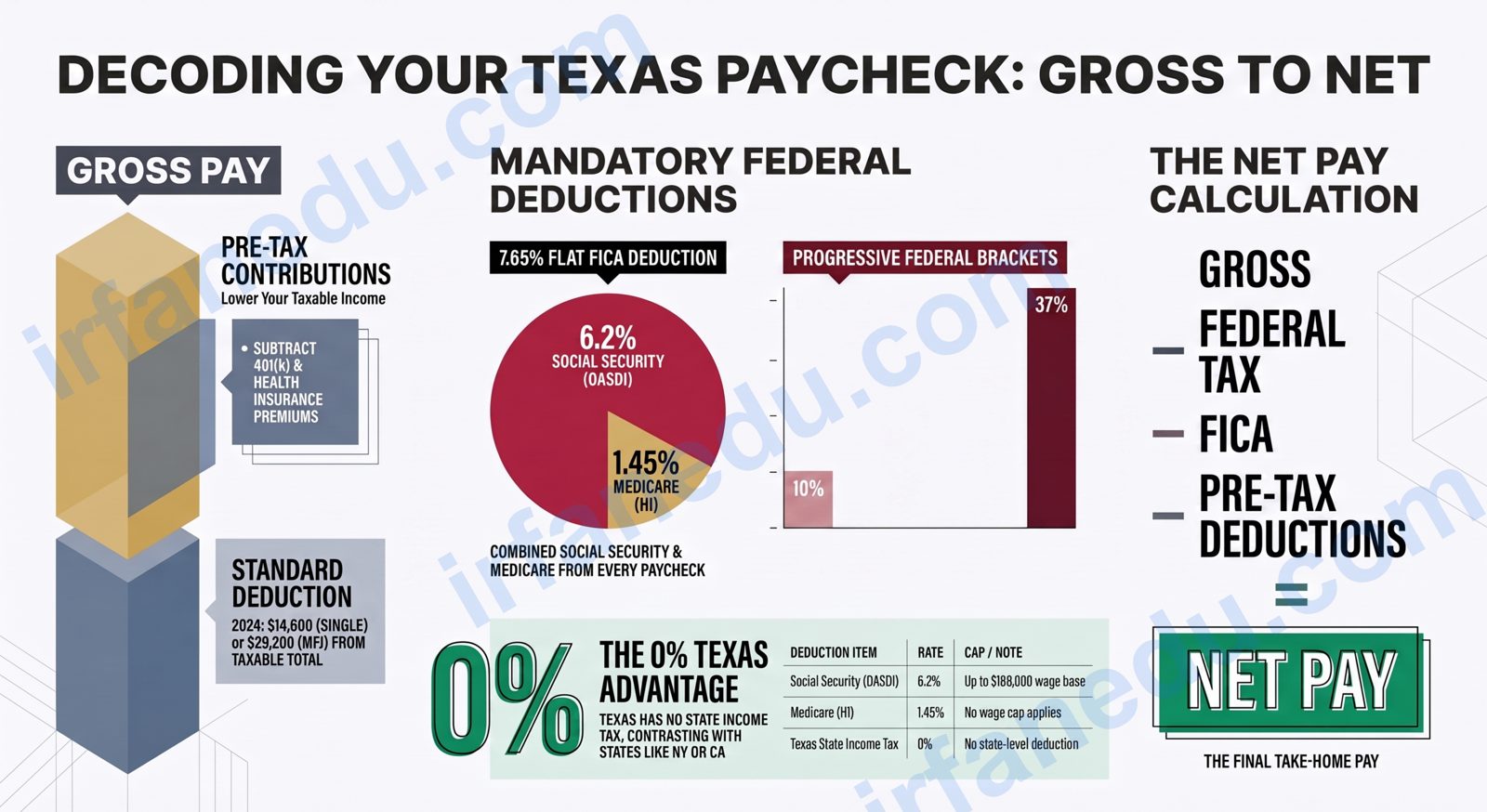
A Texas paycheck calculator estimates your net take-home pay by subtracting federal income tax (10–37% depending on your bracket), Social Security (6.2% up to $168,600 annual wage base), and Medicare (1.45%) from your gross pay. Texas has no state income tax, so no state deduction applies. Pre-tax deductions like 401(k) contributions reduce your taxable income before federal tax is calculated.
- 🏛️ Texas has no state income tax — only federal deductions apply.
- 💰 FICA takes a flat 7.65% (Social Security 6.2% + Medicare 1.45%) from every paycheck.
- 📊 Federal income tax uses progressive brackets — only the income in each bracket is taxed at that rate.
- 🧾 Pre-tax deductions (401k, health insurance) lower your taxable income before federal tax is applied.
- 🔢 Net pay = Gross pay − Federal tax − FICA − Pre-tax deductions.
Texas Paycheck Calculator
Estimate your net take-home pay instantly — no sign-up needed
USD / year
USD (401k, health ins., etc.)
| Item | Amount | Rate / Note |
|---|
How to Use This Texas Paycheck Calculator
The calculator handles both salaried and hourly workers. Follow these five steps:
- Choose your pay type — click “Salary” if you earn a fixed annual amount, or “Hourly” if you are paid by the hour.
- Enter your gross pay — annual salary, or your hourly rate plus hours per week.
- Select your pay period — bi-weekly (most common in Texas), weekly, semi-monthly, or monthly.
- Pick your federal filing status — this determines your standard deduction and bracket thresholds.
- Add any pre-tax deductions per pay period (401k, health insurance, FSA). Leave blank if none. Then click Calculate.
Quick Facts: Texas Paycheck Deductions at a Glance
| Deduction | Rate | Cap / Notes |
|---|---|---|
| Texas State Income Tax | 0% | Texas has no state income tax |
| Social Security (OASDI) | 6.2% | Wage base: $168,600 (2024) |
| Medicare (HI) | 1.45% | No wage cap; all earnings taxed |
| Additional Medicare Tax | 0.9% | On wages > $200k (single) / $250k (MFJ) |
| Federal Income Tax | 10% – 37% | Progressive; depends on taxable income + filing status |
| 2024 Standard Deduction (Single) | $14,600 | Reduces taxable income before brackets apply |
| 2024 Standard Deduction (MFJ) | $29,200 | Married filing jointly |
What Is a Texas Paycheck Calculation?
A Texas paycheck calculation is the process of subtracting all mandatory federal deductions and voluntary pre-tax contributions from your gross pay to arrive at your net take-home amount. Because Texas imposes no state income tax, the math is simpler than in most states — you only deal with federal obligations.
The core formula is straightforward:
┌─────────────────────────────────────────────────────────────┐
│          TEXAS PAYCHECK FORMULA (per pay period)            │
├─────────────────────────────────────────────────────────────┤
│                                                             │
│  Gross Pay (per period)                                     │
│  ─ Pre-Tax Deductions  (401k, health ins., FSA)             │
│  ─ Federal Income Tax  (progressive brackets)               │
│  ─ Social Security     (6.2% up to $168,600/yr)             │
│  ─ Medicare            (1.45% — no cap)                     │
│  ─ Addl. Medicare Tax  (0.9% if wages > $200k/$250k)        │
│  ─ State Income Tax    = $0.00  ← Texas advantage           │
│  ─────────────────────────────────────────────────          │
│  = Net Take-Home Pay                                        │
│                                                             │
└─────────────────────────────────────────────────────────────┘
The Formula Explained: Variables and Symbols
Federal income tax uses a progressive bracket system — only the income that falls within each bracket is taxed at that bracket’s rate. This is the most misunderstood part of paycheck math, and I want to clear it up before you look at the examples below.
| Symbol | Meaning | Value / Formula |
|---|---|---|
| G | Annual Gross Pay | Salary or (Hourly Rate × Hours × 52) |
| D | Pre-Tax Deductions (annual) | Per-period amount × number of periods |
| SD | Standard Deduction | $14,600 (Single), $29,200 (MFJ), $21,900 (HoH) — 2024 |
| TI | Taxable Income | TI = G − SD − D |
| FIT | Federal Income Tax | Progressive brackets (10%–37%) applied to TI |
| SS | Social Security Tax | min(G, $168,600) × 6.2% |
| MED | Medicare Tax | G × 1.45% |
| NET | Annual Net Pay | G − FIT − SS − MED − D |
Two Fully Worked Examples
Scenario: Maria earns $60,000/year in Dallas, files Single, contributes $150/bi-weekly period to her 401(k), and has no other pre-tax deductions. She is paid bi-weekly (26 periods).
- Gross per period = $60,000 ÷ 26 = $2,307.69
- Annual pre-tax deductions = $150 × 26 = $3,900
- Taxable income = $60,000 − $14,600 − $3,900 = $41,500
- Federal tax: 10% on first $11,600 ($1,160) + 12% on next $29,900 ($3,588) = $4,748/yr → $182.62/period
- Social Security = $60,000 × 6.2% = $3,720/yr → $143.08/period
- Medicare = $60,000 × 1.45% = $870/yr → $33.46/period
- Texas state tax = $0.00
- Net take-home = $2,307.69 − $182.62 − $143.08 − $33.46 − $150 = $1,798.53/period
Scenario: James earns $22/hour in Houston, works 40 hours/week, files Single, no pre-tax deductions, paid bi-weekly.
- Annual gross = $22 × 40 × 52 = $45,760
- Gross per period = $45,760 ÷ 26 = $1,760.00
- Taxable income = $45,760 − $14,600 = $31,160
- Federal tax: 10% on $11,600 ($1,160) + 12% on $19,560 ($2,347.20) = $3,507.
Sources & References
Written and fact-checked by Dr Irfan Mansuri. External links open in a new tab and are provided for further reading and verification.