
The single most important thing you can do before the TSI Assessment 2.0 is take at least two full practice tests under real conditions — students who do this are significantly more likely to hit the college-readiness benchmark on their first attempt.
TSI practice test: complete study guide for 2026
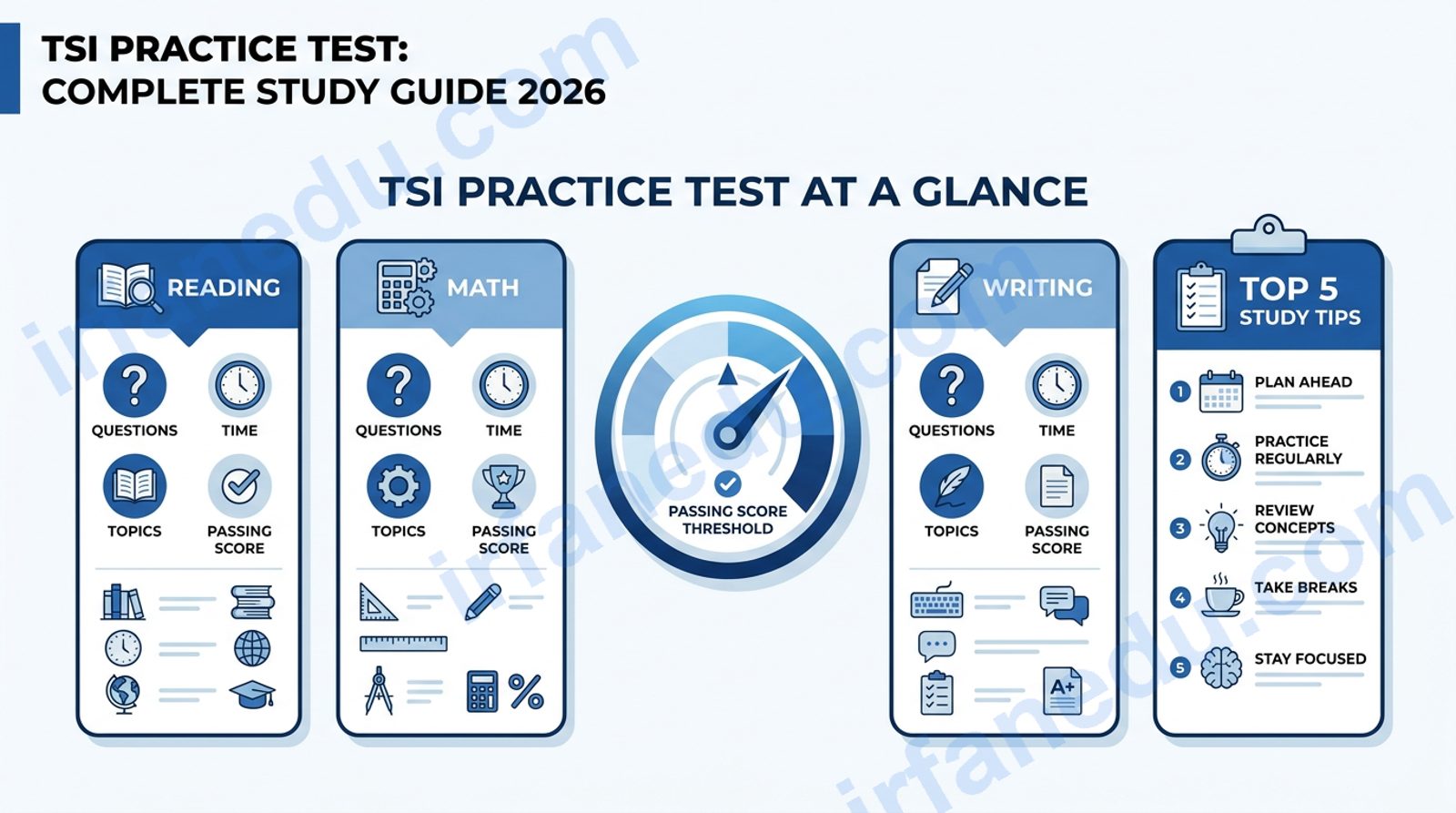
The TSI (Texas Success Initiative) Assessment 2.0 is a placement exam required by Texas public colleges and universities to determine whether incoming students are ready for college-level Reading, Writing, and Math. Scoring at or above the benchmark in each section means you go straight into credit-bearing courses — missing the benchmark means mandatory developmental coursework that costs time and money.
In my experience coaching students through college placement exams, the TSI is one of the most underestimated tests a student will take. It is not a high-stakes admissions exam, so many students walk in cold — and then spend an extra semester in non-credit courses they could have avoided with two weeks of focused practice.
This guide gives you everything: what is tested, how scoring works, a step-by-step preparation plan, worked examples, a practice quiz, and the free resources worth your time.
What is the TSI Assessment 2.0?
The TSI Assessment 2.0 is the current version of the Texas Success Initiative exam, administered by the College Board on behalf of Texas higher education institutions. It replaced the original TSI Assessment in 2021 and introduced adaptive question routing, meaning the test adjusts difficulty based on your answers.
The exam is not an admissions test — your score does not affect whether you get into college. It only determines which courses you start in. If you score below the benchmark, your institution places you in developmental (remedial) education before you can take the college-level course in that subject.
Certain students are exempt from taking the TSI: those who scored at or above a set threshold on the SAT, ACT, or STAAR End-of-Course exams, active military members, and students who already hold an associate’s or bachelor’s degree. Check with your institution to confirm your exemption status.
Quick facts at a glance
| Feature | Detail |
|---|---|
| Full name | Texas Success Initiative Assessment 2.0 (TSI2) |
| Administered by | College Board (on behalf of Texas colleges) |
| Sections | Reading, Writing (multiple-choice + essay), Math |
| Total questions | ~64 scored items + essay |
| Timed? | No — untimed (most finish in 3–5 hours) |
| Reading benchmark | 945 or above |
| Math benchmark | 950 or above |
| Writing benchmark | 945 + essay score ≥ 5 |
| Cost | Set by each institution (typically $20–$30 per section) |
| Retakes allowed? | Yes, per institution policy |
Section-by-section breakdown
Reading section
The Reading section has 24 multiple-choice questions drawn from literary and informational passages. You will encounter questions on literary analysis, main idea, author’s purpose, vocabulary in context, and inferencing. Passages range from roughly 300 to 700 words and cover both fiction and non-fiction.
In my experience, students lose the most points on inference questions — the ones that ask what the author implies rather than what the text states directly. Practice identifying the difference between what is written and what is suggested.
Writing section
The Writing section combines 20 multiple-choice grammar and rhetoric questions with one essay prompt. The multiple-choice questions test sentence structure, agreement, punctuation, and logical organization of ideas. The essay is scored on a 1–8 scale; you need a 5 or above alongside a 945 multiple-choice score to meet the college-readiness benchmark.
Math section
The Math section has 20 scored questions (plus up to 10 unscored field-test items you cannot identify). Topics span four domains:
- Quantitative reasoning — ratios, proportions, percentages, basic statistics
- Algebraic reasoning — linear equations, inequalities, systems of equations
- Geometric and spatial reasoning — area, volume, coordinate geometry
- Probabilistic and statistical reasoning — probability, data interpretation
A basic four-function calculator is allowed for some items; a scientific calculator is provided on-screen for others. You cannot bring your own calculator.
How TSI scoring works
TSI Assessment 2.0 uses a scaled score range of 310–390 for Reading and Math, and 310–390 for Writing multiple-choice. The essay adds a separate 1–8 holistic score. The adaptive design means two students can answer different sets of questions and still receive comparable scaled scores.
The adaptive scoring model trips up a lot of students who compare their experience to a friend’s. You might see harder questions than your classmate — that is actually a good sign. The algorithm routes you to harder items when you answer correctly, which is how you reach the higher score bands. Do not panic if the questions feel difficult mid-test.
If you score below the benchmark, your institution assigns a “TSI Diagnostic” sub-score that identifies exactly which skill areas need work. This diagnostic is genuinely useful — treat it as a roadmap, not a verdict.
Practice test vs. official test: key differences
| Feature | TSI practice test | Official TSI Assessment 2.0 |
|---|---|---|
| Cost | Free | $20–$30 per section (institution-set) |
| Adaptive routing | Partial or none (depends on source) | Fully adaptive |
| Score report | Immediate feedback, not official | Official scaled score + diagnostic |
| Essay graded? | Self-assessed with rubric | Scored by trained human raters |
| Counts toward placement? | No | Yes |
| Best use | Identify weak areas, build familiarity | Official college course placement |
How to prepare: a 5-step plan
Follow these steps in order. Each one builds on the previous, so skipping ahead reduces the return on your study time.
- Take a full diagnostic practice test first. Before you open a textbook, complete a full TSI practice test under real conditions — no pausing, no phone. Record your score by section and by sub-topic. This single step tells you where to spend 70% of your study hours.
- Review section-specific content. For Math, revisit linear equations, systems of equations, and percentages — these appear most frequently. For Reading, practice identifying the main idea and author’s purpose in 400-word passages. For Writing, drill subject-verb agreement, comma splices, and paragraph organization.
- Use official preparation materials. The College Board publishes a free TSI Preparation Manual with sample questions. Your institution’s testing center may also offer a free prep course or workshop — take it.
- Drill your weak areas with targeted exercises. Spend the majority of your remaining study time on the question types you missed in your diagnostic. One focused hour on a specific skill beats three hours of random review.
- Take a second full practice test one week before test day. Compare your scores to your diagnostic. If a section is still below benchmark, spend your final days on that section only. If you are above benchmark in all three, do a light review and rest.
Most guides tell students to “study a little every day.” In my experience with placement-exam prep, that advice is too vague to be useful. What actually works is a diagnostic-first approach: know your exact weak spots before you study anything, then attack those spots with focused, timed practice. Two weeks of targeted prep beats two months of unfocused review every time.
Worked examples for each section
Math: solving a linear equation (common TSI question type)
Linear equations appear in the Algebraic Reasoning domain and are among the most frequently tested Math topics. Here is a representative example worked step by step.
Problem:  Solve for x:   3x + 7 = 22

Step 1 — Subtract 7 from both sides:
         3x + 7 - 7  =  22 - 7
         3x          =  15

Step 2 — Divide both sides by 3:
         3x / 3      =  15 / 3
         x           =  5

Check:   3(5) + 7  =  15 + 7  =  22  ✓

Answer:  x = 5
Reading: identifying the author’s purpose
Author’s purpose questions ask why the author wrote a passage or included a specific detail. The answer is almost never “to entertain” in an informational text — look for “to inform,” “to argue,” or “to persuade” and match the tone of the passage.
Strategy: Read the first and last paragraph of any passage first. Authors typically state their purpose in the opening and reinforce it in the conclusion. If the passage uses data and citations, the purpose is to inform or argue. If it uses emotional language and calls to action, the purpose is to persuade.
Writing: fixing a comma splice
A comma splice is one of the most common errors tested in the Writing section. It occurs when two independent clauses are joined with only a comma.
Incorrect: She studied for three hours, she passed the TSI on her first attempt.
Correct options:
- She studied for three hours; she passed the TSI on her first attempt.
- She studied for three hours, so she passed the TSI on her first attempt.
- Because she studied for three hours, she passed the TSI on her first attempt.
Most TSI prep guides focus on content review — what topics are tested. What they miss is the adaptive mechanics of TSI 2.0. Because the test routes harder questions to students who answer correctly, a student who scores 960 in Math may have answered fewer questions correctly in absolute terms than a student who scores 930, simply because the 960-scorer was routed to harder items worth more on the scale.
The practical implication: do not guess randomly when you are unsure. A wrong answer on a hard item routes you to easier (lower-scoring) items. Take your time, eliminate wrong answers, and make your best informed guess. Slow, deliberate answering on the TSI beats fast, careless answering — the untimed format exists precisely to reward this approach.
Quick knowledge check
Select an answer to see instant feedback.
1. What is the college-readiness benchmark score for the TSI Math section?
2. The TSI Assessment 2.0 is best described as:
3. Which of the following is a comma splice?
Reveal-on-click practice problems
Try each problem on your own, then click to reveal the solution.
Math Problem 1: If 2x – 4 = 10, what is the value of x?
Add 4 to both sides: 2x = 14
Divide both sides by 2: x = 7
Answer: x = 7
Math Problem 2: A store sells a jacket for $80 after a 20% discount. What was the original price?
$80 = 80% of original price (since 20% was removed)
Original price = 80 ÷ 0.80 = $100
Answer: $100
Reading: What does “ubiquitous” most likely mean in the sentence: “Smartphones have become ubiquitous in modern classrooms”?
Context clue: “modern classrooms” implies widespread presence. “Ubiquitous” means present or found everywhere.
Answer: Present everywhere / extremely common
Writing: Identify the error — “The students was excited about the results.”
Subject-verb agreement error. “Students” is plural, so the verb must be “were,” not “was.”
Corrected: “The students were excited about the results.”
Frequently asked questions
What is the TSI practice test?
How many questions are on the TSI Assessment 2.0?
What is a passing score on the TSI?
Is the TSI test hard?
How long does the TSI take?
Where can I find free TSI practice tests?
Can I retake the TSI if I do not pass?
Sources & references
- Texas Higher Education Coordinating Board — Texas Success Initiative (TSI) official information
- Khan Academy — Algebra fundamentals (free practice for TSI Math)
- College Board — TSI Assessment 2.0 preparation resources
Editorial note: All benchmark scores and exam structure details reflect the TSI Assessment 2.0 as of August 2026. Verify current benchmarks with your institution, as individual colleges may apply additional placement criteria.