
NCERT Class 10 Maths Chapter 2 – Polynomials, Exercise 2.1 is all about understanding the geometrical meaning of the zeroes of a polynomial. In this exercise, you are given graphs of different polynomials and asked to find how many zeroes each polynomial has, simply by looking at how many times the curve crosses or touches the x-axis. There are 6 parts in Question 1, each showing a different graph.
This exercise is a great starting point for Chapter 2 because it builds your visual understanding before you move on to finding zeroes by calculation. Once you understand that the number of zeroes equals the number of times the graph intersects the x-axis, the rest of the chapter becomes much easier. These solutions follow the latest NCERT syllabus prescribed by CBSE.
Open the questions in the official book: NCERT Class 10 Maths Chapter 2 (PDF) or read it on the NCERT website.
Video Solution – Exercise 2.1
Watch the Exercise 2.1 solution on YouTube
Step-by-Step Solutions – Exercise 2.1
Tap a question to see its solution.
Question 1
Question 1 (i)
Find the number of zeroes of from the graph.
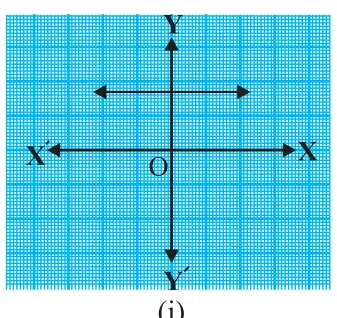
Solution:
Look at the first graph. This straight line is above the x-axis and never touches it.
So it has no zero. The number of zeroes is 0.
Remember, if a line is parallel to the x-axis, it never meets it. So the number of zeroes is 0.
Question 1 (ii)
Find the number of zeroes of from the graph.
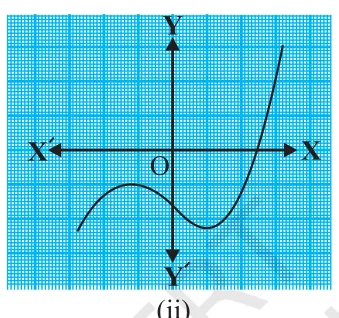
Solution:
The second graph cuts the x-axis at only one place, on the right side.
So it has only one zero. The number of zeroes is 1.
Question 1 (iii)
Find the number of zeroes of from the graph.
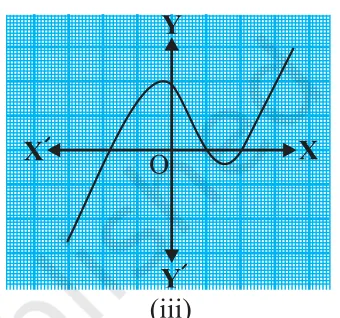
Solution:
In the third graph, the curve first cuts the x-axis on the left. Then it goes up, comes down, and cuts it two more times.
It cuts the x-axis three times in total, so the number of zeroes is 3.
Question 1 (iv)
Find the number of zeroes of from the graph.
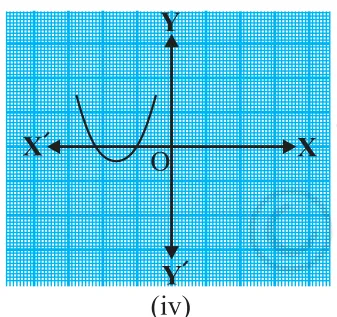
Solution:
The fourth graph is a parabola that goes below the x-axis, so it cuts the x-axis at two places.
So the number of zeroes is 2.
Remember this trick. A polynomial of degree n has at most n zeroes. A quadratic has at most 2.
Question 1 (v)
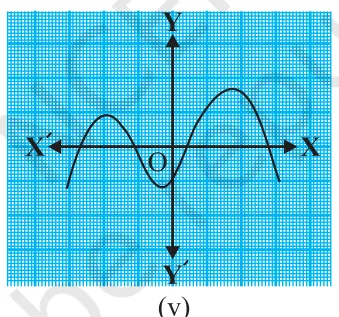
Find the number of zeroes of from the graph.
Solution:
In the fifth graph, the curve starts from the left and cuts the x-axis one, two, three and four times.
So the number of zeroes is 4.
Question 1 (vi)
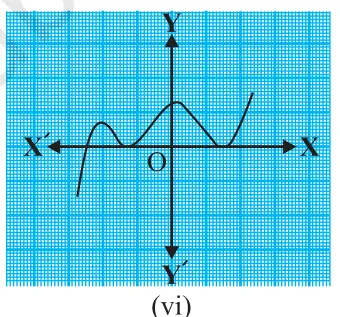
Find the number of zeroes of from the graph.
Solution:
In the last graph, the curve cuts the x-axis on the left and touches the x-axis at two places in the middle.
So it meets the x-axis three times in total. The number of zeroes is 3.
Key Takeaways – Exercise 2.1
- A zero of a polynomial p(x) is the x-value where the graph of p(x) crosses or touches the x-axis.
- The number of zeroes of p(x) equals the number of points where its graph intersects the x-axis.
- A graph that does not touch the x-axis at all has zero zeroes (e.g., Q1 part i).
- A polynomial of degree n can have at most n zeroes, which is visible from its graph.
- Exercise 2.1 has only 1 question with 6 graph-based parts – all answers come from reading the graph carefully.
CBSE Board Exam Tips
- In CBSE board exams, a 1-mark MCQ or VSA question is often asked on the number of zeroes from a graph – always count x-axis intersection points carefully, including points where the curve just touches (tangent) the x-axis.
- If the graph touches the x-axis at a point but does not cross it, that point still counts as a zero (with even multiplicity) – do not skip it.
- Remember: a straight line (linear polynomial) can have at most 1 zero, a parabola (quadratic) at most 2, and a cubic curve at most 3 – use this to cross-check your answer from the graph.
- Exercise 2.1 concepts are often tested indirectly in 2-mark questions where you are given the degree and asked the maximum possible zeroes, so make sure you understand the link between degree and number of zeroes.
Practice MCQs – Exercise 2.1
1. The graph of a polynomial p(x) is a straight line that cuts the x-axis at exactly one point. How many zeroes does p(x) have?
- A0
- B1
- C2
- D3
Show answer
Correct answer: B. 1
A straight line (linear polynomial) cuts the x-axis at exactly one point, so it has exactly 1 zero. The number of zeroes equals the number of x-axis intersections.
2. The graph of p(x) is a parabola that lies completely above the x-axis and never touches it. How many zeroes does p(x) have?
- A0
- B1
- C2
- D3
Show answer
Correct answer: A. 0
If the graph does not intersect the x-axis at all, the polynomial has no real zeroes. A parabola entirely above the x-axis has 0 zeroes.
3. A polynomial graph crosses the x-axis at x = -3, x = 0, and x = 5. What is the number of zeroes of this polynomial?
- A1
- B2
- C3
- D4
Show answer
Correct answer: C. 3
The number of zeroes equals the number of points where the graph crosses the x-axis. Since it crosses at 3 distinct points, the polynomial has 3 zeroes.
4. The graph of a quadratic polynomial touches the x-axis at exactly one point. How many zeroes does it have?
- A0
- B1
- C2
- D3
Show answer
Correct answer: B. 1
When a parabola touches (but does not cross) the x-axis at exactly one point, it has exactly 1 zero (a repeated root). That single touching point counts as one zero.
5. A cubic polynomial graph intersects the x-axis at two points and touches it (without crossing) at one more point. What is the total number of zeroes?
- A2
- B3
- C4
- D1
Show answer
Correct answer: B. 3
Each intersection point (crossing or touching) with the x-axis counts as a zero. Two crossings plus one touching point gives 3 zeroes in total.
6. What is the maximum number of zeroes a polynomial of degree 4 can have?
- A2
- B3
- C4
- D5
Show answer
Correct answer: C. 4
A polynomial of degree n has at most n zeroes. So a degree-4 polynomial can have at most 4 zeroes, meaning its graph can intersect the x-axis at most 4 times.
7. The graph of p(x) crosses the x-axis at x = 1 and x = -2, and touches it at x = 4. What is the number of zeroes of p(x)?
- A1
- B2
- C3
- D4
Show answer
Correct answer: C. 3
Both crossings and touchings of the x-axis count as zeroes. Here there are 2 crossings and 1 touching, giving a total of 3 zeroes.
8. Which of the following statements about zeroes of a polynomial is CORRECT?
- AThe number of zeroes equals the degree of the polynomial always.
- BZeroes of p(x) are the x-coordinates of points where the graph meets the x-axis.
- CA polynomial graph can never touch the x-axis without crossing it.
- DA quadratic polynomial always has exactly 2 zeroes.
Show answer
Correct answer: B. Zeroes of p(x) are the x-coordinates of points where the graph meets the x-axis.
By definition, the zeroes of p(x) are the values of x where p(x) = 0, which geometrically are the x-coordinates of the points where the graph meets the x-axis. The other options are incorrect because a polynomial may have fewer zeroes than its degree, graphs can touch without crossing, and a quadratic may have 0 or 1 zero.
9. A polynomial p(x) has its graph intersecting the x-axis at 4 distinct points. Which of the following could be the degree of p(x)?
- A2
- B3
- C4
- D1
Show answer
Correct answer: C. 4
If the graph intersects the x-axis at 4 distinct points, the polynomial has 4 zeroes. A polynomial must have degree at least 4 to have 4 zeroes, so degree 4 is the minimum valid answer among the options.
10. The graph of a polynomial p(x) is shown to cross the x-axis at x = -5 and x = 2 only. What is the number of zeroes of p(x)?
- A0
- B1
- C2
- D3
Show answer
Correct answer: C. 2
The graph crosses the x-axis at exactly 2 points (-5 and 2), so p(x) has exactly 2 zeroes. The number of zeroes is always equal to the number of x-axis intersection points.
Frequently Asked Questions
How many questions are there in NCERT Class 10 Maths Exercise 2.1?
Exercise 2.1 of Class 10 Maths Chapter 2 (Polynomials) has only 1 question, but it contains 6 parts – (i) to (vi). Each part shows a different graph of a polynomial and asks you to find the number of zeroes of p(x) from that graph.
What is the main concept tested in Exercise 2.1 of Class 10 Maths?
Exercise 2.1 tests the geometrical meaning of the zeroes of a polynomial. The key idea is that the number of zeroes of a polynomial p(x) is equal to the number of times its graph intersects (crosses or touches) the x-axis. No calculations are needed – you just read the graph.
Is Exercise 2.1 of Class 10 Maths important for the CBSE board exam?
Yes, it is important. The concept of finding zeroes from a graph is frequently asked as a 1-mark MCQ or a very short answer question in CBSE board exams. It is also the foundation for understanding the relationship between zeroes and coefficients covered in the rest of Chapter 2.
How do you find the number of zeroes of a polynomial from its graph?
Simply count the number of points where the graph of p(x) meets or cuts the x-axis. Each such point is a zero of the polynomial. If the graph does not touch the x-axis at all, the polynomial has zero zeroes.
What does it mean if the graph of p(x) touches the x-axis but does not cross it?
If the graph touches the x-axis at a point without crossing it, that point is still counted as a zero of the polynomial. This typically happens when the zero has an even multiplicity (for example, a repeated root). So you must count such touching points as zeroes too.
Can a polynomial have more zeroes than its degree?
No, a polynomial of degree n can have at most n zeroes. For example, a quadratic polynomial (degree 2) can have at most 2 zeroes, and a cubic polynomial (degree 3) can have at most 3 zeroes. This is why the graph of a quadratic can cross the x-axis at most 2 times.
Learn More: Polynomials
- Factorization of Polynomials Worksheet
- Long Division of Polynomials Calculator
- Operations with Polynomials: Complete Guide
NCERT Class 10 Maths Solutions – All Exercises
- Chapter 1: Real Numbers – Exercise 1.1, Exercise 1.2
- Chapter 2: Polynomials – Exercise 2.1
Source: Questions from the NCERT Mathematics Textbook for Class 10, Chapter 2. Solutions written by IrfanEdu.