
Factoring Calculator: Factor Any Expression Instantly
Whether you are stuck on a homework problem or need to verify your algebra work, this factoring calculator handles both integers and quadratic polynomials — and shows every step so you can learn, not just copy an answer.
Factoring is the process of rewriting a number or algebraic expression as a product of simpler parts. For integers, that means prime factors. For polynomials, it means binomials or monomials whose product equals the original expression. Mastering factoring unlocks simplifying fractions, solving quadratic equations, and understanding higher algebra.
A factoring calculator breaks a number or polynomial into its irreducible factors. For integers it finds prime factors; for polynomials it extracts the GCF, then applies the ac-method or special-product identities. Enter your expression, press Calculate, and the tool shows every step — no algebra required.
Factoring Calculator
Factor integers or quadratic polynomials — step by step
Enter a positive integer between 2 and 999,999,999.
How to Use This Calculator
- Choose a mode. Select “Factor Integer” to find prime factors of a whole number, or “Factor Quadratic” to factor an expression of the form ax² + bx + c.
- Enter your values. For integers, type the number. For quadratics, enter the three integer coefficients a, b, and c separately.
- Press Calculate. The result card appears instantly with the factored form and a numbered step-by-step solution.
- Read the steps. Each step mirrors what you would write on paper — use it to check your own working.
- Press Reset to clear all fields before a new problem.
What Is Factoring?
Factoring is the process of expressing a number or algebraic expression as a product of two or more simpler parts called factors. For the integer 12, factoring gives 2² × 3. For the polynomial x² + 5x + 6, factoring gives (x + 2)(x + 3).
Factoring is the algebraic inverse of expanding. Where expanding multiplies factors to produce a polynomial, factoring reverses that operation. It is a foundational skill for simplifying rational expressions, solving quadratic equations, and working with polynomial functions at every level of mathematics.
In my experience teaching algebra, students who understand why factoring works — not just the steps — solve problems significantly faster on timed assessments. The key insight is that every factoring technique is really just pattern recognition applied to multiplication.
The Formulas Explained
Core Factoring Formulas
GCF extraction: ax + ay = a(x + y)
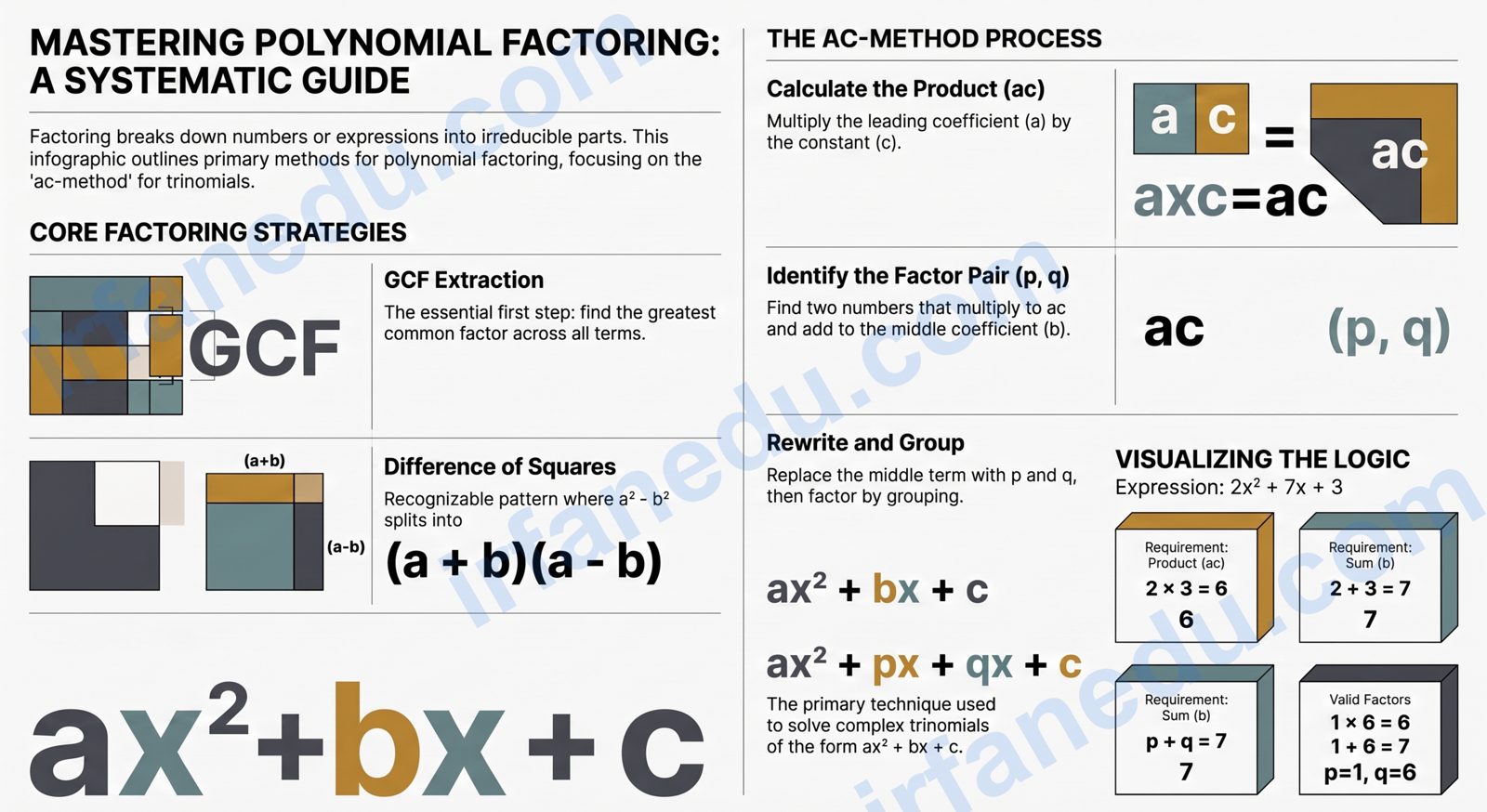
ac-method (trinomial): For ax² + bx + c, find integers p and q such that p × q = ac and p + q = b. Rewrite and factor by grouping.
Difference of squares: a² − b² = (a + b)(a − b)
Perfect square trinomial: a² + 2ab + b² = (a + b)²
| Symbol | Meaning | Example |
|---|---|---|
| a, b, c | Integer coefficients of ax² + bx + c | 2, 7, 3 |
| p, q | Factor pair: p×q = ac, p+q = b | 1, 6 for 2x²+7x+3 |
| GCF | Greatest common factor of all terms | GCF(6,9,3) = 3 |
| Δ (disc.) | Discriminant: b² − 4ac | 49 − 24 = 25 |
Worked Examples
Example 1 (Quick): Factor 2x² + 7x + 3
Step-by-step solution
- Write the expression:
2x² + 7x + 3 - GCF of 2, 7, 3 = 1 (no extraction needed).
- Compute ac = 2 × 3 = 6. Find p, q: p×q = 6 and p+q = 7. Answer:
p = 1, q = 6. - Rewrite:
2x² + 1x + 6x + 3 - Group:
x(2x + 1) + 3(2x + 1) - Factor out (2x + 1):
(2x + 1)(x + 3)
Example 2 (Thorough): Factor 6x² − 11x − 10
Step-by-step solution
- Write the expression:
6x² − 11x − 10 - GCF of 6, 11, 10 = 1 (no extraction).
- Discriminant: (−11)² − 4×6×(−10) = 121 + 240 = 361 = 19². Real integer roots confirmed.
- Compute ac = 6 × (−10) = −60. Find p, q: p×q = −60 and p+q = −11. Answer:
p = −15, q = 4(since −15×4 = −60 and −15+4 = −11). - Rewrite:
6x² − 15x + 4x − 10 - Group:
3x(2x − 5) + 2(2x − 5) - Factor out (2x − 5):
(2x − 5)(3x + 2) - Verify by expanding: (2x−5)(3x+2) = 6x²+4x−15x−10 = 6x²−11x−10. ✓
  Factor: 6x² - 11x - 10
  ┌─────────────────────────────────────────┐
  │  Step 1: ac = 6 × (-10) = -60          │
  │  Step 2: Find p, q → -15 × 4 = -60     │
  │                    → -15 + 4 = -11 ✓   │
  │  Step 3: Rewrite middle term            │
  │  6x² - 15x + 4x - 10                   │
  │  Step 4: Group                          │
  │  3x(2x - 5) + 2(2x - 5)                │
  │  Step 5: Factor out (2x - 5)            │
  │  (2x - 5)(3x + 2)           ✓          │
  └─────────────────────────────────────────┘
Common Mistakes When Factoring
Mistake 1: Skipping the GCF Step
Wrong: Jumping straight to the ac-method on 4x² + 8x + 4.
Right: Extract GCF = 4 first to get 4(x² + 2x + 1), then factor the simpler trinomial as 4(x + 1)². Skipping GCF forces you to work with larger numbers and increases errors.
Written and fact-checked by Dr Irfan Mansuri. External links open in a new tab and are provided for further reading and verification.