
How Long Should a Tie Be
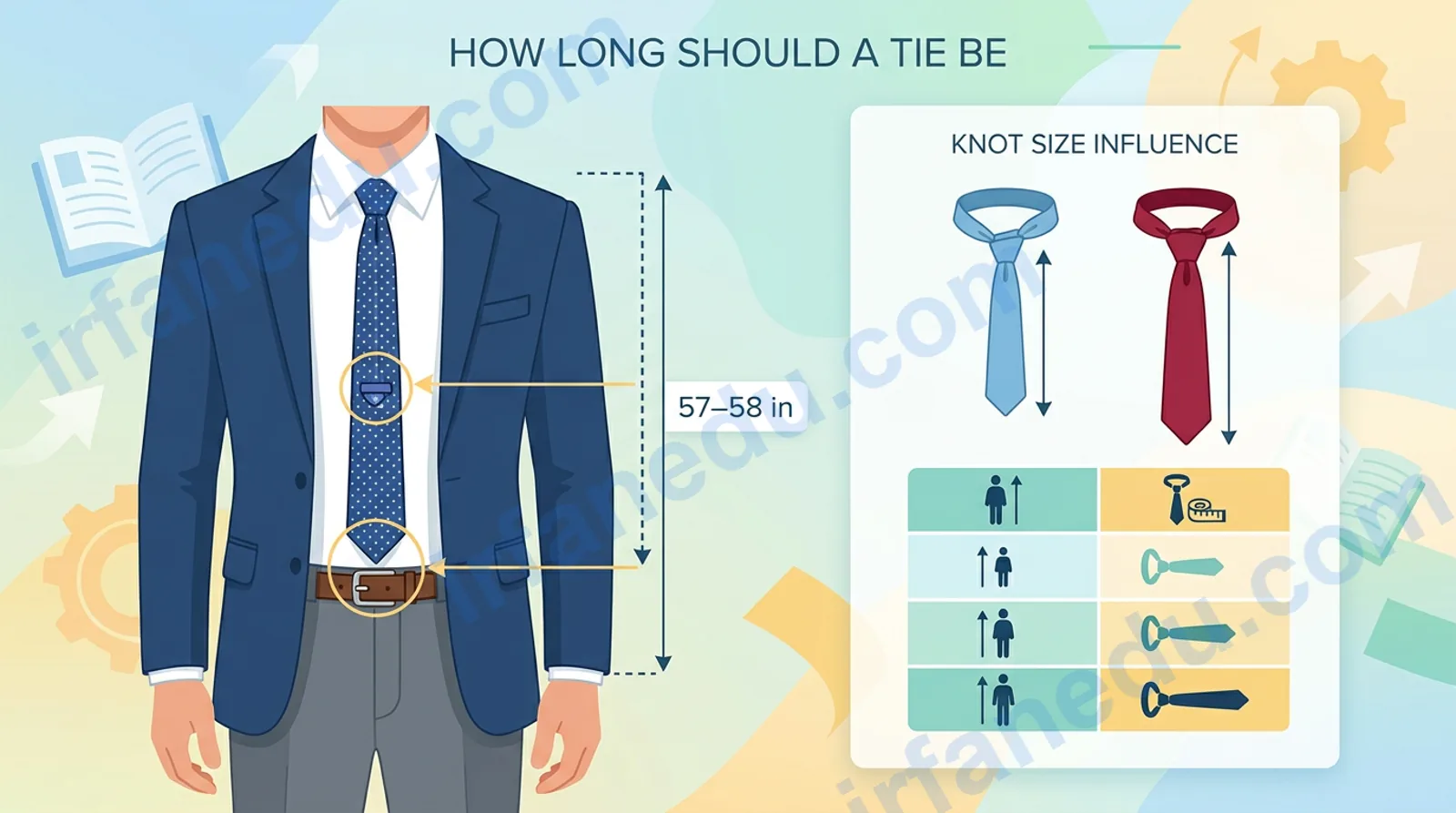
The single most common tie mistake I see is length. A tie that hangs two inches past the belt buckle looks sloppy. One that stops at the chest looks like a clip-on from 1987. The rule is simple: the front blade tip ends at your trouser waistband — right at the top of your belt buckle. The tricky part is that your height, torso proportions, and knot style all shift where that tip lands. Use the calculator below to get your number in seconds.
| Quick Answer — How long should a tie be? |
|---|
| A tie should be 57 to 58 inches long for most men. When knotted and worn, the front blade tip should end right at your trouser waistband — at or just touching the top of your belt buckle. Taller men (6’3″ and above) may need an XL tie of 60–63 inches. Knot size matters: a Full Windsor consumes about 4 extra inches versus a Four-in-Hand. |
📌 Quick Summary
- Standard tie length is 57–58 inches for men 5’7″–6’2″.
- The front blade tip should end at the top of your belt buckle.
- XL ties (60–63 in) are needed for men 6’3″ and taller.
- A Full Windsor knot uses ~4 extra inches of length.
- The back blade should be shorter — tuck it into the keeper loop.
- Width (2.5–3.5 in) is separate from length but affects proportion.
Tie Length Calculator
Enter your height and knot style — get your recommended tie length in inches.
ft
in (0–11)
affects length used
inches recommended
Step-by-step solution
How to use this calculator
- Type your height in feet and the remaining inches (e.g., 5 ft 10 in).
- Select your preferred knot style from the dropdown.
- Click Calculate. Your recommended tie length appears instantly.
- Read the step-by-step breakdown to understand exactly how the number was derived.
- Use the category label (Standard / XL) when shopping online or in-store.
What is correct tie length?
Correct tie length means the front blade tip ends at the top of your trouser waistband — right at your belt buckle. This is the single agreed-upon rule in American menswear, from the history of the necktie through to modern dress codes. The back blade should be shorter and tucked into the keeper loop (the small fabric loop on the back of the front blade).
Total tie length — measured flat from tip to tip — is what manufacturers list. Most standard ties sold in the US run 57 to 58 inches. That length works for men roughly 5'7" to 6'2" tying a Four-in-Hand knot. Outside that range, you need to adjust.
In my experience advising students before job interviews and formal events, the tip-at-waistband rule is the one detail that separates a polished look from an awkward one. I've seen candidates lose confidence simply because their tie was two inches too long and they kept fidgeting with it. Getting the length right is a five-second fix that pays off every time you wear a tie.
The formula explained
There is no single algebraic formula for tie length — it is a lookup rule based on height ranges, adjusted for knot size. Here is how I model it:
Tie length formula
Recommended length = Base length (by height) + Knot adjustment
- Height ≤ 5'7" (67 in total): Base = 57 in
- Height 5'8"–6'2" (68–74 in total): Base = 58 in
- Height ≥ 6'3" (75+ in total): Base = 60 in
Knot adjustments: Four-in-Hand +0 in | Pratt/Shelby +1 in | Half Windsor +2 in | Kelvin +2 in | Full Windsor +4 in
Variables & symbols table
| Symbol | Meaning | US unit |
|---|---|---|
| H | Your total height | inches |
| Lbase | Base tie length for your height range | inches |
| K | Extra length consumed by your knot | inches |
| Lrec | Recommended total tie length | inches |
The knot adjustment accounts for the fact that a larger knot wraps more fabric around itself, effectively shortening the front blade. A Full Windsor wraps the wide blade around the knot twice, consuming roughly 3–4 extra inches.
Knot type comparison
Different knots consume different amounts of tie length. This comparison table shows what each knot costs you in inches and what collar type it suits best.
| Knot | Extra length used | Knot size | Best collar type |
|---|---|---|---|
| Four-in-Hand | 0 in | Small, asymmetric | Narrow / button-down |
| Pratt / Shelby | +1 in | Medium | Spread / semi-spread |
| Half Windsor | +2 in | Medium-large | Spread / semi-spread |
| Kelvin | +2 in | Medium | Spread |
| Full Windsor | +4 in | Large, triangular | Wide spread / cutaway |
Worked examples
Example 1 — 5'10" man, Four-in-Hand knot
Total height: 5 × 12 + 10 = 70 inches. Height range: 68–74 in, so base = 58 in. Knot adjustment: Four-in-Hand = +0 in. Recommended: 58 inches. Category: Standard. When wearing, the front blade tip should land right at the belt buckle.
Example 2 — 6'4" man, Full Windsor knot
Total height: 6 × 12 + 4 = 76 inches. Height range: 75+ in, so base = 60 in. Knot adjustment: Full Windsor = +4 in. Recommended: 64 inches. Category: XL. Standard 58-inch ties will fall several inches short of the waistband — an XL tie is essential here.
Example 3 — 5'5" man, Half Windsor knot
Total height: 5 × 12 + 5 = 65 inches. Height range: ≤ 67 in, so base = 57 in. Knot adjustment: Half Windsor = +2 in. Recommended: 59 inches. A standard 57-in tie will leave the tip slightly above the waistband — look for a 59-in option or start the knot with the wide blade lower.
Visual: where the tip should land
  ┌──────────────────────┐
  │   COLLAR / SHIRT     │
  │                      │
  │     ┌──────┐         │
  │     │ KNOT │         │
  │     └──┬───┘         │
  │        │ front blade │
  │        │             │
  │        │             │
  │        ▼             │
  │  ══════╪══════  ← BELT BUCKLE / WAISTBAND
  │        ▼  TIP ends HERE
  │                      │
  └──────────────────────┘
Common mistakes and how to fix them
Mistake 1 — Tie hangs below the waistband
Wrong: Starting the knot with the wide blade too high on the chest, leaving too much length below the knot. Fix: Begin with the wide blade lower — about 12 inches below the narrow blade — and re-tie.
Mistake 2 — Tie stops at the navel
Wrong: Using a standard 57-in tie with a Full Windsor knot. The knot eats 4 extra inches and the tip ends up too high. Fix: Buy an XL tie or switch to a smaller knot.
Mistake 3 — Back blade hangs below the front blade
Wrong: Ignoring the keeper loop on the back of the front blade. Fix: Always thread the back blade through the keeper loop so it stays hidden and the front blade hangs freely.
The most underrated fix I teach is simply adjusting where you start the knot on your torso. Most men buy a new tie when the real problem is technique. Before spending $40 on an XL tie, try starting your existing tie with the wide blade 2–3 inches lower than usual — it often solves the length problem entirely without any new purchase.
💡 Unique Insight — what most guides get wrong about tie length
Almost every guide online treats tie length as purely a function of total height. That misses the real variable: torso-to-leg ratio. Two men who are both 5'10" can have very different torso lengths — one may have a 30-inch inseam and a long torso, the other a 34-inch inseam and a short torso. The man with the longer torso needs the tie to travel further before reaching the waistband, so he should start the knot with the wide blade 1–2 inches lower than the standard starting position. Height is a useful proxy, but if you find the standard length consistently misses your waistband, your torso-to-leg ratio is the real culprit — not the tie.
Quick quiz — test your tie knowledge
1. Where should the front blade tip of a tie end?
2. A Full Windsor knot uses approximately how many extra inches of tie length compared to a Four-in-Hand?
3. What length tie should a 6'4" man generally buy?
Frequently asked questions
How long should a tie be for a standard adult man?
How far down should a tie go?
Does knot type affect how long my tie needs to be?
What is an XL tie and who needs one?
Key takeaways
- The front blade tip must end at your trouser waistband — this is the universal rule.
- Standard tie length is 57–58 inches for most US men (5'7"–6'2").
- Men 6'3" and taller need XL ties (60–63 inches).
- A Full Windsor knot consumes ~4 extra inches — plan accordingly.
- Torso-to-leg ratio matters more than height alone; adjust starting position if needed.
- Always tuck the back blade into the keeper loop so it stays hidden.
Dr. Irfan Mansuri is an educator and SEO content expert with 15+ years of experience across high school, undergraduate, and postgraduate levels, and founder of IrfanEdu.com. I combine deep subject knowledge with proven test-taking strategies to make complex ideas simple. Connect on LinkedIn.
Sources & references
Editorial note: This article was written and fact-checked by Dr. Irfan Mansuri. Tie length figures are based on widely accepted US menswear standards. No statistics were fabricated. Last reviewed September 2026.