
Discount Calculator: Find Sale Price & Savings Fast
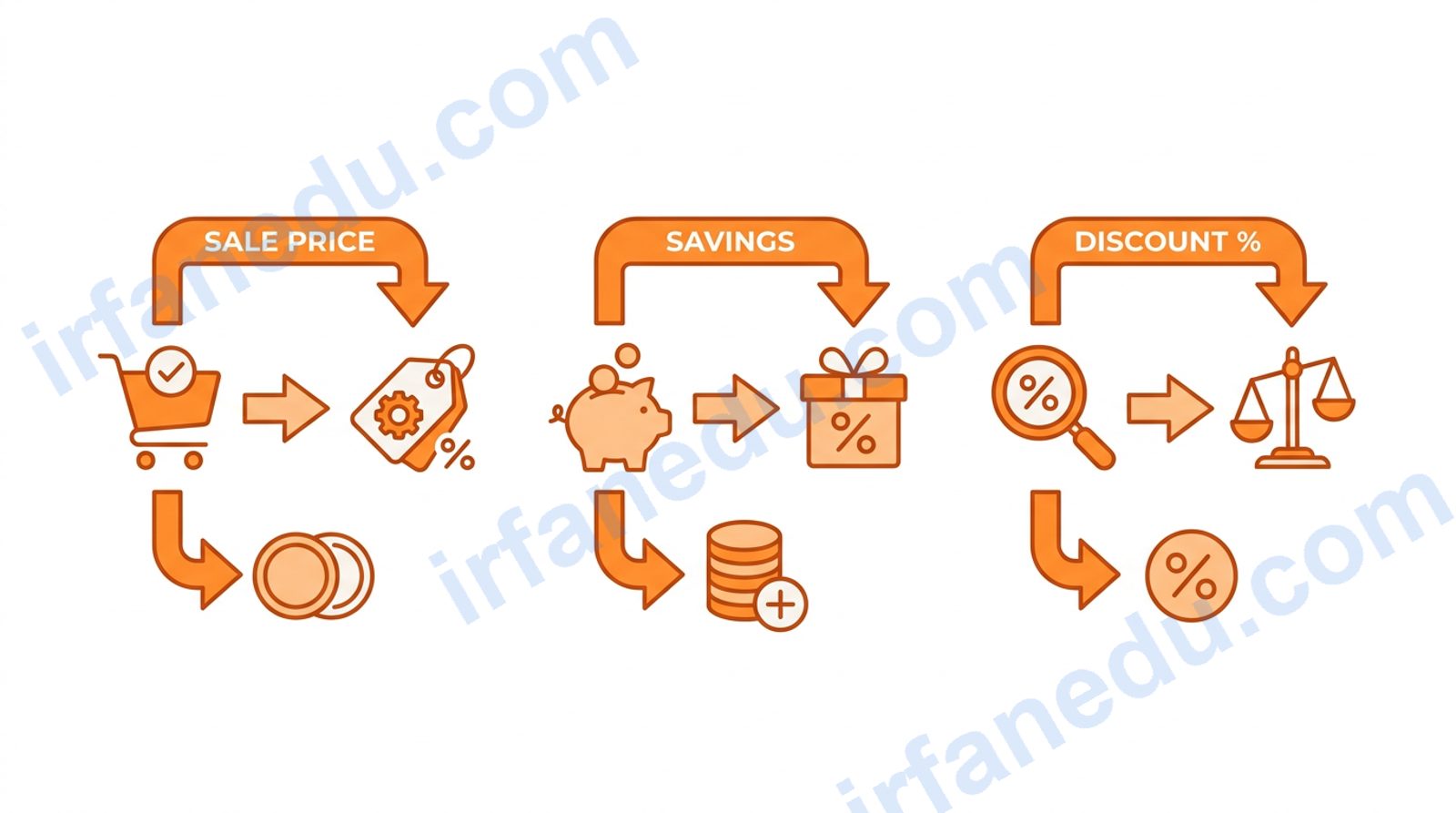
Retail buyers, procurement officers, and small-business owners use a discount calculator every single day to verify that the “40% off” sticker on a supplier invoice actually translates to the savings they expect — before the purchase order is signed. The math looks simple, but a single misplaced decimal can mean overpaying by hundreds of dollars on a bulk order. This tool does the arithmetic for you and shows every step so you can audit the result.
A discount calculator finds the sale price, savings amount, or discount percentage using the formula: Sale Price = Original Price × (1 − Discount% ÷ 100). For example, a 25% discount on an $80 item gives a sale price of $60 and savings of $20. To reverse it: Discount% = (Savings ÷ Original Price) × 100.
⚡ In Short
- Sale Price = Original Price × (1 − Discount% ÷ 100)
- Savings = Original Price × Discount% ÷ 100
- Discount% = (Savings ÷ Original Price) × 100
- Stacked discounts multiply, they do NOT add — 20% + 10% = 28%, not 30%
- Use the calculator below to solve for any one of the three unknowns instantly
Discount Calculator
Choose what you want to find, then fill in the known values.
$
%
Step-by-Step Solution
The three core discount formulas:
Sale Price = Original Price × (1 − Discount% ÷ 100)Savings = Original Price × (Discount% ÷ 100)Discount% = (Savings ÷ Original Price) × 100Original Price = Sale Price ÷ (1 − Discount% ÷ 100)| Symbol | Meaning | Unit |
|---|---|---|
| P | Original (list) price | Currency ($, €, £, etc.) |
| d | Discount rate | Percent (%) |
| S | Sale (discounted) price | Currency |
| Savings | Amount saved | Currency |
What is a discount? A discount is a reduction applied to the original (list) price of a product or service, expressed as a percentage of that original price. The result is the sale price — the amount the buyer actually pays.
Discounts appear in retail promotions, wholesale pricing, invoice settlements, and financial negotiations. The same percentage-based formula applies in every context, whether you are buying a jacket at 30% off or negotiating a 15% early-payment discount on a supplier invoice.
How to Use This Discount Calculator
- Pick your mode. Choose what you want to find: Sale Price, Savings Amount, Discount %, or Original Price.
- Enter the known values. Fill in the labeled fields. Each input shows a placeholder example so you know the expected format.
- Click Calculate. The result card appears instantly with the answer, useful unit conversions, and a numbered step-by-step breakdown.
- Audit the steps. The step-by-step solution plugs in your exact numbers, so you can verify the math yourself.
- Click Reset to clear all fields and start a new calculation.
What Is a Discount?
A discount is a percentage-based reduction applied to the original (list) price of a product or service. The buyer pays the reduced amount — the sale price — while the difference between the two prices is the savings.
Discounts appear everywhere: a 15% early-payment reduction on a B2B invoice, a "buy one get one 50% off" retail promotion, or a 10% student concession at a bookstore. In every case, the same three-variable relationship holds: original price, discount rate, and sale price. Know any two, and you can find the third.
In my experience tutoring students and working with small-business owners, the most common confusion is between the discount amount and the discount rate. A "$20 off" coupon and a "20% off" coupon are very different things — but people treat them interchangeably. The formula makes the distinction explicit: the rate is always relative to the original price, never to the sale price.
The Discount Formula Explained
Three formulas cover every discount scenario. They are all rearrangements of the same relationship.
| Goal | Formula | Example (P=$80, d=25%) |
|---|---|---|
| Find Sale Price | S = P × (1 − d/100) | $80 × 0.75 = $60 |
| Find Savings | Savings = P × d/100 | $80 × 0.25 = $20 |
| Find Discount % | d = (Savings / P) × 100 | ($20 / $80) × 100 = 25% |
| Find Original Price | P = S / (1 − d/100) | $60 / 0.75 = $80 |
The multiplier (1 − d/100) is the key. It converts the discount rate into the fraction of the original price you actually pay. A 25% discount means you pay 75% of the original — so multiply by 0.75.
Worked Examples
Example 1: Retail Purchase (Find Sale Price)
A jacket has an original price of $120 and is on sale at 35% off. What is the sale price?
- Savings = $120 × 0.35 = $42
- Sale Price = $120 − $42 = $78
You pay $78 and save $42. Verify with the multiplier: $120 × 0.65 = $78. Both routes give the same answer.
Example 2: Reverse Calculation (Find Original Price)
A laptop is listed at a sale price of $850 after a 15% discount. What was the original price?
- Multiplier = 1 − 0.15 = 0.85
- Original Price = $850 ÷ 0.85 = $1,000
This is the calculation most people get wrong — they add 15% to $850 and get $977.50, which is incorrect. You must divide by the multiplier, not add the percentage back.
  Original Price ($1,000)
       |
       | × 0.85 (i.e. 1 - 15/100)
       v
  Sale Price ($850)
       |
       | ÷ 0.85  <-- reverse: find original
       v
  Original Price ($1,000)

  Savings = $1,000 - $850 = $150
  Check: $150 / $1,000 × 100 = 15% ✓
Example 3: Finding Discount Percentage
A supplier charges $340 for an item that normally costs $400. What discount percentage are they offering?
- Savings = $400 − $340 = $60
- Discount% = ($60 ÷ $400) × 100 = 15%
Common Mistakes When Calculating Discounts
These errors appear constantly in classrooms and in real purchasing decisions. Knowing them saves money.
| Wrong Approach | Correct Approach |
|---|---|
| Adding the discount % back to the sale price to find the original (e.g. $850 + 15% = $977.50) | Divide the sale price by (1 − d/100): $850 ÷ 0.85 = $1,000 |
| Adding stacked discounts (20% + 10% = 30%) | Apply sequentially: $100 × 0.80 = $80, then $80 × 0.90 = $72 (28% total, not 30%) |
| Calculating discount on the sale price instead of the original price | Always apply the discount rate to the original (list) price |
| Confusing a flat dollar-off coupon with a percentage discount | Convert to percentage first: ($20 off $100) = 20% discount |
The stacked-discount mistake is the one I see most often in procurement settings. A vendor offers "20% off, then an extra 10% for early payment" — and the buyer assumes they are getting 30% off. They are not. They are getting 28% off. On a $50,000 order, that $1,000 difference matters. Always multiply the multipliers: 0.80 × 0.90 = 0.72, meaning you pay 72% of the original price.
Real-World Applications of Discount Calculations
Discount math is not just for shopping — it appears in finance, business, and everyday negotiations.
| Context | How Discounts Are Used | Key Formula |
|---|---|---|
| Retail / E-commerce | Seasonal sales, clearance pricing, coupon codes | Sale Price = P × (1 − d/100) |
| B2B Procurement | Volume discounts, early-payment terms (e.g. 2/10 net 30) | Savings = P × d/100 |
| Finance | Bond pricing, present value calculations use discount rates | PV = FV ÷ (1 + r
Sources & ReferencesWritten and fact-checked by Dr Irfan Mansuri. External links open in a new tab and are provided for further reading and verification. |