
HESI Practice Test: The Complete 2026 Study Guide That Actually Works
Think of the HESI A2 exam the way a pilot thinks about a flight simulator. The simulator does not replace real flying, but no serious pilot skips it — because the cockpit should never be the first place you meet a problem. A HESI practice test works exactly the same way: it puts you inside the real exam’s pressure before the score actually counts.
In this guide I break down every section of the HESI A2, show you exactly how to build a study plan around practice tests, and give you a worked math example that trips up more students than any other question type. Whether you are preparing for nursing school, allied health, or a dental hygiene program, this is the most practical HESI prep guide you will find.
After reading this guide, you will be able to:
- Identify every HESI A2 section and what it tests
- Interpret your practice test scores and know what they mean
- Build a realistic 6-week study plan around timed practice tests
- Avoid the three most common HESI prep mistakes
📌 Quick Summary
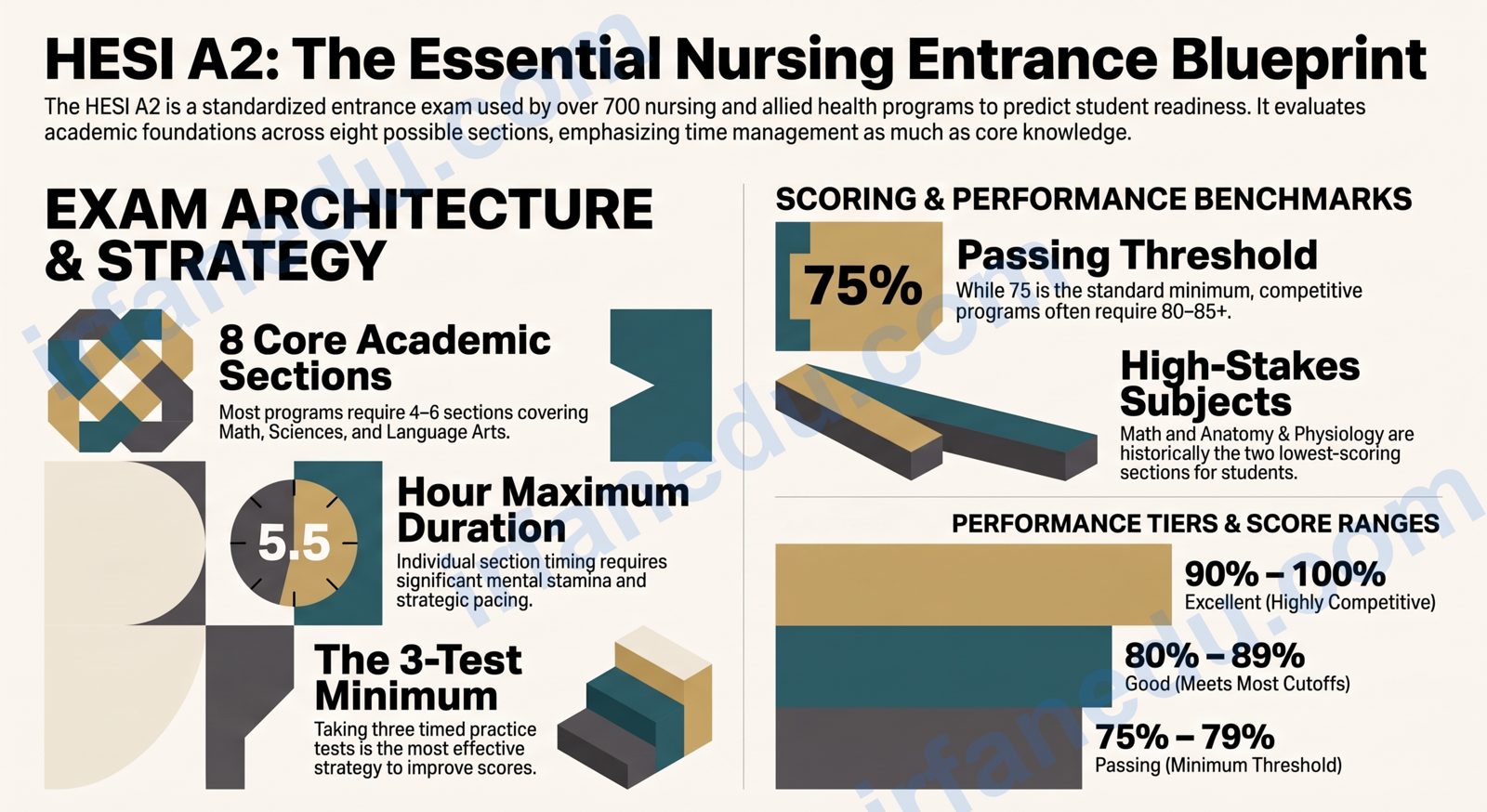
- 📝 HESI A2 has up to 8 sections; most programs require 4-6 of them
- 🎯 Passing score is typically 75/100; competitive programs want 80+
- ⏱ Full exam can run up to 5.5 hours; plan your stamina accordingly
- 📊 Math and Anatomy & Physiology are the two lowest-scoring sections on average
- 🔄 Three timed full-length practice tests is the research-backed minimum before test day
- 🆓 Free resources exist (Khan Academy, Elsevier portal) but paid sims are more realistic
1. What Is the HESI A2 Exam?
The HESI A2 (Health Education Systems, Inc. Admission Assessment) is a standardized entrance exam that nursing and allied health programs use to predict student readiness. It is published by Elsevier and administered at approved testing centers worldwide.
The exam does not test nursing knowledge — it tests the academic foundation you need before nursing school. Think of it as a readiness check: can you handle the math, reading, and science demands of a rigorous clinical program?
Students applying to Associate Degree Nursing (ADN), Bachelor of Science in Nursing (BSN), Licensed Practical Nurse (LPN), Dental Hygiene, Radiologic Technology, and other allied health programs. Over 700 programs in the United States and internationally use HESI A2 scores in their admissions process.
The exam is computer-based, individually timed by section, and scored on a 0-100 scale per section. Your composite score is the average of all required sections. Schools set their own minimum cutoffs, so a score that gets you into one program may not meet another program’s requirement.
2. HESI A2 Sections: Full Breakdown
The HESI A2 contains up to 8 academic sections plus an optional Personality Profile and Learning Style assessment. Here is what each section tests and how many questions it contains.
| Section | Questions | Time Limit | What It Tests | Avg. Difficulty |
|---|---|---|---|---|
| Math | 55 | 50 min | Fractions, ratios, dosage calculations, basic algebra | Medium-High |
| Reading Comprehension | 55 | 60 min | Main idea, inference, vocabulary in context | Medium |
| Vocabulary & General Knowledge | 55 | 50 min | Medical and general vocabulary definitions | Medium |
| Grammar | 55 | 50 min | Parts of speech, sentence structure, punctuation | Medium |
| Biology | 30 | 25 min | Cell biology, genetics, metabolism, ecosystems | Medium-High |
| Chemistry | 30 | 25 min | Periodic table, chemical reactions, atomic structure | High |
| Anatomy & Physiology | 30 | 25 min | Body systems, organs, physiological processes | High |
| Physics | 25 | 50 min | Motion, forces, energy, waves, electricity | High |
Most nursing programs require Math, Reading Comprehension, Vocabulary, Grammar, and Anatomy & Physiology. Physics is required less often but appears in some radiologic technology and respiratory therapy programs. Always verify with your specific program.
3. Quick Facts Table
| Fact | Detail |
|---|---|
| Full Name | HESI Admission Assessment (HESI A2) |
| Publisher | Elsevier Health Sciences |
| Format | Computer-based, multiple choice |
| Total Sections | Up to 8 academic + optional personality/learning style |
| Scoring Scale | 0–100 per section; composite = average of required sections |
| Typical Passing Score | 75 composite (varies by program) |
| Maximum Exam Duration | ~5.5 hours (all 8 sections) |
| Retake Policy | Varies by school; typically 60-day waiting period |
| Cost | Approx. $40–$70 USD (set by testing institution) |
| Official Study Materials | Elsevier HESI A2 Study Guide (sold separately) |
4. How HESI Scoring Works
Each HESI A2 section is scored on a 0-100 scale, where your score represents the percentage of questions you answered correctly. There is no penalty for wrong answers, so you should always guess rather than leave a question blank.
Your composite score is the arithmetic mean of all required sections. If your program requires five sections and you score 80, 78, 72, 85, and 76, your composite is (80+78+72+85+76) ÷ 5 = 78.2.
- 90-100: Excellent — highly competitive for selective programs
- 80-89: Good — meets or exceeds most program cutoffs
- 75-79: Passing — meets minimum at most schools; borderline for competitive programs
- Below 75: Below typical cutoff — retake recommended after targeted study
One thing most guides do not explain clearly: your HESI score report also shows a national percentile rank. A score of 80 might put you in the 65th percentile nationally. Admissions committees at competitive programs often look at percentile rank alongside the raw score, so aiming for 85+ gives you a meaningful edge.
5. Practice Test vs. Real Exam: Key Differences
Knowing the differences between a HESI practice test and the real exam helps you calibrate your preparation and avoid false confidence — or unnecessary anxiety.
| Feature | HESI Practice Test | Real HESI A2 |
|---|---|---|
| Question source | Third-party or Elsevier sample bank | Official Elsevier question bank |
| Score counts for admissions | No | Yes |
| Timed per section | Depends on platform | Always timed |
| Immediate feedback | Usually yes | Score report only |
| Calculator allowed | Platform-dependent | On-screen calculator provided for Math |
| Retake freely | Yes | 60-day wait (most schools) |
| Cost | Free to ~$30 | $40–$70 per attempt |
In my experience working with pre-nursing students, the biggest mistake I see is treating practice tests as content review tools rather than performance simulators. A practice test is only valuable if you take it under exact real conditions — timed, no notes, no phone, no pausing. Students who do this consistently score 8-12 points higher on the actual exam than those who “practice” by reading through questions casually. The discomfort of a timed simulation is the point.
6. How to Build a 6-Week HESI Study Plan
A structured 6-week plan gives you enough time to cover content, practice under timed conditions, and review mistakes without burning out. Here is the framework I recommend to every pre-nursing student I work with.
- Confirm your required sections. Contact your nursing program directly. Ask which sections they require, what minimum score they accept, and whether they consider the composite or individual section scores. This single step saves you from studying sections you do not need.
- Take a diagnostic practice test (Week 1). Sit a full timed practice test with no preparation. Your raw scores tell you exactly where to focus. Do not skip this step — guessing at your weak areas wastes weeks.
- Content review by section (Weeks 2-4). Spend the most time on your lowest-scoring sections. Use the official Elsevier HESI A2 Study Guide for content, Khan Academy for math and science foundations, and Quizlet decks for vocabulary. Aim for 60-90 minutes of focused study per day.
- Take a second full practice test (Week 4). Compare your scores to Week 1. Sections that improved confirm your study method is working. Sections that did not improve need a different approach — try a different resource or ask a tutor.
- Targeted drilling (Week 5). Focus exclusively on remaining weak sections. Do 30-50 practice questions per weak section daily. Review every wrong answer and understand the reasoning, not just the answer.
- Final practice test + light review (Week 6). Take your third full timed practice test at the start of Week 6. Aim for 80+ on every required section. The last 2-3 days before the exam: light review only, no new content, prioritize sleep and routine.
- ☐ Scored 80+ on all required sections in a timed practice test
- ☐ Reviewed and understood every wrong answer from all 3 practice tests
- ☐ Know your testing center location and arrival time
- ☐ Confirmed what ID and materials to bring
- ☐ Practiced with the on-screen calculator for Math
- ☐ Slept 7-8 hours the night before
- ☐ Eaten a proper meal before the exam
📐 Explore the Complete Geometry Formula Sheet →
7. Worked Example: HESI Math Problem
The HESI Math section trips up more students than any other section because it includes dosage calculation questions that require unit conversion. Here is a worked example of the exact type that appears most often.
HESI MATH — DOSAGE CALCULATION (WORKED SOLUTION)
═══════════════════════════════════════════════════

  GIVEN:
  ┌─────────────────────────────────────────────┐
  │  Dose required   = 0.5 mg                   │
  │  Dose available  = 0.25 mg per tablet        │
  └─────────────────────────────────────────────┘

  FORMULA:
  ┌─────────────────────────────────────────────┐
  │  Tablets = Dose Required ÷ Dose per Tablet  │
  └─────────────────────────────────────────────┘

  CALCULATION:
  ┌─────────────────────────────────────────────┐
  │  Tablets = 0.5 mg ÷ 0.25 mg/tablet          │
  │  Tablets = 2 tablets                        │
  └─────────────────────────────────────────────┘

  ✅ ANSWER: Give 2 tablets.

  COMMON MISTAKE: Dividing 0.25 ÷ 0.5 instead
  of 0.5 ÷ 0.25 — always put REQUIRED on top.
The key rule: always put the required dose in the numerator. Students who flip the fraction consistently get these wrong. In my experience, practicing 20 dosage calculation problems per day for one week eliminates this error almost entirely.
Most prep guides tell you to study your weakest section hardest. That advice is incomplete — and can backfire.
Here is what I have observed across hundreds of pre-nursing students: if your weakest section is Chemistry or Physics and your program does not require those sections, studying them is pure wasted time. Worse, students who over-invest in a low-weight section often under-prepare for Math or Anatomy & Physiology, which nearly every program requires.
The correct strategy is: study by required-section weight, not by personal weakness. Rank your required sections by how much each one affects your composite score, then allocate study hours proportionally. A student who needs a 78 composite across 5 required sections should spend 40% of their study time on Math and A&P alone — because those two sections have the highest variance and the lowest average scores nationally.
8. Best HESI Practice Test Resources
Not all HESI practice resources are equal. Here is an honest breakdown of what is actually worth your time and money.
- Elsevier Student Portal: Limited free sample questions in the official format — the closest thing to real HESI questions available for free
- Khan Academy: Excellent for Math foundations (fractions, ratios, algebra) and Biology/Chemistry content review
- Quizlet: Community-created HESI vocabulary and A&P flashcard decks — useful for spaced repetition
- YouTube: Search “HESI A2 [section name] review” for free video walkthroughs
- Mometrix HESI A2 Study Guide (~$30-40): Most realistic full-length practice tests; detailed answer explanations
- Pocket Prep HESI A2 App (~$15/month): Best mobile option; adaptive question bank; tracks your progress by section
- Official Elsevier HESI A2 Study Guide (~$40): Published by the exam maker; content review is authoritative but practice questions are limited
- Nursehub / NurseAchieve: Full-length timed simulations closest to the real exam interface
My honest recommendation: start with Khan Academy (free) for content gaps, then invest in one paid full-length simulation platform for your timed practice tests. You do not need to buy everything — one good paid resource plus free content review is enough for most students.
🧠 Quick Knowledge Check
Test what you just learned. Select an answer to see if you are right.
Q1. What is the typical minimum composite score required to pass the HESI A2?
Q2. How many academic sections does the HESI A2 contain at maximum?
Q3. In a HESI dosage calculation, if the required dose is 1.5 mg and the available dose is 0.5 mg per tablet, how many tablets are needed?
9. Practice Problems
Try each problem on your own first, then click to reveal the full solution.
📝 Practice Problem 1 — Math: A patient needs 750 mL of IV fluid over 5 hours. What is the flow rate in mL per hour?
Flow rate = Total volume ÷ Time
Flow rate = 750 mL ÷ 5 hours = 150 mL/hour
Key tip: Always check your units. The question asks for mL/hour, so divide mL by hours. If it asked for mL/minute, you would divide again by 60.
📝 Practice Problem 2 — Reading Comprehension: What is the main idea of a passage that describes how the kidneys filter blood, remove waste, and regulate fluid balance?
The main idea is: “The kidneys perform multiple essential functions to maintain the body’s internal balance.”
Key tip: Main idea questions ask for the central theme, not a detail. If the passage covers three kidney functions, the main idea is not any one function — it is the overarching point that all three functions share.
📝 Practice Problem 3 — Vocabulary: What does the medical term “hypertension” mean?
Hypertension means abnormally high blood pressure. “Hyper-” = above normal; “-tension” = pressure/tone.
Key tip: Learn the 20 most common medical prefixes (hyper-, hypo-, brady-, tachy-, peri-, etc.) and you can decode hundreds of HESI vocabulary terms without memorizing each one individually.
📏 Master Distance & Midpoint Formulas for Math Prep →
10. Frequently Asked Questions
What is a HESI practice test?
What score do you need to pass the HESI A2?
How many sections are on the HESI A2 exam?
How long is the HESI A2 exam?
Where can I find free HESI practice tests?
11. Related Articles
Dr. Irfan Mansuri
Dr. Irfan Mansuri is an educator and SEO content expert with 15+ years of experience across high school, undergraduate, and postgraduate levels, and founder of IrfanE
Sources & References
Written and fact-checked by Dr Irfan Mansuri. External links open in a new tab and are provided for further reading and verification.