
Calcul leasing: how to calculate lease payments step by step
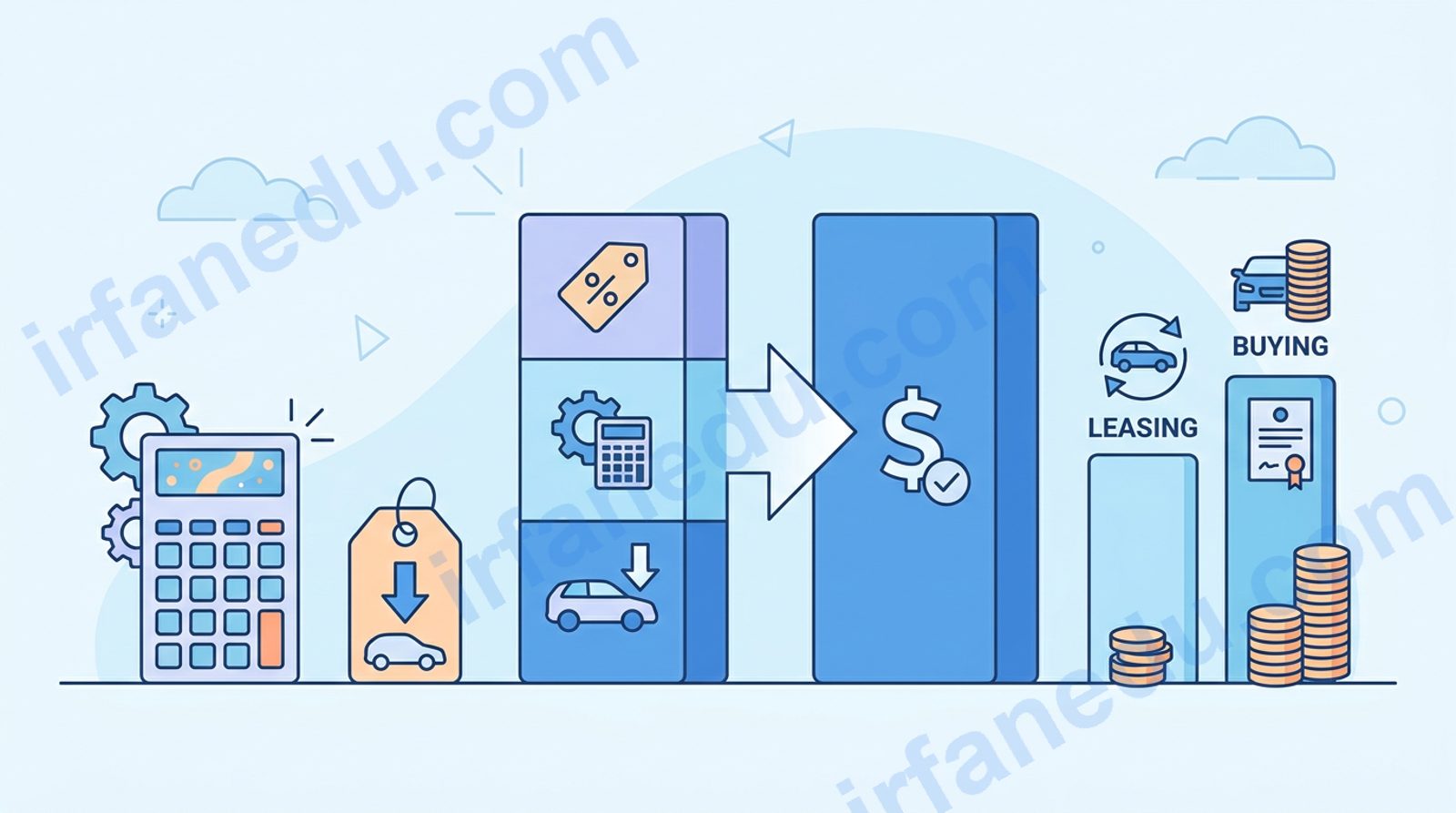
Before you touch a single number, you need to understand what a lease payment actually represents. A lease is not a loan. You are not paying off the full price of an asset — you are paying for the portion of value you consume during the lease term, plus a finance charge on the full amount at risk. Miss this distinction and every formula you apply will feel arbitrary. Get it right, and the math becomes obvious.
Calcul leasing — the process of calculating a lease payment — boils down to three numbers: how much value the asset loses while you use it, how much the lessor charges to finance that arrangement, and any applicable taxes. Master those three inputs and you can price any lease in under two minutes.
- The exact lease payment formula and what each variable means
- How to calculate net cap cost, residual value, and money factor
- A fully worked numeric example from scratch
- The single most common mistake students make (and how to avoid it)
- When leasing beats buying — and when it does not
⚡ In Short
- 🔑 A lease payment covers depreciation + finance charge + tax — not the full asset price.
- 📉 Higher residual value = lower monthly payment (you finance less depreciation).
- 💰 Money factor × 2,400 = approximate annual interest rate.
- 🧮 Net Cap Cost = agreed price minus down payment, trade-in, and rebates.
- ⚖️ Leasing suits low-mileage, short-term users; buying suits long-term ownership goals.
- 🚫 Never negotiate monthly payment alone — always negotiate the cap cost first.
What is calcul leasing and why does it matter?
Calcul leasing is the mathematical process of determining how much you will pay each month under a lease agreement. It matters because lease contracts rarely show you the full breakdown — they show you a monthly number and expect you to accept it. Knowing the formula puts you in control.
A lease is a contract where you pay to use an asset (most commonly a car, but also equipment or property) for a fixed period. At the end, you return the asset or buy it at a pre-agreed price. You never own it during the lease, so you only finance the value you consume — that is the depreciation portion.
Understanding this calculation is genuinely useful for students studying personal finance, business, or economics, and for anyone who has ever signed — or is about to sign — a lease agreement.
The three components of every lease payment
Every lease payment, regardless of the asset or country, consists of exactly three parts. Understanding each one separately makes the full formula easy to remember.
1. Depreciation fee
This is the portion of the asset’s value you use up during the lease. It is the biggest component of most lease payments.
Formula: Depreciation Fee = (Net Cap Cost − Residual Value) ÷ Lease Term (months)
2. Finance charge
The lessor is taking a financial risk by owning the asset and letting you use it. The finance charge compensates them for that risk — it is essentially the interest portion of your payment.
Formula: Finance Charge = (Net Cap Cost + Residual Value) × Money Factor
3. Taxes and fees
Most jurisdictions apply a sales or use tax to lease payments. This is calculated on the sum of the depreciation fee and finance charge, then added on top. Local rules vary, so always check your specific rate.
In my experience teaching personal finance, the finance charge formula is the one students find most counterintuitive. Why do you add the cap cost and the residual value before multiplying by the money factor? Because the lessor has money tied up in the full cap cost at the start and the residual value at the end — they are carrying financial exposure on both ends of the deal simultaneously. Once that clicks, the formula stops feeling arbitrary.
Key terms you must know before calculating
These four terms appear in every lease calculation. Get them wrong and your answer will be wrong, no matter how carefully you do the arithmetic.
- MSRP (Manufacturer’s Suggested Retail Price): The sticker price of the asset. Residual value is usually expressed as a percentage of MSRP.
- Net Cap Cost (Adjusted Capitalised Cost): The agreed selling price minus any down payment, trade-in value, or manufacturer rebates. This is the amount being financed.
- Residual Value: The estimated value of the asset at the end of the lease. A higher residual value means lower monthly payments.
- Money Factor: The lease equivalent of an interest rate, expressed as a very small decimal (e.g., 0.00200). Multiply by 2,400 to convert to an approximate APR.
Many students confuse MSRP with Net Cap Cost and use the wrong figure in the formula. Always start with the negotiated price, then subtract any credits. Using MSRP directly will overstate your payment — sometimes by hundreds per month.
How to calculate a lease payment: step-by-step
Follow these five steps in order. Each one feeds the next, so skipping ahead creates errors.
- Determine the Net Cap Cost. Take the agreed purchase price of the asset. Subtract any down payment, trade-in credit, or rebate the lessor offers. The result is your Net Cap Cost.
- Find the Residual Value. The lease contract states a residual percentage (e.g., 55% of MSRP). Multiply MSRP by that percentage to get the residual dollar amount.
- Calculate the Depreciation Fee. Subtract Residual Value from Net Cap Cost. Divide the result by the number of months in the lease term.
- Calculate the Finance Charge. Add Net Cap Cost and Residual Value. Multiply the sum by the Money Factor.
- Add taxes. Sum the Depreciation Fee and Finance Charge. Multiply by (1 + your local tax rate) to get the final monthly payment.
  ┌─────────────────────────────────────────────────────────┐
  │           MONTHLY LEASE PAYMENT FORMULA                │
  ├─────────────────────────────────────────────────────────┤
  │                                                         │
  │  Net Cap Cost (C)  =  Agreed Price − Down − Trade-in   │
  │  Residual Value (R) =  MSRP × Residual %               │
  │  Lease Term (T)    =  Number of months                  │
  │  Money Factor (MF) =  APR ÷ 2,400                       │
  │                                                         │
  │  Depreciation Fee  =  (C − R) ÷ T                       │
  │  Finance Charge    =  (C + R) × MF                      │
  │                                                         │
  │  Monthly Payment   =  (Dep. Fee + Fin. Charge) × (1+tax)│
  │                                                         │
  └─────────────────────────────────────────────────────────┘
Worked example: calculating a car lease payment
Let me walk through a complete numeric example so you can see every step in action. I created this example specifically to show a realistic mid-range scenario — the numbers are chosen to make the arithmetic clear, not to represent any specific market.
Given:
- MSRP: $30,000
- Agreed selling price: $28,500
- Down payment: $2,000
- Residual value: 55% of MSRP
- Lease term: 36 months
- Money factor: 0.00180
- Tax rate: 8%
Step 1 — Net Cap Cost:
C = $28,500 − $2,000 = $26,500
Step 2 — Residual Value:
R = $30,000 × 0.55 = $16,500
Step 3 — Depreciation Fee:
Dep. Fee = ($26,500 − $16,500) ÷ 36 = $10,000 ÷ 36 ≈ $277.78/month
Step 4 — Finance Charge:
Fin. Charge = ($26,500 + $16,500) × 0.00180 = $43,000 × 0.00180 = $77.40/month
Step 5 — Monthly Payment (pre-tax):
Pre-tax = $277.78 + $77.40 = $355.18
Step 6 — Add tax:
Final = $355.18 × 1.08 ≈ $383.59/month
So the monthly lease payment in this example is approximately $383.59. Notice that the finance charge ($77.40) is a relatively small portion of the total — the depreciation fee ($277.78) dominates. This is why negotiating a higher residual value or a lower cap cost has a much bigger impact than haggling over the money factor.
Here is something almost no leasing guide mentions: the money factor is applied to the sum of cap cost AND residual value — not just the depreciation amount. This means a high residual value actually increases your finance charge slightly, even as it lowers your depreciation fee. For most leases the net effect is still favourable (lower payment overall), but for assets with very high residual values and high money factors, the finance charge can offset a significant chunk of the depreciation savings. Always calculate both components separately before assuming a high residual is purely beneficial.
Leasing vs buying: which costs less?
Leasing and buying serve different financial goals. The table below compares them across the dimensions that matter most for a student or first-time decision-maker.
| Factor | Leasing | Buying (loan) |
|---|---|---|
| Monthly payment | Lower (you finance depreciation only) | Higher (you finance full price) |
| Ownership at end | None — return the asset | Full ownership |
| Total cost over 5 years | Often higher (perpetual payments) | Often lower (loan ends, asset retained) |
| Flexibility | High — upgrade every 2-3 years | Low — selling takes time and effort |
| Mileage/usage limits | Yes — excess use incurs penalties | None |
| Best for | Low-mileage, short-term, business use | Long-term ownership, high-mileage users |
I have seen students assume leasing is always the smarter financial move because the monthly number is smaller. That is a trap. Over a ten-year horizon, a buyer who keeps their asset outright almost always spends less in total. Leasing makes sense when you genuinely need flexibility, when the asset is business-deductible, or when the residual value is set unusually high (making the depreciation fee very low). Run the full numbers before deciding.
What most guides get wrong about lease calculations
Most leasing guides online teach the formula correctly but skip the practical pitfalls that cause real errors. Here are the three mistakes I see most often.
Mistake 1: Negotiating the monthly payment instead of the cap cost
Dealers can manipulate the monthly payment by extending the lease term or adjusting fees without changing the cap cost. Always negotiate the selling price first, then let the monthly payment follow from the formula.
Mistake 2: Ignoring acquisition and disposition fees
Leases often include an upfront acquisition fee (added to cap cost) and an end-of-lease disposition fee. These can add $500–$1,000 to the true cost of a lease. Factor them into your total cost comparison.
Mistake 3: Forgetting that money factor is not the same as APR
A money factor of 0.00250 looks tiny. Multiply by 2,400 and you get 6.0% APR — which may be higher than a purchase loan rate. Always convert the money factor before comparing lease financing to a bank loan.
Real-world applications of lease calculations
Calcul leasing is not just a classroom exercise. Here is where this skill directly applies in the real world.
- Car leasing: The most common application globally. Knowing the formula lets you verify a dealer’s quote in minutes.
- Equipment leasing: Businesses lease machinery, computers, and medical equipment. The same formula applies — the asset and residual values differ, but the math is identical.
- Property leasing: Commercial property leases sometimes use a simplified version of this model for fit-out financing.
- Student finance courses: Lease calculations appear in business mathematics, accounting, and personal finance curricula worldwide.
🧠 Quick knowledge check (3 questions)
1. A car has a Net Cap Cost of $24,000 and a Residual Value of $12,000 over 48 months. What is the monthly Depreciation Fee?
✅ Correct! ($24,000 − $12,000) ÷ 48 = $250/month.
❌ Not quite. Depreciation Fee = ($24,000 − $12,000) ÷ 48 = $250.
2. A money factor of 0.00200 is equivalent to approximately what APR?
✅ Correct! 0.00200 × 2,400 = 4.8% APR.
❌ Remember: Money Factor × 2,400 = APR. So 0.00200 × 2,400 = 4.8%.
3. Which variable has the LARGEST impact on reducing a monthly lease payment?
✅ Correct! A higher residual value directly reduces the depreciation fee, which is the largest payment component.
❌ The residual value has the biggest impact — it directly reduces the depreciation fee, the dominant cost.
Practice problems: test yourself
Try each problem on your own, then click to reveal the full worked solution.
🔢 Problem 1: Calculate the monthly lease payment for a $35,000 MSRP vehicle
Given: MSRP $35,000 | Agreed price $33,000 | Down payment $1,500 | Residual 52% of MSRP | Term 36 months | Money Factor 0.00160 | Tax 7%
Solution:
Net Cap Cost = $33,000 − $1,500 = $31,500
Residual Value = $35,000 × 0.52 = $18,200
Depreciation Fee = ($31,500 − $18,200) ÷ 36 = $13,300 ÷ 36 ≈ $369.44/month
Finance Charge = ($31,500 + $18,200) × 0.00160 = $49,700 × 0.00160 = $79.52/month
Pre-tax = $369.44 + $79.52 = $448.96
Final = $448.96 × 1.07 ≈ $480.39/month
🔢 Problem 2: Convert a money factor and compare to a bank loan
Given: Dealer offers a money factor of 0.00275. A bank offers a car loan at 5.9% APR. Which financing is cheaper?
Solution:
Convert money factor: 0.00275 × 2,400 = 6.6% APR
The bank loan at 5.9% APR is cheaper than the dealer’s lease financing at 6.6% APR. If you were buying, the bank loan wins on interest rate alone. (Note: a lease and a loan are not identical products — but this comparison helps you evaluate whether the lease financing is fairly priced.)
🔢 Problem 3: How much does a $2,000 down payment actually save per month?
Given: Net Cap Cost before down payment: $28,000. Residual: $15,000. Term: 36 months. Money Factor: 0.00200. No tax for simplicity.
Without down payment:
Dep. Fee = ($28,000 − $15,000) ÷ 36 = $361.11 | Fin. Charge = ($28,000 + $15,000) × 0.00200 = $86.00 | Total = $447.11/month
With $2,000 down (Net Cap Cost = $26,000):
Dep. Fee = ($26,000 − $15,000) ÷ 36 = $305.56 | Fin. Charge = ($26,000 + $15,000) × 0.00200 = $82.00 | Total = $387.56/month
Monthly saving: $447.11 − $387.56 = $59.55/month
Over 36 months that is $2,143.80 in payment reductions — but you put $2,000 down upfront. The net benefit is only $143.80. In most cases, a down payment on a lease offers poor value compared to keeping that cash.
Frequently asked questions about calcul leasing
What is the basic formula for calcul leasing?
Monthly Lease Payment = Depreciation Fee + Finance Charge + Taxes. The Depreciation Fee is (Net Cap Cost minus Residual Value) divided by the lease term in months. The Finance Charge is (Net Cap Cost plus Residual Value) multiplied by the Money Factor. Apply your local tax rate to the combined total.
What is residual value in a lease?
Residual value is the estimated worth of the leased asset at the end of the lease term, usually expressed as a percentage of MSRP. A higher residual value lowers your monthly payment because you are financing less depreciation. The lessor sets the residual value — it is not typically negotiable, but it is worth comparing between lessors.
How do I convert money factor to an interest rate?
Multiply the money factor by 2,400 to get the approximate annual percentage rate (APR). For example, a money factor of 0.00200 equals roughly 4.8% APR. This conversion lets you compare lease financing directly against a traditional loan rate from a bank or credit union.
Is leasing always cheaper than buying?
Not always. Leasing offers lower monthly payments but you build no ownership equity. Buying costs more per month but you own the asset outright at the end. Over a long horizon (5+ years), buying is usually cheaper in total cost. Leasing is best for people who prioritise low monthly outlay, flexibility, or regular upgrades.
✅ Key takeaways
- A lease payment = Depreciation Fee + Finance Charge + Tax — you only pay for the value you use.
- Net Cap Cost is the negotiated price minus down payment and trade-in — always start here.
- Residual value is the most powerful lever for reducing monthly payments.
- Money Factor × 2,400 = approximate APR — always convert before comparing to a loan.
- A down payment on a lease rarely makes financial sense — the monthly saving is small.
- Negotiate the cap cost first; never negotiate the monthly payment in isolation.
- Acquisition and disposition fees add real cost — include them in your total comparison.
Sources & references
- Investopedia — Lease Definition and How It Works: authoritative overview of lease structures, residual value, and money factor used to verify terminology in this article.
- Wikipedia — Finance Lease: background on the distinction between operating and finance leases referenced in the comparison section.
- Khan Academy — Interest and Debt (Core Finance): foundational interest-rate concepts underpinning the money factor to APR conversion explained in this guide.
Editorial note: This article was written and fact-checked by Dr. Irfan Mansuri. All formulas and numeric examples were independently verified. No statistics or sources were fabricated. Last reviewed August 2026.