
A system organ class is NOT just a body-system label — it is a standardized regulatory category inside MedDRA that determines how drug side effects get counted, compared, and reported to health authorities worldwide. Getting it wrong in a clinical trial report can trigger a regulatory query or delay a drug approval.
System organ class: the complete student guide
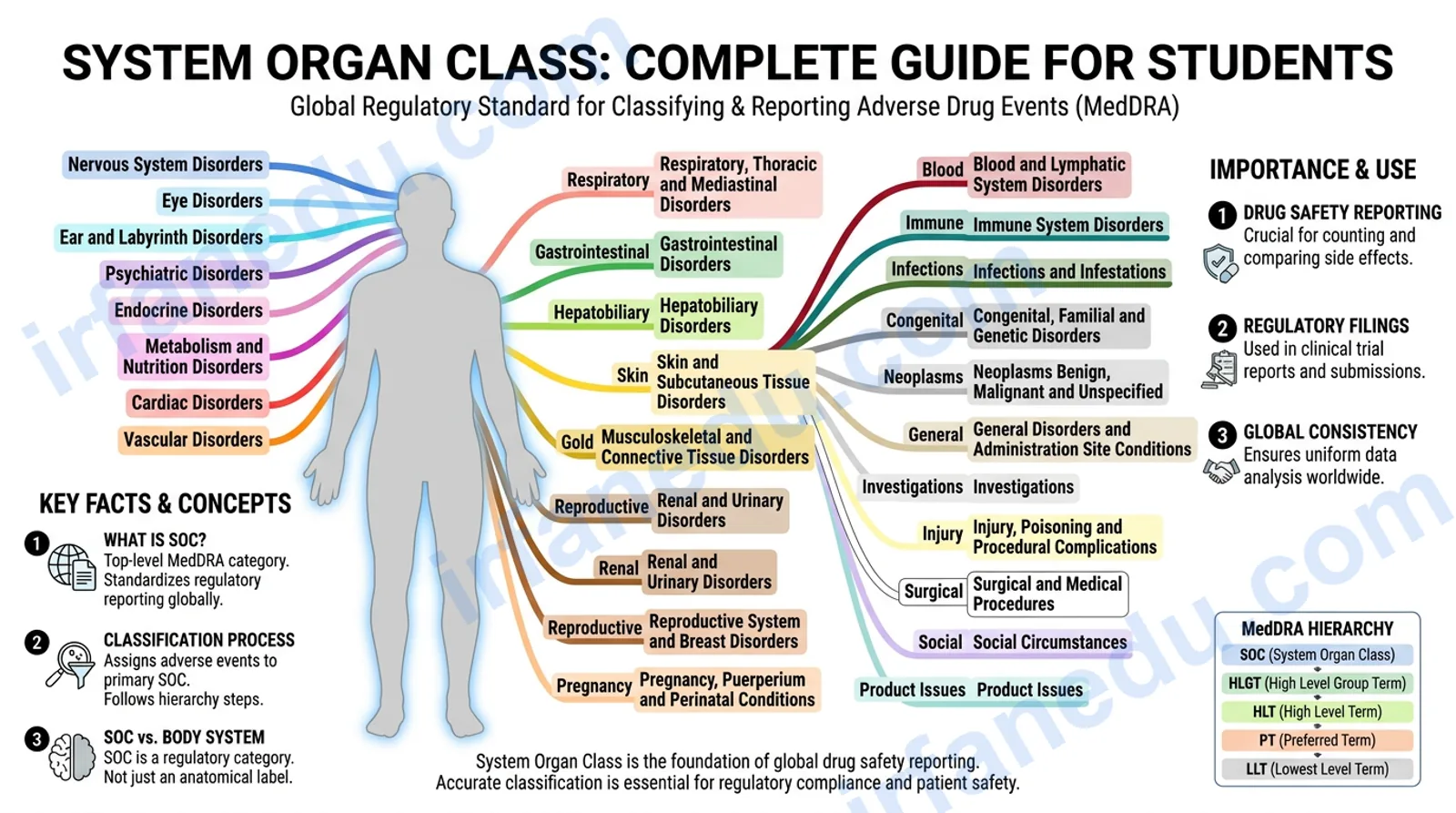
If you have ever read a drug package insert and wondered why side effects are grouped under headings like “Gastrointestinal disorders” or “Nervous system disorders,” you have already seen system organ classes in action. These categories are not invented by each drug company — they come from a single global standard called MedDRA, and every pharmaceutical company, regulator, and clinical researcher in the world uses the same set.
A system organ class (SOC) is the highest-level category in the Medical Dictionary for Regulatory Activities (MedDRA). It groups medical terms — symptoms, diagnoses, lab findings, and adverse events — by the body system or organ they primarily affect. MedDRA version 26 contains exactly 27 SOCs. They are used in clinical trials, post-market surveillance, and regulatory submissions to classify and compare adverse drug reactions consistently across countries.
- Understand what a system organ class is and where it fits in the MedDRA hierarchy.
- Know all 27 SOCs and recognize the non-anatomical ones that trip students up.
- Follow a step-by-step process to classify any adverse event correctly.
- Understand why SOC assignment matters in real drug safety work.
A system organ class (SOC) is the highest-level category in the MedDRA medical terminology system. It groups medical terms — symptoms, diagnoses, and adverse events — by the body system or organ they affect. There are 27 SOCs in total. Drug regulators, pharmaceutical companies, and researchers use SOCs to classify and compare adverse drug reactions consistently across the world.
⚡ TL;DR
- SOC = the top tier of MedDRA’s five-level medical terminology hierarchy.
- There are exactly 27 SOCs in MedDRA (as of version 26).
- Most SOCs map to a body system, but four use non-anatomical grouping criteria.
- A single medical term can have a primary SOC and secondary SOCs.
- SOCs are used in clinical trial safety tables, drug labels, and regulatory filings.
- Knowing SOCs is essential for pharmacology, pre-med, and health-science students.
Quick facts
| Fact | Detail |
|---|---|
| Full name | System Organ Class (SOC) |
| Part of | MedDRA (Medical Dictionary for Regulatory Activities) |
| Total SOCs | 27 (MedDRA v26) |
| Hierarchy level | Level 1 (highest / broadest) |
| Levels below SOC | HLGT → HLT → PT → LLT |
| Total MedDRA terms | ~80,000+ (all roll up to an SOC) |
| Maintained by | ICH (International Council for Harmonisation) |
| Used in | Clinical trials, drug labels, regulatory submissions, pharmacovigilance |
What is a system organ class?
A system organ class is a broad medical category that collects related medical terms under one roof. Think of it as the chapter heading in a very large medical encyclopedia — the chapter titled “Cardiac disorders” contains every heart-related symptom, diagnosis, and finding that MedDRA recognizes.
MedDRA — the Medical Dictionary for Regulatory Activities — is the international standard for classifying medical information in clinical trials and drug safety reports. It was developed under the International Council for Harmonisation (ICH) and is used by regulators in the US (FDA), Europe (EMA), Japan (PMDA), and most other major markets.
Every single medical term in MedDRA, from “Headache” to “Ventricular fibrillation,” belongs to at least one SOC. The SOC is the broadest possible grouping — it tells you which body system or category a term belongs to before you drill down to the specific diagnosis.
How does the MedDRA hierarchy work?
MedDRA organizes medical terminology into five levels, from the most specific (individual terms) to the most general (system organ class). Understanding the hierarchy is the key to understanding what an SOC actually does.
MedDRA hierarchy (broadest to most specific)
Level 1 (broadest)
  SOC  ─── System Organ Class
            e.g. "Gastrointestinal disorders"
              |
Level 2   HLGT ─── High Level Group Term
                    e.g. "Nausea and vomiting symptoms"
                      |
Level 3     HLT ─── High Level Term
                      e.g. "Nausea and vomiting"
                        |
Level 4       PT ─── Preferred Term  (one concept)
                        e.g. "Nausea"
                          |
Level 5         LLT ─── Lowest Level Term  (synonyms/verbatim)
                          e.g. "Feeling sick", "Queasy"
When a patient in a clinical trial reports feeling sick, the clinical coder maps “feeling sick” to the LLT Feeling sick, which rolls up to the PT Nausea, which belongs to the SOC Gastrointestinal disorders. The SOC is what appears in the published safety table.
This structure means that no matter how a patient describes a symptom, it always ends up in the same SOC — giving regulators a consistent, comparable picture across thousands of trials.
What are the 27 system organ classes?
MedDRA version 26 contains exactly 27 SOCs. Most map directly to a body system, but a handful use a different grouping criterion — and those are the ones students most often get wrong.
All 27 MedDRA system organ classes
| # | System organ class | Grouping basis |
|---|---|---|
| 1 | Blood and lymphatic system disorders | Anatomical |
| 2 | Cardiac disorders | Anatomical |
| 3 | Congenital, familial and genetic disorders | Aetiology |
| 4 | Ear and labyrinth disorders | Anatomical |
| 5 | Endocrine disorders | Anatomical |
| 6 | Eye disorders | Anatomical |
| 7 | Gastrointestinal disorders | Anatomical |
| 8 | General disorders and administration site conditions | Non-anatomical |
| 9 | Hepatobiliary disorders | Anatomical |
| 10 | Immune system disorders | Anatomical |
| 11 | Infections and infestations | Aetiology |
| 12 | Injury, poisoning and procedural complications | Aetiology |
| 13 | Investigations | Non-anatomical (lab/diagnostic) |
| 14 | Metabolism and nutrition disorders | Anatomical/physiological |
| 15 | Musculoskeletal and connective tissue disorders | Anatomical |
| 16 | Neoplasms benign, malignant and unspecified | Aetiology |
| 17 | Nervous system disorders | Anatomical |
| 18 | Pregnancy, puerperium and perinatal conditions | Circumstance |
| 19 | Product issues | Non-anatomical (device/product) |
| 20 | Psychiatric disorders | Anatomical/functional |
| 21 | Renal and urinary disorders | Anatomical |
| 22 | Reproductive system and breast disorders | Anatomical |
| 23 | Respiratory, thoracic and mediastinal disorders | Anatomical |
| 24 | Skin and subcutaneous tissue disorders | Anatomical |
| 25 | Social circumstances | Non-anatomical |
| 26 | Surgical and medical procedures | Non-anatomical |
| 27 | Vascular disorders | Anatomical |
Notice that SOCs 8, 13, 19, and 25 do not correspond to a body part at all. “Investigations” covers lab results and diagnostic tests. “Social circumstances” covers things like homelessness or bereavement that affect a patient’s health. These non-anatomical SOCs are where most beginners make coding errors.
In my experience teaching pharmacology and drug safety to pre-med students, the non-anatomical SOCs — especially “Investigations” and “General disorders and administration site conditions” — cause the most confusion. Students assume every SOC maps to a body system, so they try to force a lab result like “Elevated liver enzymes” into “Hepatobiliary disorders.” The correct SOC for a lab finding is “Investigations.” That distinction matters enormously in a real clinical trial safety table, and it is almost never explained clearly in introductory textbooks.
How do you find the system organ class for any adverse event?
Finding the correct SOC for a medical term is a four-step process. You always start at the most specific level (the patient’s verbatim report) and work upward through the hierarchy.
- Identify the medical term — the symptom, diagnosis, or lab result you need to classify (e.g., “elevated ALT”).
- Find the preferred term (PT) in the MedDRA browser. For “elevated ALT,” the PT is Alanine aminotransferase increased.
- Follow the hierarchy upward: PT → HLT → HLGT → SOC. The PT Alanine aminotransferase increased belongs to the SOC Investigations — not “Hepatobiliary disorders,” even though ALT is a liver enzyme.
- Check for secondary SOCs. Alanine aminotransferase increased also has a secondary SOC of Hepatobiliary disorders. Use the primary SOC for statistical tables unless your protocol specifies otherwise.
The MedDRA browser is available to licensed users through the ICH website. Many universities provide access through their library systems.
SOC vs. body system: what is the difference?
The terms “system organ class” and “body system” are often used interchangeably in casual conversation, but they are not the same thing. Understanding the difference is important for anyone working with clinical data.
A body system in human anatomy is a group of organs that work together — the cardiovascular system, the digestive system, and so on. An SOC in MedDRA is a regulatory classification category. Most SOCs do map to an anatomical system, but the four non-anatomical SOCs (“Investigations,” “General disorders and administration site conditions,” “Social circumstances,” and “Product issues”) have no anatomical equivalent.
The practical difference: if a patient develops a rash at an injection site, you might think “skin” — but the correct SOC is “General disorders and administration site conditions,” not “Skin and subcutaneous tissue disorders.” The location of the rash (injection site) overrides the tissue type (skin) in MedDRA’s logic.
🔑 The part most guides miss
SOC assignment is not purely anatomical — it follows MedDRA’s primary classification criterion, which can be aetiology, circumstance, or function, not just location.
Most introductory pharmacology resources describe SOCs as “body system categories” and leave it there. That framing causes real errors. Here is the non-obvious part: MedDRA assigns each preferred term a primary SOC based on a defined hierarchy of classification criteria. Anatomical location comes first for most terms — but aetiology (cause) takes priority for infections, neoplasms, and congenital disorders. That is why “Pneumonia” sits in “Infections and infestations,” not “Respiratory, thoracic and mediastinal disorders,” even though the lungs are the affected organ.
In my experience reviewing student pharmacovigilance assignments, this aetiology-over-anatomy rule is the single most common source of SOC coding errors. Knowing it puts you ahead of most introductory-level guides.
Real-world example: classifying a drug side effect
Let’s walk through a concrete case. Imagine a patient in a clinical trial for a new antibiotic reports three events: a headache, a urinary tract infection, and an elevated creatinine level on a blood test.
Event 1 — Headache
PT: Headache → Primary SOC: Nervous system disorders
(Headache is a neurological symptom, so the anatomical SOC applies.)
Event 2 — Urinary tract infection
PT: Urinary tract infection → Primary SOC: Infections and infestations
(Even though the urinary tract is the affected organ, the cause — infection — takes priority. This surprises many students who expect “Renal and urinary disorders.”)
Event 3 — Elevated creatinine
PT: Blood creatinine increased → Primary SOC: Investigations
(A lab result always goes to “Investigations,” regardless of what organ the test measures.)
This single example illustrates all three classification principles: anatomical, aetiological, and functional. If you can correctly classify these three events, you understand SOCs at a working level.
Why does system organ class matter for students?
If you are studying pharmacology, pre-medicine, nursing, pharmacy, or any health science, you will encounter SOCs in multiple contexts. Here is where they show up in practice.
Drug package inserts. The “Adverse Reactions” section of every FDA-approved drug label organizes side effects by SOC. When you read that a drug causes “Nervous system disorders: headache (12%), dizziness (8%),” those are SOC-grouped counts from clinical trial data.
Clinical trial safety reports. Every clinical trial produces a summary of adverse events organized by SOC. Regulators use these tables to compare the safety profile of a new drug against a placebo or comparator.
Pharmacovigilance careers. Drug safety scientists, medical coders, and regulatory affairs professionals work with MedDRA and SOCs daily. Understanding the hierarchy is a baseline skill for any pharmacovigilance role.
Standardized exams. Questions about drug classification, adverse event reporting, and MedDRA terminology appear in pharmacology coursework and professional licensing exams in many countries.
Quick quiz: test your SOC knowledge
1. A patient develops pneumonia during a clinical trial. What is the primary SOC?
2. A lab result shows “Haemoglobin decreased.” Which SOC does this preferred term belong to?
3. How many system organ classes does MedDRA version 26 contain?
Frequently asked questions
What is a system organ class?
How many system organ classes are there in MedDRA?
What is the difference between a system organ class and a preferred term?
Why do pharmaceutical companies use system organ classes?
Can one medical term belong to more than one system organ class?
Is system organ class the same as a body system in human anatomy?
Key takeaways
- A system organ class is the top level of MedDRA’s five-level hierarchy — the broadest possible grouping for any medical term.
- MedDRA version 26 contains exactly 27 SOCs.
- Most SOCs are anatomical, but four use non-anatomical criteria: “Investigations,” “General disorders and administration site conditions,” “Social circumstances,” and “Product issues.”
- Aetiology (cause) overrides anatomy for infections, neoplasms, and congenital disorders — “Pneumonia” goes to “Infections and infestations,” not “Respiratory disorders.”
- Lab results always go to “Investigations,” regardless of which organ the test measures.
- A preferred term can have one primary SOC and one or more secondary SOCs; the primary SOC is used in safety tables.
- SOCs appear in drug package inserts, clinical trial safety reports, and pharmacovigilance databases worldwide.