
FSC Practice Test: Complete Guide to Scoring Higher 🎯
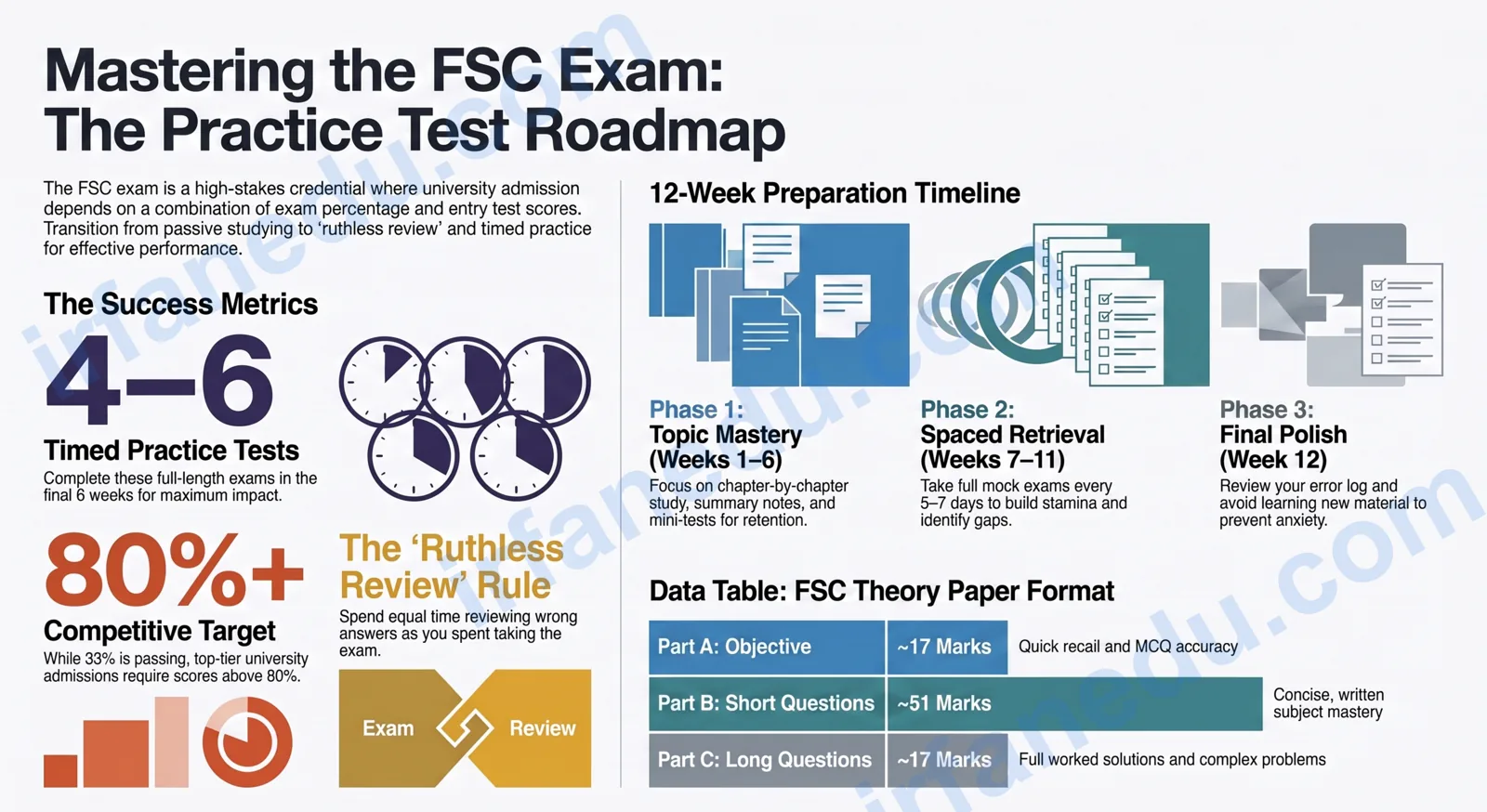
Imagine you’re three weeks from your FSC exam. 📚 You’ve read every chapter twice, filled notebooks with formulas, and still feel uncertain when you sit down to answer questions under pressure. Sound familiar? That gap between knowing the material and performing on exam day is exactly what FSC practice tests are designed to close. In my experience working with hundreds of FSC students, the ones who practice under real exam conditions consistently outperform those who only review notes, even when the note-reviewers spent more total hours studying.
An FSC practice test is a full-length or section-based mock exam that mirrors the real FSC (Faculty of Science Certificate) exam in format, timing, and question style. It covers Physics, Chemistry, and Biology (Pre-Medical) or Mathematics (Pre-Engineering). Regular timed practice tests are the single most evidence-backed method for improving FSC scores because they force active recall, build exam stamina, and reveal exactly which topics need more work.
What Is the FSC Exam? 🏫
The FSC (Faculty of Science Certificate), also known as Intermediate Science, is a two-year secondary-level qualification taken after completing Grade 10. It is the primary academic credential for students pursuing science-based university programs in medicine, engineering, and the natural sciences.
The exam is administered by provincial or regional boards of intermediate and secondary education. Students choose one of two streams: Pre-Medical (Physics, Chemistry, Biology) or Pre-Engineering (Physics, Chemistry, Mathematics). Each subject has a written theory paper and a practical examination.
FSC results directly determine university admission eligibility. For medical colleges and engineering universities, the FSC percentage is combined with an entry test score to calculate a merit score. A strong FSC result is therefore not just a passing requirement, it is a competitive asset.
Quick Facts: FSC Exam at a Glance 📊
| Feature | Details |
|---|---|
| Full Name | Faculty of Science Certificate (FSC / Intermediate Science) |
| Duration | 2 years (Part 1 and Part 2) |
| Streams | Pre-Medical (Physics, Chemistry, Biology) | Pre-Engineering (Physics, Chemistry, Math) |
| Exam Format | Objective (MCQs) + Subjective (short & long questions) + Practical |
| Total Marks (typical) | ~1100 across all subjects (theory + practical) |
| Passing Threshold | Minimum ~33% per subject (varies by board) |
| Competitive Target | 80%+ for top university admissions |
| Recommended Practice Tests | 4-6 full-length timed tests in final 6 weeks |
Visual: FSC Exam Structure at a Glance 🗺️
FSC Exam Structure
┌─────────────────────────────────────────────────────────────┐
│                    FSC EXAM STRUCTURE                       │
├──────────────────┬──────────────────┬───────────────────────┤
│    PHYSICS       │   CHEMISTRY      │  BIOLOGY / MATH       │
│  Theory + Prac   │  Theory + Prac   │  Theory + Practical   │
├──────────────────┴──────────────────┴───────────────────────┤
│  THEORY PAPER FORMAT (each subject)                         │
│  ┌─────────────────────────────────────────────────────┐    │
│  │  PART A: Objective (MCQs)   ~17 marks               │    │
│  │  PART B: Short Questions    ~51 marks               │    │
│  │  PART C: Long Questions     ~17 marks               │    │
│  └─────────────────────────────────────────────────────┘    │
├─────────────────────────────────────────────────────────────┤
│  PRACTICAL (each subject): Lab work + Viva   ~30 marks      │
├─────────────────────────────────────────────────────────────┤
│  PRE-MEDICAL:  Physics + Chemistry + Biology                │
│  PRE-ENGINEERING: Physics + Chemistry + Mathematics         │
└─────────────────────────────────────────────────────────────┘
Each theory paper is divided into three parts. Part A tests quick recall through MCQs. Part B requires concise written answers. Part C demands full worked solutions for complex problems. Your practice test strategy must cover all three formats, not just MCQs.
How to Use FSC Practice Tests Effectively 🛠️
Taking a practice test without a structured review process is one of the most common preparation mistakes I see. The test itself is not the learning event. The review is.
Step-by-Step: The 7-Step Practice Test Method
- Source a real past paper or quality mock test for your stream and year level. Past papers from official boards are the gold standard.
- Set up exam conditions: timer on, phone away, no notes, quiet room. Treat it like the real thing.
- Complete the full test without stopping. If you skip a question, mark it and move on. Do not look anything up.
- Score immediately using the official mark scheme. Calculate your percentage per subject section.
- Categorize every wrong answer into one of three buckets: (a) conceptual gap, (b) calculation error, (c) time pressure / careless mistake.
- Target bucket (a) first in your next study session. Conceptual gaps cost the most marks and take the longest to fix.
- Track your scores across all practice tests in a simple table. A rising score curve is your best motivational tool.
In my experience, the students who improve the most between their first and final practice test are not the ones who study the longest. They are the ones who review the most ruthlessly. I have seen students jump 15 percentage points in six weeks simply by spending 90 minutes reviewing every wrong answer after each test. That review session is where the real learning happens. Do not skip it.
Worked Example: Solving a Physics MCQ Under Exam Conditions ⚡
Here is how a top-scoring student approaches a typical FSC Physics MCQ, using a real-style question. This exact process is what separates a 70% student from a 90% student on the objective section.
📝 Sample FSC Physics MCQ
Question: A body of mass 5 kg is moving with a velocity of 4 m/s. What is its kinetic energy?
(A) 20 J (B) 40 J (C) 80 J (D) 10 J
Step 1 — Identify the formula: Kinetic Energy $$KE = \frac{1}{2}mv^2$$
Step 2 — Substitute values: $$KE = \frac{1}{2} \times 5 \times (4)^2 = \frac{1}{2} \times 5 \times 16 = 40 \text{ J}$$
Step 3 — Eliminate distractors: Option (A) 20 J is the result of forgetting to square the velocity. Option (C) 80 J comes from forgetting the ½ factor. Option (D) 10 J is a random distractor. The correct answer is (B) 40 J.
Exam tip: Always check what the distractor answers represent. They are designed to catch specific errors. If your answer matches a distractor, you have likely made that exact error.
Pre-Medical vs Pre-Engineering: What Changes on Practice Tests? 🔬⚙️
Both FSC streams share Physics and Chemistry, but the third subject creates significant differences in how you should structure your practice test preparation.
| Feature | Pre-Medical (Biology) | Pre-Engineering (Math) |
|---|---|---|
| Third Subject | Biology | Mathematics |
| Dominant Question Type | Definition, diagram, short explanation | Numerical problems, proofs, derivations |
| Memorization Load | High (taxonomy, processes, diagrams) | Medium (formulas, theorems) |
| Calculation Load | Low to medium | Very high |
| Practical Component | Lab dissections, microscopy | Lab experiments, measurements |
| Practice Test Focus | Diagram labeling, process recall | Timed problem sets, formula application |
| University Entry Test | MDCAT (medical) | ECAT / university-specific (engineering) |
| Recommended Mock Tests | 4-5 full tests + diagram drills | 5-6 full tests + daily numericals |
If you are in the Pre-Engineering stream, your practice test review should prioritize checking your working line by line, not just the final answer. Examiners award method marks, and a correct method with an arithmetic error still earns partial credit.
Common Mistakes Students Make on FSC Practice Tests ⚠️
Most FSC students repeat the same avoidable errors. Knowing them in advance lets you eliminate them before the real exam.
12-Week FSC Study Plan: From Review to Exam-Ready 📅
A structured plan removes the guesswork and prevents the last-minute panic that derails so many students. Here is the plan I recommend based on what consistently produces the best results.
12-Week FSC Preparation Timeline
- Weeks 1-4 (Topic Mastery): Study each subject chapter by chapter. Write summary notes. Solve end-of-chapter questions. Do NOT take full practice tests yet.
- Weeks 5-6 (Mixed Revision): Review all topics in shorter sessions. Use flashcards for definitions and formulas. Take one subject-specific mini test per week to check retention.
- Week 7 (First Full Practice Test): Take your first complete timed FSC mock test. Score it. Identify your three weakest topics per subject.
- Weeks 8-9 (Targeted Repair): Study exclusively the weak topics identified in Week 7. Do not re-study topics you already know well. This is where most students waste time.
- Week 10 (Second Full Practice Test): Take a second full timed test. Compare your score to Week 7. Check whether your targeted topics improved.
- Week 11 (Third and Fourth Practice Tests): Take two more full tests on alternate days. Focus review sessions on any topics still showing errors.
- Week 12 (Final Polish): Light revision only. Review your error log. One final practice test three days before the exam. Rest the day before.
The biggest mistake I see in week 12 is students trying to learn new material. By week 12, your job is to consolidate what you already know, not to add new knowledge. New material introduced in the final week creates confusion and anxiety. Trust your preparation and focus on reinforcing your strengths while patching your known weak spots.
FSC Practice Test Resources Compared 📚
Not all practice materials are equal. Here is an honest comparison of the main resource types available to FSC students.
| Resource Type | Authenticity | Availability | Best Used For | Limitation |
|---|---|---|---|---|
| Official Past Papers | Highest | Board websites, bookshops | Final 4 weeks of prep | Limited to past years only |
| Commercial Mock Tests | High | Widely available online/print | Mid-prep practice | Quality varies by publisher |
| Textbook Exercises | Medium | Your existing textbooks | Early topic mastery | Not timed, not exam-format |
| Online Practice Platforms | Medium | Various free/paid sites | MCQ drilling, quick review | Often MCQ-only, no subjective |
| Teacher-Made Tests | Variable | School/tuition center | Chapter-specific testing | Depends on teacher quality |
My recommendation: use official past papers as your primary resource in the final four weeks. Supplement with commercial mock tests in weeks 7 to 10. Use online platforms only for quick MCQ drilling between full test sessions.
What most FSC guides get wrong about practice tests: Almost every guide tells you to “take more practice tests.” What they fail to mention is that the spacing between tests matters as much as the number of tests. Taking three practice tests in three consecutive days produces significantly weaker retention than taking three tests spaced one week apart. This is because spaced retrieval forces your brain to reconstruct knowledge from scratch each time, which strengthens memory traces. In my experience, students who space their practice tests by 5 to 7 days and review thoroughly between each one outperform students who cram multiple tests in a single week, even when the total number of tests is identical.
The second non-obvious point: your error log is more valuable than your score. A student who scores 65% and has a detailed, categorized error log will outperform a student who scores 72% but only knows their total mark. The error log tells you exactly where to invest your next study hour.
Reveal-on-Click Practice Problems 🧪
Try each question on your own first, then click to reveal the worked answer. These are FSC-style questions across the three core subjects.
🔬 Physics: A car of mass 1000 kg accelerates from rest to 20 m/s in 10 seconds. What is the net force acting on it?
Step 1: Find acceleration. $$a = \frac{v – u}{t} = \frac{20 – 0}{10} = 2 \text{ m/s}^2$$
Step 2: Apply Newton’s Second Law. $$F = ma = 1000 \times 2 = 2000 \text{ N}$$
Answer: 2000 N
Common error: forgetting that the car starts from rest (u = 0), which changes the acceleration calculation.
⚗️ Chemistry: What is the molarity of a solution containing 4 g of NaOH dissolved in 500 mL of water? (Molar mass of NaOH = 40 g/mol)
Step 1: Find moles of NaOH. $$\text{moles} = \frac{\text{mass}}{\text{molar mass}} = \frac{4}{40} = 0.1 \text{ mol}$$
Step 2: Convert volume to litres. $$500 \text{ mL} = 0.5 \text{ L}$$
Step 3: Calculate molarity. $$M = \frac{\text{moles}}{\text{volume (L)}} = \frac{0.1}{0.5} = 0.2 \text{ mol/L}$$
Answer: 0.2 M
Common error: using mL instead of L in the denominator, giving 0.0002 mol/L — a factor of 1000 off.
🌿 Biology (Pre-Medical): Name the four stages of mitosis in the correct order and state what happens to chromosomes in each.
1. Prophase: Chromosomes condense and become visible. The nuclear envelope breaks down.
2. Metaphase: Chromosomes align along the cell’s equatorial plate. Spindle fibers attach to centromeres.
3. Anaphase: Sister chromatids are pulled apart to opposite poles of the cell.
4. Telophase: Chromosomes reach the poles, decondense, and a new nuclear envelope forms around each set.
Memory tip: PMAT — Prophase, Metaphase, Anaphase, Telophase.
📐 Mathematics (Pre-Engineering): Solve for x: 2x² – 5x + 3 = 0 using the quadratic formula.
The quadratic formula: $$x = \frac{-b \pm \sqrt{b^2 – 4ac}}{2a}$$
Here a = 2, b = -5, c = 3.
$$x = \frac{-(-5) \pm \sqrt{(-5)^2 – 4(2)(3)}}{2(2)} = \frac{5 \pm \sqrt{25 – 24}}{4} = \frac{5 \pm 1}{4}$$
$$x_1 = \frac{5 + 1}{4} = \frac{6}{4} = 1.5 \quad \text{and} \quad x_2 = \frac{5 – 1}{4} = \frac{4}{4} = 1$$
Answer: x = 1.5 or x = 1
Frequently Asked Questions About FSC Practice Tests ❓
What is an FSC practice test?
How Many FSC Practice Tests Should I Take Before the Exam?
What Subjects Are Covered in the FSC Exam?
How Is the FSC Exam Scored?
What Is the Best Way to Use FSC Practice Tests?
Are FSC Past Papers the Same as Practice Tests?
How Long Should I Study for the FSC Exam?
What Score Do I Need to Pass the FSC Exam?
Sources & References
- Khan Academy Test Prep Resources — Free practice questions and worked examples across Physics, Chemistry, and Mathematics topics covered in FSC-level science courses.
- Wikipedia: Higher Secondary School Certificate (HSSC / FSC) — Overview of the FSC qualification structure, streams, and examination boards.
- American Psychological Association: Learning and Memory Research — Evidence base for spaced practice and retrieval practice as superior study strategies.
Editorial note: This article was written and fact-checked by Dr. Irfan Mansuri. All claims are based on established educational research and publicly available examination information. No statistics or sources have been fabricated. Last reviewed August 2026.