
MCAP practice test: the complete student guide to scoring higher in 2026
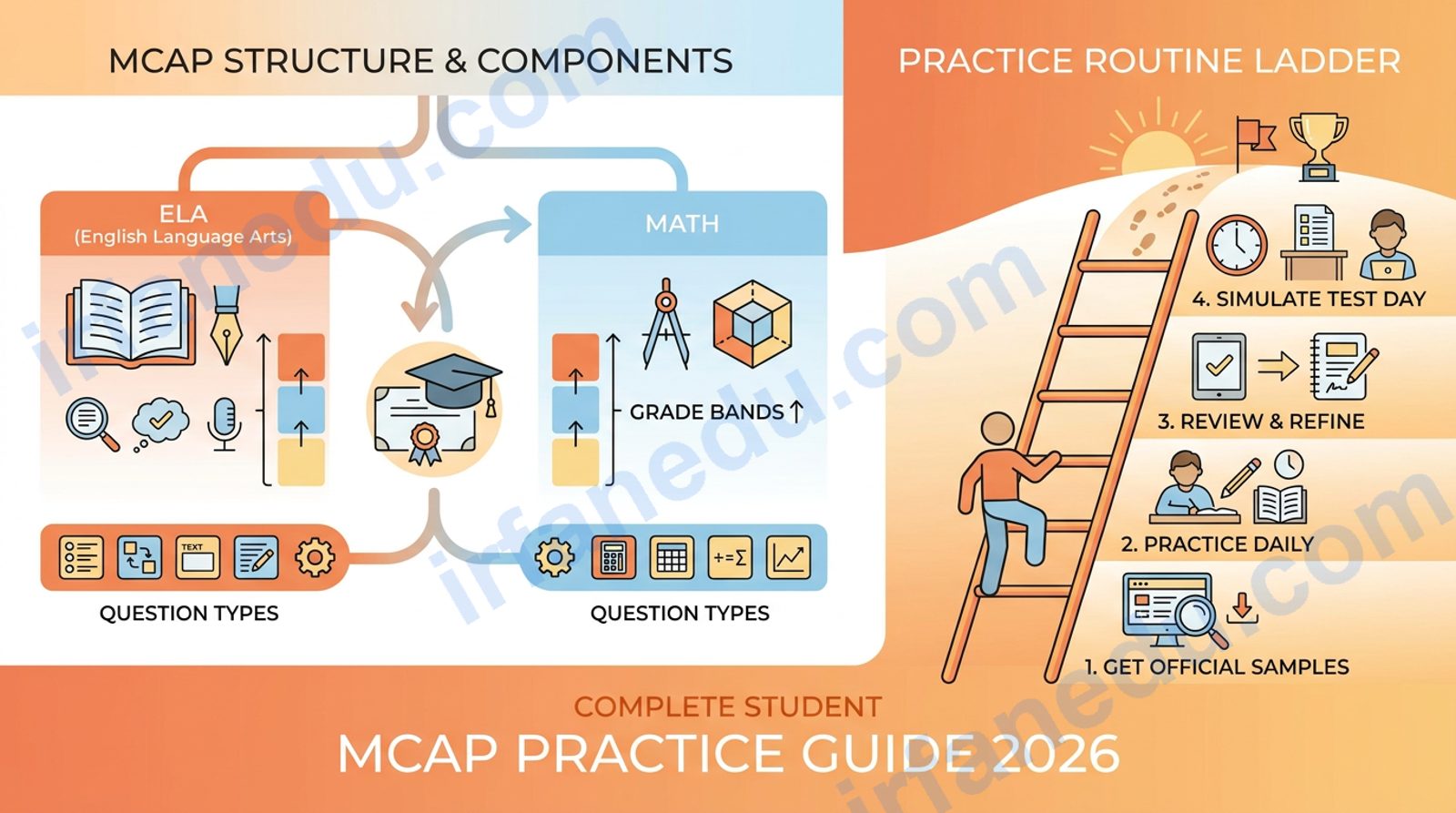
A teacher once told me that the single best thing a student can do before any standardized test is to sit down with the actual official practice materials — not a third-party workbook, not a random quiz app, but the real thing released by the testing body. That advice has held up across every assessment I have worked with, and it is especially true for the MCAP.
The MCAP (Maryland Comprehensive Assessment Program) is the state assessment for Maryland students in grades 3 through 8 and high school. It tests English Language Arts (ELA) and Mathematics, is fully computer-based, and is aligned to the Common Core State Standards. Official MCAP practice tests are available free of charge and mirror the real exam in format, question types, and difficulty level.
In this guide I walk you through exactly what the MCAP tests, where to get the best free practice materials, how to use them strategically, and the mistakes I see students make most often. By the end you will have a clear, actionable plan.
An MCAP practice test is a free, official sample assessment released by the Maryland State Department of Education that mirrors the real MCAP exam in format, question types, and difficulty. Students in grades 3-8 and high school use these practice tests to get familiar with the interface, identify weak areas, and build test-taking confidence before the actual assessment. Download them free at mdassessments.com.
- MCAP tests ELA and Math for Maryland students, grades 3-8 and high school.
- Official free practice tests are at mdassessments.com — use those first, not third-party sites.
- The test is computer-based; practicing on-screen matters more than most students realize.
- Score your practice test by error type (concept gap vs. careless), not just by total score.
- One targeted review week between two practice tests beats five unfocused study sessions.
- Performance levels: Distinguished, Strong, Moderate, Developing — aim for Moderate or above.
What is the MCAP and why does it matter for students?
The MCAP is Maryland’s primary state assessment, replacing the older PARCC test. It measures how well students have mastered the Maryland College and Career Ready Standards (MCCRS), which are built on the Common Core framework. Schools, districts, and families use MCAP results to gauge academic progress and identify students who need additional support.
For high school students, MCAP results can also factor into graduation requirements. A student who scores at the Developing level may need to complete additional coursework or alternative assessments before earning a diploma, depending on their school’s policy. That makes preparation genuinely consequential, not just a box-ticking exercise.
In my experience, students underestimate the MCAP because it is a state test rather than a high-stakes college entrance exam. That is a mistake. The multi-part constructed-response questions on MCAP ELA demand the same close-reading and evidence-citing skills you need for the SAT or ACT. Treating MCAP prep seriously builds a foundation that pays off on every future test.
| Detail | Information |
|---|---|
| Full name | Maryland Comprehensive Assessment Program |
| Subjects tested | English Language Arts (ELA) and Mathematics |
| Grade levels | Grades 3-8 and High School (Algebra I, Algebra II, English 10) |
| Format | Computer-based; no paper option for most students |
| Question types | Multiple choice, multi-select, technology-enhanced, constructed response |
| Performance levels | Distinguished, Strong, Moderate, Developing |
| Official practice source | mdassessments.com (free) |
| Administered by | Maryland State Department of Education (MSDE) |
How is the MCAP test structured?
The MCAP is divided into sessions, and each session has a time limit. Understanding the structure before you sit down with a practice test removes a major source of anxiety on test day.
The Math test typically runs across two or three sessions. The first session is non-calculator; subsequent sessions allow a four-function or scientific calculator depending on the grade. The ELA test is organized around reading passages followed by clusters of questions — some asking you to identify evidence, others asking you to write a short or extended response.
| Feature | MCAP ELA | MCAP Math |
|---|---|---|
| Core skill | Reading comprehension, writing, evidence use | Conceptual understanding, procedural fluency, application |
| Question formats | Evidence-based selected response, constructed response, research simulation | Multiple choice, multi-select, equation editor, constructed response |
| Calculator | Not applicable | No calculator (Session 1); calculator allowed (Sessions 2-3) |
| Hardest part for most students | Extended written response (citing text evidence) | Multi-part problems requiring explanation of reasoning |
| Best practice strategy | Read passages actively; annotate on screen | Show all work; check units and reasonableness |
Where can you find free official MCAP practice tests?
The single best source is the official MCAP portal at mdassessments.com, maintained by the Maryland State Department of Education. Every grade and subject has released sample items and full practice forms available at no cost.
Here is what you will find there and how to use each resource:
- Practice tests (full forms): These are the closest thing to the real exam. They run in the same online interface, use the same question types, and are scored the same way. Always start here.
- Released items: Individual questions released from past exams. Useful for drilling specific skills after you have identified weak areas from a full practice test.
- Scoring guides: For constructed-response questions, the scoring rubrics show you exactly what graders look for. Reading these is one of the highest-leverage activities a student can do.
- Accessibility and accommodations practice: If you have an IEP or 504 plan, the portal also has practice sessions with the specific tools (text-to-speech, extended time simulation) you are entitled to use.
Do not use unofficial “MCAP practice test” PDFs floating around the internet unless you can verify they come directly from MSDE. I have reviewed several third-party versions and found question formats that do not match the real exam — practicing on those builds the wrong mental model for test day.
How to use MCAP practice tests effectively: a step-by-step approach
Taking a practice test and just checking your score is the least effective way to use these materials. Here is the method I recommend, which I have refined over years of working with test-prep students.
-
Download the grade-specific practice form from mdassessments.com. Make sure you have the correct grade and subject. A Grade 7 Math form is meaningless preparation for a Grade 8 student.
-
Simulate real test conditions. Sit at a desk, set a timer matching the real session time, close all other tabs, and use only the tools allowed on the real test. This is non-negotiable — your brain needs to practice under the same conditions it will face on test day.
-
Score your test and categorize each error. For every wrong answer, write one of three labels: (C) careless error — you knew how but rushed; (K) knowledge gap — you did not know the concept; (T) time pressure — you ran out of time and guessed. The label determines your next action.
-
Build a targeted review plan. Spend 80% of your remaining study time on K-errors. C-errors are fixed by slowing down and checking work. T-errors are fixed by practicing pacing, not by studying more content.
-
Retake a second practice form after one week of targeted review. Compare your error categories. If K-errors in the same skill cluster are still appearing, you need a different explanation of that concept, not more practice problems.
The error-categorization step is the one students skip most often, and it is the most valuable. I have seen students take six practice tests and make zero score progress because they kept practicing the same skills they already knew. Categorizing errors forces you to confront the uncomfortable truth about where your real gaps are.
Worked examples: what MCAP questions actually look like
The best way to understand the MCAP format is to work through representative examples. Below I walk through one Math and one ELA example using the same reasoning process you should apply on the real test.
Math example: multi-part problem (Grade 7 ratio reasoning)
A common MCAP Math question type asks you to solve a problem AND explain your reasoning. Here is a simplified version:
QUESTION
A recipe uses 3 cups of flour for every 2 cups of sugar.
Part A: How many cups of flour are needed for 5 cups of sugar?
Part B: Explain how you found your answer.

SOLUTION
Part A:
  Set up the ratio:  flour / sugar = 3 / 2
  Scale up:          ? / 5 = 3 / 2
  Cross-multiply:    2 × ? = 3 × 5 = 15
  Divide:            ? = 15 ÷ 2 = 7.5 cups of flour

Part B (model answer):
  "I used the unit rate. For every 1 cup of sugar,
   the recipe needs 3/2 = 1.5 cups of flour.
   Multiplying 1.5 × 5 gives 7.5 cups of flour."

MCAP SCORING NOTE:
  Part A: 1 point for correct answer (7.5 cups)
  Part B: 1 point for valid mathematical explanation
          that references the ratio or unit rate.
          Writing only "I multiplied" earns 0 points.
ELA example: evidence-based selected response
MCAP ELA often pairs two questions: the first asks what the text says; the second asks you to choose the best evidence from the passage that supports your first answer. Students who read the second question before answering the first are far less likely to pick evidence that does not actually connect.
On evidence-based question pairs, read both questions together before you read the passage. This tells your brain exactly what to look for while reading, instead of having to re-read the passage a second time to hunt for evidence.
Common MCAP preparation mistakes — and how to fix them
Most students make the same preparation errors. Knowing them in advance gives you a real edge.
Mistake 1 — Practicing on paper when the test is on a computer. The MCAP is fully computer-based. Typing a constructed response is slower than handwriting for most students who have not practiced it. Always use the online practice interface, not a printed PDF version.
Mistake 2 — Ignoring the scoring rubric for written responses. The rubric for MCAP ELA constructed responses explicitly rewards citing specific textual evidence. A well-written paragraph with no quotes or paraphrased evidence from the text earns partial credit at best. Read the rubric before you write a single practice response.
Mistake 3 — Cramming the night before. MCAP tests conceptual understanding, not memorized facts. A student who has practiced consistently over four weeks will always outperform one who crammed for two nights. Sleep the night before the test; your working memory depends on it.
The most underrated MCAP preparation activity is reading the scoring rubrics for constructed-response questions out loud with a parent or tutor. When you have to explain what “fully developed, text-supported response” means in plain language, you internalize the standard in a way that passive reading never achieves.
Here is something most MCAP prep guides do not tell you: the technology-enhanced question types — drag-and-drop, equation editor, hot-text selection — are where students lose the most points they should have gotten right. The concept is not the problem; the interface is unfamiliar. In my experience, spending 20 minutes specifically practicing these question types in the online portal (not on paper) recovers more points than an equivalent 20 minutes of content review for students who are already at a Moderate level. The interface is a skill, and it is a trainable one.
Frequently asked questions about MCAP practice tests
Where can I find official MCAP practice tests?
How many questions are on the MCAP test?
Is the MCAP test hard?
What score do you need to pass the MCAP?
Related articles you may find useful
- Maryland Assessments — Official MCAP Practice Tests & Released Items (MSDE) — Primary source for all official MCAP practice materials, scoring guides, and accessibility tools.
- Maryland State Department of Education — MCAP Program Overview — Official program description, performance level descriptors, and graduation requirements.
- Khan Academy — Math Practice (Grades 3-8 & High School) — Free, standards-aligned math practice that complements MCAP Math preparation across all grade bands.
Editorial note: All factual claims in this article are based on official MSDE documentation and publicly available MCAP materials. No statistics or quotes have been fabricated. Last reviewed August 2026 by Dr. Irfan Mansuri.