
Hazmat Practice Test: 7 Things Nobody Tells You Before Exam Day 🚨
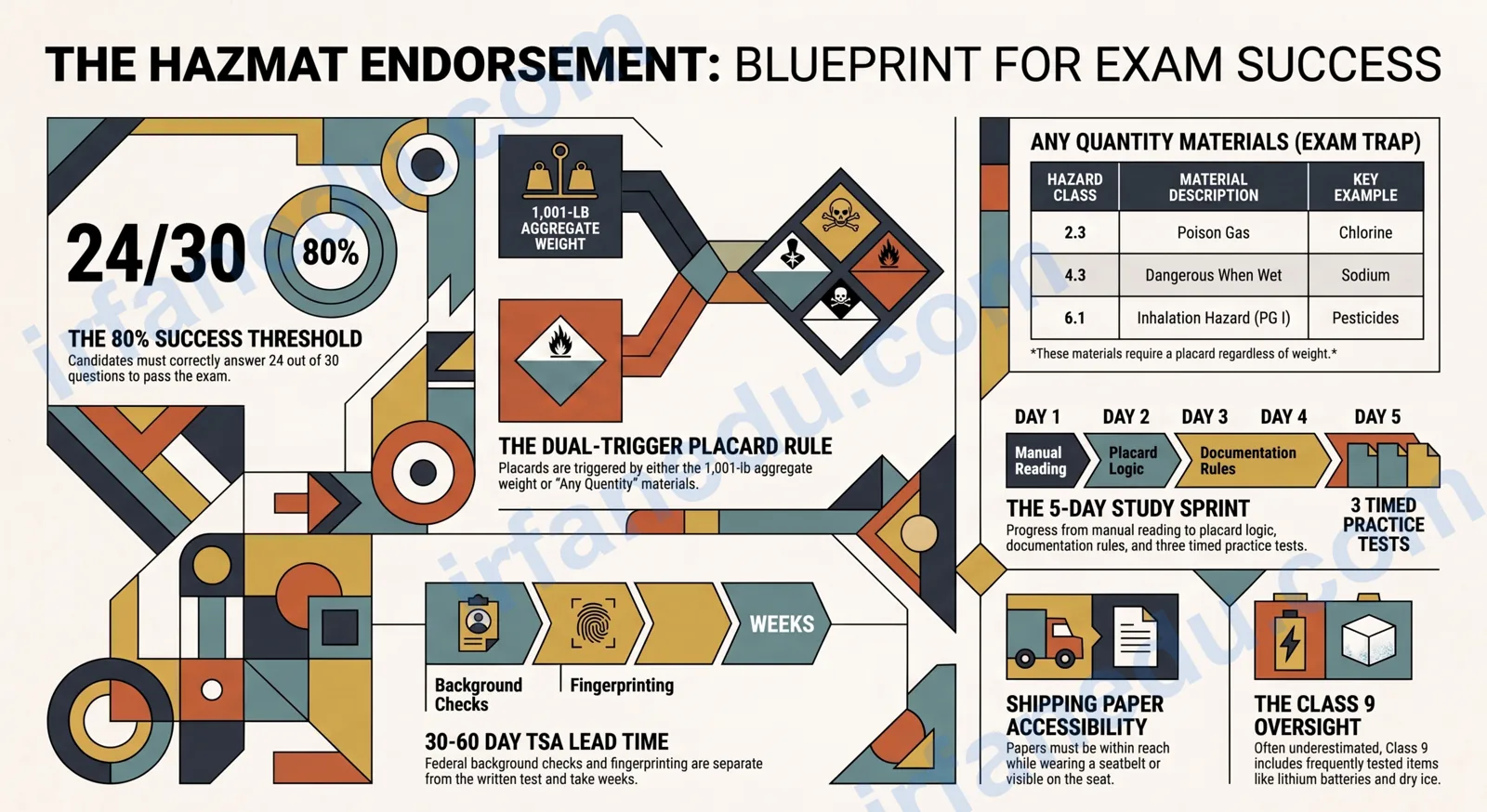
Most CDL candidates treat the hazmat endorsement test as a quick add-on — a few extra questions, no big deal. In my experience tutoring hundreds of drivers, that attitude is exactly why so many fail on the first attempt. The hazmat knowledge test is narrow in scope but precise in its language, and the DOT regulations it draws from leave almost no room for interpretation.
The hazmat practice test is the single most effective preparation tool for the CDL hazmat endorsement exam. It mirrors the real 30-question DOT-based knowledge test, covering all 9 hazard classes, placarding thresholds, shipping paper requirements, and emergency response rules. Candidates who complete three or more full practice tests before their official exam pass at a significantly higher rate than those who only read the handbook.
- 🎯 Understand what the hazmat test actually measures (it’s not what most guides say)
- 📦 Learn all 9 DOT hazard classes with real-world cargo examples
- 🪧 Master the placarding rules — the most commonly failed topic
- 📄 Know exactly what shipping papers must contain
- ✅ Follow a proven 5-day study plan to pass on your first attempt
7 things nobody tells you about the hazmat practice test 🚫
Every study guide covers the basics. Here are the seven things that actually separate candidates who pass from those who have to retake.
- The test is about recognition, not recall. You won’t be asked to recite a regulation number. You’ll be shown a scenario — a cargo description, a weight, a situation — and asked what action is required. Practice tests train your pattern recognition far better than flashcards.
- Placarding rules have two completely different triggers. One trigger is weight-based (the 1,001-pound rule for non-bulk packages). The other is quantity-independent — certain materials require placards regardless of how little you’re carrying. Most candidates only study one trigger and get blindsided by the other.
- The background check is not part of the written test — but it can block you. The TSA threat assessment (fingerprinting) is a separate federal process under 49 CFR Part 1572. It can take 30-60 days. Many candidates pass the written test but can’t get their endorsement because they started the background check too late.
- Class 9 is the most underestimated class. “Miscellaneous hazardous materials” sounds harmless. But Class 9 includes dry ice, lithium batteries, and magnetized materials — items that appear on the test far more often than their vague label suggests.
- Shipping papers must be within arm’s reach — not just in the cab. The exact regulatory language says the driver must be able to reach the shipping papers from the driver’s seat while wearing a seat belt. Practice tests will test this exact phrasing.
- Emergency response information is a separate requirement from shipping papers. Many candidates conflate the two. The Emergency Response Guide (ERG) number or emergency contact must appear on or alongside the shipping paper — it’s a distinct data field, not just part of the description.
- You can use the FMCSA’s own practice materials legally and for free. The Federal Motor Carrier Safety Administration publishes the official CDL manual online at fmcsa.dot.gov. Your state’s hazmat section is drawn directly from it. Using the official source alongside third-party practice tests is the highest-yield study combination.
In my experience, the candidates who fail the hazmat test on their first attempt almost always have the same gap: they studied the list of hazard classes but never practiced applying the placarding decision process to a real scenario. The test is scenario-driven, not definition-driven. Shift your practice toward “given this cargo, what do I do?” and your score will jump noticeably.
The 9 hazmat classes explained 🧪
The DOT divides all hazardous materials into 9 classes. Each class has a specific diamond-shaped placard with a designated color and number. Knowing the class, color, and a real-world example for each is essential for the test.
| Class | Name | Placard color | Real-world example | Key test point |
|---|---|---|---|---|
| 1 | Explosives | Orange | Fireworks, ammunition | 6 divisions (1.1–1.6); division determines placard |
| 2 | Gases | Green (non-flammable), Red (flammable), White (poison) | Propane (2.1), CO₂ (2.2), Chlorine (2.3) | Poison gas (2.3) requires placard at ANY quantity |
| 3 | Flammable liquids | Red | Gasoline, ethanol | Most common hazmat cargo; flashpoint below 60°C |
| 4 | Flammable solids | Red/white stripes (4.1), White (4.2), Blue (4.3) | Matches (4.1), white phosphorus (4.2), sodium (4.3) | 4.3 (dangerous when wet) is a high-frequency test topic |
| 5 | Oxidizers / Organic peroxides | Yellow | Hydrogen peroxide (5.1), benzoyl peroxide (5.2) | Organic peroxides (5.2) require placard at ANY quantity |
| 6 | Toxic / Infectious | White (skull & crossbones) | Pesticides (6.1), medical waste (6.2) | Inhalation hazard (PG I) requires placard at ANY quantity |
| 7 | Radioactive | Yellow/white | Medical isotopes, uranium ore | Transport index determines placard category (I, II, III) |
| 8 | Corrosives | Black/white | Battery acid, sodium hydroxide | Segregation from food items is a tested rule |
| 9 | Miscellaneous | White/black stripes | Dry ice, lithium batteries, magnetized material | Lithium battery rules are a growing test focus |
How placarding rules actually work 🪧
Placarding is the most heavily tested topic on the hazmat endorsement exam. The core rule sounds simple — display a placard when you carry hazardous materials — but the actual regulation has two distinct triggers that most study guides blur together.
Trigger 1: The 1,001-pound rule (aggregate weight)
For most hazmat classes, you must placard when the total gross weight of all non-bulk packages in a single hazard class reaches or exceeds 1,001 pounds (454 kg). This applies to Classes 1.4, 3, 4, 5, 6.1, 8, and 9.
Trigger 2: Any quantity — no weight threshold
Certain high-hazard materials require a placard regardless of quantity. These include:
- Class 1.1, 1.2, 1.3 (high-hazard explosives)
- Class 2.3 (poison gas)
- Class 4.3 (dangerous when wet)
- Class 5.2 (organic peroxides, Type B)
- Class 6.1 (inhalation hazard, Packing Group I)
- Class 7 (radioactive — Yellow III label)
🗺 Placarding decision flowchart
  START: You have a hazmat shipment
           |
           v
  Is the material in the "ANY QUANTITY" list?
  (Classes 1.1/1.2/1.3, 2.3, 4.3, 5.2-Type B,
   6.1 PG I inhalation, 7-Yellow III)
           |
    YES    |    NO
     |     |     |
     v           v
  PLACARD    Is total gross weight of
  REQUIRED   non-bulk packages >= 1,001 lb?
                  |
           YES    |    NO
            |     |     |
            v           v
         PLACARD     NO PLACARD
         REQUIRED     REQUIRED
                      (but shipping
                       papers still
                       required)
Shipping papers: what the test really asks 📄
Shipping papers are the hazmat driver’s most important document. The test focuses on two things: what information they must contain, and where they must be located.
Required information on every hazmat shipping paper
- Proper shipping name — the DOT-approved name, not a trade name
- Hazard class or division number
- UN/NA identification number (e.g., UN1203 for gasoline)
- Packing group (I, II, or III — where applicable)
- Total quantity and unit of measure
- Emergency response information — ERG guide number or 24-hour emergency contact phone number
Where must shipping papers be located?
When driving: within reach from the driver’s seat while wearing a seat belt — typically on the seat or in the door pouch. When out of the vehicle: on the driver’s seat or in a door pouch visible from outside. This exact location rule appears on the test regularly.
You are carrying 500 gallons of ethanol (UN1170, Class 3, PG II). Your shipping paper lists the trade name “EtOH” instead of the proper shipping name “Ethanol.” Is this compliant?
Answer: No. The DOT requires the proper shipping name as listed in the Hazardous Materials Table (49 CFR 172.101). Trade names alone are not acceptable. The correct entry would be: Ethanol, 3, UN1170, PG II, 500 gal.
Hazmat vs other CDL endorsements: what’s different 🔍
Understanding how the hazmat endorsement compares to other CDL add-ons helps you allocate your study time correctly. The hazmat test is uniquely demanding because it combines federal regulation knowledge with a federal background check.
| Feature | Hazmat (H) | Tanker (N) | Doubles/Triples (T) | Passenger (P) |
|---|---|---|---|---|
| Written test questions | 30 | 20 | 20 | 20 |
| Passing score | 80% | 80% | 80% | 80% |
| Federal background check | ✅ Yes (TSA) | ❌ No | ❌ No | ❌ No |
| Skills/road test required | ❌ No | ✅ Yes | ✅ Yes | ✅ Yes |
| Primary study focus | DOT regulations, placarding | Liquid surge, rollovers | Coupling, stability | Passenger safety, evacuation |
| Renewal period | Every 5 years (with TSA renewal) | With CDL renewal | With CDL renewal | With CDL renewal |
Step-by-step: how to prepare in 5 days 📅
You don’t need weeks to pass the hazmat test. A focused 5-day plan — about 60-90 minutes per day — is enough for most candidates who have no prior hazmat knowledge.
- Day 1 — Read the hazmat section of your state CDL manual. Focus on the 9 classes and their placard colors. Don’t memorize yet — just build familiarity. Download the free FMCSA CDL resource page as your official reference.
- Day 2 — Master the placarding rules. Use the flowchart above. Practice applying the 1,001-lb rule and the any-quantity rule to 10 different cargo scenarios you invent yourself.
- Day 3 — Study shipping papers and emergency response. Memorize the 6 required data fields. Practice identifying compliant vs non-compliant shipping paper entries.
- Day 4 — Take your first full 30-question hazmat practice test. Do it under timed conditions (no notes, 45 minutes). Score yourself and review every wrong answer against the CDL manual.
- Day 5 — Take two more practice tests. Focus your second test on your weakest topic. On your third test, simulate exam day: phone away, timer on, one attempt only. If you score 90%+ on test 3, you’re ready.
Common mistakes that fail candidates ❌
These are the errors I see most often when reviewing failed hazmat test attempts. Each one is avoidable with targeted practice.
| Mistake | Why it fails you | Correct approach |
|---|---|---|
| Confusing class numbers with division numbers | Class 1 has 6 divisions; the test asks about specific divisions | Learn each division’s hazard level and placard separately |
| Assuming all hazmat requires a placard | Below-threshold non-bulk packages don’t require placards | Always apply the two-trigger test before answering |
| Forgetting the ERG emergency contact requirement | Shipping papers without emergency response info are non-compliant | Treat ERG info as a mandatory 7th field on every paper |
| Skipping Class 9 in study sessions | Lithium battery and dry ice questions appear regularly | Spend at least 15 minutes specifically on Class 9 examples |
| Not starting the TSA background check early | Processing can take 30-60 days; delays endorsement issuance | Submit fingerprints at least 30 days before your planned test date |
The 1,001-pound rule applies to aggregate weight per hazard class — not per shipment. Most study guides describe it as a “per-shipment” threshold, which is technically misleading. If you carry 600 lb of Class 3 gasoline AND 600 lb of Class 3 ethanol, the aggregate Class 3 weight is 1,200 lb — which exceeds the threshold, so you must placard. But if you carry 600 lb of Class 3 and 600 lb of Class 8 corrosives, each class is below 1,001 lb independently, so neither requires a placard based on weight alone. The test exploits exactly this distinction. I’ve seen candidates with otherwise solid preparation miss 3-4 questions because they applied the threshold to the total shipment weight instead of per-class weight.
🧠 Mini quiz: test yourself now
Select an answer — instant feedback appears below each question. No sign-up needed.
Q1. You are carrying 950 lb of Class 3 flammable liquid in non-bulk packages. Do you need to display a placard?
Q2. A shipment contains a small cylinder of chlorine gas (Class 2.3). Does it require a placard?
Q3. Where must shipping papers be located when the driver is out of the vehicle?