
MCAT Physics Equations: The Complete Guide, Cheat Sheet & Practice Worksheet
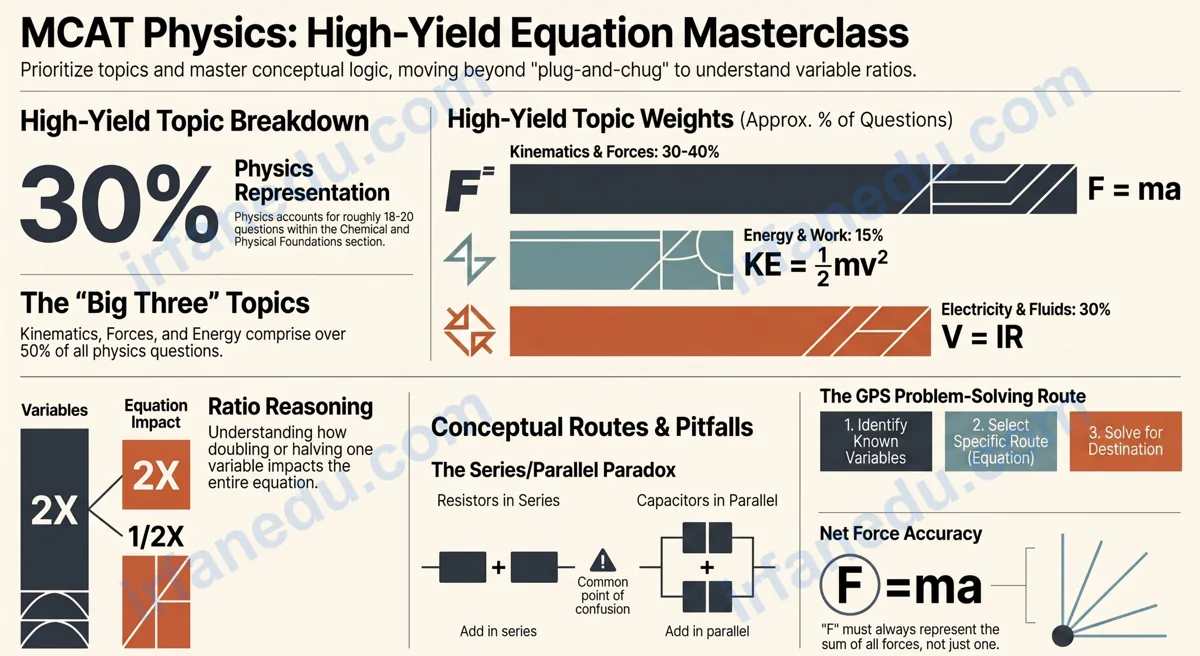
Think of MCAT Physics Like a GPS — You Already Know the Destination
Imagine you are driving to a city you have never visited. You know your starting point, your speed, and the time you have been driving. A GPS does not invent new physics — it uses a handful of reliable equations to calculate exactly where you are. MCAT physics works the same way.
Every MCAT physics problem gives you a starting point (known variables) and asks you to find a destination (the unknown). Your job is not to invent new formulas — it is to recognize which equation is the right “route.” The entire MCAT physics equation list is finite, algebra-based, and completely learnable. I have helped hundreds of pre-med students realize this, and it changes everything about how they study.
MCAT physics equations are algebra-based formulas covering seven topics: kinematics, forces, energy, fluids, electricity, waves, and optics. The MCAT does not provide a formula sheet, so you must memorize roughly 50-60 equations. The highest-yield formulas — F=ma, KE=½mv², V=IR, P=F/A, and the lens equation — appear across multiple question types and are worth mastering first.
- 🎯 Learn which equations are highest-yield on the MCAT
- 🔢 See every core formula organized by topic
- 📐 Work through fully solved examples for each topic
- 🚫 Avoid the most common equation mistakes students make
- 📄 Download a free printable cheat sheet + answer key
MCAT physics equations cover seven core topics: kinematics, forces and Newton’s laws, energy and work, fluids, electricity and circuits, waves and sound, and optics. You do not need calculus — all equations are algebra-based. The most tested formulas include F=ma, KE=½mv², P=F/A, V=IR, and the lens equation 1/f = 1/do + 1/di. No formula sheet is provided on test day.
📄 Free Printable Worksheet: 10 MCAT physics practice problems with a full answer key — ready to print or use on screen.
⚡ TL;DR – Quick Summary
- 📌 The MCAT covers ~50-60 physics equations across 7 topics — no formula sheet provided.
- 📌 Kinematics, forces, and energy equations are the highest-yield — master these first.
- 📌 All MCAT physics is algebra-based; no calculus and no calculator on test day.
- 📌 Understanding the concept behind each equation beats pure memorization every time.
- 📌 The lens equation (1/f = 1/do + 1/di) and Ohm’s Law (V=IR) appear in almost every MCAT.
- 📌 Practice applying equations to passages — not just solving isolated plug-and-chug problems.
📊 MCAT Physics Quick Facts
| Topic | Key Equations | Approx. % of Physics Qs | Difficulty |
|---|---|---|---|
| Kinematics | v = v₀ + at, x = v₀t + ½at² | 15-20% | Medium |
| Forces (Newton’s Laws) | F = ma, Fg = mg, Ff = μN | 15-20% | Medium |
| Energy & Work | KE = ½mv², PE = mgh, W = Fd | 15% | Low-Medium |
| Fluid Mechanics | P = F/A, P = ρgh, A₁v₁ = A₂v₂ | 15% | High |
| Electricity & Circuits | V = IR, P = IV, C = Q/V | 15% | High |
| Waves & Sound | v = fλ, f’ = f(v±vo)/(v±vs) | 10% | Medium |
| Optics | 1/f = 1/do + 1/di, n₁sinθ₁ = n₂sinθ₂ | 10% | High |
What Are MCAT Physics Equations and Why Do They Matter?
MCAT physics equations are the mathematical relationships that describe how physical quantities — force, velocity, energy, charge, pressure — relate to each other. They are the formal version of intuitions you already have: push harder, things accelerate faster (F = ma); climb higher, you store more energy (PE = mgh).
The MCAT’s Chemical and Physical Foundations of Biological Systems section (Section 1) contains roughly 30% physics content. That translates to about 18-20 physics-related questions per test. A strong command of equations can realistically add 3-5 points to your total score.
What makes MCAT physics different from a university physics course is the emphasis on conceptual reasoning over calculation. Many questions ask you to predict what happens when a variable doubles or halves — without any arithmetic at all. That means you need to understand the relationship inside each equation, not just memorize the symbols.
In my experience teaching MCAT prep, the students who struggle most with physics are not the ones who forgot equations — they are the ones who memorized equations without ever asking “what does this equation actually mean?” When a student truly understands that F = ma means force is what causes a change in motion, not motion itself, they stop confusing force with velocity and their score jumps. Conceptual clarity is the real cheat code.
Kinematics Equations: How Do Objects Move?
Kinematics describes motion without asking why — it just tracks position, velocity, and acceleration over time. The four core kinematic equations are your toolkit for any object moving in a straight line with constant acceleration.
| Equation | Variables | Use When |
|---|---|---|
| v = v₀ + at | v, v₀, a, t | No displacement given |
| x = v₀t + ½at² | x, v₀, a, t | No final velocity given |
| v² = v₀² + 2ax | v, v₀, a, x | No time given |
| x = ½(v + v₀)t | x, v, v₀, t | No acceleration given |
Projectile motion splits into two independent components: horizontal (constant velocity, a = 0) and vertical (constant acceleration, a = -g ≈ -10 m/s²). Treat them separately, then combine at the end.
📐 Worked Example — Kinematics
Problem: A ball is dropped from rest off a 20 m cliff. How long does it take to hit the ground? (g = 10 m/s²)
Step 1: Identify knowns: x = 20 m, v₀ = 0, a = 10 m/s² (downward). Unknown: t.
Step 2: Choose equation with x, v₀, a, t: x = v₀t + ½at²
Step 3: Substitute: 20 = 0 + ½(10)t² → 20 = 5t² → t² = 4 → t = 2 s
Forces and Newton’s Laws: What Causes Motion to Change?
Newton’s three laws explain why objects accelerate, stay still, or interact. On the MCAT, Newton’s Second Law (F = ma) is the engine of almost every mechanics problem.
| Equation | Meaning | Key Notes |
|---|---|---|
| F = ma | Net force = mass × acceleration | F is the NET (total) force |
| Fg = mg | Gravitational force (weight) | g ≈ 10 m/s² on MCAT |
| Ff = μN | Friction force | μs > μk (static > kinetic) |
| Fs = -kx | Spring (Hooke’s Law) | x = displacement from equilibrium |
| Fc = mv²/r | Centripetal force | Directed toward center of circle |
🔭 Visual: Free Body Diagram — Elevator Problem
Person in elevator accelerating UPWARD:

        ↑  N (Normal force from scale)
        |
   [Person: 60 kg]
        |
        ↓  Fg = mg = 600 N (downward)

Net force = N - Fg = ma
N = m(g + a) = 60(10 + 2) = 720 N

Scale reads MORE than weight when accelerating up.
Scale reads LESS than weight when accelerating down.
📐 Worked Example — Newton’s Second Law
Problem: A 60 kg person stands in an elevator accelerating upward at 2 m/s². What does the scale read?
Step 1: Draw forces: Normal force N (up), weight Fg = mg = 600 N (down).
Step 2: Net force equation (upward positive): N – Fg = ma
Step 3: N = m(g + a) = 60(10 + 2) = 60 × 12 = 720 N
Energy, Work, and Power: What Does Force Accomplish?
Energy equations describe what force actually achieves over distance or time. The conservation of energy is one of the most powerful problem-solving tools on the MCAT — when you cannot track every force, track energy instead.
| Equation | Meaning | Units |
|---|---|---|
| KE = ½mv² | Kinetic energy | Joules (J) |
| PE = mgh | Gravitational potential energy | Joules (J) |
| W = Fd cosθ | Work done by a force | Joules (J) |
| P = W/t = Fv | Power | Watts (W) |
| KE₁ + PE₁ = KE₂ + PE₂ | Conservation of mechanical energy | — |
| Efficiency = Wout/Win × 100% | Efficiency of a machine | % |
Fluid Mechanics Equations: How Do Liquids and Gases Behave?
Fluid mechanics is one of the highest-difficulty MCAT physics topics because it combines multiple equations in a single passage. The key insight is that fluids transmit pressure and obey conservation of energy (Bernoulli) and conservation of mass (continuity).
| Equation | Meaning | Watch Out For |
|---|---|---|
| P = F/A | Pressure = Force / Area | Smaller area → higher pressure |
| P = ρgh | Hydrostatic pressure at depth h | ρ = fluid density, not object density |
| Ptotal = Patm + ρgh | Absolute pressure at depth | Add atmospheric pressure |
| Fb = ρfluid × Vsubmerged × g | Buoyant force (Archimedes) | V is submerged volume only |
| A₁v₁ = A₂v₂ | Continuity equation (flow rate) | Narrower pipe → faster flow |
| P₁ + ½ρv₁² + ρgh₁ = P₂ + ½ρv₂² + ρgh₂ | Bernoulli’s equation | Energy conservation for fluids |
Bernoulli’s equation intimidates students because it looks long. In my experience, the MCAT almost never asks you to use all six terms at once. Most Bernoulli questions either hold height constant (canceling the ρgh terms) or hold velocity constant (canceling the ½ρv² terms). Identify which terms drop out first, and the equation shrinks to something manageable in seconds.
Electricity and Circuits: How Does Charge Flow?
Electricity questions on the MCAT test your understanding of how voltage, current, resistance, and power relate — and how those relationships change in series vs. parallel circuits.
| Equation | Meaning | Key Notes |
|---|---|---|
| V = IR | Ohm’s Law: Voltage = Current × Resistance | Foundation of all circuit problems |
| P = IV = I²R = V²/R | Power dissipated in a resistor | Three equivalent forms — pick the one with your knowns |
| Rs = R₁ + R₂ + … | Resistors in series | Same current, voltages add |
| 1/Rp = 1/R₁ + 1/R₂ + … | Resistors in parallel | Same voltage, currents add |
| C = Q/V | Capacitance | Q = charge, V = voltage |
| E = ½CV² | Energy stored in a capacitor | Analogous to KE = ½mv² |
| F = kq₁q₂/r² | Coulomb’s Law | k ≈ 9×10⁹ N·m²/C² |
📐 Worked Example — Parallel Resistors
Problem: Two 6 Ω resistors are connected in parallel. What is the equivalent resistance?
Step 1: Use 1/Rp = 1/R₁ + 1/R₂ = 1/6 + 1/6 = 2/6 = 1/3
Step 2: Rp = 3 Ω
Insight: Parallel resistance is always less than the smallest individual resistor. This is a quick sanity check — if your answer is bigger than 6 Ω, you made an error.
Waves, Sound, and Optics: How Does Energy Travel?
Waves and optics questions often feel unfamiliar because students spend less time on them in pre-med coursework. But the equations are few and the patterns are predictable once you know them.
Waves and Sound
| Equation | Meaning |
|---|---|
| v = fλ | Wave speed = frequency × wavelength |
| f’ = f × (v ± vo) / (v ∓ vs) | Doppler effect (f’ = observed frequency) |
| I = P/A | Intensity = Power / Area |
| β = 10 log(I/I₀) | Sound level in decibels (I₀ = 10⁻¹² W/m²) |
Optics (Lenses and Mirrors)
| Equation | Meaning | Sign Convention |
|---|---|---|
| 1/f = 1/do + 1/di | Thin lens / mirror equation | Real image: di positive; virtual: negative |
| m = -di/do = hi/ho | Magnification | m negative = inverted image |
| n₁sinθ₁ = n₂sinθ₂ | Snell’s Law (refraction) | n = index of refraction |
| n = c/v | Index of refraction | c = 3×10⁸ m/s |
📐 Worked Example — Thin Lens Equation
Problem: A converging lens has focal length f = 10 cm. An object is placed 40 cm in front of it. Where is the image?
Step 1: 1/f = 1/do + 1/di → 1/10 = 1/40 + 1/di
Step 2: 1/di = 1/10 – 1/40 = 4/40 – 1/40 = 3/40
Step 3: di = 40/3 ≈ 13.3 cm (real, on opposite side of lens)
Common MCAT Physics Equation Mistakes (Wrong vs. Right)
Most MCAT physics errors come from a small set of recurring mistakes. Recognizing them in advance is one of the highest-value things you can do before test day.
| ❌ Wrong | ✅ Right | Why It Matters |
|---|---|---|
| Using F = ma where F is just one force | F in F = ma is the NET (total) force | Forgetting friction or normal force gives wrong acceleration |
| Using g = 9.8 m/s² in calculations | Use g = 10 m/s² on the MCAT (no calculator) | Saves time; MCAT questions are designed for g = 10 |
| Applying KE = ½mv² to rotational motion | Rotational KE = ½Iω² (different equation) | Mixing translational and rotational equations gives wrong answers |
| Using total volume in buoyancy (Fb = ρVg) | V = submerged volume only | A floating object is only partially submerged |
| Adding capacitors in parallel like resistors | Capacitors in parallel: C = C₁ + C₂ (they ADD, opposite of resistors) | Capacitors and resistors have opposite rules for series/parallel |
| Ignoring the cosθ term in W = Fd cosθ | Always check the angle between force and displacement | Perpendicular force does zero work |
Most guides teach MCAT physics equations as a flat list to memorize. That is the wrong mental model, and it is why students freeze on passage-based questions.
The MCAT tests equations in ratio form far more often than in plug-and-chug form. For example, a question might say: “If the radius of a pipe doubles, how does flow velocity change?” You are not expected to calculate a number — you are expected to know that from the continuity equation A₁v₁ = A₂v₂, if area (proportional to r²) quadruples, velocity must quarter.
In my experience reviewing hundreds of MCAT score reports, students who practice “what happens when X doubles?” drills for every equation outperform students who practice numerical calculation by a significant margin on the physics section. Build a ratio-reasoning habit, not just a formula-recall habit. This is the preparation shift that most guides never mention.
📝 MCAT Physics Practice Worksheet
Use the problems below to test your equation recall and problem-solving process. Work through each problem on paper, showing your substitution step. Then check your answers using the key below.
How to use this worksheet: Print the PDF (download button above or below), solve all problems without looking at the equations, then self-check with the answer key. Repeat any problem you got wrong until you can solve it from scratch without notes.
- A 2 kg object accelerates at 5 m/s². What is the net force acting on it?
- A car starts from rest and reaches 30 m/s in 6 s. What is its acceleration?
- How far does an object travel if it starts from rest, accelerates at 4 m/s², for 3 s?
- A 60 kg person stands on a scale in an elevator accelerating upward at 2 m/s². What does the scale read? (g = 10 m/s²)
- A 5 kg box is lifted 3 m vertically. How much gravitational potential energy does it gain? (g = 10 m/s²)
- What is the kinetic energy of a 4 kg ball moving at 6 m/s?
- A fluid exerts a pressure of 800 Pa over an area of 0.05 m². What is the force?
- A resistor has a voltage of 12 V across it and a current of 3 A through it. What is its resistance?
- Two resistors of 6 Ω each are connected in parallel. What is the equivalent resistance?
- A lens has a focal length of 10 cm. An object is placed 40 cm away. Where is the image? (Use 1/f = 1/do + 1/di)
📋 Show Answer Key
- 10 N (F = ma = 2 × 5)
- 5 m/s² (a = Δv/t = 30/6)
- 18 m (x = ½at² = ½ × 4 × 9)
- 720 N (N = m(g+a) = 60 × 12)
- 150 J (PE = mgh = 5 × 10 × 3)
- 72 J (KE = ½mv² = ½ × 4 × 36)
- 40 N (F = PA = 800 × 0.05)
- 4 Ω (R = V/I = 12/3)
- 3 Ω (1/Rp = 1/6 + 1/6 = 1/3)
- di ≈ 13.3 cm (1/di = 1/10 – 1/40 = 3/40)
📄 Want a print-ready version? Download the full PDF worksheet with a clean answer key — perfect for timed practice sessions.
🧠 Interactive MCAT Physics Quiz
Test Your Equation Knowledge (3 Questions)
1. A 3 kg object is acted on by a net force of 15 N. What is its acceleration?
Show Answer
2. Which equation correctly describes the buoyant force on a submerged object?
Show Answer
3. Two capacitors (4 μ
Sources & References
Reviewed by Dr. Irfan Mansuri. External links open in a new tab and are provided for further reading and verification.