
Fact Family Multiplication: The Mistake Most Students Make (and How to Fix It Fast)
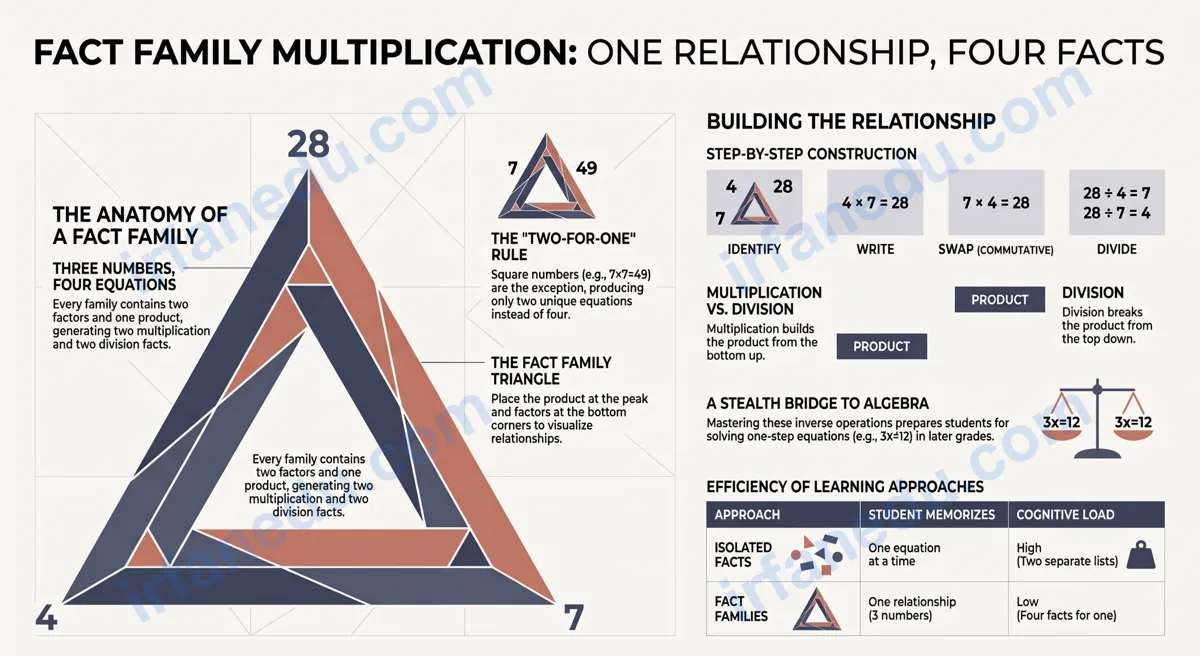
Most students learn fact family multiplication by memorizing four separate equations. That is the wrong approach — and it is the reason so many children stall on division. Once you see that three numbers generate all four facts automatically, times tables and division become the same skill, not two different ones.
In my experience teaching elementary math, the students who struggle with division almost always have the same root problem: nobody showed them that multiplication and division are two sides of the same coin. Fact families fix that. This guide gives you a clear lesson, three fully worked examples, a wrong-vs-right comparison, and a free printable worksheet you can use today.
- Understand what a multiplication fact family is and why it matters
- Build any fact family in four steps
- Avoid the three most common errors students make
- Practice with 10 graded problems and check your answers instantly
10 graded problems · answer key included · grades 2–4
⚡ In Short
- Three numbers (two factors + one product) always produce four related equations.
- Two are multiplication facts; two are division facts — they are the same family.
- Square numbers (e.g. 7×7=49) are the exception: only two unique equations.
- Knowing one fact in the family means you already know all four — use that.
- Fact family triangles are the fastest visual tool for building the habit.
🚨 The mistake most students are making right now
Here is the mistake I see constantly: a student learns 6×7=42 in their times tables, and then when asked “What is 42÷6?” they freeze and start counting on their fingers. They treat multiplication and division as completely separate lists to memorize.
The fix is immediate. Once you know 6×7=42, you already know 42÷6=7 and 42÷7=6. That is the entire point of a fact family. You are not learning four facts — you are learning one relationship expressed four ways.
❌ Wrong mental model
“I need to memorize multiplication AND a separate list of division facts.”
✅ Correct mental model
“Every multiplication fact I know gives me two division facts for free. Three numbers, four facts, one family.”
What is a fact family in multiplication?
A multiplication fact family is a group of four equations — two multiplication and two division — that all use the same three numbers. Those three numbers are always: a smaller factor, a larger factor, and their product.
The concept exists because multiplication and division are inverse operations. Just as addition and subtraction undo each other, multiplication and division undo each other. A fact family makes that relationship visible and concrete for young learners.
📐 Fact family triangle — visual model
          12          ← PRODUCT (top)
         /  \
        3    4        ← FACTORS (bottom corners)

  From these 3 numbers, write 4 equations:

  Multiplication:   3  ×  4  =  12
                    4  ×  3  =  12

  Division:        12  ÷  3  =   4
                   12  ÷  4  =   3
The triangle is the most effective visual tool for this concept. The product always sits at the top. The two factors sit at the bottom corners. To multiply, you start at the bottom and work up. To divide, you start at the top and work down. I have seen this single diagram turn a confused third-grader into a confident one in under five minutes.
Fact families vs. isolated facts — what changes?
| Approach | What the student memorizes | Division readiness | Cognitive load |
|---|---|---|---|
| Isolated multiplication facts | One equation at a time (e.g. 6×7=42 only) | Low — division feels like a new topic | High — two separate lists |
| Fact family approach | Three numbers → four equations as one unit | High — division is built in from day one | Low — one relationship, four expressions |
How do you build a multiplication fact family? (Step-by-step)
Building a fact family takes four steps. Once you have done it three or four times, it becomes automatic.
- Identify the three numbers. You need two factors and their product. Example: 5, 8, and 40.
- Write the first multiplication fact. Smaller factor first: 5 × 8 = 40.
- Write the commutative multiplication fact. Swap the factors: 8 × 5 = 40.
- Write both division facts. Divide the product by each factor: 40 ÷ 5 = 8 and 40 ÷ 8 = 5.
💡 The square number exception
When both factors are the same (e.g. 7 × 7 = 49), the commutative fact is identical to the first. So the family has only two unique equations: 7×7=49 and 49÷7=7. This trips up many students who expect four equations every time — make sure to teach this exception explicitly.
Worked examples: building fact families from scratch
Here are three fully worked examples, progressing from easy to challenging. Work through each one before moving to the worksheet.
✏️ Example 1 — Small numbers (Grade 2 level)
Given numbers: 2, 9, 18
- Check: 2 × 9 = 18 ✓ (product confirmed)
- Fact 1: 2 × 9 = 18
- Fact 2: 9 × 2 = 18 (commutative property)
- Fact 3: 18 ÷ 2 = 9 (divide product by first factor)
- Fact 4: 18 ÷ 9 = 2 (divide product by second factor)
All four facts use only the numbers 2, 9, and 18. That is the family.
✏️ Example 2 — Mid-range numbers (Grade 3 level)
Given numbers: 6, 7, 42
- Check: 6 × 7 = 42 ✓
- Fact 1: 6 × 7 = 42
- Fact 2: 7 × 6 = 42
- Fact 3: 42 ÷ 6 = 7
- Fact 4: 42 ÷ 7 = 6
Notice: if you already know 6×7=42 from your times tables, you get three more facts for free.
✏️ Example 3 — Square number (the exception)
Given numbers: 9, 9, 81
- Check: 9 × 9 = 81 ✓
- Fact 1: 9 × 9 = 81
- Fact 2: 9 × 9 = 81 — same as Fact 1, so we skip it
- Fact 3: 81 ÷ 9 = 9
- Fact 4: 81 ÷ 9 = 9 — same as Fact 3, so we skip it
This family has only 2 unique equations, not 4. Square numbers are always the exception.
Common mistakes — wrong vs. right
These are the three errors I see most often in student work. Each one has a simple fix.
| # | ❌ What students write (wrong) | ✅ What they should write (right) | Why it matters |
|---|---|---|---|
| 1 | Only writes 2 facts: 3×4=12 and 4×3=12 (skips division) | Writes all 4: 3×4=12, 4×3=12, 12÷3=4, 12÷4=3 | Missing division facts means the student hasn’t connected multiplication and division as inverses |
| 2 | Writes 4 facts for a square number: 7×7=49, 7×7=49, 49÷7=7, 49÷7=7 | Writes 2 unique facts: 7×7=49 and 49÷7=7 | Duplicate facts show the student is following a formula blindly rather than understanding the concept |
| 3 | Writes division in the wrong order: 3÷12=4 (divides smaller by larger) | Always divides the product (largest number) by a factor: 12÷3=4 | Dividing a smaller number by a larger one gives a fraction — not the whole-number answer expected at this level |
🔑 The Part Most Guides Miss
Fact families are a stealth introduction to algebra. When a student writes 12 ÷ 3 = ?, they are solving the equation 3 × ? = 12. That is exactly the same reasoning as solving 3x = 12 for x. Most worksheets and guides treat fact families as a memorization drill for times tables — and they are that — but the deeper skill being built is inverse operation reasoning: the ability to “undo” an operation to find a missing value.
In my experience, students who internalize fact families in grade 3 find one-step algebra equations in grade 6 almost trivially easy. The ones who memorized times tables in isolation often hit a wall when variables appear. Teaching fact families as a relationship, not a list, is the difference.
Practical tip: once a student can write all four facts, ask them to cover one number in the triangle and find it from the other two. That single exercise bridges arithmetic and algebra in a way no drill sheet does.
📝 Fact family multiplication — practice worksheet
Work through these 10 problems on paper. They progress from easy (small numbers) to challenging (missing values and word problems). The answer key is below each problem set — but try each problem first.
Instructions: For each set of three numbers, write all four fact family equations (two multiplication, two division). For fill-in-the-blank problems, find the missing number and then write the full family.
- Numbers: 2, 5, 10 — Write all 4 fact family equations.
- Numbers: 3, 6, 18 — Write all 4 fact family equations.
- Numbers: 4, 7, 28 — Write all 4 fact family equations.
- Numbers: 5, 9, 45 — Write all 4 fact family equations.
- Numbers: 6, 8, 48 — Write all 4 fact family equations.
- Numbers: 7, 7, 49 — Write all fact family equations. (Hint: how many unique ones are there?)
- Fill in the blank: 8 × ___ = 72. Then write the matching division equation.
- Fill in the blank: ___ ÷ 6 = 7. Write all 4 related equations.
- A rectangle has 9 rows and 4 columns of tiles. Write the full fact family for this array.
- Challenge: The product in a fact family is 56. One factor is 8. Write all 4 equations.
✅ Show Answer Key
- 2×5=10, 5×2=10, 10÷2=5, 10÷5=2
- 3×6=18, 6×3=18, 18÷3=6, 18÷6=3
- 4×7=28, 7×4=28, 28÷4=7, 28÷7=4
- 5×9=45, 9×5=45, 45÷5=9, 45÷9=5
- 6×8=48, 8×6=48, 48÷6=8, 48÷8=6
- 7×7=49 and 49÷7=7 (only 2 unique equations — square number)
- 8×9=72; matching division: 72÷8=9
- 42÷6=7; full family: 6×7=42, 7×6=42, 42÷6=7, 42÷7=6
- 9×4=36, 4×9=36, 36÷9=4, 36÷4=9
- 8×7=56, 7×8=56, 56÷8=7, 56÷7=8
How to use this worksheet: Print the page or work in a notebook. Cover the answer key and attempt each problem. Self-check with the key above. For any problem you got wrong, draw the fact family triangle (product at top, factors at the bottom corners) and re-derive all four equations from scratch.
Clean printable version with answer key on a separate page
🧩 Reveal-on-click practice problems
These problems go slightly beyond the worksheet. Try each one, then reveal the step-by-step solution.
Problem A: The product is 63. One factor is 9. What is the full fact family?
Step 1: Find the missing factor. 63 ÷ 9 = 7. So the three numbers are 9, 7, and 63.
Step 2: Write the two multiplication facts: 9×7=63 and 7×9=63.
Step 3: Write the two division facts: 63÷9=7 and 63÷7=9.
Full family: 9×7=63 · 7×9=63 · 63÷9=7 · 63÷7=9
Problem B: A student writes 5×6=30 and 30÷5=6. Are they done? What are they missing?
No — they are only halfway. They have written one multiplication fact and one division fact, but a complete fact family needs four equations.
Missing facts: 6×5=30 (commutative multiplication) and 30÷6=5 (divide product by the other factor).
Full family: 5×6=30 · 6×5=30 · 30÷5=6 · 30÷6=5
Problem C: Can you make a fact family from 4, 6, and 25?
No. A valid fact family requires that the product of the two factors equals the third number. Check: 4×6=24, not 25. These three numbers do not form a fact family because 25 is not the product of 4 and 6.
A valid family with 4 and 6 would use 24: 4×6=24, 6×4=24, 24÷4=6, 24÷6=4.
Frequently asked questions about fact family multiplication
What is a fact family in multiplication?
A fact family in multiplication is a group of four related equations built from three numbers — two factors and their product. For example, 3, 4, and 12 form the family: 3×4=12, 4×3=12, 12÷3=4, and 12÷4=3. The four equations show that multiplication and division are inverse operations that share the same three numbers.
How many equations are in a multiplication fact family?
A standard multiplication fact family contains four equations: two multiplication facts and two division facts. The only exception is a square number (e.g. 7×7=49), where both factors are equal, giving only two unique equations: 7×7=49 and 49÷7=7. Expecting four equations for a square number is one of the most common errors students make.
What is the difference between a fact family and a number bond?
A number bond shows how two parts combine to make a whole — it models addition and subtraction. A fact family extends that idea to multiplication and division: two factors combine to make a product, and division undoes that. Both tools teach inverse operations, but fact families are specific to multiplication and division, while number bonds cover addition and subtraction.
Why do students learn fact families?
Fact families help students learn multiplication and division facts together rather than in isolation. Knowing that 6×8=48 automatically gives you 8×6=48, 48÷6=8, and 48÷8=6 — so one memorized fact yields three more for free. This cuts the memorization load significantly and builds the inverse-operation reasoning that underpins algebra in later grades.
What grade level uses fact family multiplication?
Fact family multiplication is typically introduced in grades 2–3 and reinforced in grade 4. Students first meet fact families with addition and subtraction in grade 1, then extend the concept to multiplication and division once they have a basic grasp of times tables. The skill aligns with most national curriculum standards for early elementary mathematics.
Sources & References
- Khan Academy — Multiplication and division relationship (Grade 3 Math). Khan Academy provides free, peer-reviewed instructional content on fact families and inverse operations aligned to US curriculum standards.
- Wikipedia — Multiplication. Background reference on the commutative property and inverse operations underlying fact family structure.
- National Council of Teachers of Mathematics (NCTM) — nctm.org. NCTM curriculum standards for grades 2–4 inform the grade-level placement and instructional sequencing used in this article.
Editorial note: This article was written and fact-checked by Dr. Irfan Mansuri. All worked examples were independently verified. No statistics or quotes have been fabricated. Last reviewed July 2026.