
NCLEX Practice Questions — Set 13
How to use this set
Run it as a timed block rather than dipping in and out. 100 items at roughly a minute each is close to the pace the real exam asks for, and pacing is a skill that only improves under a clock. Answer every item before you open a single rationale — checking as you go turns a test into a reading exercise and hides the questions you were unsure about.
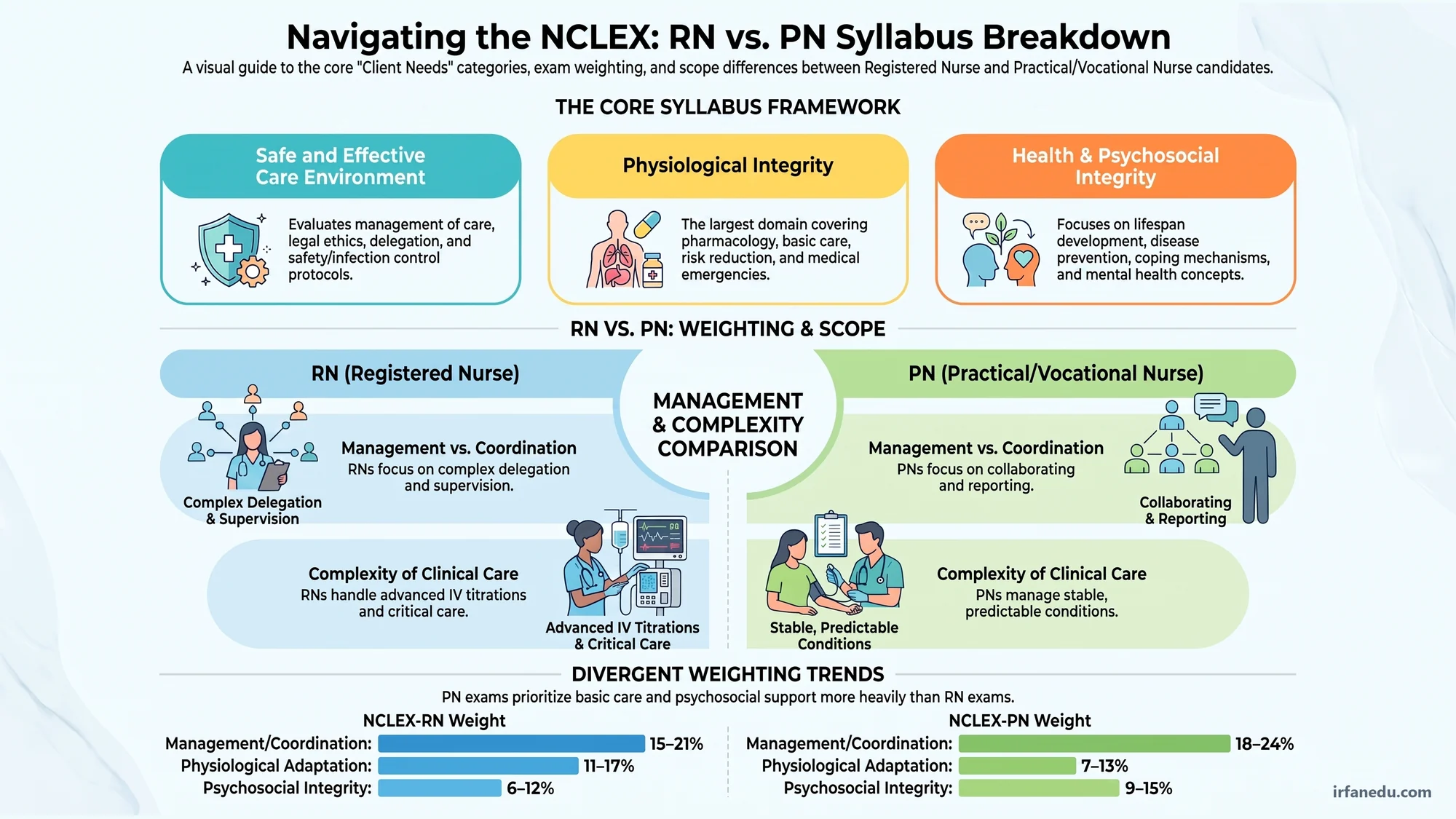
These sets are numbered rather than sorted by subject. The questions come from a general NCLEX bank that carries no topic field, and labelling them by eye would put a share of them under the wrong heading, so they are presented as mixed sets — which is how the exam itself arrives.
The 100 questions
The nurse is caring for clients in a family practice clinic. Which client should the nurse assess first?
Show answer and rationale
Correct answer: A. The female client who is having burning and pain on urination.
More than likely, this client has a urinary tract infection, which requires a midstream urinalysis. Of these four clients, this client should be seen first to have the test ordered.
The nurse and unlicensed assistive personnel (UAP) are working in a family practice clinic. Which task should the nurse delegate to the UAP?
Show answer and rationale
Correct answer: D. Take the vital signs of a client scheduled for a physical examination.
The UAP is trained to take vital signs on a client who is stable. This task could safely be delegated by the nurse.
Which task is most appropriate for the nurse on the renal unit to delegate to the unlicensed assistive personnel (UAP)?
Show answer and rationale
Correct answer: B. Escort the client with acute polynephritis to the radiology department for a CT scan.
The unlicensed assistive personnel (UAP) can escort a client who is stable to the radiology department; therefore, this is the most appropriate task to delegate to the UAP.
Which task should the employee health nurse delegate to the unlicensed assistive personnel (UAP)?
Show answer and rationale
Correct answer: A. Tell the UAP to apply an ice pack to the client who slipped and has a sprained right ankle.
The UAP can apply ice to the right ankle since the client is stable.
The nurse manager in the medical-surgical outpatient clinic is making assignments. Which task is most appropriate to delegate/assign to the UAP/LPN?
Show answer and rationale
Correct answer: D. Ask the LPN to administer the flu vaccine to the client.
The LPN can administer medication to the client; therefore, this is an appropriate assignment.
Which behavior warrants intervention by the clinical manager in the medical-surgical outpatient clinic?
Show answer and rationale
Correct answer: D. The UAP is discussing a client’s condition in the waiting room.
The unlicensed assistive personnel (UAP) is violating HIPAA rules concerning confidentiality, so the clinical manager should intervene.
The UAP in the school nurse’s office is listening to a female student who is pregnant and scared to tell her parents. Which action should the school nurse implement?
Show answer and rationale
Correct answer: C. Do not take any action and allow the UAP to listen to the student.
The nurse should allow the UAP to continue to talk to the female student, and then the nurse can talk to the student after the UAP and student finish talking.
The nurse observes an LPN discussing an intravenous pyleogram, a diagnostic test, with a client in the waiting room of the outpatient clinic. Which action should the nurse implement?
Show answer and rationale
Correct answer: B. Tell the LPN the nurse needs to talk to her in the office area.
The nurse should remove the LPN from the situation without embarrassing the LPN. Asking the LPN to come to the office area is the appropriate action for the nurse to take. The LPN’s action is a violation of HIPAA.
The charge nurse in a large outpatient clinic notices the staff members are arguing and irritable with one other and the atmosphere has been very tense for the past week. Which action should the charge nurse take?
Show answer and rationale
Correct answer: B. Schedule a meeting with the staff to discuss the situation.
The charge nurse should call a meeting and attempt to determine what is causing the staff’s behavior and the tense atmosphere. The charge nurse could then problem-solve, with the goal being to have a more relaxed atmosphere in which to work.
The employee health nurse is obtaining a urine specimen for a pre-employment drug screen. Which action should the nurse implement first?
Show answer and rationale
Correct answer: A. Maintain the chain of custody for the specimen.
The urine specimen must adhere to a chain of custody, so the client cannot dispute the results.
The client comes to the clinic reporting pain and burning on urination. Which action should the nurse implement first?
Show answer and rationale
Correct answer: D. Request the client give a midstream urine specimen.
The client is verbalizing the classic signs/symptoms of a urinary tract infection, but it must be confirmed with a urinalysis. The nurse should first obtain the specimen so the results will be available by the time the HCP sees the client.
The nurse is working at the emergency health clinic in a disaster shelter. Which intervention is priority when initially assessing the client?
Show answer and rationale
Correct answer: D. Determine whether the client has his or her routine medications.
During a disaster, the priority is to determine whether the client has routine medications that can be taken while in the shelter. If clients have life-sustaining medications, then obtaining the medications becomes priority. Remember, psychiatric medications are life sustaining.
The HCP orders an intravenous pyelogram for the 27-year-old male client diagnosed with R/O renal calculi. The client is diagnosed with schizophrenia and is delusional. Which action should the clinic nurse implement?
Show answer and rationale
Correct answer: C. Obtain informed consent from the client’s significant other.
An incompetent client is an individual who is not autonomous and cannot give or withhold consent-for example, individuals who are cognitively impaired, mentally ill, neurologically incapacitated, or under the influence of mind-altering drugs. This client is diagnosed with schizophrenia, a mental illness, and is delusional; therefore, the client’s significant other must sign for the procedure.
The home health (HH) aide tells the home health nurse one of the older male clients is taking an herbal supplement, saw palmetto, every day. Which statement is the nurse’s best response?
Show answer and rationale
Correct answer: C. "Saw palmetto is used to treat benign prostatic hypertrophy. Let him take it."
Saw palmetto is recommended by many urologists and used to treat BPH; therefore, this is the most appropriate statement.
The home health (HH) aide caring for the client who is postoperative kidney transplant asks the home health nurse, "Why is the physical therapist coming to visit the client?" Which statement is the home health nurse’s best response?
Show answer and rationale
Correct answer: D. "The physical therapist will work with the client on strengthening and endurance."
This is the role of the physical therapist, a member of the home care team.
The home health (HH) nurse is admitting a female client diagnosed with end-stage renal disease who refuses to be placed on hemodialysis. The client is ready to die, but verbalizes having so many regrets in her life. Which intervention would be most appropriate for the nurse?
Show answer and rationale
Correct answer: B. Contact the agency chaplain to come talk to the client.
The NCSBN NCLEX-RN� test blueprint includes referrals, under Management of Care. The client is in spiritual distress, and the chaplain is the member of the team who addresses spiritual needs.
The nurse is preparing to perform a dressing change on a female client who has end-stage renal disease. The nurse notes the client’s husband is silently holding the client’s hand and praying. Which action should the nurse implement first?
Show answer and rationale
Correct answer: A. Quietly leave the room and come back later for the dressing change.
This is a private moment and should be respected by the nurse. The nurse should allow the client and spouse quiet time together.
The unit manager on the renal unit is evaluating the staff nurse. Which data should be included in the nurse’s yearly evaluation?
Show answer and rationale
Correct answer: D. The appropriateness of the nurse’s written documentation in the charts.
The nurse’s care is being evaluated, including the nurse’s documentation. The completeness of documentation should be included in the evaluation.
The hospice nurse is providing follow-up care with the family member of a client who died with chronic renal disease. Which intervention is priority?
Show answer and rationale
Correct answer: A. Check on the family 1 to 2 months after the death of the client.
The family and friends will have returned to their own lives 1 to 2 months after a family member has died. This is when the next of kin needs support from the hospice nurse. Hospice will follow up with the significant other for up to 13 months.
The nurse is attempting to start an intravenous (IV) line in an elderly client who is dehydrated. After two unsuccessful attempts, which intervention should the nurse implement?
Show answer and rationale
Correct answer: B. Ask a second nurse to attempt to start the IV.
After two attempts, the nurse should arrange for a second nurse to attempt the placement.
The client diagnosed with chronic kidney disease (CKD), and who has a left forearm graft, is assigned to the nurse and unlicensed assistive personnel (UAP). Which action by the UAP requires immediate intervention by the nurse?
Show answer and rationale
Correct answer: B. The UAP takes the BP on the client’s left arm.
The nurse should stop the UAP from using the arm with the graft. Pressure on the graft could occlude the graft.
The client with open surgery of the kidney has an AP 118 and B/P 88/58. Which intervention should the nurse implement first?
Show answer and rationale
Correct answer: A. Notify the client’s surgeon immediately.
The client’s apical pulse (AP) and blood pressure (B/P) indicate the client is hemorrhaging; therefore, the nurse should first notify the client’s surgeon.
The 88-year-old female client is complaining of urinary frequency and dribbling. Which nursing interventions should be implemented? Rank in order of performance.
Show answer and rationale
Correct answer: A. Put a bedside commode at the client’s bedside.
Safety should be the primary concern of the nurse. A bedside commode will provide the client with an option that is easier to get to than walking to the bathroom and prevent the client from slipping on urine that may be dribbled.
The nurse in the dialysis center is initiating the morning dialysis run. Which client should the nurse assess first?
Show answer and rationale
Correct answer: C. The client on peritoneal dialysis who is complaining of a hard, rigid abdomen.
The client on peritoneal dialysis who has a hard, rigid abdomen has a potentially life-threatening complication; this client should be assessed first and then sent to the hospital.
The male client with chronic kidney disease has received the initial dose of erythropoietin, a biological response modifier, 1 week ago. Which data warrants the nurse to notify the healthcare provider?
Show answer and rationale
Correct answer: B. The client has a blood pressure reading of 184/102.
After the initial administration of erythropoietin, a client’s antihypertensive medications may need to be adjusted. Therefore, this elevated blood pressure warrants notifying the healthcare provider. Erythropoietin therapy is contraindicated in clients with hypertension that cannot be controlled.
The nurse is developing a nursing care plan for the client diagnosed with chronic kidney disease. Which nursing problem should be addressed first?
Show answer and rationale
Correct answer: B. Excess fluid volume.
Excess fluid volume is priority because of the stress placed on the heart and vessels, which could lead to heart failure, pulmonary edema, and death.
The client receiving dialysis is complaining of being dizzy and light-headed. Which priority intervention should the nurse implement?
Show answer and rationale
Correct answer: D. Bolus the client 300 mL of 0.9% saline solution.
Normal saline infusion increases the amount of volume in the bloodstream, which will decrease the client’s lightheadedness and dizziness.
The client is NPO and is receiving total parenteral nutrition (TPN) via a subclavian line. Which precautions should the nurse implement? Select all that apply.
Show answer and rationale
Correct answer: B. Weigh the client daily, first thing in the morning.
The client is weighed daily in the same clothes and at the same time to monitor for fluid overload and evaluate daily weight.
The client has received IV solutions for 3 days through a 20-gauge IV catheter placed in the left cephalic vein. On morning rounds the nurse notes the IV site is tender to palpation, it is edematous, and a red streak has formed. Which interventions should the nurse implement? Rank in priority order.
Show answer and rationale
Correct answer: A. Discontinue the intravenous line.
The client has signs of phlebitis and the IV must be removed to prevent further complications.
The nurse and unlicensed assistive personnel (UAP) are caring for a group of clients. Which nursing intervention should the nurse perform?
Show answer and rationale
Correct answer: B. Instruct the client on appropriate fluid restrictions.
The nurse cannot delegate teaching to the UAP.
Which nursing diagnosis is priority for the client who has undergone a transurethral resection of the prostate (TURP)?
Show answer and rationale
Correct answer: A. Potential for hemorrhage.
This is a potential life-threatening nursing diagnosis and is the client’s priority. This is the reason for the three-way continuous bladder irrigation.
The client is 1 day postoperative transurethral resection of the prostate (TURP). Which action by the unlicensed assistive personnel (UAP) warrants intervention by the nurse?
Show answer and rationale
Correct answer: A. The UAP increased the client’s irrigation fluid to clear clots from the tubing.
The unlicensed assistive personnel (UAP) cannot increase the irrigation fluid because this requires assessment and judgment. This behavior warrants intervention by the nurse.
The male client diagnosed with renal calculi is admitted to the medical unit. Which intervention should the nurse implement first?
Show answer and rationale
Correct answer: C. Assess the client’s pain.
Assessment is the first part of the nursing process and is always priority. The intensity of the renal colic pain can be so intense it can cause a vasovagal response, with resulting hypotension and syncope.
The female client with renal calculi is scheduled for a STAT kidney, ureter, bladder (KUB). Which statement by the client warrants intervention by the nurse?
Show answer and rationale
Correct answer: A. "I have not had my period for 3 months."
An x-ray should not be completed on a client who may be pregnant. The x-rays could harm the fetus.
The client diagnosed with renal calculi is 1 hour post-procedure lithotripsy. Which task is most appropriate for the nurse to delegate to the unlicensed assistive personnel (UAP)?
Show answer and rationale
Correct answer: A. Instruct the UAP to strain the client’s urine and place any sediment in a sterile container.
The UAP can strain the client’s urine. This task does not require judgment or evaluation. Any sediment should be placed in a sterile container and sent to the laboratory for analysis.
The client had surgery to remove a kidney stone. Which of the following laboratory assessment data warrants intervention by the nurse?
Show answer and rationale
Correct answer: D. A urinalysis showing blood in the urine.
Hematuria is not uncommon after removal of a kidney stone, but cause for further assessment by the nurse. It may indicate hemorrhaging, which is life threatening.
Which intervention should the nurse implement first for the client diagnosed with urinary incontinence?
Show answer and rationale
Correct answer: C. Palpate the bladder after an incontinent episode.
The nurse should assess first to determine the etiology of the incontinence before the treatment plan can be formulated. By palpating the bladder after voiding, the nurse can determine if the incontinence was the result of overdistention of the bladder.
The nurse is caring for an elderly female client who has an indwelling catheter. Which data warrants notifying the healthcare provider?
Show answer and rationale
Correct answer: C. The client has had a change in her mental status.
When an elderly client’s mental status changes, the nurse should notify the HCP because it is not normal or expected. This could indicate a urinary tract infection secondary to an indwelling catheter. Elderly clients often do not present with classic signs and symptoms of infection.
The nurse is observing the unlicensed assistive personnel (UAP) provide care to a client with an indwelling catheter. Which action by the UAP warrants immediate intervention by the nurse?
Show answer and rationale
Correct answer: D. The UAP does not secure the tubing to the client’s leg with tape.
The client’s catheter should be secured on the leg to prevent manipulation, which increases the risk for a urinary tract infection. This warrants immediate intervention by the nurse.
Ms. Mary, RN, and Ms. Debbie, the UAP, are caring for clients on the unit. Which nursing task would be most appropriate for Ms. Mary to delegate to Ms. Debbie?
Show answer and rationale
Correct answer: A. Assist the radiology technician with a portable chest x-ray.
Ms. Debbie, the UAP, can assist the radiology technician with the portable chest x-ray. The RN cannot delegate assessment, teaching, evaluation, medications, or an unstable client. If Ms. Debbie is pregnant, then the nurse should not delegate this task.
Mr. Ray is preparing to perform hemodialysis on the client diagnosed with end-stage renal disease. Which data warrants immediate intervention from Mr. Ray?
Show answer and rationale
Correct answer: A. Inability to palpate thrill or auscultate a bruit.
The dialysis access is compromised; therefore, this client warrants intervention because Mr. Ray cannot perform hemodialysis.
The client who is 1 day postoperative cystectomy has a nasogastric tube (NGT) in place and an IV running at 150 mL/hr via an IV pump. Which data should Ms. Mary report to the healthcare provider?
Show answer and rationale
Correct answer: C. The client has crackles bilaterally in the lower lobes.
The client may be developing pneumonia or acute respiratory distress syndrome; therefore, Ms. Mary should notify the healthcare provider. This is a complication of surgery.
The elderly client is diagnosed with chronic glomerulonephritis. Which lab value indicates the condition has gotten worse?
Show answer and rationale
Correct answer: A. The glomerular filtration rate is 60 mL/minute.
Glomerular filtration rate (GFR) is approximately 120 mL per minute. If the GFR is decreased to 60 mL per minute, the kidneys are functioning at about one-half filtration capacity.
The client returned from surgery after having a TURP and has a P 96, R 20, B/P 110/70 and light pink urine draining in the indwelling urinary bag. Which interventions should Mr. Ray implement? Select all that apply.
Show answer and rationale
Correct answer: D. Assess the urine in the continuous irrigation drainage bag.
The client is stable, but Mr. Ray should assess the drainage. The drainage should be light pink for a client who had a TURP.
The client diagnosed with renal calculi is admitted to the unit. Which intervention should Ms. Mary implement first?
Show answer and rationale
Correct answer: D. Assess the client’s pain and rule out complications.
Assessment is the first part of the nursing process and is always priority. The intensity of the renal colic pain can be so intense it can cause a vasovagal response, with resulting hypotension and syncope.
The client diagnosed with renal calculi is scheduled for lithotripsy. Which post-procedure nursing task is most appropriate to delegate to Ms. Debbie, the UAP?
Show answer and rationale
Correct answer: B. Instruct Ms. Debbie to strain the client’s urine.
The client’s urine must be strained to determine if the renal stone was dissolved and is being passed out of the body. Straining the urine is not assessment, teaching, evaluation, medications, or an unstable client; therefore, this can be delegated to Ms. Debbie.
Ms. Brenda is making rounds on clients. Which client should Ms. Brenda assess first?
Show answer and rationale
Correct answer: D. The client with an ileal conduit who has not had any drainage in the drainage bag.
An ileal conduit is a procedure that diverts urine from the bladder and provides an alternate cutaneous pathway for urine to exit the body. Urinary output should always be at least 30 mL per hour. This client should be assessed to make sure that the stents placed in the ureters have not become dislodged, or to ensure that edema of the ureters is not occurring.
Ms. Mary, the RN, and Ms. Cindy, the LPN, are caring for clients. Which intervention should Ms. Mary assign Ms. Cindy?
Show answer and rationale
Correct answer: A. Administer a narcotic analgesic to the client with renal calculi.
The LPN can administer narcotic analgesics to a client; therefore, this would be an appropriate assignment.
The charge nurse has received laboratory data for clients in the medical department. Which client would require intervention by the charge nurse?
Show answer and rationale
Correct answer: A. The client receiving the anticonvulsant phenytoin (Dilantin) who has serum levels of 24 mg/dL.
The therapeutic range for Dilantin is 10-20 mg/dL. This client’s higher level warrants intervention because the serum level is above therapeutic range.
The nurse is administering medications for clients on a neurological unit. Which medication should the nurse administer first?
Show answer and rationale
Correct answer: C. An anticholinesterase medication to a client diagnosed with myasthenia gravis.
Anticholinesterase medications administered for myasthenia gravis must be administered on time to preserve muscle functioning, especially the functioning of the muscles of the upper respiratory tract. This is the priority medication.
The nurse has just received the shift report. Which client should the nurse assess first?
Show answer and rationale
Correct answer: D. The client with a C-6 spinal cord injury who has autonomic dysreflexia.
The client with a C-6 SCI is expected to have autonomic dysreflexia but it is an emergency situation; therefore, the nurse should assess this client first.
The nurse and unlicensed assistive personnel (UAP) are caring for a client with right-sided paralysis. Which action by the UAP requires the nurse to intervene?
Show answer and rationale
Correct answer: C. The UAP places her hand under the client’s right axilla to help the client move up in bed.
This action is inappropriate and would require intervention by the nurse because pulling on a flaccid shoulder joint could cause shoulder dislocation; the client should be pulled up by placing the arm underneath the client’s back or using a lift sheet.
The charge nurse is making client assignments for a neuro-medical floor. Which client should be assigned to the most experienced nurse?
Show answer and rationale
Correct answer: C. The elderly client who is experiencing a stroke in evolution.
Because the client is having an evolving stroke, the client is experiencing a worsening of signs/symptoms over several minutes to hours; thus, the client is at risk for dying and should be cared for by the most experienced nurse.
The client diagnosed with a cerebrovascular accident (CVA) has residual right-sided hemiparesis and difficulty swallowing, but is scheduled for discharge. Which referral is most appropriate for the case manager to make at this time?
Show answer and rationale
Correct answer: D. Inpatient rehabilitation unit.
This client should be referred to an inpatient rehabilitation facility for intensive therapy before deciding on long-term placement (home with home healthcare or a long-term care facility). The initial rehabilitation a client receives can set the tone for all further recuperation. This is the appropriate referral at this time.
The nurse and LPN are caring for a client diagnosed with a stroke. Which intervention should the nurse assign to the LPN?
Show answer and rationale
Correct answer: C. Administer the client’s anticoagulant subcutaneously.
The LPN could administer routine parenteral medications. This is the best task to assign to the LPN.
The nurse on the surgical unit is working with an unlicensed assistive personnel (UAP). Which task is most appropriate for the nurse to delegate to the UAP?
Show answer and rationale
Correct answer: A. Escort a client who has been discharged to the client’s vehicle.
The UAP can escort the client to the vehicle after discharge.
Which client should the charge nurse assess first after receiving the change-of-shift report?
Show answer and rationale
Correct answer: A. The client with a C-6 SCI who is complaining of dyspnea and has a respiratory rate of 12 breaths/minute.
This client with dyspnea and a respiration rate of 12 has signs/symptoms of a respiratory complication and should be assessed first because ascending paralysis at the C-6 level could cause the client to stop breathing.
The client with a C-6 spinal cord injury (SCI) comes to the emergency department complaining of a throbbing headache and has a B/P of 200/120. Which intervention should the nurse implement first?
Show answer and rationale
Correct answer: D. Insert an indwelling urinary catheter.
Autonomic dysreflexia is a life-threatening condition and can be considered a medical emergency requiring immediate attention. The nurse should not assess but should intervene, and the most common cause is a full bladder.
The intensive care unit nurse and unlicensed assistive personnel (UAP) are caring for a client with right-sided paralysis secondary to a cerebrovascular accident. Which action by the UAP requires the nurse to intervene?
Show answer and rationale
Correct answer: A. The UAP places the client on the abdomen with the head to the side.
This is not an appropriate intervention because the client is at risk for increased intracranial pressure (ICP); therefore, the client should not be placed on the stomach. The prone position helps promote hyperextension of the hip joints, which is essential for normal gait and helps prevent knee and hip flexion contractures, and done in rehabilitation.
The critical care charge nurse is making client assignments for the shift. Which client should the charge nurse assign to the graduate nurse who just completed the orientation?
Show answer and rationale
Correct answer: A. The client with amyotrophic lateral sclerosis on a ventilator who is dying and whose family is at the bedside.
The less experienced nurse could care for the client on a ventilator and console the family as needed. This client is not in a life-threatening situation and is stable for the condition.
The charge nurse is making rounds and notices that the sharps container in the client’s room is above the fill line. Which action should the charge nurse implement?
Show answer and rationale
Correct answer: B. Instruct the UAP to change the sharps container.
The UAP can change a sharps container. This must be done because a sharps container above the fill line is a violation of Occupational Safety Health Administration (OSHA) rules and can result in a financial fine.
The wife of a client diagnosed with a brain tumor tells the nurse, "I don’t know how I will make it if something happens to my husband. I love him so much." Which statement is most appropriate for the nurse?
Show answer and rationale
Correct answer: A. "I will call the chaplain to come and talk to you."
The nurse should address the client’s comment and not "pass the buck" to someone else.
Which priority client problem should be included in the care plan for the client diagnosed with Guillain-Barr� syndrome who is admitted to the critical care unit?
Show answer and rationale
Correct answer: B. Ineffective breathing pattern.
Guillain-Barr� syndrome produces ascending paralysis that will cause respiratory failure; therefore, breathing pattern is priority.
To which collaborative healthcare team member should the critical care nurse refer the client in the late stages of myasthenia gravis (MG)?
Show answer and rationale
Correct answer: C. Speech therapist.
Speech therapists address swallowing problems, and clients with MG are dysphagic and are at risk for aspiration; the speech therapist can help match food consistency to the client’s ability to swallow and thus help enhance client safety. This referral would be appropriate in the critical care unit.
The nurse caring for a client is accidentally stuck with the stylet used to start an IV infusion. The nurse flushes the skin with water and tries to get the area to bleed. Which action should the nurse implement next?
Show answer and rationale
Correct answer: D. Notify the charge nurse and complete the incident report.
The nurse should notify the charge nurse first so the hospital protocol can be followed, including notifying the infection control nurse, completing an incident report, obtaining blood from the client, and starting prophylactic medication if warranted.
The nurse is caring for clients in a long-term care facility. Which client should the nurse assess first after receiving the morning report?
Show answer and rationale
Correct answer: D. The client diagnosed with Parkinson’s disease who began to hallucinate during the night.
The client diagnosed with Parkinson’s disease who has begun to hallucinate may be experiencing an adverse reaction to one of the medications used to treat the disease. The nurse should assess this client first.
The nurse in a long-term care facility is administering medications to a group of clients. Which medication should the nurse administer first?
Show answer and rationale
Correct answer: A. Neostigmine (Prostigmin) to a client diagnosed with myasthenia gravis.
Prostigmin promotes muscle function in clients diagnosed with myasthenia gravis. This medication should always be administered on time to prevent loss of muscle tone, especially the muscles of the upper respiratory tract. This is the priority medication to administer at this time.
The nurse in a long-term care facility is developing the plan of care for a client diagnosed with end-stage Alzheimer’s disease. Which client problem is priority for this client?
Show answer and rationale
Correct answer: A. Increased risk for injury.
Safety is the highest priority for clients diagnosed with end-stage Alzheimer’s disease because the client is unaware of his or her own surroundings and can easily wander from an area of safety.
The clinic nurse is providing discharge instructions to an elderly client diagnosed with cataracts. Which intervention is most important for the nurse to implement?
Show answer and rationale
Correct answer: C. Teach the client to increase the light in the home.
Cataracts cause less light to be filtered through an opaque lens to the retina. The client should have as much light as possible in the home to prevent falls.
A wife tells the clinic nurse her husband had been fine and is now confused, doesn’t know where he is, and is not acting like his usual self. Which intervention should the nurse implement first?
Show answer and rationale
Correct answer: A. Perform a neurological assessment.
The nurse should first assess the client’s neurological status. It is not normal for an elderly person to have a change in behavior; this is cause for assessment.
The charge nurse observes the client’s nurse telling the unlicensed assistive personnel (UAP) to feed an elderly client diagnosed with a cerebrovascular accident (CVA). Which question should the charge nurse ask the client’s nurse?
Show answer and rationale
Correct answer: D. "How does the client swallow the medications?"
This question will determine whether the nurse has assessed the client’s ability to swallow. The nurse cannot delegate unstable clients, and a client newly diagnosed with a CVA may be unstable and have difficulty swallowing.
The client diagnosed with a cerebrovascular accident (CVA) is confined to a wheelchair for most of the waking hours. Which intervention is priority for the nurse to implement?
Show answer and rationale
Correct answer: C. Get a pressure-relieving cushion to place in the wheelchair.
All clients remaining in a wheelchair for extended periods of time should have a wheelchair cushion that relieves pressure to prevent skin breakdown.
The nurse enters the room, and the client is beginning to have a tonic-clonic seizure. Which action should the nurse implement first?
Show answer and rationale
Correct answer: C. Note the time the client’s seizure began.
The nurse should first look at his or her watch and time the seizure. Assessment is the first intervention because there is no action the nurse can implement to stop or intervene with the seizure.
The rehabilitation nurse tells the unlicensed assistive personnel (UAP) to assist the client recovering from Guillain-Barr� syndrome with a.m. care. Which action by the UAP warrants immediate intervention?
Show answer and rationale
Correct answer: B. The UAP puts the side rails up when bathing the client.
The client is recovering from a potentially debilitating disease, and in the rehabilitation unit the client should be out of the bed as much as possible. Bathing the client in bed would warrant intervention by the nurse.
The nurse is the first person on the scene of a motor vehicle accident. The driver is in the driver’s seat unconscious. Which action should the nurse implement first?
Show answer and rationale
Correct answer: C. Ensure the driver has a patent airway.
The nurse should first ensure a patent airway. According to Maslow’s Hierarchy of Needs, airway is always priority.
The clinic nurse is making assignments for the large family practice clinic. Which task should be assigned to the staff nurse who is 4 months pregnant?
Show answer and rationale
Correct answer: A. Have the staff nurse answer the telephone calls from clients.
This would be the most appropriate assignment because the nurse would not be exposed to any contagious diseases or dangerous radiological procedures.
Which task is most appropriate for the clinic nurse to delegate to the unlicensed assistive personnel (UAP)?
Show answer and rationale
Correct answer: A. Ask the UAP to escort the client in a wheelchair to the car.
The client is stable because he or she is being sent home; therefore, the UAP could safely complete this task.
The employee health nurse is caring for an employee who fell off a ladder and is complaining of low back pain radiating down both legs. Which intervention should the nurse implement first?
Show answer and rationale
Correct answer: C. Refer the client to an HCP for further evaluation.
The nurse should first care for the client and refer the client to an HCP for possible x-rays, pain medication, and further treatment. The employee health nurse’s responsibility is to ensure the employee is safe to work, and this client is not.
The employee health nurse is caring for a male employee who reports tripping and is complaining of right knee pain. There is no visible injury, and the client has a normal neurovascular assessment. Which intervention should the nurse implement?
Show answer and rationale
Correct answer: B. Obtain a urine specimen for a drug screen.
The employee must submit to a urine drug screen anytime there is an injury. This is standard practice by many employers to help determine whether the employee was under the influence during the time of the accident. Workers’ compensation will not be responsible if the employee is under the influence of alcohol or drugs.
The community health nurse is triaging victims at the site of a disaster. Which client should the nurse categorize as black, priority 4?
Show answer and rationale
Correct answer: D. The client who has full thickness burns over 60% of the body.
This client should be categorized as black, priority 4, which means the injury is extensive and chances of survival are unlikely even with definitive care. Clients should receive comfort measures and be separated from other casualties, but not abandoned.
The home health (HH) nurse enters the home of an 80-year-old female client who had a cerebrovascular accident (CVA), or "brain attack," 2 months ago. The client is complaining of a severe headache. Which intervention should the nurse implement first?
Show answer and rationale
Correct answer: C. Tell the client to sit down, and take her blood pressure.
The number 1 risk factor for a CVA is arterial hypertension. Because the client has a history of a CVA and is complaining of a severe headache, which is a symptom of hypertension, the nurse should first take the client’s blood pressure. If it is elevated, the client needs to be taken to the emergency department. In the home setting, asking about the pain scale would not affect the care the nurse provides.
A client has been diagnosed with rule out bacterial meningitis, and a nurse is assisting the healthcare provider with a lumbar puncture. Which intervention should the nurse implement first?
Show answer and rationale
Correct answer: A. Tell the client to empty the bladder.
The first intervention is to empty the client’s bladder prior to the procedure.
The home health (HH) nurse is scheduling visits for the day. Which client should the nurse visit first?
Show answer and rationale
Correct answer: C. The client with a C-5 SCI who reports redness and drainage at the Halo vest sites.
The client is reporting an infection at insertion sites into the bone, which can lead to osteomyelitis. This client is exhibiting a potentially life-threatening condition and should be seen first.
The clinic nurse is triaging client’s telephone calls. Which client should the nurse call first?
Show answer and rationale
Correct answer: A. The client whose friend has botulism who has vomiting and abdominal cramping pain.
Botulism is the most serious type of food poisoning and the client is exhibiting signs/symptoms of it; therefore, the nurse should return this phone call first.
The home health (HH) nurse is caring for a 22-year-old female client who sustained an L-5 spinal cord injury 2 months ago. The client says, "I will never be happy again. I can’t walk, I can’t drive, and I had to quit college." Which intervention should the nurse implement first?
Show answer and rationale
Correct answer: A. Allow the client to ventilate her feelings of powerlessness.
Therapeutic communication addresses the client’s feelings and attempts to allow the client to verbalize feelings. The client is still grieving over her loss, and the nurse should let her vent feelings.
The client being admitted with transient ischemic attack is complaining of a headache. The client is allergic to morphine, iodine, and codeine. Which healthcare provider order should the nurse question?
Show answer and rationale
Correct answer: A. Schedule for CT scan with contrast in a.m.
The client is allergic to iodine; therefore, the client cannot have the CT scan with contrast because it is iodine. The nurse should question this HCP order.
The home health (HH) nurse is admitting a female client diagnosed with myasthenia gravis. The client tells the nurse, "Even with my medication I get exhausted when I do anything." Which intervention should the nurse implement?
Show answer and rationale
Correct answer: A. Contact the HH occupational therapist to discuss the client’s concern.
The occupational therapist could assist the client in identifying ways to save energy when performing activities of daily living. Myasthenia gravis is a neurological condition that causes skeletal muscle weakness.
The nurse is caring for clients in the emergency department. Which client should the nurse assess first?
Show answer and rationale
Correct answer: C. The client with an epidural hematoma.
An epidural hematoma results from bleeding between the dura and the inner surface of the skull, and is a medical emergency. This client should be seen first.
The nurse in the neurological clinic is triaging phone calls. Which client should the nurse contact first?
Show answer and rationale
Correct answer: B. The client with a tension headache who is reporting nausea and vomiting.
The tension headache does not involve nausea or vomiting but may involve photophobia or phonophobia. Since the nausea and vomiting are not expected, the nurse should return this phone call first.
A client sustained a severe head injury, and his wife is concerned about what to do if he has a seizure when they go home. Which statement indicates the wife understands the most important action to take if her husband has a seizure?
Show answer and rationale
Correct answer: A. "I will move all the furniture out of his way."
The most important action the wife can take if her husband has a seizure is to make sure he does not get injured during the seizure. Moving all the furniture out of the way will help ensure the client’s safety.
The multidisciplinary team is meeting to discuss a client with right-sided weakness who has developed a Stage 2 pressure ulcer over the sacral area that is not healing. Which priority intervention should the client’s home health (HH) nurse recommend?
Show answer and rationale
Correct answer: A. Recommend a referral to the home healthcare agency wound care nurse.
The wound care nurse’s primary role is to address non-healing pressure ulcers. This referral is the priority intervention.
The home health (HH) aide tells the nurse the client diagnosed with multiple sclerosis is having problems getting out of the bed to the chair, and is now having problems getting into the shower. Which intervention should the nurse implement?
Show answer and rationale
Correct answer: C. Contact the agency physical therapist about the situation.
The physical therapist is the member of the healthcare team who is responsible for helping the client with mobility issues.
The nurse is teaching the client with tension-type headaches. Which statement indicates the client needs more teaching?
Show answer and rationale
Correct answer: D. "Cold packs to the back of my neck will help my headache."
Massage and moist hot packs to the neck and head can help a client with tensiontype headaches. This statement indicates the client needs more teaching.
The client in a multiple car crash dies in the emergency department. Which priority intervention should the emergency department nurse implement when addressing the needs of the client’s family?
Show answer and rationale
Correct answer: B. Escort the family to a private room to grieve.
The nurse’s priority intervention should be to address the grieving process of the family.
The neurologist has explained to the family of a 22-year-old client with a traumatic brain injury placed on a ventilator after a motor vehicle accident that the client does not have any brain function. Which referral is appropriate at this time?
Show answer and rationale
Correct answer: B. A tissue and organ bank.
A 22-year-old client who experienced a traumatic brain death may be a good candidate for organ donation. Most tissue and organ banks prefer to be the ones to approach the family. This is the best referral.
The nurse is caring for clients in an ophthalmology clinic. Which client warrants intervention by the nurse?
Show answer and rationale
Correct answer: D. The client with primary open angle glaucoma who reports excruciating eye pain.
The client with primary open-angle glaucoma reports no symptom of pain or pressure, so a client reporting eye pain warrants intervention by the nurse.
The nurse is at a park and observes a client fall and a stick become impaled into the right eye. Which intervention should the nurse implement first?
Show answer and rationale
Correct answer: D. Stabilize the stick in the client’s eye.
The nurse should first stabilize the foreign object to help prevent further damage. The stick should not be removed because it will cause more damage and possibly enucleate the eye.
The nurse and unlicensed assistive personnel (UAP) are caring for a minimally responsive client diagnosed with multiple sclerosis who weighs more than 400 pounds. Which action is priority when moving the client in the bed?
Show answer and rationale
Correct answer: A. Obtain a lifting device made for lifting heavy clients.
The nurse and the UAP should protect themselves from injury. A lifting device should be used before attempting to move the client.
The terminally ill client diagnosed with ALS (Lou Gehrig’s disease) has a DNR order in place and is currently complaining of "pain all over." The nurse notes the client has shallow breathing and a P 67, R 8, B/P 104/62. Which intervention should the nurse implement?
Show answer and rationale
Correct answer: C. Administer the narcotic pain medication IVP.
The nurse should administer the IVP narcotic pain medication even if the client has shallow breathing, with respirations of 8. A nurse should never administer a medication with the intent of hastening the client’s death, but medicating a dying client to achieve a peaceful death is an appropriate intervention.
The nurse in a rehabilitation facility is evaluating the progress of a female client who sustained a C-6-C-7 spinal cord injury. Which outcome indicates the client is improving?
Show answer and rationale
Correct answer: B. The client can maneuver the automatic wheelchair into the hallway.
The client’s ability to maneuver a wheelchair indicates that the client has progressed in therapy.
What to do with your score
Score the set, then spend longer on the review than you did on the questions. For every item you missed, decide which of three things went wrong: you did not know the fact, you misread what the item was asking, or you knew the fact and still chose second-best. Those need three different fixes — content review, slower reading, and priority-framework practice — and lumping them together is why question banks stop working for people.
Read the rationale on the items you got right as well. Arriving at the correct option for the wrong reason is common, and it does not survive a harder version of the same question.
More NCLEX practice and review
Everything on this site tagged NCLEX lives in the NCLEX category.
Sources