
Solving Inequalities Worksheet: Free Printable PDF + Answer Key
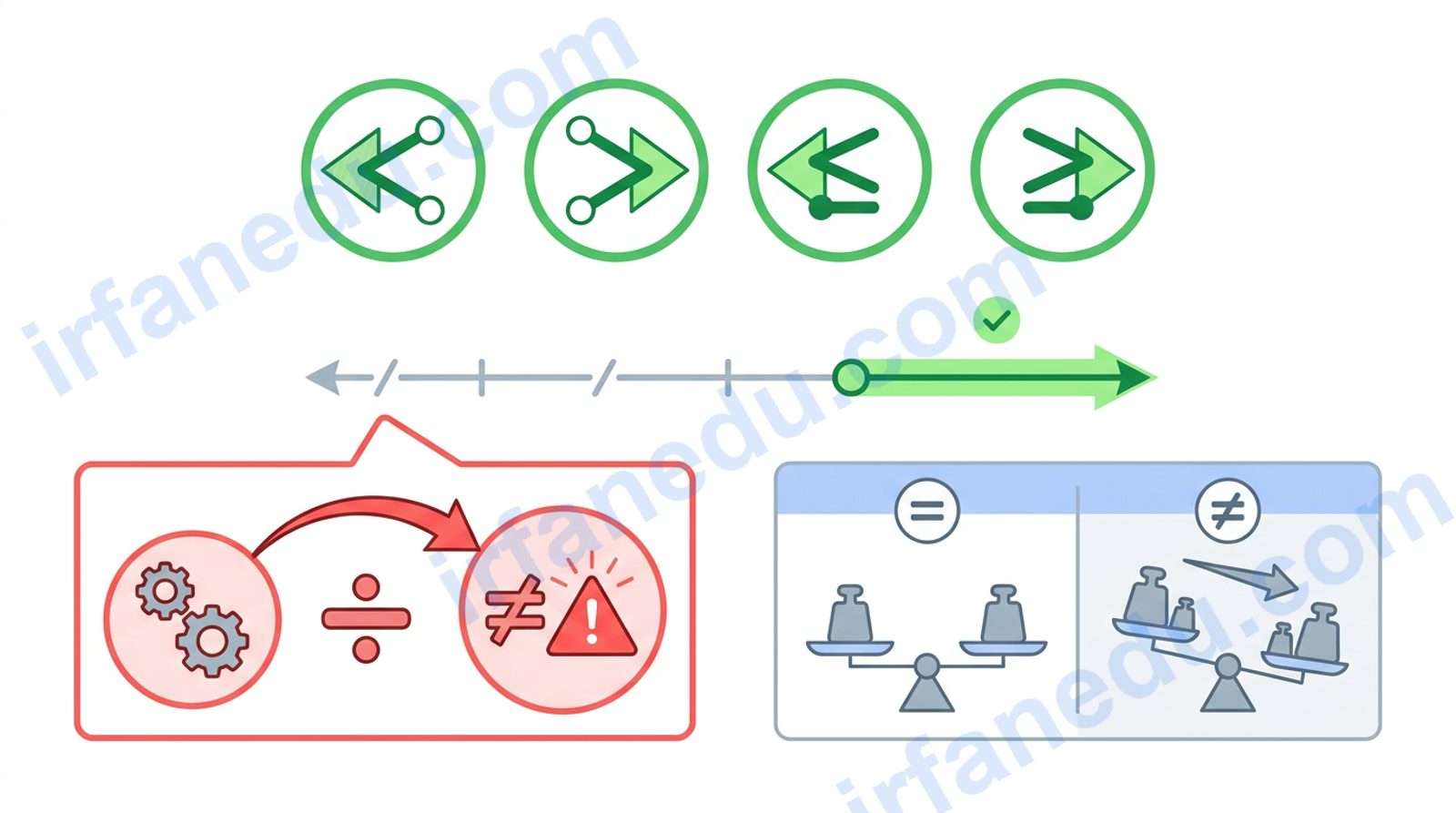
Are you looking for a solving inequalities worksheet that actually teaches the skill, not just drills it? You are in the right place. This page gives you a complete lesson, 10 printable practice problems ordered from easy to hard, a full answer key, and a free PDF download — all in one spot.
Solving an inequality means finding every value of the variable that makes the statement true. You use the same inverse operations as in equations, with one critical extra rule: when you multiply or divide both sides by a negative number, you must flip the inequality sign. The answer is always a range of values, not a single number.
📄 Free Printable PDF: 10 problems + full answer key, ready to print.
- Inequalities use <, >, ≤, ≥ instead of = and have a range of solutions.
- Solve exactly like an equation, but flip the sign when multiplying/dividing by a negative.
- Graph solutions with an open circle (strict) or closed circle (non-strict) on a number line.
- This worksheet covers one-step, two-step, and multi-step problems — 10 total, easy to hard.
- A full answer key is included on-page and in the downloadable PDF.
What Is an Inequality?
An inequality is a mathematical statement that compares two expressions using one of four symbols: < (less than), > (greater than), ≤ (less than or equal to), or ≥ (greater than or equal to). Unlike an equation, which has one specific solution, an inequality describes a whole set of values that satisfy the condition.
For example, x + 3 = 7 has exactly one answer: x = 4. But x + 3 > 7 has infinitely many answers: x = 5, x = 6, x = 100, and every value greater than 4. That entire solution set is written as x > 4.
Inequality: A statement showing that two expressions are not necessarily equal, using <, >, ≤, or ≥. The solution is a range of values, represented on a number line or in interval notation.
You will see inequalities everywhere in real life. A speed limit sign says “drive ≤ 60 mph.” A minimum age rule says “you must be ≥ 18.” A budget constraint says “spend < $500.” Algebra just gives you the tools to solve for the unknown in those situations.
How to Solve Inequalities Step by Step
Solving an inequality follows the same logic as solving an equation — you apply inverse operations to isolate the variable. The only extra rule is the sign-flip when dividing or multiplying by a negative number.
- Simplify both sides. Distribute any brackets and combine like terms on each side separately.
- Move variable terms to one side. Add or subtract to collect all terms with the variable on one side and all constants on the other.
- Isolate the variable. Multiply or divide both sides by the coefficient of the variable.
- Flip the sign if you divided by a negative. This is the step most students forget. If your last operation was ÷ or × by a negative number, reverse the inequality symbol.
- Write and graph the solution. Express the answer as an inequality, then plot it on a number line: open circle for < or >, closed circle for ≤ or ≥, and shade the correct direction.
  How to Read a Number Line Solution
  ───────────────────────────────────────────────────────
  x > 4  (open circle — 4 is NOT included)

  ←──────────────○══════════════════════════════→
  0    1    2    3    4    5    6    7    8    9

  x >= 4  (closed circle — 4 IS included)

  ←──────────────●══════════════════════════════→
  0    1    2    3    4    5    6    7    8    9

  ○ = open (strict: < or >)   ● = closed (non-strict: <= or >=)
Worked Examples: Three Solved Inequalities
Before you tackle the worksheet, walk through these three fully solved examples. I have chosen them to mirror the difficulty progression in the practice problems below.
Solve: x + 5 > 9
- Subtract 5 from both sides: x + 5 − 5 > 9 − 5
- Result: x > 4
- Graph: open circle at 4, shade to the right.
No sign flip needed — we only subtracted a positive number.
Solve: 3x + 2 > 11
- Subtract 2 from both sides: 3x > 9
- Divide both sides by 3 (positive — no flip): x > 3
- Graph: open circle at 3, shade to the right.
Solve: −4x < 20
- Divide both sides by −4. Because we are dividing by a negative number, flip the sign: < becomes >
- Result: x > −5
- Graph: open circle at −5, shade to the right.
This is the most common error point. Always check: did I divide or multiply by a negative? If yes, flip.
In my experience teaching algebra, the sign-flip rule is not hard to understand — it is hard to remember under pressure. I tell students to write “NEG = FLIP” in big letters at the top of every inequality test. That single habit has saved more grades than any amount of extra practice. Make it a reflex, not a rule you have to recall.
Common Mistakes When Solving Inequalities
Most errors on inequality problems come from just two sources: forgetting the sign flip, and misreading the graph. Here is a direct wrong-vs-right comparison for each.
Problem: −2x < 8
Divide by −2: x < −4
Sign not flipped — answer is incorrect.
Problem: −2x < 8
Divide by −2, flip sign: x > −4
Sign flipped because we divided by a negative.
Graph for x ≥ 3: Open circle at 3.
Open circle means 3 is excluded — but ≥ includes it.
Graph for x ≥ 3: Closed (filled) circle at 3.
Closed circle means 3 is included, which matches ≥.
A third common mistake: students add or subtract a negative number and think that triggers the sign flip. It does NOT. The flip only happens when you multiply or divide by a negative. Adding or subtracting any number — positive or negative — never changes the direction of the inequality.
Why does the sign flip at all? Most worksheets just state the rule without explaining it. Here is the actual reason: multiplying both sides of a true inequality by −1 reverses the order of numbers on the number line. Consider 2 < 5. Multiply both sides by −1: −2 and −5. Now −2 is to the RIGHT of −5, so −2 > −5. The relationship reversed. This is not an arbitrary rule — it is a direct consequence of how negative numbers are ordered. Once students see this geometric reason, they almost never forget the rule again.
Equations vs. Inequalities: Side-by-Side Comparison
Students who are new to inequalities often mix up the two. This table shows exactly where they are the same and where they differ.
| Feature | Equation (=) | Inequality (<, >, ≤, ≥) |
|---|---|---|
| Symbol used | = (equals) | <, >, ≤, ≥ |
| Number of solutions | Usually one exact value | Infinitely many (a range) |
| Solving method | Inverse operations | Inverse operations + sign-flip rule |
| Answer form | x = 4 | x > 4 or [4, ∞) |
| Number line graph | Single point (dot) | Ray or segment (shaded) |
| Multiply/divide by negative | No effect on symbol | Flip the inequality sign |
| Example | 2x + 1 = 9 → x = 4 | 2x + 1 > 9 → x > 4 |
Practice Worksheet: 10 Solving Inequalities Problems
Work through all 10 problems below. They start with simple one-step inequalities and build up to multi-step problems with distribution. Show your steps, write your answer as an inequality, and graph each solution on a number line in your notebook.
Print the PDF (download button below) or work directly in your notebook. Solve each problem showing all steps. When you finish, check your work against the answer key — it is hidden below the problem list so you are not tempted to peek. Use the answer key to diagnose which step went wrong, not just whether you got the right answer.
- x + 5 > 9
- y − 3 ≤ 7
- 2x < 14
- m / 4 ≥ 3
- 3x + 2 > 11
- 2y − 5 ≤ 9
- −4x < 20
- 5 − 2x ≥ 1
- 3(x − 1) > 2x + 4
- −2(x + 3) ≤ 4x + 6
Show Answer Key
- x > 4
- y ≤ 10
- x < 7
- m ≥ 12
- x > 3
- y ≤ 7
- x > −5 (divided by −4, sign flipped)
- x ≤ 2 (subtracted 5, then divided by −2 — sign flipped)
- x > 7 (distribute, collect terms: x > 7)
- x ≥ −2 (distribute, collect terms, divide by 6)
📄 Download the PDF: All 10 problems + answer key, print-ready.
I deliberately made problems 9 and 10 require distribution and collecting terms on both sides. In my experience, students who can handle those two problems independently are genuinely ready for an algebra test — not just the worksheet. If you got those wrong, go back to Example 3 and trace where the steps diverge. The error is almost always in the distribution step, not the sign flip.
Frequently Asked Questions About Solving Inequalities
What is the most important rule when solving inequalities?
The most important rule is to flip the inequality sign whenever you multiply or divide both sides by a negative number. For example, dividing both sides of −2x < 8 by −2 gives x > −4, not x < −4. Every other step mirrors solving a regular equation. Forgetting this flip is the single most common source of errors on inequality problems.
How Do You Graph the Solution to an Inequality on a Number Line?
Draw a number line and locate the boundary value. Use an open circle (hollow dot) for strict inequalities (< or >) to show that value is NOT included in the solution. Use a closed circle (filled dot) for non-strict inequalities (≤ or ≥) to show that value IS included. Then shade the ray in the direction of the solution — right for “greater than,” left for “less than.”
What Is the Difference Between an Equation and an Inequality?
An equation (e.g., x + 3 = 7) has exactly one solution. An inequality (e.g., x + 3 > 7) has infinitely many solutions — a whole range of values. You solve both using inverse operations, but an inequality’s answer is expressed as a range, shown on a number line or in interval notation such as (4, ∞).
What Does a Compound Inequality Mean?
A compound inequality combines two inequalities. “AND” compounds (e.g., 2 < x ≤ 8) require both conditions to be true simultaneously — the solution is the overlap (intersection). “OR” compounds (e.g., x < 1 or x > 5) are satisfied when either condition is true — the solution is the union of both ranges. Graph “AND” as a segment between two points; graph “OR” as two separate rays.
What Grade Level Is This Solving Inequalities Worksheet Designed For?
This worksheet covers one-step, two-step, and multi-step inequalities, which are typically taught in grades 6 through 9 (middle school and early high school algebra). The problems progress from easy to challenging, making it suitable for both first-time learners and students reviewing before a test. The final two problems (distribution + collecting terms) align with early Algebra 1 standards.
Related Articles
Sources & References
- Khan Academy — Solving Inequalities Review (Algebra) — authoritative free resource covering one-variable inequalities with practice exercises.
- Wikipedia — Inequality (Mathematics) — formal definition, properties, and historical context of mathematical inequalities.
- IrfanEdu.com — Complete Geometry Formula Sheet — companion reference for algebra and geometry students.
✍ Editorial note: This article was written and fact-checked by Dr. Irfan Mansuri. All practice problems have been independently verified for correctness. No statistics or claims have been fabricated. Last reviewed August 2026.