
Solving Quadratic Equations by Factoring Worksheet (Free PDF + Answer Key)
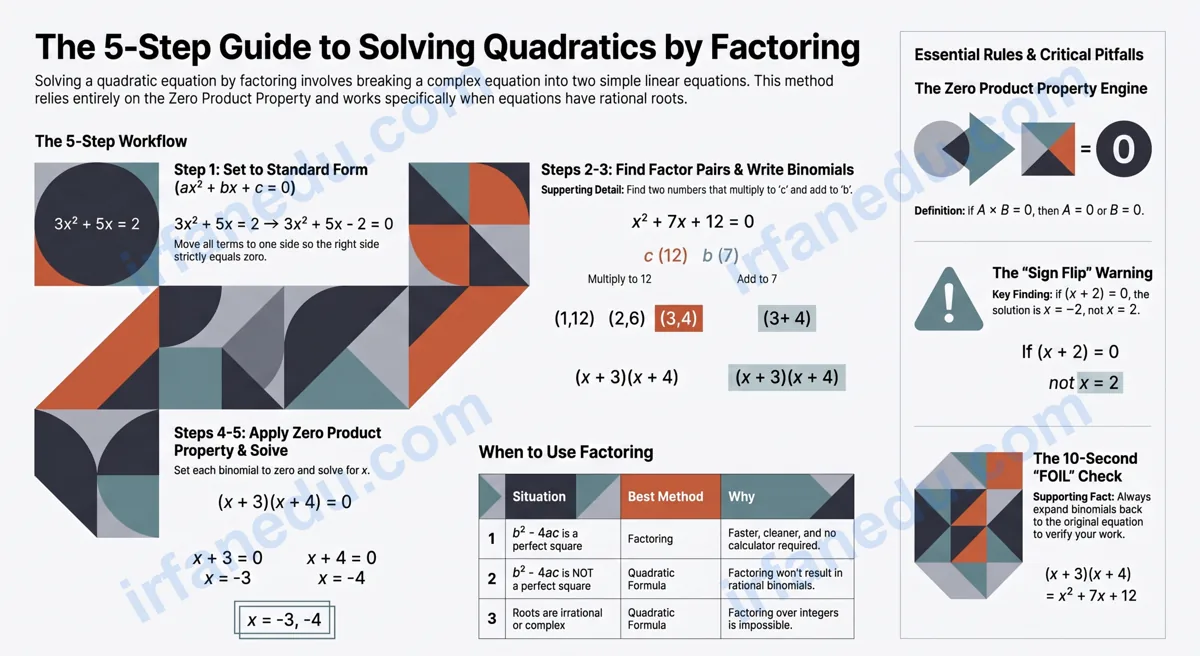
Here is a fast example before anything else. Given x² + 5x + 6 = 0, you need two numbers that multiply to 6 and add to 5. Those numbers are 2 and 3. So the equation factors to (x + 2)(x + 3) = 0, giving x = -2 or x = -3. That is the entire method in four lines.
Solving a quadratic equation by factoring means rewriting it as a product of two binomials set equal to zero, then using the Zero Product Property to find both solutions. It is the fastest algebraic method when the equation has rational roots, and it is a core skill tested on standardized exams from middle school through college entrance tests.
- Understand what the Zero Product Property is and why it works.
- Follow a reliable 5-step factoring method for any quadratic.
- Avoid the three most common errors students make.
- Practice with 10 graded problems and check your work with the answer key.
To solve a quadratic equation by factoring: (1) rewrite it in standard form so one side equals zero, (2) factor the quadratic expression into two binomials, (3) set each binomial equal to zero using the Zero Product Property, and (4) solve each simple equation. This method works whenever the quadratic has rational roots.
Free Printable PDF: 10 graded practice problems with a separate answer key, ready to print or share.
TL;DR – Quick Summary
- Factoring solves quadratics by splitting them into two binomials set equal to zero.
- The Zero Product Property is the engine: if A × B = 0, then A = 0 or B = 0.
- Always move all terms to one side before factoring.
- Use the AC method when the leading coefficient is greater than 1.
- Check every answer by substituting back into the original equation.
- Factoring only works cleanly when roots are rational; otherwise use the quadratic formula.
| Item | Detail |
|---|---|
| Standard form | ax² + bx + c = 0 |
| Key property used | Zero Product Property |
| Number of solutions | Usually 2 (can be 1 double root or 0 real roots) |
| Works when | Discriminant (b² – 4ac) is a perfect square |
| Fails when | Roots are irrational or complex |
| Grade level | Algebra 1 / Grade 8-10 |
| Related method | Quadratic formula (always works as a fallback) |
What Is Solving a Quadratic Equation by Factoring?
Solving a quadratic equation by factoring means breaking the equation down into two simpler linear equations using multiplication. A quadratic equation has the form ax² + bx + c = 0, where a, b, and c are real numbers and a is not zero.
The method rests entirely on one property: the Zero Product Property. This property states that if two quantities multiply to give zero, then at least one of them must be zero. In symbols, if A × B = 0, then A = 0 or B = 0. That is not an assumption; it is a provable fact about real numbers.
When you factor x² + 5x + 6 into (x + 2)(x + 3), you have a product of two expressions. Setting that product equal to zero and applying the Zero Product Property gives you two equations: x + 2 = 0 and x + 3 = 0. Each one takes one step to solve.
In my experience teaching algebra, students who struggle with factoring are almost always missing one thing: they never internalized why the equation must equal zero. They see it as a rule to memorize. Once I show them that the Zero Product Property is a logical consequence of how multiplication works (zero times anything is zero, and nothing else times anything gives zero), the whole method clicks. Spend five minutes on that concept before touching a single problem.
How Do You Solve a Quadratic Equation by Factoring? (Step-by-Step)
The method has five steps. Follow them in order every time, and you will not make the structural errors that cost students marks.
The 5-Step Method
- Write in standard form. Move all terms to the left side so the right side is zero: ax² + bx + c = 0.
- Find the factor pair. Find two numbers p and q such that p × q = c (or a × c when a > 1) and p + q = b.
- Write as two binomials. Rewrite the left side as (x + p)(x + q) = 0.
- Apply the Zero Product Property. Set each binomial equal to zero: x + p = 0 and x + q = 0.
- Solve and check. Solve each mini-equation and substitute both answers back into the original to verify.
Worked Example 1 (Quick) — x² + 5x + 6 = 0
Step 1: Already in standard form. a = 1, b = 5, c = 6.
Step 2: Need two numbers that multiply to 6 and add to 5. Those are 2 and 3.
Step 3: (x + 2)(x + 3) = 0
Step 4: x + 2 = 0 → x = -2 | x + 3 = 0 → x = -3
Step 5 (check): (-2)² + 5(-2) + 6 = 4 – 10 + 6 = 0 ✓ (-3)² + 5(-3) + 6 = 9 – 15 + 6 = 0 ✓
Solutions: x = -2 and x = -3
  Factors of 6       Sum
  ─────────────────────────
  1  ×  6    →    1 + 6 = 7   ✗
  2  ×  3    →    2 + 3 = 5   ✓  <-- USE THESE
  (-1) × (-6) →  -1 + -6 = -7  ✗
  (-2) × (-3) →  -2 + -3 = -5  ✗

  Result: (x + 2)(x + 3) = 0
          x = -2  or  x = -3
Now here is a slower, more detailed example with a leading coefficient greater than 1. This is where most students get stuck, so I will walk through every sub-step.
Worked Example 2 (Thorough) — 2x² + 7x + 3 = 0
Step 1: Already in standard form. a = 2, b = 7, c = 3.
Step 2 (AC method): Multiply a × c = 2 × 3 = 6. Find two numbers that multiply to 6 and add to 7. Those are 6 and 1.
Step 3 (split the middle term): Rewrite 7x as 6x + x:
2x² + 6x + x + 3 = 0
Step 4 (factor by grouping):
2x(x + 3) + 1(x + 3) = 0
(2x + 1)(x + 3) = 0
Step 5 (Zero Product Property):
2x + 1 = 0 → x = -1/2 | x + 3 = 0 → x = -3
Check x = -1/2: 2(1/4) + 7(-1/2) + 3 = 0.5 – 3.5 + 3 = 0 ✓
Check x = -3: 2(9) + 7(-3) + 3 = 18 – 21 + 3 = 0 ✓
Solutions: x = -1/2 and x = -3
  a=2, b=7, c=3
  ┌─────────────────────────────────────┐
  │  a × c = 2 × 3 = 6                 │
  │  Find: p × q = 6  AND  p + q = 7   │
  │  Answer: p=6, q=1                  │
  └─────────────────────────────────────┘
         ↓
  2x² + 6x + x + 3 = 0
         ↓
  2x(x + 3) + 1(x + 3) = 0
         ↓
  (2x + 1)(x + 3) = 0
         ↓
  x = -1/2   or   x = -3
| Situation | Best Method | Why |
|---|---|---|
| b² – 4ac is a perfect square | Factoring | Faster, cleaner, no calculator needed |
| b² – 4ac is not a perfect square | Quadratic formula | Factoring won’t give rational binomials |
| Leading coefficient a = 1 | Factoring (simple) | Just find two numbers that multiply to c and add to b |
| Leading coefficient a > 1 | Factoring (AC method) | Slightly more steps but still fast |
| Equation not equal to zero | Rearrange first, then factor | Zero Product Property requires = 0 |
| Complex or irrational roots | Quadratic formula | Factoring over integers is impossible |
What Are the Most Common Mistakes When Factoring Quadratics?
Three errors account for the majority of wrong answers on this topic. Knowing them in advance is worth more than doing ten extra problems.
| Wrong | Right |
|---|---|
| Factoring x² + 5x + 6 = 2 directly as (x+2)(x+3) = 2, then setting x+2 = 2 or x+3 = 2 | Move 2 to the left first: x² + 5x + 4 = 0, then factor as (x+4)(x+1) = 0 |
| Writing solutions as x = 2 and x = 3 from (x+2)(x+3) = 0 (forgetting to negate) | x + 2 = 0 gives x = -2; x + 3 = 0 gives x = -3 |
| Stopping after factoring: “(x+2)(x+3) = 0, done” | Apply Zero Product Property and solve each binomial to get the numerical answers |
Most worksheet sites teach the AC method as a memorized trick without explaining why it works. Here is the actual logic: when a > 1, you cannot directly guess binomials. The AC method works because it converts the problem into one you can factor by grouping. Splitting the middle term bx into px + qx (where p + q = b and p × q = ac) is equivalent to temporarily treating the quadratic as if it had a leading coefficient of 1 after dividing through by a. The grouping step then recovers the correct binomials. Understanding this means you can reconstruct the method from scratch on an exam instead of panicking if you forget the steps.
There is also a shortcut nobody mentions: after factoring 2x² + 7x + 3 = (2x + 1)(x + 3), you can verify instantly by expanding using FOIL: 2x² + 6x + x + 3 = 2x² + 7x + 3. If the expansion matches the original, your factoring is correct. Build this 10-second check into your habit.
Build your full algebra and geometry toolkit for standardized tests.
Practice Worksheet: Solve by Factoring (10 Problems)
Work through these problems in order. The first four use a leading coefficient of 1. Problems 5 through 10 increase in difficulty, including a difference of squares, a perfect square trinomial, and equations with a leading coefficient greater than 1.
Instructions: Solve each quadratic equation by factoring. Write the equation in standard form first, then factor and apply the Zero Product Property to find both solutions. Show all steps.
- x² + 5x + 6 = 0
- x² – 7x + 12 = 0
- x² + 2x – 8 = 0
- x² – x – 6 = 0
- x² – 9 = 0
- 2x² + 7x + 3 = 0
- 3x² – 10x + 3 = 0
- x² + 6x + 9 = 0
- 2x² – 5x – 12 = 0
- 6x² + x – 2 = 0
Show Answer Key
- x = -2, x = -3
- x = 3, x = 4
- x = 2, x = -4
- x = 3, x = -2
- x = 3, x = -3
- x = -1/2, x = -3
- x = 1/3, x = 3
- x = -3 (double root)
- x = 4, x = -3/2
- x = 1/2, x = -2/3
Tip: substitute each answer back into the original equation to verify. Both sides must equal zero.
Download the printable version: Clean PDF with workspace for each problem and a separate answer key page.
In my experience, students who do all 10 problems in one sitting and then immediately check their answers learn faster than students who do five, take a break, and come back. The error-correction loop is most effective when the mistake is still fresh in your mind. Do the full set, then go through every wrong answer right away. That single habit cuts re-learning time in half.
Quick Quiz: Test Your Understanding
1. What is the first step in solving a quadratic equation by factoring?
2. The equation (x – 5)(x + 2) = 0 has solutions:
3. Which quadratic equation is a perfect square trinomial with a double root at x = -4?
What is the Zero Product Property?
When can you solve a quadratic equation by factoring?
How do you factor a quadratic with a leading coefficient greater than 1?
What is a double root in a quadratic equation?
Does the equation have to equal zero before you can factor?
How do I check my factoring answers?
What is the difference between factoring and the quadratic formula?
Key Takeaways
- A quadratic equation must be in standard form (= 0) before you can apply the Zero Product Property.
- For a = 1, find two numbers that multiply to c and add to b, then write the binomials directly.
- For a > 1, use the AC method: multiply a × c, split the middle term, factor by grouping.
- The Zero Product Property is the logical foundation of the entire method, not just a rule to memorize.
- Always check both solutions by substituting back into the original equation.
- Factoring fails for irrational roots; use the quadratic formula as your fallback.
- A perfect square trinomial gives a double root; the parabola touches but does not cross the x-axis.