
Reson: What It Is, How It Works & Why It Matters
You have probably heard a wine glass shatter when a singer hits the right note. Or seen a child on a swing go higher and higher with perfectly timed pushes. Both are the same phenomenon: resonance — often searched simply as “reson.” It is one of the most powerful and far-reaching ideas in all of physics.
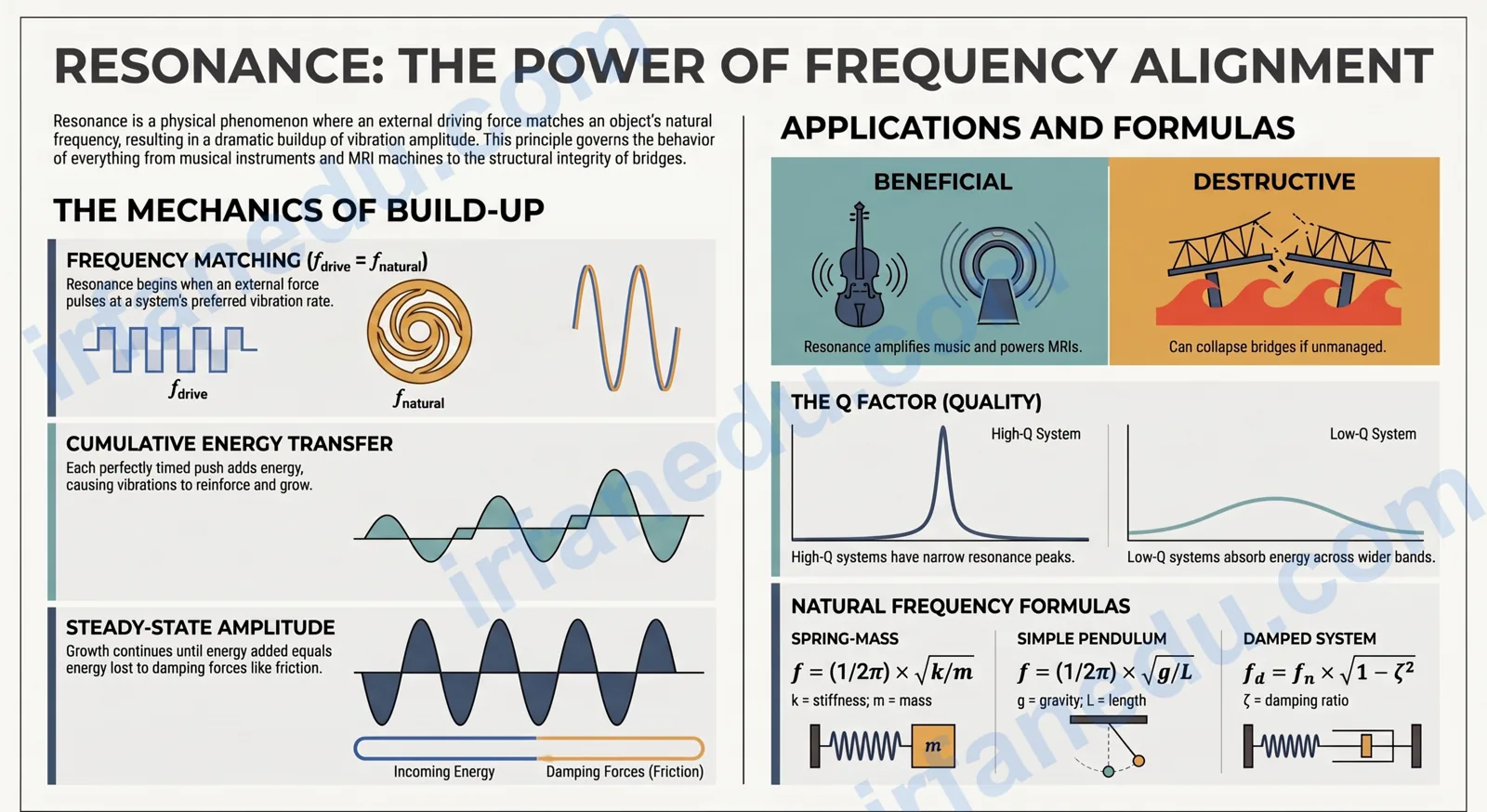
Resonance is the tendency of a system to oscillate with greater amplitude at specific frequencies called its natural frequencies. When an external driving force matches a system’s natural frequency, energy transfers into the system efficiently — and the amplitude of vibration grows dramatically. This principle governs musical instruments, structural engineering, medical imaging, and atomic physics.
- 📌 Understand what natural frequency means and why every object has one
- 📌 See exactly how resonance builds up, step by step
- 📌 Work through real numerical examples
- 📌 Spot the three mistakes students make most often on tests
- 📌 Explore surprising real-world applications from bridges to MRI machines
🎯 The Short Version
- 🔵 Every object has a natural frequency — its preferred vibration rate
- 🔵 Resonance happens when a driving force matches that natural frequency
- 🔵 At resonance, amplitude grows large; away from it, amplitude stays small
- 🔵 Damping limits how large the amplitude gets in real systems
- 🔵 Resonance is both useful (music, MRI) and dangerous (bridge collapse)
- 🔵 Formula for spring-mass: f = (1/2π)√(k/m)
Quick Facts About Resonance
| Fact | Detail |
|---|---|
| Full term | Resonance (from Latin resonare — “to resound”) |
| Core requirement | Driving frequency = natural frequency of the system |
| Key formula (spring-mass) | f = (1/2π) × √(k/m) |
| Key formula (pendulum) | f = (1/2π) × √(g/L) |
| What limits amplitude | Damping (friction, air resistance, material absorption) |
| Famous failure | Tacoma Narrows Bridge, 1940 |
| Famous medical use | MRI (Magnetic Resonance Imaging) |
| Appears in | Physics, engineering, chemistry, music, medicine |
What Is Resonance (Reson)?
Resonance is the amplification of vibration that occurs when an external force drives a system at its natural frequency. The word “reson” is simply a shortened search form of “resonance” — the full scientific term.
Every physical object — a guitar string, a bridge, a molecule — has at least one natural frequency. This is the frequency at which it vibrates most easily when disturbed. Tap a crystal glass and it rings at one specific pitch. That pitch is its natural frequency.
When you apply a periodic force at that exact frequency, each push adds to the last. The vibrations reinforce each other. Amplitude — the size of the oscillation — grows. In an undamped ideal system, it would grow without limit. In the real world, damping (friction, air resistance, internal material losses) caps the growth at some maximum value.
🔵 Key Definition
Resonance is the condition in which a system’s response amplitude reaches a maximum because the driving frequency equals the system’s natural frequency. Formally: fdrive = fnatural.
📊 Resonance Curve: Amplitude vs. Driving Frequency
  Amplitude
     |
HIGH |              *
     |            *   *
     |          *       *
 MED |        *           *
     |      *               *
 LOW |  * *                   * * *
     |_________________________________
     0    f1   f_natural   f2    f3
                  ↑
           RESONANCE PEAK
           (max amplitude)

  Low damping  → tall, narrow peak
  High damping → short, broad peak
What Is Natural Frequency and Why Does Every Object Have One?
Natural frequency is the rate at which an object oscillates when set in motion and left alone — with no ongoing external force. It depends entirely on the object’s physical properties: its mass and its stiffness (or restoring force).
Think of a playground swing. A long swing oscillates slowly (low natural frequency). A short swing oscillates quickly (high natural frequency). The child’s mass matters too — a heavier child lowers the frequency slightly. Neither the child nor the swing “chooses” this frequency; it is determined by physics.
For a spring-mass system, the natural frequency formula is:
🔵 Spring-Mass Natural Frequency
f = (1 / 2π) × √(k / m)
Where: f = natural frequency (Hz), k = spring constant (N/m), m = mass (kg)
For a simple pendulum:
🔵 Pendulum Natural Frequency
f = (1 / 2π) × √(g / L)
Where: g = 9.8 m/s², L = pendulum length (m)
Notice: a stiffer spring (larger k) or a shorter pendulum (smaller L) gives a higher natural frequency. A heavier mass (larger m) gives a lower natural frequency. This is why a bass guitar string — thicker and heavier — vibrates more slowly than a treble string.
How Does Resonance Build Up? A Step-by-Step Explanation
Resonance does not happen instantly. It builds up over many cycles as energy accumulates. Here is the exact mechanism:
- Initial push: An external force applies a small vibration to the system. The system starts oscillating at a small amplitude.
- Frequency match: The driving force repeats at exactly the system’s natural frequency. Each new push arrives when the system is moving in the same direction as the push.
- Energy addition: Because the timing is perfect, each push adds energy rather than cancelling it. The amplitude grows with each cycle.
- Damping balance: As amplitude grows, so does the energy lost to damping per cycle. Eventually, energy added per cycle equals energy lost per cycle.
- Steady state: The system reaches a maximum (steady-state) amplitude. In a lightly damped system, this maximum is very large. In a heavily damped system, it is modest.
In my experience teaching this topic, the step students most often miss is Step 2 — the timing of the push. They understand “same frequency” intellectually, but they do not visualize that the push must arrive when the system is already moving in the push’s direction. I always use the swing analogy: push at the top of the forward arc and you add energy; push at the wrong moment and you fight the swing. That single image makes the whole mechanism click.
Worked Example: Calculating Resonant Frequency
Let me walk through a real numerical example — the kind you will see on a physics test.
✅ Example 1: Spring-Mass System
Problem: A 0.5 kg block is attached to a spring with spring constant k = 200 N/m. What is the natural frequency of this system?
Step 1: Write the formula: f = (1/2π) × √(k/m)
Step 2: Substitute: f = (1/2π) × √(200/0.5) = (1/2π) × √400
Step 3: √400 = 20, so f = 20 / (2π) = 20 / 6.283 ≈ 3.18 Hz
Interpretation: If you push this block at 3.18 pushes per second, it will resonate — amplitude will grow dramatically.
✅ Example 2: Pendulum
Problem: A pendulum is 0.25 m long. What is its natural frequency? (g = 9.8 m/s²)
Step 1: f = (1/2π) × √(g/L) = (1/2π) × √(9.8/0.25)
Step 2: √(39.2) ≈ 6.26, so f = 6.26 / 6.283 ≈ 0.996 Hz (about 1 Hz)
Interpretation: This pendulum completes about one full swing per second. Push it once per second and it resonates.
Resonance vs. Forced Vibration: What Is the Difference?
Students often confuse resonance with any kind of forced vibration. They are related but not the same. Forced vibration is the broader category; resonance is a special case of it.
| Feature | Forced Vibration | Resonance |
|---|---|---|
| Definition | System vibrates at the driving frequency, whatever it is | Driving frequency = natural frequency of the system |
| Amplitude | Depends on how close the driving frequency is to natural frequency | Maximum possible amplitude for that system |
| Energy transfer | Partial — some energy is wasted fighting the system’s preferred frequency | Optimal — energy transfers into the system most efficiently |
| Phase relationship | Phase lag varies with frequency | Driving force is 90° ahead of displacement at resonance |
| Everyday example | Pushing a swing at random intervals | Pushing a swing at exactly its natural period |
🧠 Worth Knowing
Most guides describe resonance as if the driving frequency must be exactly equal to the natural frequency. In practice, resonance occurs across a bandwidth — a range of frequencies around the natural frequency where amplitude is significantly elevated. The width of this band is determined by the system’s Q factor (quality factor): Q = fnatural / bandwidth. A high-Q system (like a tuning fork, Q ≈ 1000) has a very narrow resonance peak — it is extremely selective. A low-Q system (like a car’s shock absorbers, Q ≈ 0.5) has a broad, flat response — it absorbs energy across many frequencies without ringing. This is why engineers deliberately add damping to structures: they are lowering Q to spread the resonance peak and prevent catastrophic buildup at any single frequency. Most textbooks skip the Q factor entirely at the introductory level, which is why students are surprised when “close to” the natural frequency still causes large oscillations.
Real-World Applications of Resonance
Resonance is not just a textbook concept. It shapes the world around you in ways you interact with every day.
🎵 Musical Instruments
Every string instrument — guitar, violin, piano — uses resonance. A plucked string vibrates at its natural frequency. The hollow body of the instrument is designed so its air cavity resonates at the same frequencies, amplifying the sound. Without resonance, a guitar would sound like a quiet buzz. According to the Britannica article on resonance in physics, this acoustic resonance is the fundamental principle behind all string and wind instruments.
🏥 MRI Scanners
Magnetic Resonance Imaging works by placing hydrogen atoms in a strong magnetic field, then hitting them with radio waves at their exact resonant frequency. The atoms absorb energy, then release it as a signal that creates a detailed image of soft tissue. No radiation, no surgery — just resonance at the atomic scale.
🌉 Bridge Engineering
The 1940 Tacoma Narrows Bridge collapse is the most famous engineering failure caused by resonance. Wind created aerodynamic forces that matched the bridge’s natural torsional frequency. The bridge oscillated with increasing amplitude until it tore apart. Modern bridges use dampers and asymmetric designs specifically to avoid resonance.
📡 Radio Tuning
When you tune a radio, you are adjusting an electrical circuit’s natural frequency to match the frequency of the station you want. The circuit resonates at that frequency, selectively amplifying that signal above all others. Every channel you tune to is a resonance phenomenon.
⚗️ Molecular Spectroscopy
In chemistry, molecules absorb infrared light at frequencies that match their natural vibrational frequencies. Scientists use this to identify unknown compounds — each molecule has a unique resonance “fingerprint.” This is the basis of infrared spectroscopy.
Useful vs. Harmful Resonance: A Comparison
| Application | Type | How Resonance Is Used or Avoided |
|---|---|---|
| Guitar / violin body | ✅ Useful | Body cavity resonates to amplify string vibrations |
| MRI scanner | ✅ Useful | Hydrogen nuclei resonate at radio frequencies to produce images |
| Radio / TV tuning | ✅ Useful | LC circuit resonates at the broadcast frequency |
| Microwave oven | ✅ Useful | 2.45 GHz microwaves resonate with water molecules, heating food |
| Tacoma Narrows Bridge | ❌ Harmful | Wind vortices matched bridge’s natural frequency → collapse |
| Building in an earthquake | ❌ Harmful | Ground motion at building’s natural frequency → structural failure |
| Engine vibration in cars | ❌ Harmful (managed) | Dampers and mounts prevent resonance at engine RPM |
Common Mistakes Students Make About Resonance
In my experience, three errors show up again and again on tests and in homework. Here is how to avoid each one.
❌ Mistake 1: Confusing Resonance with Any Large Vibration
Large amplitude alone does not mean resonance. A hard hit on a drum produces large amplitude, but it is not resonance. Resonance requires the driving frequency to match the natural frequency. Always check the frequency condition first.
❌ Mistake 2: Thinking Resonance Always Causes Destruction
Students remember the bridge collapse and assume resonance is always dangerous. It is only destructive when a structure is not designed to handle the resulting amplitude. MRI, music, and radio tuning are all resonance — and all beneficial.
❌ Mistake 3: Ignoring Damping in Calculations
The formula f = (1/2π)√(k/m) gives the undamped natural frequency. In a real system with damping, the resonant frequency shifts slightly lower. For most introductory problems this shift is negligible, but in advanced work you must account for it. The damped natural frequency is: fd = fn × √(1 – ζ²), where ζ is the damping ratio.
The mistake that costs students the most marks is Mistake 3 — not because the formula is hard, but because they never learned that the undamped formula is an approximation. I have seen students lose points on university entrance exams for applying the undamped formula to a problem that explicitly states “heavily damped.” Always read for damping clues in the problem setup.
🧩 Quick Check: Test Your Understanding
Q1. A spring has k = 50 N/m and a mass of 2 kg attached. What is the natural frequency?
Q2. At resonance, the driving frequency is _____ the natural frequency.
Q3. Which of these is an example of resonance being used beneficially?
Select an answer to highlight it. Correct answers are marked ✓.
Practice Problems: Try These Yourself
Problem 1: A 1 kg mass on a spring with k = 400 N/m. What is the natural frequency?
f = (1/2π) × √(k/m) = (1/2π) × √(400/1) = (1/2π) × 20 = 20/6.283 ≈ 3.18 Hz
If you drive this system at 3.18 Hz, it will resonate.
Problem 2: A pendulum is 1.0 m long. What is its natural frequency? (g = 9.8 m/s²)
f = (1/2π) × √(g/L) = (1/2π) × √(9.8/1.0) = (1/2π) × 3.13 = 3.13/6.283 ≈ 0.498 Hz
This pendulum completes about one half-swing per second. Its period T = 1/f ≈ 2.0 seconds.
Problem 3: A system resonates at 5 Hz. The mass is 0.4 kg. What is the spring constant?
From f = (1/2π)√(k/m), rearrange: k = m × (2πf)²
k = 0.4 × (2π × 5)² = 0.4 × (31.42)² = 0.4 × 987.5 ≈ 395 N/m
Frequently Asked Questions About Resonance
What is resonance in simple terms?
What is natural frequency?
What is a real-world example of resonance?
Is resonance always harmful?
How do you calculate resonant frequency?
✅ Key Takeaways
- Resonance occurs when a driving frequency equals a system’s natural frequency.
- Every physical object has at least one natural frequency, set by its mass and stiffness.
- At resonance, amplitude grows to a maximum limited only by damping.
- The spring-mass resonant frequency formula is f = (1/2π)√(k/m).
- Damping (friction, air resistance) prevents infinite amplitude in real systems.
- Resonance is both beneficial (MRI, music, radio) and dangerous (structural failures).
- The Q factor describes how sharply peaked a resonance is — high Q means narrow, selective resonance.