
🧵 Tension Calculator: Two Strings at Different Angles
✓ Expert Reviewed by Dr. Irfan Mansuri | Last Updated: July 2026
📋 Table of Contents
🛋️ Think of a Hammock — Then Think Harder
Picture a hammock strung between two trees. You climb in, and the ropes pull tight at an angle. Now ask yourself: which rope is under more stress? The one attached at a steeper angle, or the shallower one? Most people guess wrong the first time.
That everyday hammock is exactly the physics problem this calculator solves. When a weight hangs from two strings attached to a ceiling (or any support) at different angles, each string carries a different share of the load. The steeper string carries less tension than you might expect, and the shallower string can be surprisingly stressed.
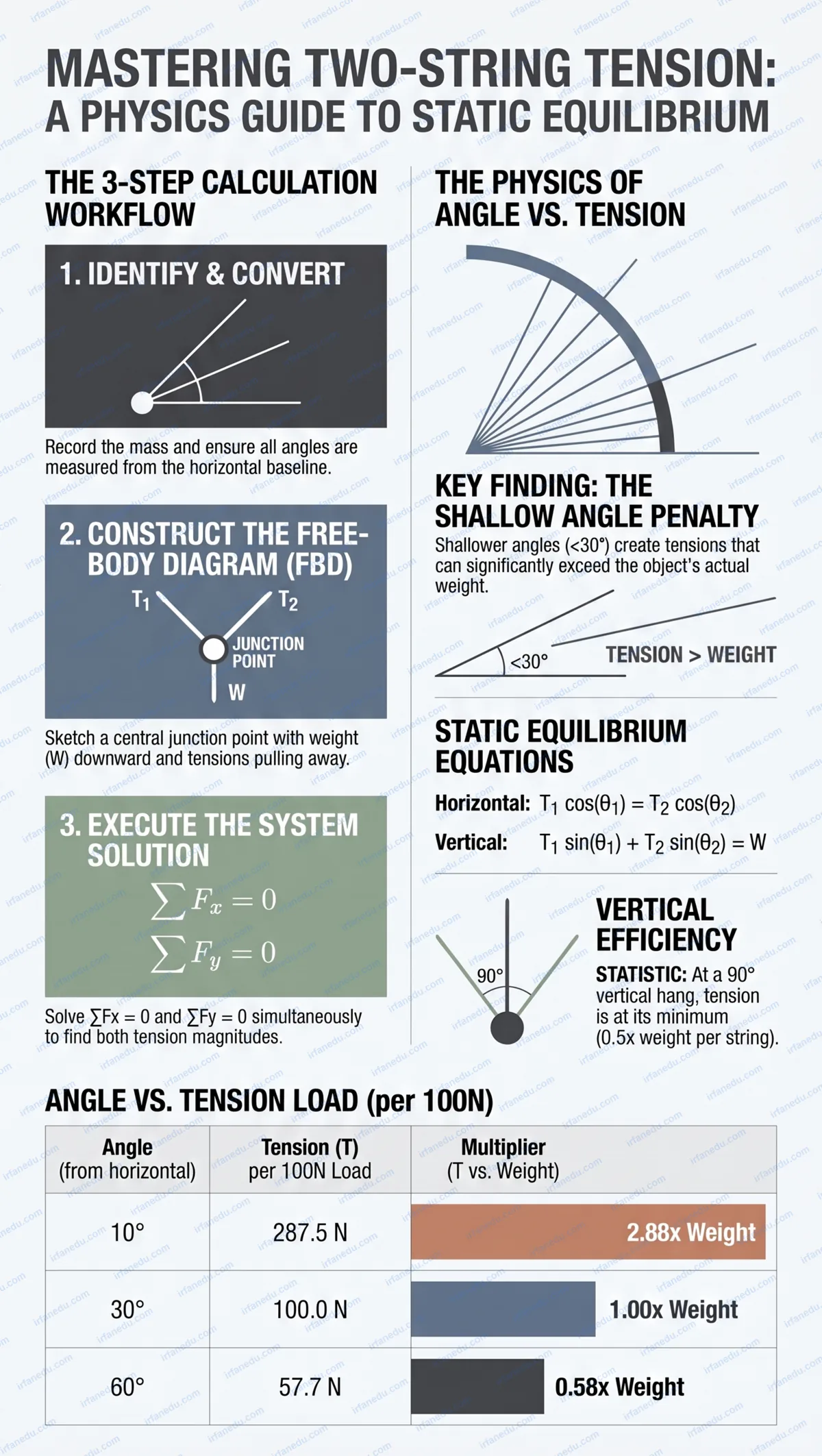
To find the tension in two strings at different angles, apply static equilibrium: set the sum of horizontal forces and the sum of vertical forces each equal to zero. This gives two equations with two unknowns (T1 and T2), which you solve to get T1 = W·cos(θ2) / sin(θ1+θ2) and T2 = W·cos(θ1) / sin(θ1+θ2).
This calculator does all that algebra for you — instantly. Enter the weight and the two angles, and you get T1, T2, and a numbered step-by-step solution you can follow or copy into your homework.
- The correct formula for two-string tension at different angles
- How to set up and solve the equilibrium equations
- Why a shallower angle always means higher tension
- How to avoid the most common calculation mistakes
⚡ TL;DR – Quick Summary
- 🧵 Two strings at different angles create different tensions T1 and T2.
- ⚖️ Static equilibrium gives two equations: horizontal and vertical force balance.
- 📐 Formula: T1 = W·cos(θ2)/sin(θ1+θ2), T2 = W·cos(θ1)/sin(θ1+θ2).
- 📉 Shallower angle = higher tension; steeper angle = lower tension.
- 🔢 Use the calculator above to solve any combination of W, θ1, θ2 instantly.
- ✅ String length does NOT affect tension — only angle and weight matter.
| Parameter | Symbol | SI Unit | Typical Range |
|---|---|---|---|
| Weight of object | W | Newton (N) | 1 N – 10,000 N |
| Angle of string 1 (from horizontal) | θ1 | Degrees (°) | 1° – 89° |
| Angle of string 2 (from horizontal) | θ2 | Degrees (°) | 1° – 89° |
| Tension in string 1 | T1 | Newton (N) | Depends on W, θ1, θ2 |
| Tension in string 2 | T2 | Newton (N) | Depends on W, θ1, θ2 |
| Gravitational acceleration | g | m/s² | 9.81 m/s² (standard) |
🔢 Interactive Tension Calculator
Two-String Tension Calculator
Find T1 & T2 instantly — with step-by-step solution
N
°
°
🔍 Step-by-Step Solution
Governing Equations (Static Equilibrium)
T2·cos(θ2) = T1·cos(θ1)
T1·sin(θ1) + T2·sin(θ2) = W
T1 = W · cos(θ2) / sin(θ1 + θ2)
T2 = W · cos(θ1) / sin(θ1 + θ2)
| Symbol | Meaning | SI Unit |
|---|---|---|
| W | Weight of hanging object (= m·g) | Newton (N) |
| T1 | Tension in string 1 | Newton (N) |
| T2 | Tension in string 2 | Newton (N) |
| θ1 | Angle string 1 makes with horizontal | Degrees (°) |
| θ2 | Angle string 2 makes with horizontal | Degrees (°) |
| g | Gravitational acceleration (standard) | 9.81 m/s² |
SI Dimensions of Tension: [M·L·T⁻²] — same as force.
What is String Tension?
Tension is the pulling force transmitted along a string, rope, or cable when it is taut. In a two-string system, each string pulls the junction point (where the weight hangs) upward and inward. The angle each string makes with the horizontal determines how much of that pull acts vertically (supporting the weight) versus horizontally (canceling the other string’s pull).
When the system is in static equilibrium, the object is not moving. That means the total force in every direction is zero. This gives us the two equations we need to find T1 and T2 exactly.
Note: This calculator assumes massless, inextensible strings and a point mass. It does not account for string weight or elasticity.
📖 How to Use This Calculator
- Enter W (Weight): Type the weight of the hanging object in Newtons. If you know the mass in kg, multiply by 9.81 to get Newtons (e.g., 10 kg × 9.81 = 98.1 N).
- Enter θ1: Type the angle that String 1 makes with the horizontal ceiling line, in degrees. This must be between 1° and 89°.
- Enter θ2: Type the angle that String 2 makes with the horizontal, in degrees. Same range applies.
- Click Calculate: The calculator instantly shows T1 and T2 in Newtons, plus unit-conversion chips (kgf, lbf) and a numbered step-by-step solution.
- Check the steps: Each step mirrors the algebra you would write in a physics exam. Use it to verify your own work.
- Reset: Click the Reset button to clear all fields and start fresh.
🔬 What Is Tension in a String?
Tension is the internal pulling force that acts along a taut string or rope. It always pulls the object toward the string's attachment point — never pushes.
When a weight hangs from two strings, the junction point (the knot) is in equilibrium. Three forces act on it: the downward weight W, and the two tensions T1 and T2 pulling upward and outward along each string. For the knot to stay still, these three forces must balance perfectly.
The key insight is that each tension has two components:
- Vertical component: T·sin(θ) — this helps support the weight.
- Horizontal component: T·cos(θ) — this is balanced by the other string's horizontal pull.
A string at a shallow angle (close to horizontal) has a small vertical component. So it needs a large tension to contribute enough upward force. That is why nearly horizontal strings are under enormous stress — a fact that surprises many students the first time they see it.
In my experience, the single biggest conceptual hurdle for students is this: they expect the string closer to vertical to have more tension because it "looks like it's doing more work." But the math shows the opposite. A shallower string must be far more tense to deliver the same upward force. Once students see this in the calculator — watching T1 shoot up as θ1 drops toward 0° — the concept clicks instantly. A live calculator beats a textbook diagram every time.
📐 The Formula Explained: Deriving T1 and T2
The derivation starts from Newton's First Law applied to a stationary object: the net force is zero in every direction.
Step 1 — Set Up the Free-Body Diagram
Draw the junction point. Three forces act on it: T1 at angle θ1 above horizontal (pulling left and up), T2 at angle θ2 above horizontal (pulling right and up), and W pulling straight down.
Step 2 — Write the Equilibrium Equations
Sources & References
Reviewed by Dr. Irfan Mansuri. External links open in a new tab and are provided for further reading and verification.