
What is affective language in a classroom? A teacher’s complete guide 🧠💜
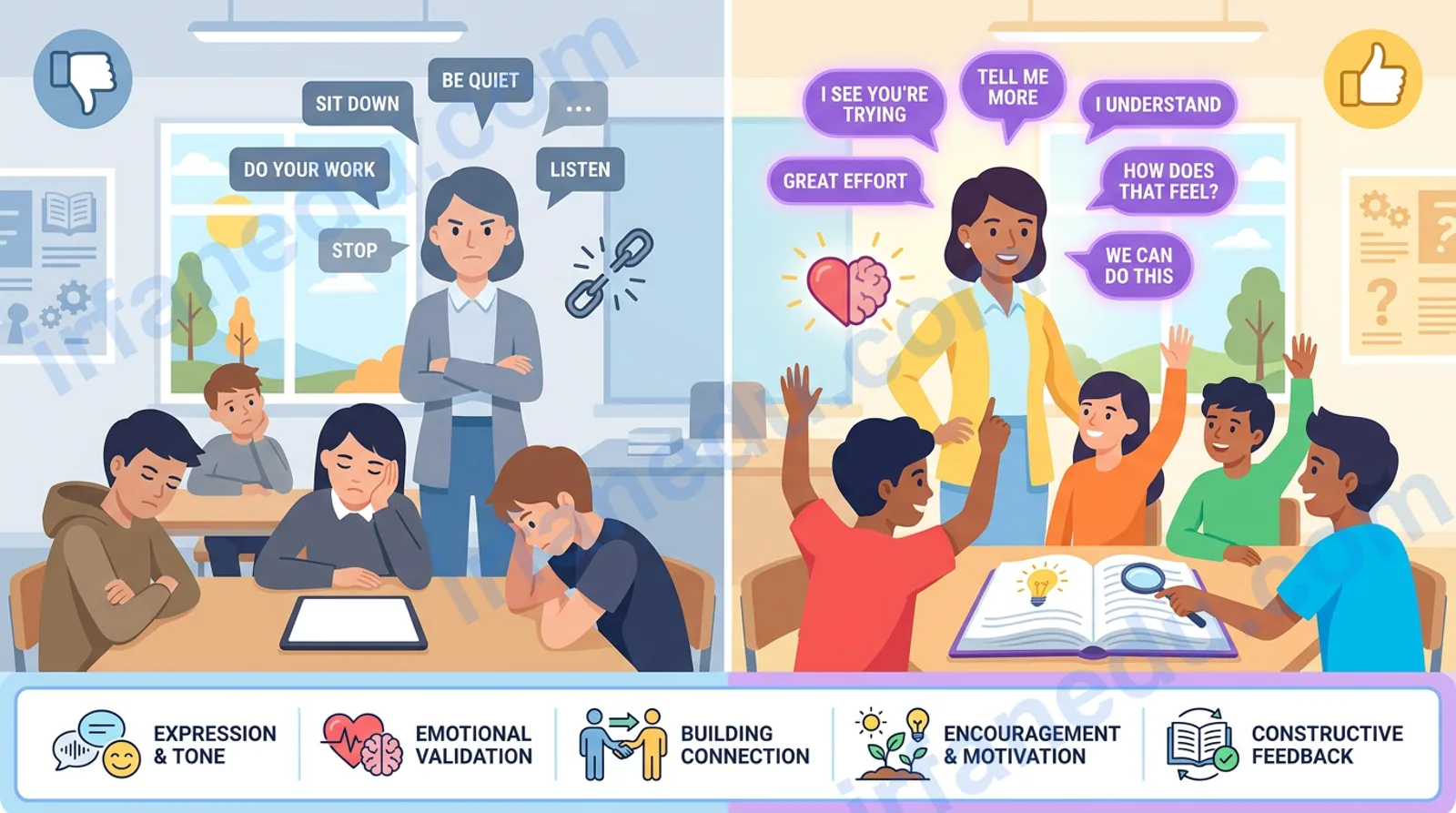
If the term “affective language” has ever left you puzzled — whether you’re a new teacher, a parent trying to understand your child’s classroom, or a student studying education — you’re not alone. 💜 It sounds technical, but the idea behind it is something every great teacher already does instinctively. This guide breaks it down clearly, with real examples you can use tomorrow.
Affective language in a classroom is the deliberate use of emotionally supportive words, tone, and phrases by a teacher to build student confidence, psychological safety, and motivation. It covers everything from specific praise and empathy statements to growth-oriented feedback and emotional validation.
In my 15+ years working with teachers and students across different educational systems, I’ve seen one pattern repeat itself: the classrooms where students thrive academically are almost always the ones where the emotional climate feels safe. And that climate is built, word by word, through affective language.
- A clear, quotable definition of affective language
- The five main categories with real classroom examples
- How it differs from cognitive language
- A step-by-step method for using it effectively
- The most common mistakes — and how to avoid them
- A practical checklist you can print and use
Affective language in a classroom is the deliberate use of emotionally supportive words, tone, and phrases by a teacher to build student confidence, psychological safety, and motivation. It includes praise, encouragement, empathy statements, and growth-oriented feedback. Research consistently links affective language to higher student engagement and academic achievement.
Quick facts at a glance 📊
| Fact | Detail |
|---|---|
| Definition | Language that addresses students’ emotions, attitudes, and motivation |
| Origin concept | Rooted in Bloom’s Taxonomy — the affective domain (Krathwohl et al., 1964) |
| Key goal | Build psychological safety so students take intellectual risks |
| Main types | Praise, encouragement, empathy, growth feedback, emotional validation |
| Who uses it | Teachers, teaching assistants, tutors, school counsellors |
| Common mistake | Using generic, hollow praise (“Good job!”) instead of specific affective language |
| Related concept | Growth mindset, social-emotional learning (SEL), student motivation |
Why affective language matters for learning 💡
Affective language directly affects how students feel about themselves as learners. When students feel emotionally safe, they ask questions without fear of embarrassment, attempt difficult problems, and persist through failure. When they don’t feel safe, they go quiet, avoid challenge, and disengage.
This isn’t just intuition. The affective filter hypothesis, developed by linguist Stephen Krashen, proposes that high emotional anxiety acts as a mental block that prevents new information from being processed and retained. While originally applied to language acquisition, educators have extended this principle across all subjects: a student who is anxious or feels judged simply cannot learn as effectively as one who feels supported.
In my experience observing hundreds of lessons, the most impactful thing a teacher does in the first five minutes of class isn’t the warm-up activity — it’s the emotional signal they send. A single dismissive comment (“We’ve been over this already”) can shut down a student for the rest of the lesson. Affective language is the invisible curriculum that either opens or closes the door to learning.
Affective language also connects directly to intrinsic motivation. When students hear their effort acknowledged rather than just their grade, they begin to associate learning with personal growth rather than performance anxiety. That shift is transformative.
The five categories of classroom affective language 🗂️
Affective language isn’t one single thing — it falls into five distinct categories, each serving a different emotional function in the classroom.
1. Specific praise
Specific praise names exactly what the student did well. It is far more powerful than generic praise because it tells the student what behaviour or thinking to repeat.
Instead of: “Great work!”
Say: “I noticed you checked your answer by working backwards — that’s exactly the kind of mathematical thinking that builds real understanding.”
2. Encouragement during struggle
This type of affective language appears when a student is stuck or frustrated. Its job is to normalise difficulty and sustain effort.
“This is genuinely one of the harder parts of this topic. The fact that you’re still working through it tells me a lot about your persistence.”
3. Empathy statements
Empathy statements acknowledge a student’s emotional experience without dismissing it. They signal that the teacher sees the whole person, not just the academic output.
“I can see this is frustrating. That feeling is completely normal — it usually means you’re right at the edge of understanding something new.”
4. Growth-oriented feedback
This is feedback that frames errors as information rather than failure. It is closely linked to growth mindset language and redirects students toward improvement.
“Your answer isn’t quite right yet — but look at step two. You made a really smart move there. Let’s build on that.”
5. Emotional validation
Emotional validation confirms that a student’s feelings are legitimate. It differs from empathy in that it explicitly names and accepts the emotion rather than just acknowledging it.
“It’s okay to feel nervous before a presentation. That nervousness means you care — and that’s actually a strength.”
In my experience, most teachers are reasonably good at praise and encouragement. The category they consistently underuse is emotional validation. There’s a fear that naming emotions will derail the lesson. In reality, the opposite is true: when a student’s emotion is named and accepted in ten seconds, they can move on. When it’s ignored, it sits in the room all lesson.
Affective vs cognitive language: what’s the difference? ⚖️
Cognitive language targets the intellect — it explains, instructs, questions, and corrects. Affective language targets the emotions — it motivates, validates, encourages, and builds safety. Skilled teachers use both, often in the same sentence.
| Dimension | Cognitive language | Affective language |
|---|---|---|
| Primary target | The student’s thinking | The student’s emotions and motivation |
| Typical examples | “The formula is F = ma.” / “What evidence supports that?” | “I believe you can work this out.” / “That was a brave attempt.” |
| Goal | Transfer knowledge and build skills | Build confidence, safety, and persistence |
| Risk if overused alone | Students know what to do but feel too anxious to try | Students feel good but lack the knowledge to succeed |
| Best used | During instruction, explanation, and questioning | During struggle, feedback, and transitions |
| Bloom’s domain | Cognitive domain | Affective domain |
The key insight here is that neither type works well in isolation. A classroom full of cognitive language but no affective language produces knowledgeable but anxious students. A classroom full of affective language but no cognitive rigour produces confident but underprepared ones.
How to use affective language step by step 🪜
Using affective language effectively is a skill — it requires intention, observation, and practice. Here is a six-step method I recommend to teachers I work with.
- Observe the emotional climate first. Before you speak, scan the room. Are students leaning in or pulling back? Do they look anxious, bored, or engaged? Your affective language should respond to what you actually see, not what you assume.
- Name the effort, not just the outcome. Shift from “That’s correct” to “I can see you really worked through each step carefully.” This tells students that effort is valued, not just being right.
- Use empathy statements when students are stuck. When a student is struggling, say: “This part is genuinely tricky — let’s slow down and look at it together.” This normalises difficulty and keeps the student in the room emotionally.
- Replace fixed-ability language with growth language. Catch yourself before saying anything that implies ability is fixed. Swap “You’re not a maths person” for “You haven’t mastered this yet — and that’s exactly what practice is for.”
- Make every affective phrase specific and genuine. Generic praise loses impact within days. Tie every affective phrase to something observable the student actually did. Students are remarkably good at detecting hollow words.
- Audit your language once a week. Record or mentally replay one lesson per week. Count how many affective vs purely directive phrases you used. Most teachers are surprised to find the ratio is heavily skewed toward directive language.
 Teacher uses affective language
           │
           ▼
 Student feels emotionally safe
           │
           ▼
 Student takes intellectual risk
  (asks questions, attempts hard tasks)
           │
           ▼
 Teacher observes effort → uses more
  specific affective language
           │
           ▼
 Student builds intrinsic motivation
  and academic confidence
           │
           └──────────────────────────────┐
                                          ▼
                              Cycle reinforces itself
Common mistakes teachers make with affective language ⚠️
Even well-meaning teachers can undermine their own affective language without realising it. These are the four mistakes I see most often.
Mistake 1: Using hollow, generic praise
“Good job, everyone! Great work today!”
Why it fails: Students quickly learn that this phrase appears regardless of what they actually did. It loses all motivational power and can even feel patronising to older students.
Mistake 2: Praising ability instead of effort
“You’re so smart — this comes naturally to you!”
Why it fails: Research by psychologist Carol Dweck shows that ability-based praise leads students to avoid challenge for fear of appearing less smart. Effort-based praise builds resilience.
Mistake 3: Affective language only for high achievers
The teacher praises the students who get the right answer and stays silent or corrective with those who struggle.
Why it fails: The students who most need affective language — those who are anxious, disengaged, or struggling — receive the least of it. This widens the confidence gap.
Mistake 4: Affective language that contradicts body language
Saying “Great question!” while glancing at the clock or continuing to write on the board.
Why it fails: Students read non-verbal cues faster than words. If your body language signals impatience or dismissal, no amount of positive phrasing will compensate.
The most powerful affective language is delivered with full physical presence: face the student, make brief eye contact, and pause before responding. That pause alone signals that what the student said matters.
Most guides treat affective language as a tool for managing behaviour or boosting self-esteem. That framing misses the deeper mechanism. Affective language works because it directly lowers the cognitive load of self-monitoring. When a student is worried about being judged, a significant portion of their working memory is occupied by social threat-detection — not the maths problem in front of them. Affective language that genuinely signals safety frees up that working memory for actual learning. This is why two students with identical ability can perform very differently in the same lesson depending on the emotional climate — and why affective language is, at its core, a cognitive intervention as much as an emotional one.
Affective language checklist for teachers ✅
Use this checklist to audit your own classroom language. You can work through it after a lesson or keep it on your desk as a planning prompt.
- I used at least one piece of specific, effort-focused praise today (not just “Good job”)
- When a student struggled, I used an empathy statement before offering a correction
- I avoided any language that implies ability is fixed (“you’re not a maths person,” “some people just get it”)
- I acknowledged a student’s emotional experience at least once during the lesson
- My body language matched my affective words (I paused, made eye contact, faced the student)
- I distributed affective language across all students — not just the high achievers
- I used growth-oriented feedback on at least one piece of incorrect work (“not yet” framing)
- I avoided hollow filler phrases that appear regardless of student effort
- I named at least one specific thing a student did — not just that they did something
- I checked in with at least one disengaged student using an open, non-judgmental question
I recommend teachers do a 5-minute mental replay of one lesson per week using this checklist. Not to judge themselves, but to notice patterns. In my experience, most teachers discover they use affective language in bursts — heavily at the start of term and almost not at all by week eight when pressure builds. The teachers whose students consistently outperform expectations are the ones who maintain the habit under pressure, not just when it’s easy.
Frequently asked questions ❓
What is affective language in a classroom?
What are examples of affective language a teacher can use?
Is affective language the same as praise?
Why does affective language matter for student learning?
Can affective language be overused?
How is affective language different from cognitive language in teaching?
Dr. Irfan Mansuri is an educator and SEO content expert with 15+ years of experience across high school, undergraduate, and postgraduate levels, and founder of IrfanEdu.com. I combine deep subject knowledge with proven teaching strategies to make complex ideas simple and genuinely useful for students, teachers, and parents worldwide. Connect on LinkedIn →
Sources & references
- Wikipedia — Affective filter hypothesis — Background on Krashen’s affective filter and its implications for learning environments.
- Wikipedia — Taxonomy of educational objectives (Bloom’s Taxonomy) — The foundational framework that defines the affective domain in education.
- Wikipedia — Language — Practical classroom applications of growth mindset and effort-based language.
Editorial note: This article was written and fact-checked by Dr. Irfan Mansuri. All claims are based on established educational research and the author’s direct professional experience. No statistics or quotes have been fabricated.