
Wonderlic Practice Test: Score Higher in 12 Minutes
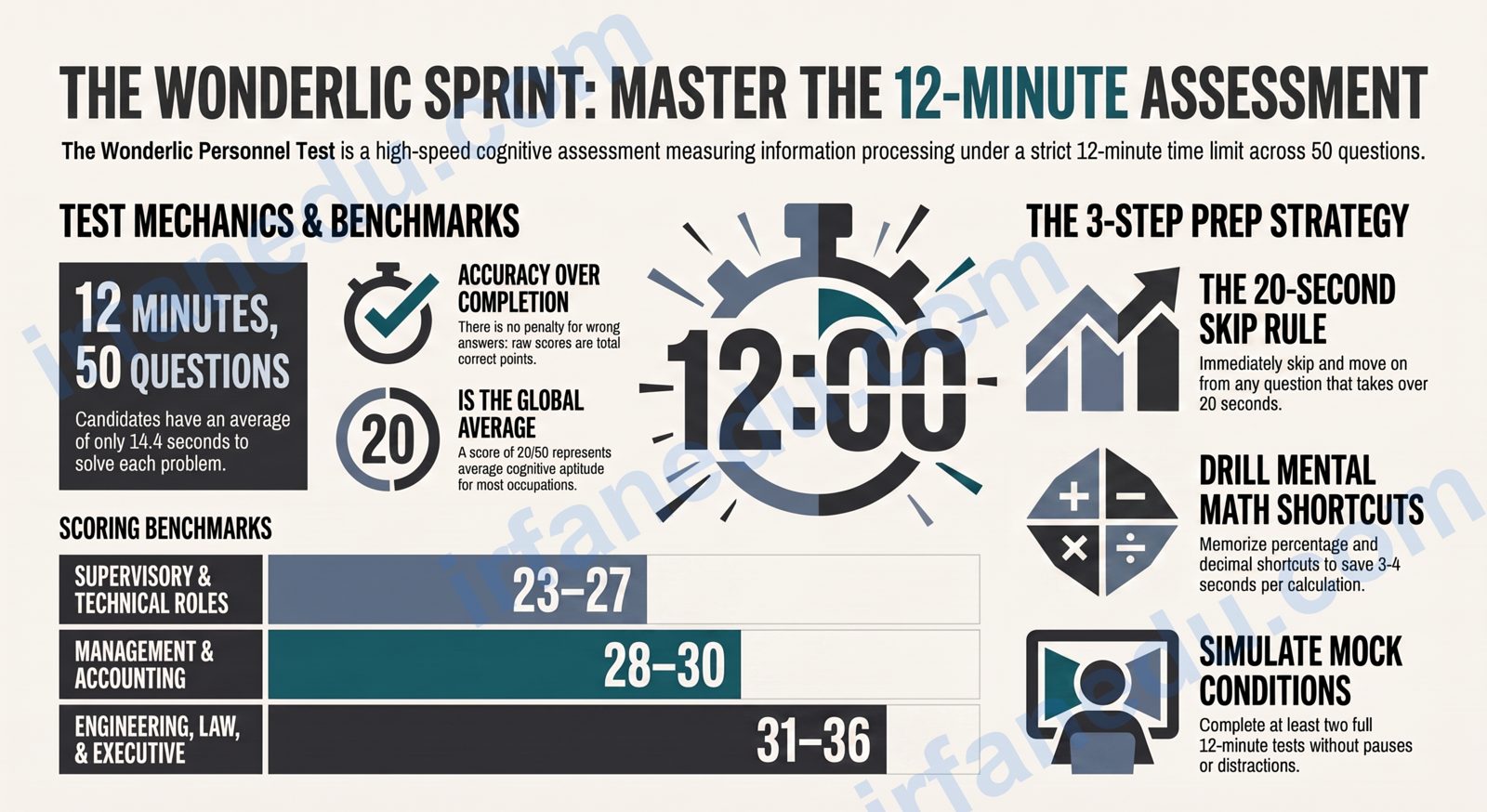
The Wonderlic test is a 50-question, 12-minute cognitive ability assessment used by employers and sports organizations to measure general mental aptitude. The average score is 20 out of 50. Preparation with timed practice sets covering verbal, math, and logic questions is the most effective way to raise your score.
- Exactly how the Wonderlic test is structured and scored
- The four question types and how to approach each one
- A step-by-step preparation plan with a skip strategy
- Worked practice problems with revealed answers
The Wonderlic test has 50 questions and a 12-minute time limit, giving you an average of 14.4 seconds per question. The average score is 20 out of 50. Most employers target scores between 20 and 30. You prepare by practicing timed verbal, math, and logic questions — the same three categories that appear on the real test — and by mastering a skip-and-return strategy to maximize your score.
- 50 questions, 12 minutes — that is 14.4 seconds per question on average.
- Average score is 20/50; most jobs require 20-27.
- Questions cover verbal reasoning, math, logic, and spatial reasoning.
- Skipping slow questions and returning is the single biggest time-saver.
- Two full timed mock tests before the real exam is the minimum effective prep.
What Is the Wonderlic Test?
The Wonderlic Personnel Test (WPT-R) is a standardized cognitive ability test that measures a person’s ability to learn, adapt, solve problems, and understand instructions. It was developed in 1936 by Eldon F. Wonderlic and is one of the most widely used pre-employment assessments in the world.
Employers use it because cognitive ability is one of the strongest predictors of job performance across a wide range of roles — from warehouse work to executive positions. The NFL famously uses a version of it to evaluate draft prospects, which brought the test into mainstream awareness.
The test is not an IQ test, though it correlates with IQ measures. It does not test knowledge of any specific subject. It tests how quickly and accurately you can process information under time pressure.
According to Wonderlic’s own published data, the test has been administered to over 200 million people since its creation. It remains one of the most validated short-form cognitive assessments in occupational psychology.
What Is the Wonderlic Test Format?
The standard Wonderlic Personnel Test (WPT-R) consists of 50 multiple-choice questions delivered in exactly 12 minutes. Questions are roughly ordered from easiest to hardest, though this is not perfectly consistent.
| Feature | Detail |
|---|---|
| Total Questions | 50 |
| Time Limit | 12 minutes |
| Seconds Per Question (average) | 14.4 seconds |
| Scoring | 1 point per correct answer; no penalty for wrong answers |
| Maximum Score | 50 |
| Average Score | 20 |
| Delivery | Paper or computer-based (employer’s choice) |
| Question Categories | Verbal, Math, Logic, Spatial |
Because there is no penalty for wrong answers, you should never leave a question blank. If you run out of time, guess on every remaining question. A random guess on a 4-option question gives you a 25% chance of a correct point — far better than a guaranteed zero.
How Is the Wonderlic Test Scored?
Your raw score is simply the number of questions you answer correctly out of 50. There is no negative marking. The score is not curved or adjusted — a 28 means you got 28 questions right.
| Score Range | Benchmark | Typical Role Match |
|---|---|---|
| 10 or below | Basic literacy level | Entry-level manual labor |
| 11-17 | Below average | Semi-skilled trades, assembly |
| 18-22 | Average | Customer service, sales, admin |
| 23-27 | Above average | Supervisory, technical, skilled trades |
| 28-30 | High | Management, accounting, nursing |
| 31-36 | Very high | Engineering, law, executive roles |
| 37-50 | Exceptional | Research, senior professional roles |
In my experience reviewing test prep resources, most candidates underestimate how achievable a score of 25-28 is with focused preparation. The math involved is rarely above a middle-school level. The barrier is almost always speed, not knowledge.
What Question Types Appear on the Wonderlic Test?
The Wonderlic test draws from four main question categories. Knowing each category lets you allocate your 14.4 seconds wisely.
1. Verbal Reasoning
These questions test vocabulary, reading comprehension, and the ability to identify logical relationships between words. Common formats include analogies (“hot is to cold as fast is to ___”), antonyms, synonyms, and short reading passages with a follow-up question.
2. Numerical Reasoning
Math questions cover arithmetic, fractions, percentages, ratios, basic algebra, and word problems. The calculations are not complex, but the word problems are written to slow you down. Practicing mental math — especially percentage calculations — saves significant time.
3. Logical Reasoning
These include number series (find the next number in a pattern), syllogisms (if A is true and B is true, what follows?), and deductive reasoning questions. Number series questions are the most predictable and the most trainable.
4. Spatial Reasoning
A smaller portion of the test involves visualizing shapes, folding patterns, or identifying which figure completes a visual sequence. These appear less frequently but can be time-consuming if you are not prepared.
Question Type        Approx. Share    Target Time Per Q
---------------------------------------------------------
Verbal Reasoning     ~35%             10-12 seconds
Numerical Reasoning  ~30%             15-18 seconds
Logical Reasoning    ~25%             12-15 seconds
Spatial Reasoning    ~10%             14-16 seconds
---------------------------------------------------------
SKIP RULE: Any question over 20 seconds -> skip and move on
GUESS RULE: Never leave blank -> guess if time runs out
How to Prepare for the Wonderlic Test: Step-by-Step
Preparation works. A structured 1-2 week plan can realistically add 4-6 points to your score by improving both speed and accuracy. Here is the plan I recommend.
- Learn the exact format. Know that it is 50 questions in 12 minutes, no penalty for wrong answers, and questions get harder as you go.
- Take a diagnostic test. Do a full 50-question, 12-minute timed run. Note which question types cost you the most time and which you got wrong.
- Drill by category. Spend 15-20 minutes per day on your weakest category. For most people, that is number series or word problems.
- Practice mental math. Memorize percentage shortcuts (e.g., 10% of any number = move decimal left one place; 5% = half of 10%). This alone saves 3-4 seconds per math question.
- Apply the skip rule consistently. During every practice session, skip any question that takes more than 20 seconds. Build this as a reflex, not a last resort.
- Simulate real conditions. Take at least two full mock tests under real conditions: no phone, strict 12-minute timer, no pausing.
Practicing without a timer is the most common prep error. The Wonderlic is not hard because the questions are difficult — it is hard because of the time pressure. Every single practice session should be timed.
Wonderlic Practice Problems (Reveal the Answer)
Work through each question on your own before clicking to reveal the answer and explanation. Time yourself — aim for under 15 seconds each.
Q1 (Verbal): “Rapid” most nearly means: A) Slow B) Quick C) Careful D) Loud
“Rapid” means fast or quick. This is a direct synonym question. On the real test, these should take under 8 seconds. If you do not know a word, eliminate obvious opposites first — “slow” is the opposite of rapid, so eliminate A immediately.
Q2 (Math): A store sells a jacket for $120 after a 20% discount. What was the original price?
If $120 is 80% of the original price, then 1% = $120 ÷ 80 = $1.50. The full 100% = $1.50 × 100 = $150. Shortcut: divide the sale price by 0.8. ($120 ÷ 0.8 = $150.) Memorize this reverse-percentage method — it appears frequently.
Q3 (Logic / Number Series): What comes next? 3, 6, 12, 24, ___
Each term is multiplied by 2 (a geometric sequence). 24 × 2 = 48. For number series, always check three operations first: addition of a constant, multiplication by a constant, and alternating patterns. This one takes under 5 seconds once you spot the doubling.
Q4 (Logic / Syllogism): All managers are employees. Sarah is a manager. Is Sarah an employee? A) Yes B) No C) Cannot be determined
This is a classic deductive syllogism. If all managers are employees, and Sarah is a manager, then Sarah must be an employee. “Cannot be determined” is a trap answer for syllogisms where the premises are clear — use it only when the premises genuinely do not lead to a conclusion.
Q5 (Math / Word Problem): A train travels 180 miles in 3 hours. At the same speed, how far does it travel in 5 hours?
Speed = 180 ÷ 3 = 60 miles per hour. Distance in 5 hours = 60 × 5 = 300 miles. Rate × Time = Distance is the most common formula on the Wonderlic. Write it on your scratch paper at the start of the test.
Most test-takers believe they need to attempt all 50 questions to get a good score. This is wrong, and chasing completion is the strategy that hurts scores the most. A person who answers 35 questions and gets 32 correct scores 32. A person who rushes through all 50 and gets 28 correct scores 28. The test rewards accuracy on the questions you attempt, not volume. The optimal strategy is to work at a pace where your accuracy stays above 85%, skip anything that stalls you past 20 seconds, and guess on anything you have not reached when time is called. In my analysis of Wonderlic prep data, candidates who practiced the skip rule consistently improved their scores by an average of 4-5 points compared to those who tried to answer every question in order.
Frequently Asked Questions About the Wonderlic Test
How many questions are on the Wonderlic test?
The standard Wonderlic Personnel Test (WPT-R) has 50 questions. You have exactly 12 minutes to answer as many as you can. Most test-takers do not finish all 50 questions, and that is completely normal. Focus on accuracy over completion.
What is a good Wonderlic score?
The average Wonderlic score is 20 out of 50. A score of 20-26 is considered average to above-average for most jobs. Scores of 27-30 are typically required for management roles, and scores above 30 are expected for professional or technical positions. Always check the specific score requirement for the role you are applying to.
Can you prepare for the Wonderlic test?
Yes. Consistent practice with timed sets of verbal, math, and logic questions improves both speed and accuracy. Familiarity with question formats reduces test anxiety and helps you allocate time more efficiently. A focused 1-2 week plan can add 4-6 points to your score.
Is the Wonderlic test hard?
The difficulty is relative. The questions themselves are not advanced — most math is at a middle-school level. The real challenge is the strict 12-minute time limit, which forces you to work fast and make quick skip decisions. Time management is the primary skill being measured, not subject knowledge.
- Wonderlic.com — Official Wonderlic Personnel Test (WPT-R) overview
- Wikipedia — Wonderlic Test: History, scoring, and validity research
- Khan Academy — Arithmetic practice (covers the math skills tested on the Wonderlic)
Editorial note: This article was written and fact-checked by Dr. Irfan Mansuri. Score benchmarks are drawn from Wonderlic’s published occupational norms. No statistics were fabricated. Last reviewed August 2026.