
Average PSAT Score: What’s Good, What’s Not, and How to Actually Improve
Is the PSAT score something you actually need to worry about? Honestly — it depends on what you want from it. For most students, the PSAT is a low-stakes diagnostic that tells you exactly where you stand before the SAT. For a small group of high-scorers, it is the gateway to National Merit Scholarships worth thousands of dollars. Knowing which camp you are in changes everything about how you should interpret your result.
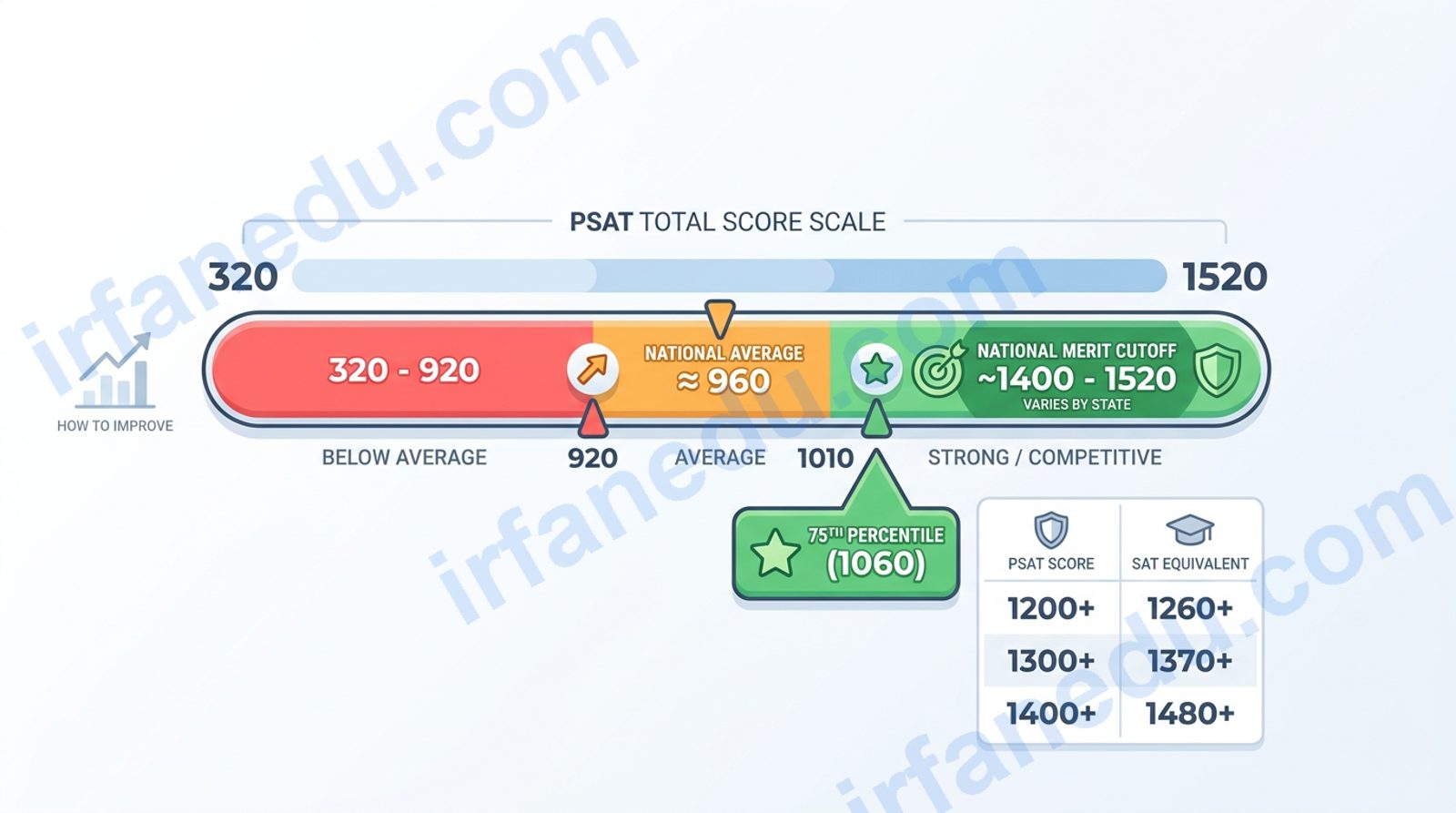
The average PSAT score is approximately 920-960 out of a maximum of 1520. A score above 1010 places you in the top 25% of test-takers nationally. National Merit Scholarship consideration requires a score in the 1400-1520 range, with the exact cutoff varying by state. The PSAT does not directly affect college admissions — colleges never see it — but it is the single best early indicator of your SAT readiness.
- Understand what the national average PSAT score actually means for your grade level.
- Read a score-range breakdown with real percentile benchmarks.
- Learn how the National Merit cutoff works and whether it is realistic for you.
- Get a concrete, step-by-step plan to raise your score before the next test date.
Is the PSAT Score Really Necessary to Stress About?
The short answer is: not for most students. The PSAT is not sent to any college, and it does not appear on any transcript. If you score a 900 or a 1100, no admissions officer will ever know. The test’s real job is to give you a data-rich snapshot of your academic skills roughly 12-18 months before your SAT date.
That said, dismissing it entirely is a mistake. A student who treats the PSAT as a throwaway test misses one of the best free diagnostics available. The score report breaks your performance into specific skill categories — things like “Heart of Algebra,” “Problem Solving and Data Analysis,” and “Words in Context” — which tells you precisely where to direct your study time.
For 11th graders specifically, the stakes are higher. The PSAT/NMSQT (National Merit Scholarship Qualifying Test) taken in junior year is the one that counts for National Merit. If you are a strong student aiming for selective universities, a National Merit Commended or Semifinalist designation can add real weight to your application and unlock scholarship money.
In my experience working with students across multiple score ranges, the biggest mistake I see is treating the PSAT result as a verdict rather than a starting point. A score of 880 in 10th grade is not a ceiling — it is a map. The students who improve the most are the ones who sit down with their score report the week after results come out, identify their two weakest skill areas, and start working on those specifically. The score itself matters far less than what you do with it.
What Is the PSAT Score Range?
The PSAT total score runs from 320 to 1520. It is made up of two section scores, each ranging from 160 to 760: Evidence-Based Reading and Writing (EBRW) and Math. You cannot score below 320 even if you leave every answer blank, and you cannot exceed 1520 even with a perfect raw score.
Within each section, there are also subscores (1-15) and cross-test scores (10-40) that give you a more granular view of your skills. These subscores are where the real diagnostic value lives. A student with a 700 Math section score might have a weak “Advanced Math” subscore but a strong “Heart of Algebra” subscore — and that distinction changes the study plan entirely.
TOTAL SCORE SCALE: 320 ──────────────────────────────── 1520

  320 ──── 760 ──── 920 ──── 1010 ──── 1150 ──── 1400 ──── 1520
   |         |        |         |          |          |         |
 Min      25th     ~Avg      Top 25%   Top 10%   Nat'l Merit  Max
         pctile   (50th)    nationally nationally  Zone

SECTION SCORES (each):
  160 ──────────────── 760
  EBRW: 160 – 760
  Math: 160 – 760

SELECTION INDEX (National Merit):
  48 ──────────────── 228
  Formula: 2 × (Reading + Writing/Language + Math Test scores)
What Is the Average PSAT Score by Grade Level?
The national average PSAT score differs meaningfully between 10th and 11th graders, which makes sense — students gain a full year of instruction between the two test dates.
| Grade | Avg Total Score | Avg EBRW | Avg Math | Top 25% Threshold | Top 10% Threshold |
|---|---|---|---|---|---|
| 10th Grade (PSAT 10) | ~920 | ~470 | ~450 | ~1010 | ~1120 |
| 11th Grade (PSAT/NMSQT) | ~960 | ~490 | ~470 | ~1060 | ~1150 |
| National Merit Cutoff (typical) | ~1400-1520 | ~700+ | ~700+ | Top 1% | Top 1% |
Note: These figures are based on College Board reported data and represent approximate national averages. Exact figures shift slightly year to year. Always check the College Board’s official annual score report for the most current numbers.
What Is a Good PSAT Score?
A “good” PSAT score is relative to your goal, not to a fixed number. Here is how I break it down for students I work with:
- At or below average (320-960): Your score is telling you that targeted SAT prep is needed. This is not a bad outcome — it is useful information. Most students in this range can improve substantially with focused practice.
- Above average (960-1060): You are in solid shape. With consistent prep, an SAT score in the 1100-1200 range is very achievable.
- Strong (1060-1200): You are in the top 10-25% nationally. A well-structured study plan can push you toward 1300+ on the SAT.
- Highly competitive (1200-1400): You are a strong candidate for merit-based scholarships at many universities. Consider whether the National Merit zone is within reach.
- National Merit zone (1400-1520): You are in contention for National Merit recognition. The exact cutoff varies by state — check your state’s Selection Index cutoff from the College Board.
A 10th grader scoring 1100 is performing exceptionally well relative to their peers. That same score in 11th grade is strong but not National Merit territory. Always compare your score to the correct grade-level percentile table, not just the raw number.
How the National Merit Scholarship Cutoff Actually Works
National Merit is not based on your total PSAT score — it is based on a separate calculation called the Selection Index. The Selection Index equals 2 times the sum of your Reading Test score, Writing and Language Test score, and Math Test score (each on a scale of 8-38).
The formula: Selection Index = 2 × (Reading + Writing/Language + Math)
The maximum Selection Index is 228. Each state sets its own cutoff based on the performance of students in that state. Highly competitive states like New Jersey, Massachusetts, and California typically have cutoffs of 221-228. Less competitive states may have cutoffs in the 209-215 range. This means a student in one state might earn National Merit Commended status with a score that would not qualify in another state.
Most guides tell you the National Merit cutoff is “around 1400-1520” and leave it there. Here is what they miss: the Selection Index is calculated from your test scores (8-38 scale), not your section scores (160-760 scale). This means a student who is slightly unbalanced — say, very strong in Math but weaker in Reading — can be disadvantaged relative to a student with a more even profile at the same total score. A student with Reading 34 / Writing 34 / Math 34 gets a Selection Index of 204. A student with Reading 38 / Writing 38 / Math 38 gets 228. The practical implication: if you are targeting National Merit, raising your weakest test score by even 2-3 points has a larger impact on your Selection Index than pushing an already-strong score higher. Target your floor, not your ceiling.
How to Improve Your PSAT Score: A Step-by-Step Plan
Improving your PSAT score is a skill-building process, not a cramming exercise. Here is the plan I recommend to students who want to see real gains.
- Retrieve your full score report. Log in to the College Board student portal. Download the detailed report — not just the total score, but every subscore and cross-test score. This is your diagnostic baseline.
- Identify your two lowest subscores. These are your highest-leverage targets. Improving a weak area from the 30th to the 50th percentile is far easier than pushing a strong area from the 80th to the 90th.
- Use Khan Academy’s Official SAT Practice. Khan Academy’s free platform is directly linked to College Board data. When you connect your College Board account, it automatically generates a personalised practice plan based on your actual PSAT results. This is the single most efficient free resource available.
- Take one full timed practice test every two weeks. Simulate real conditions — timed, quiet room, no phone, same time of day as the actual test. Stamina and pacing are skills that only improve with practice under pressure.
- Review every wrong answer in writing. Do not just check the answer key. Write down, in your own words, why the correct answer is correct and why your answer was wrong. This forces active processing and dramatically reduces repeat errors.
- Repeat the cycle and track your subscore progress. After each practice test, compare your subscores to your baseline. Adjust your study focus to whichever area has shown the least improvement.
The students I have seen improve the most — sometimes by 150-200 points between their PSAT and SAT — share one habit: they review wrong answers with genuine curiosity rather than frustration. They ask “what did I misunderstand?” rather than “how did I miss that?” That mindset shift turns every practice test into a targeted lesson rather than a performance review.
PSAT vs. SAT: How Do the Scores Compare?
The PSAT and SAT share the same scoring framework, which makes direct comparison straightforward. A 960 on the PSAT corresponds roughly to a 960-1000 on the SAT for a student who does no additional preparation. The PSAT is slightly easier — it covers a narrower range of content and has slightly less complex reading passages — which is why a raw PSAT score does not perfectly predict an SAT score without accounting for additional study.
The key insight: your PSAT score is not your SAT ceiling. It is your SAT starting point. Students who engage in 40-80 hours of focused preparation between their PSAT and SAT typically improve by 80-150 points. Students who do nothing typically see gains of 20-40 points from natural academic growth alone.
Quick Knowledge Check: PSAT Score Quiz
Test Your PSAT Score Knowledge
1. What is the maximum possible PSAT total score?
2. Which formula calculates the PSAT Selection Index for National Merit?
3. Do colleges receive your PSAT score?
Frequently Asked Questions About PSAT Scores
What is the average PSAT score?
What is a good PSAT score?
What is the PSAT score range?
What PSAT score do you need for National Merit?
Does the PSAT score affect college admissions?
How is the PSAT scored?
Can you use your PSAT score to predict your SAT score?
Related Articles
Dr. Irfan Mansuri
Dr. Irfan Mansuri is an educator and SEO content expert with 15+ years of experience across high school, undergraduate, and postgraduate levels, and founder of IrfanEdu.com. I combine deep subject knowledge with proven test-taking strategies to make complex ideas simple. Connect on LinkedIn.
Sources & References
- College Board — PSAT/NMSQT & PSAT 10 Scores: Understanding Your Results (Official score interpretation guide, College Board)
- Khan Academy — Official SAT Practice on Khan Academy (Free, College Board-linked personalised SAT/PSAT prep)
- National Merit Scholarship Corporation — NMSC Program Overview (Official National Merit program details and eligibility)
Editorial note: Score averages cited in this article are based on publicly available College Board annual score reports. Exact figures shift year to year; always verify current data at the College Board’s official website. This article was written and fact-checked by Dr. Irfan Mansuri and reflects information current as of August 2026.