
LSAT practice test: the complete guide to scoring higher
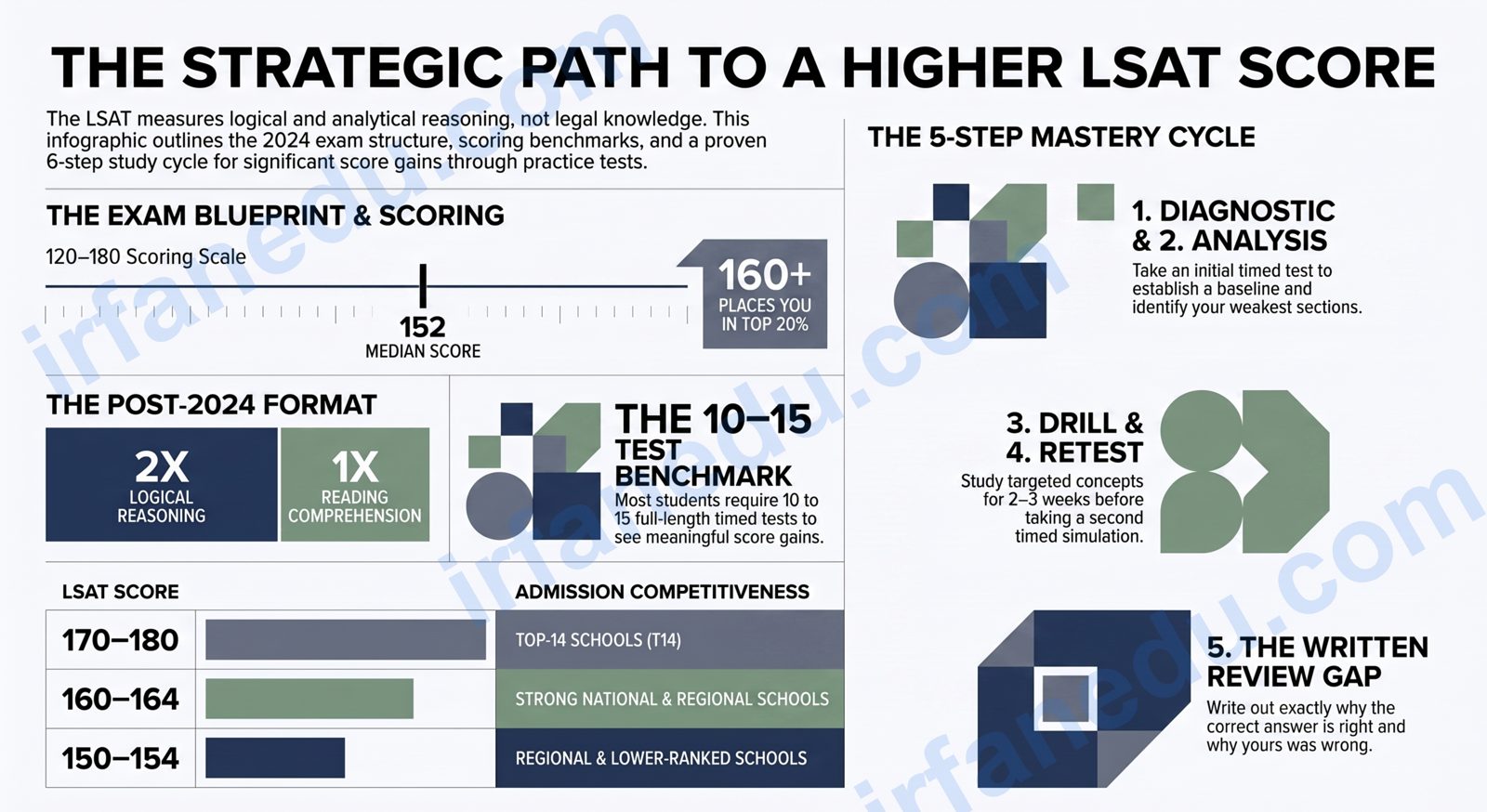
An LSAT practice test is a full-length, timed simulation of the Law School Admission Test, covering Logical Reasoning, Analytical Reasoning (Logic Games), and Reading Comprehension. Taking official practice tests under real exam conditions is the single most proven method to raise your LSAT score, because it trains the pattern recognition and pacing skills the actual exam rewards.
Every year, thousands of law school applicants plateau on the LSAT because they study content without practicing under pressure. In my experience working with test-prep students, the gap between a 155 and a 165 almost always comes down to how well someone has trained with timed, full-length practice tests — not how many vocabulary lists they memorized.
This guide gives you everything: what the LSAT actually tests, where to get official practice tests, a six-step study plan, and the review method that separates students who improve from those who stall.
- The LSAT has three scored sections: Logical Reasoning, Analytical Reasoning, and Reading Comprehension.
- Official practice tests from LSAC LawHub are the gold standard — third-party tests can differ in difficulty calibration.
- Always take practice tests under timed, exam-like conditions to build real pacing skills.
- Review every wrong answer in writing — this single habit drives more score improvement than any other activity.
- Target 10 to 15 full-length practice tests over your prep period, spaced with focused study in between.
- Your target score should match the median LSAT of your goal law schools, not a generic benchmark.
Table of Contents
- What the LSAT actually tests
- Where to find official LSAT practice tests
- Step-by-step LSAT practice test study plan
- How to review a practice test (the right way)
- Free vs. paid LSAT practice resources compared
- Common mistakes students make with practice tests
- What LSAT score do you actually need?
- Unique insight: the review gap most students miss
- Practice problems
- Quick knowledge check
- Frequently asked questions
- About the author
- Sources & references
What the LSAT actually tests
The LSAT measures skills that law school demands every day: reading dense arguments critically, spotting logical flaws, and working through complex rule-based systems under time pressure. It does not test legal knowledge or memorized facts.
The current LSAT (administered digitally) has three scored sections and one unscored variable section. Here is the breakdown:
| Section | Questions | Time | What it tests |
|---|---|---|---|
| Logical Reasoning | ~24-26 per section (1 section) | 35 min | Analyzing arguments, identifying assumptions, flaws, and inferences |
| Analytical Reasoning (Logic Games) | ~22-24 | 35 min | Applying rules to order, group, or assign elements in a scenario |
| Reading Comprehension | ~26-28 | 35 min | Understanding complex passages, author’s purpose, and inference |
| Variable (unscored) | Varies | 35 min | Experimental section — not counted in your score |
Scores range from 120 to 180. The median score is around 152. A score of 160 places you in approximately the top 20% of all test-takers, according to LSAC’s published score percentile tables.
Where to find official LSAT practice tests
Official LSAT practice tests come from LSAC, the organization that writes the real exam. These are the only tests guaranteed to match the actual difficulty, question style, and scoring curve.
| Resource | Cost | Official? | Best for |
|---|---|---|---|
| LSAC LawHub (free tier) | Free | Yes | 1 free full-length test; diagnostic baseline |
| LSAC LawHub Advantage | ~$99/year | Yes | Full test library (70+ tests); best overall value |
| Khan Academy LSAT Prep | Free | Yes (LSAC partnership) | Targeted question-type drills; good for concept building |
| 7Sage, Blueprint, Manhattan Prep | Paid (varies) | No (third-party) | Structured courses; supplement official tests |
| Older PrepTest books (Amazon) | ~$15-25 each | Yes (real past tests) | Offline practice; note pre-2024 format difference |
Khan Academy’s LSAT prep is a legitimate free resource because it was built in direct partnership with LSAC. The questions are real retired LSAT questions, not simulations. I recommend it as a supplement to full-length LawHub tests, not a replacement.
Step-by-step LSAT practice test study plan
A structured study plan turns raw practice tests into score gains. Here is the six-step cycle I recommend to every student starting LSAT prep from scratch.
Sit down with a full-length official LSAT practice test, set a 35-minute timer per section, and complete it with no prep. Do not study first. Your raw score here is your baseline. Write it down.
Break your results into three columns: Logical Reasoning, Analytical Reasoning, Reading Comprehension. Count wrong answers per section. Your weakest section by percentage is your first priority.
Drill the specific question types where you lost the most points. For Logical Reasoning, this usually means assumption and flaw questions. For Logic Games, it means diagramming practice. Use Khan Academy or a prep course for concept instruction.
Simulate real exam conditions: same time of day as your actual test, no phone, no music. Compare your score to the diagnostic. Any gain confirms the targeted study is working.
For each wrong answer, write one sentence explaining why the correct answer is right and one sentence explaining why your answer was wrong. This is the highest-value activity in all of LSAT prep.
Continue the test-review-study cycle. Aim for 10 to 15 full-length tests total. In the final two weeks before your exam, take two or three tests back-to-back to simulate the full exam day experience.
  +------------------+       +--------------------+
  |  1. DIAGNOSTIC   | ----> |  2. SECTION        |
  |  Full-length     |       |     ANALYSIS       |
  |  timed test      |       |  (find weak spots) |
  +------------------+       +--------------------+
           ^                          |
           |                          v
  +------------------+       +--------------------+
  |  6. REPEAT       |       |  3. TARGETED       |
  |  10-15 tests     |       |     CONCEPT STUDY  |
  |  total           |       |  (2-3 weeks)       |
  +------------------+       +--------------------+
           ^                          |
           |                          v
  +------------------+       +--------------------+
  |  5. WRITTEN      | <---- |  4. TIMED PRACTICE |
  |  ANSWER REVIEW   |       |     TEST #2        |
  |  (every test)    |       |  (real conditions) |
  +------------------+       +--------------------+

  Score gain lives in the REVIEW step — most students skip it.
How to review a practice test (the right way)
Most students take a practice test, check their score, and move on. That approach produces almost no improvement. The review is where the learning happens.
Here is the review method that consistently produces score gains in my experience:
- Mark every question you were uncertain about during the test, even if you got it right. Correct answers reached by guessing are as important to review as wrong answers.
- Categorize each error. Was it a timing error (you ran out of time), a comprehension error (you misread the stimulus), or a reasoning error (you understood but chose wrong)? Each type needs a different fix.
- Write out the explanation. Do not just read the answer key. Write, in your own words, why the correct answer is correct. This forces active processing rather than passive recognition.
- Track your error patterns over time. Keep a simple log: date, test number, section, question type, error type. After three tests, patterns emerge that tell you exactly where to focus.
In my experience, the single biggest mistake LSAT students make is treating practice tests as score-checking exercises rather than learning tools. I have seen students take 20 practice tests and improve by only 3 points because they never reviewed deeply. I have also seen students take 8 tests and jump 12 points because they spent twice as long reviewing as testing. The test itself is not the training — the review is.
Free vs. paid LSAT practice resources compared
You do not need to spend a lot of money to prepare well for the LSAT. The most important resource — official practice tests — is available free or at low cost directly from LSAC.
Here is how free and paid options compare on the factors that matter most:
| Factor | Free (LawHub + Khan Academy) | Paid (LawHub Advantage / Prep Course) |
|---|---|---|
| Question authenticity | Real LSAC questions | Real LSAC questions |
| Number of full tests | 1 free test on LawHub | 70+ tests (LawHub Advantage) |
| Concept instruction | Good (Khan Academy videos) | Excellent (structured courses) |
| Score analytics | Basic | Detailed (section, question type) |
| Best for | Budget prep; supplemental drilling | Full prep cycle; serious score goals |
| Verdict | Start here | Upgrade if targeting 165+ |
My recommendation: start with the free LawHub test and Khan Academy to understand the format. If you are targeting a top-14 law school where a 168+ is competitive, the LawHub Advantage subscription at ~$99 is worth it for access to the full test library.
Explore more test prep guides on IrfanEdu
Common mistakes students make with practice tests
Knowing what not to do is as valuable as knowing what to do. These are the five most common practice-test mistakes I see, and the fix for each.
Taking tests untimed
Untimed practice builds familiarity but does not build the pacing skill the real exam demands. Every practice test after your first diagnostic should be fully timed, 35 minutes per section, no exceptions.
Using only third-party tests
Third-party LSAT tests vary in difficulty calibration. A score of 162 on a prep-company test does not reliably predict a 162 on the real exam. Use official LSAC tests for all full-length simulations and reserve third-party materials for concept drills only.
Skipping the variable section
On the real exam, you will not know which section is unscored. Skipping it in practice trains you to mentally check out mid-exam. Always complete all sections, including the variable one.
Reviewing only wrong answers
If you answered a question correctly but were not confident, that question needs review too. A correct guess that goes unreviewed is a future wrong answer waiting to happen.
Cramming tests in the final week
Taking four or five tests in the last week before your exam does not raise your score — it raises your anxiety. The final week should be light review, one timed section per day maximum, and sleep prioritization.
What LSAT score do you actually need?
Your target score depends entirely on where you want to go to law school. There is no universal "good" LSAT score — there is only the score that makes you competitive at your specific target schools.
Here is a general reference based on publicly available law school admissions data:
- 150-154: Competitive at many regional and lower-ranked law schools.
- 155-159: Competitive at a broad range of accredited law schools; scholarship potential at lower-ranked schools.
- 160-164: Competitive at many strong regional and some national schools; scholarship potential at mid-ranked schools.
- 165-169: Competitive at top-25 law schools; strong scholarship potential at many schools.
- 170-180: Competitive at top-14 schools (T14); median or above at Harvard, Yale, Columbia, and similar programs.
Look up the 25th and 75th percentile LSAT scores for each school you are targeting on their official admissions pages or on LSAC's law school search tool. Your target should be at or above the school's 75th percentile LSAT to maximize your admission odds and scholarship potential.
What most LSAT guides get wrong about practice test frequency: The standard advice is "take as many practice tests as possible." In reality, taking tests faster than you can review them produces diminishing returns and can actually reinforce bad habits. The research on deliberate practice — most clearly articulated by cognitive psychologist Anders Ericsson — shows that improvement comes from targeted feedback loops, not raw repetition. For the LSAT, this means: one practice test every 7 to 10 days during active prep, with the days in between spent on written review and targeted drilling. Students who follow this spacing consistently outperform those who take a test every two days with minimal review. The test is not the training. The review is.
A second non-obvious point: your score on practice tests taken in the morning will typically be 2 to 4 points higher than tests taken in the afternoon, because the LSAT is primarily administered in the morning. If your real exam is a morning slot, always take your practice tests at the same time of day. This is a simple calibration most students never make.
Practice problems: test your LSAT reasoning
These are original practice questions in the style of LSAT Logical Reasoning. Work through each one before revealing the answer.
Question 1: All students who study daily pass their exams. Maria passed her exam. Therefore, Maria studied daily. Is this argument valid?
The original statement says studying daily guarantees passing. But passing does not guarantee that studying daily was the cause. Maria could have passed for other reasons (prior knowledge, exam difficulty, etc.). On the LSAT, this flaw is called "affirming the consequent" and appears frequently in Flaw question types. The correct logical form would be: "All students who study daily pass. Maria did NOT pass. Therefore, Maria did NOT study daily" — that is valid (modus tollens).
Question 2: A law firm hired only graduates from top-10 law schools last year. James is a top-10 law school graduate. What can you conclude?
The statement tells you the firm's hires came from top-10 schools, but it does not say the firm hired ALL top-10 graduates. James meeting the criterion does not guarantee he was hired. This tests the distinction between a necessary condition (top-10 degree is necessary to be hired) and a sufficient condition (it is not sufficient on its own). Recognizing this distinction is critical for LSAT Logical Reasoning assumption and inference questions.
Question 3: A reading comprehension passage argues that mandatory pro bono requirements for lawyers would reduce access to justice. What type of question would ask you to identify the assumption this argument depends on?
The argument assumes that mandatory pro bono requirements would not increase the overall supply of legal services to underserved populations — or that lawyers would reduce their paid work rather than add pro bono hours. An Assumption question asks you to identify what the argument must take for granted. The negation test is useful here: negate the assumption and check if the argument falls apart. If it does, you have found a necessary assumption.
Quick knowledge check
Select the best answer. The correct choice highlights automatically.
1. Which LSAT section was replaced by a second Logical Reasoning section starting August 2024?
Correct! Analytical Reasoning (Logic Games) was removed from the LSAT in August 2024 and replaced with a second Logical Reasoning section.
2. What is the LSAT score range?
Correct! The LSAT is scored on a scale of 120 to 180, with 180 being a perfect score.
3. According to this guide, what is the highest-value activity in LSAT prep?
Correct! Written answer review — explaining why the correct answer is right and why your answer was wrong — is the highest-value activity in LSAT prep.
Frequently asked questions about LSAT practice tests
How many LSAT practice tests should I take before the real exam?
Where can I find free official LSAT practice tests?
What is a good LSAT practice test score?
Should I take LSAT practice tests under timed conditions?
Check out my guide to Parallel and Perpendicular Lines and the Distance and Midpoint Formulas guide for ACT math prep — both build the logical-spatial reasoning skills that carry over to LSAT Analytical Reasoning.
- LSAC — About the LSAT (official test structure, scoring, and format information)
- Khan Academy — Free LSAT Prep (official LSAC partnership; real retired LSAT questions)
- Wikipedia — Law School Admission Test (overview, history, score percentiles)
Editorial note: This article was written and fact-checked by Dr. Irfan Mansuri. All statistics and format details are sourced from LSAC's official publications. No data has been fabricated. Last reviewed August 2026.