
CDL practice test: complete study guide to pass in 2026
The CDL passing rule
Correct answers ÷ Total questions × 100 ≥ 80%
On the standard 50-question general knowledge test: you need 40 correct answers to pass.
Every CDL knowledge section — including endorsements — uses this same 80% threshold.
Miss more than 10 questions on a 50-question test and you fail, regardless of which questions you got right.
⚡ TL;DR
- The CDL knowledge test requires 80% to pass (40/50 on the general knowledge section).
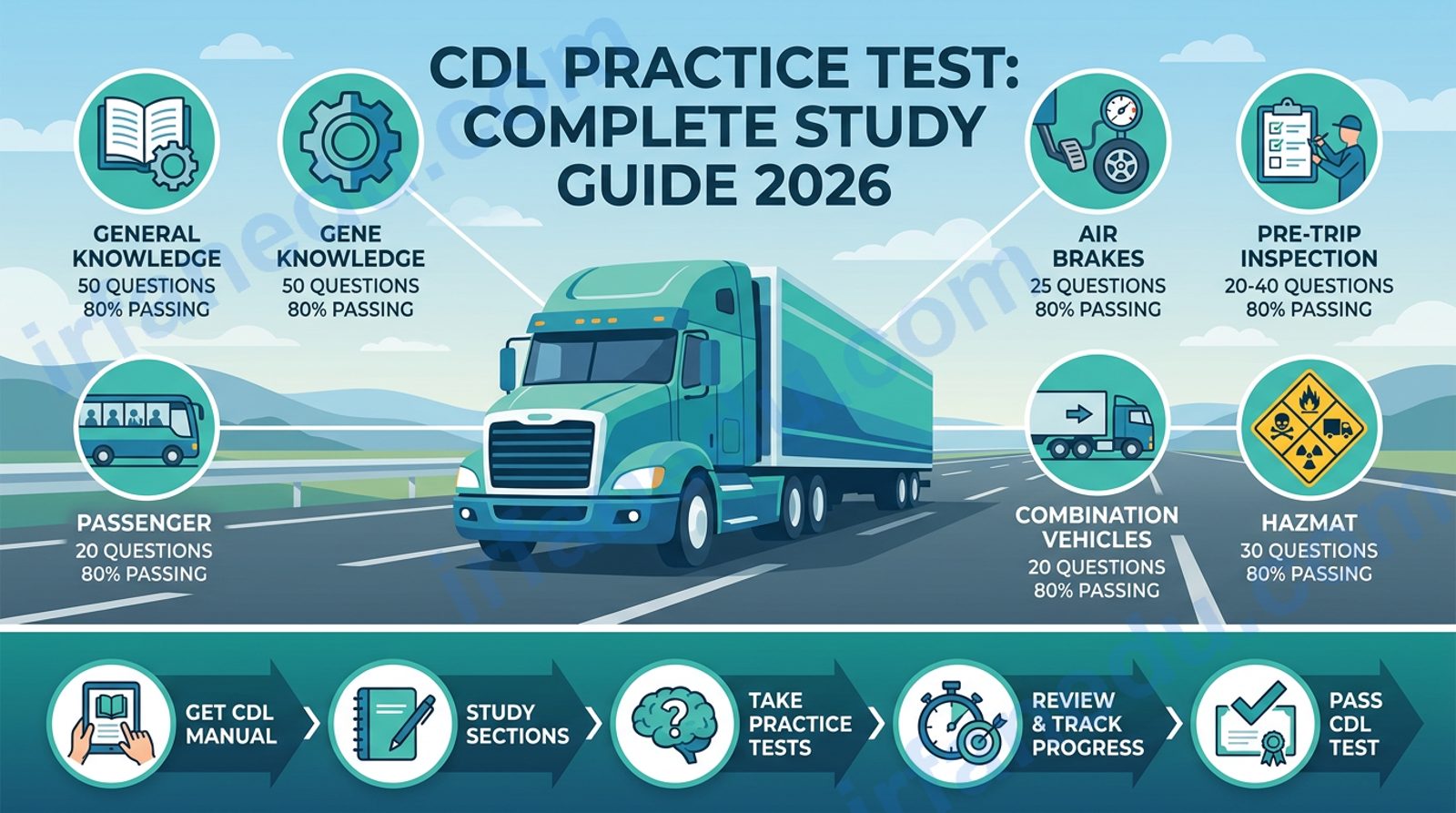
- There are six main test sections: general knowledge, air brakes, hazmat, tanker, combination vehicles, and pre-trip inspection.
- Read the official FMCSA CDL manual before taking any practice test.
- Take a diagnostic practice test first to find your weakest topics immediately.
- Score 90%+ on three consecutive practice tests before booking the real exam.
- Each endorsement (Hazmat, Tanker, Passenger) requires its own separate practice test.
What is the CDL knowledge test and who needs it?
The CDL knowledge test is a written (or computer-based) exam required by every U.S. state before a candidate can obtain a Commercial Driver’s License. It is governed by the Federal Motor Carrier Safety Administration (FMCSA), which sets the minimum standards that all states must follow.
You need a CDL if you drive a vehicle with a gross vehicle weight rating (GVWR) over 26,001 lbs, transport 16 or more passengers (including the driver), or haul hazardous materials requiring placards. The specific CDL class you need depends on the vehicle type.
The knowledge test is the first hurdle. Pass it, and you receive a Commercial Learner’s Permit (CLP), which allows you to practice driving with a qualified CDL holder before taking the skills (road) test.
In my experience helping students prepare for licensing exams, the biggest mistake CDL candidates make is jumping straight into practice tests without reading the manual first. Practice tests without the manual are like practicing math without learning the formulas — you memorize answers without understanding the rules. Read the manual once, then use practice tests to confirm your understanding. That order matters enormously.
What are the CDL test sections and how many questions does each have?
The CDL exam is not one single test — it is a set of knowledge tests, each covering a specific topic area. The general knowledge test is mandatory for all CDL applicants. Additional tests are required based on the vehicle type and the endorsements you need.
| Test section | Questions | Pass mark (80%) | Who needs it |
|---|---|---|---|
| General Knowledge | 50 | 40 correct | All CDL applicants |
| Air Brakes | 25 | 20 correct | Vehicles with air brakes |
| Combination Vehicles | 20 | 16 correct | Class A applicants |
| Hazardous Materials (H) | 30 | 24 correct | Hazmat endorsement |
| Tanker Vehicles (N) | 20 | 16 correct | Tanker endorsement |
| Doubles/Triples (T) | 20 | 16 correct | Doubles/Triples endorsement |
| Passenger Transport (P) | 20 | 16 correct | Passenger endorsement |
| School Bus (S) | 20 | 16 correct | School bus endorsement |
Notice that the air brakes test is a restriction, not an endorsement. If you skip it, your CDL will carry a restriction preventing you from driving any vehicle with air brakes — which eliminates most commercial trucks. Take the air brakes test.
How to prepare for the CDL knowledge test: a step-by-step plan
Preparation works best as a structured sequence, not random practice. Here is the exact process I recommend based on the study patterns of candidates who pass on their first attempt.
-
Get the official CDL manual from FMCSA or your state DMV. This is the only source the real test draws from. Download it free at fmcsa.dot.gov. Read it cover-to-cover before touching a practice test. This takes 4-6 hours but eliminates guessing.
-
Identify your required CDL class and endorsements. Class A covers combination vehicles (semi-trucks). Class B covers single large vehicles (city buses, dump trucks). Class C covers smaller commercial vehicles carrying hazmat or 16+ passengers. Your target job determines which endorsement tests you also need.
-
Take a full diagnostic practice test without studying first. A cold 50-question general knowledge test shows you exactly which chapters you need to study most. Do not skip this step — it saves hours of studying topics you already know.
-
Study your weak chapters from the manual. Return to the specific chapters covering your missed questions. Summarize each rule in your own words. Writing a summary forces active recall, which is far more effective than re-reading.
-
Take one full practice test per day for each required section. Review every wrong answer immediately. Do not move on until you understand why the correct answer is correct — not just what it is.
-
Book the real test once you score 90%+ on three consecutive practice tests. The 90% target gives you a 10-point buffer above the 80% pass mark, accounting for exam-day nerves and unfamiliar question phrasing.
Pre-trip inspection checklist (the most-failed section)
The pre-trip inspection is a physical skills test, but the knowledge test includes questions about the correct inspection sequence. Know these seven areas in order:
- Engine compartment — fluid levels, belts, hoses, leaks
- Cab interior — gauges, controls, mirrors, seatbelts
- Front of vehicle — lights, reflectors, windshield, wipers
- Left side — tires, wheels, fuel tank, battery box
- Rear of vehicle — lights, reflectors, mud flaps, cargo doors
- Right side — mirror image of left side inspection
- Signal/brake check — with a helper or using mirrors
Worked example: calculating your CDL practice test score
Understanding the math behind your score helps you set realistic daily targets. Here are two worked examples using the formula from the opening box.
Example 1 — General knowledge test (50 questions)
Scenario: You answer 43 out of 50 questions correctly on a practice test.
Calculation: 43 ÷ 50 × 100 = 86%
Result: Pass (86% > 80%). You have a 6-point buffer above the pass mark. Good, but aim higher — push toward 90%+ before the real exam.
What to do next: Review the 7 wrong answers. Identify which CDL manual chapters they came from. Re-read those chapters and retake a fresh practice test tomorrow.
Example 2 — Air brakes test (25 questions)
Scenario: You answer 18 out of 25 questions correctly.
Calculation: 18 ÷ 25 × 100 = 72%
Result: Fail (72% < 80%). You missed 7 questions — 2 more than the maximum allowed.
What to do next: Do not retake the practice test immediately. Return to the air brakes chapter in the CDL manual. Focus on: dual air brake systems, air brake application pressure, low air pressure warning devices, and parking brake procedures. These four subtopics generate the majority of air brakes test questions.
I track study patterns across many exam types, and CDL air brakes is consistently the section where candidates lose the most points. The reason is almost always the same: candidates treat it as a memorization exercise. Air brakes has a physical logic to it — pressure builds, valves open, brakes release. Once you understand the system mechanically, the questions become obvious. Find a diagram of a dual air brake system and trace the airflow yourself. Ten minutes with a diagram beats two hours of flashcards.
CDL STUDY ROADMAP
─────────────────────────────────────────────────────────────
WEEK 1                          WEEK 2                WEEK 3
─────────────────────────────────────────────────────────────
[Read CDL Manual]  →  [Diagnostic Test]  →  [Daily Practice]
  All chapters         Score baseline        1 test/day
  ~4-6 hours           Find weak spots       Review wrongs
                            │
                            ▼
                    [Study Weak Chapters]
                    Return to manual
                    Summarize in own words
─────────────────────────────────────────────────────────────
TARGET: Score 90%+ on 3 consecutive tests → Book real exam
─────────────────────────────────────────────────────────────
ENDORSEMENT TESTS (add after General Knowledge is solid)
  Air Brakes (25Q)   Hazmat (30Q)   Combination (20Q)
  Tanker (20Q)       Passenger (20Q)  School Bus (20Q)
─────────────────────────────────────────────────────────────
CDL class A vs B vs C: which test do you need?
The CDL class determines the scope of your knowledge test and the vehicles you can legally drive. Choosing the wrong class means studying for the wrong test — a costly mistake.
Class A is the most comprehensive and covers combination vehicles (a tractor pulling a trailer with GVWR over 10,000 lbs). Class B covers single large vehicles. Class C covers smaller vehicles that still require a CDL due to passenger count or hazmat cargo.
A Class A license automatically grants you the privilege to drive Class B and C vehicles. A Class B license covers Class C. The reverse is not true.
Explore more test prep guides on IrfanEdu
Practice tests measure recall, not understanding — and the CDL test measures understanding. Most CDL practice test guides tell you to repeat tests until you memorize the answers. That works for simple recall questions, but the FMCSA deliberately writes situational questions that change the scenario slightly — different vehicle type, different road condition, different cargo — to test whether you understand the rule, not just whether you remember the answer from a practice bank.
In my analysis of CDL test failures, candidates who scored 95%+ on practice tests still failed the real exam because they had memorized answer patterns rather than internalizing the underlying FMCSA regulations. The fix: after every wrong answer on a practice test, find the exact rule in the CDL manual and read the full paragraph — not just the sentence with the answer. Context is what the real test probes.
This is also why the FMCSA updates the question bank periodically. Memorized answer lists go stale; understanding the regulations does not.
Test yourself: CDL knowledge mini-quiz
Try these three questions drawn from common CDL general knowledge topics. Select an answer to see if you are correct.
CDL quick quiz
Q1. What is the minimum passing score on any CDL knowledge test section?
Q2. Which CDL class covers combination vehicles (tractor-trailer)?
Q3. How many questions are on the CDL air brakes knowledge test?
Frequently asked questions about CDL practice tests
How many questions are on the CDL general knowledge test?
The CDL general knowledge test contains 50 questions. You must answer at least 40 correctly (80%) to pass. Questions cover traffic laws, vehicle inspection, cargo handling, shifting, backing, and safe driving practices as defined in the FMCSA CDL manual.
What score do you need to pass the CDL knowledge test?
You need a minimum score of 80% to pass any CDL knowledge test section. For a 50-question general knowledge test, that means at least 40 correct answers. For a 25-question air brakes test, you need 20 correct. The 80% threshold applies to all endorsement tests as well.
How many times can you take the CDL written test if you fail?
Retake rules vary by state. Most states allow 3 attempts before requiring a waiting period of 7-30 days. Some states charge a retake fee per attempt. Check your state’s DMV website for the exact policy before you test, so a failure does not catch you off guard financially or logistically.
What topics does the CDL general knowledge test cover?
The CDL general knowledge test covers vehicle inspection, basic vehicle control, shifting and backing, coupling and uncoupling, pre-trip inspection procedures, cargo securement rules, driving in hazardous conditions, emergency procedures, and accident reporting. All topics come directly from the FMCSA CDL manual.
Is the CDL practice test the same as the real test?
CDL practice tests are not identical to the real test, but they are drawn from the same FMCSA-approved topic areas and question types. The real test uses a rotating bank of questions, so you will rarely see the exact same wording twice. Consistent practice builds the knowledge and recall needed to handle any question phrasing.
Do I need a separate CDL practice test for every endorsement?
Yes. Each CDL endorsement — Hazmat (H), Tanker (N), Passenger (P), School Bus (S), and Doubles/Triples (T) — has its own separate knowledge test with its own question bank. Practice each endorsement test individually in addition to the general knowledge test. Do not assume overlap covers you.
How long does it take to prepare for the CDL knowledge test?
Most candidates prepare in 2-4 weeks studying 1-2 hours per day. Candidates with prior commercial driving experience often need less time. The key variable is whether you read the official CDL manual before starting practice tests. Skipping the manual and relying only on practice tests typically extends preparation time and increases failure risk.
Where can I find official CDL practice test questions?
The Federal Motor Carrier Safety Administration (FMCSA) publishes the official CDL manual at fmcsa.dot.gov, which is the authoritative source for all test content. Your state’s DMV website also provides sample questions specific to your jurisdiction. These are the most reliable sources for CDL practice test preparation.
Related reading on IrfanEdu
- Complete Geometry Formula Sheet — a structured reference for students preparing for standardized tests
- Distance & Midpoint Formulas — step-by-step math guide for test prep
Sources & references
- Federal Motor Carrier Safety Administration (FMCSA) — Commercial Driver’s License Information — the official source for CDL manual content, test requirements, and endorsement rules.
- Wikipedia — Commercial Driver’s License — overview of CDL classes, federal regulations, and endorsement categories.
Editorial note: This article was written and fact-checked by Dr. Irfan Mansuri. All statistics and test requirements reflect FMCSA federal minimums as of August 2026. Individual state requirements may vary slightly — always verify with your state’s DMV before testing.