
Driver’s Permit Practice Test: The Complete Study Guide to Pass First Try
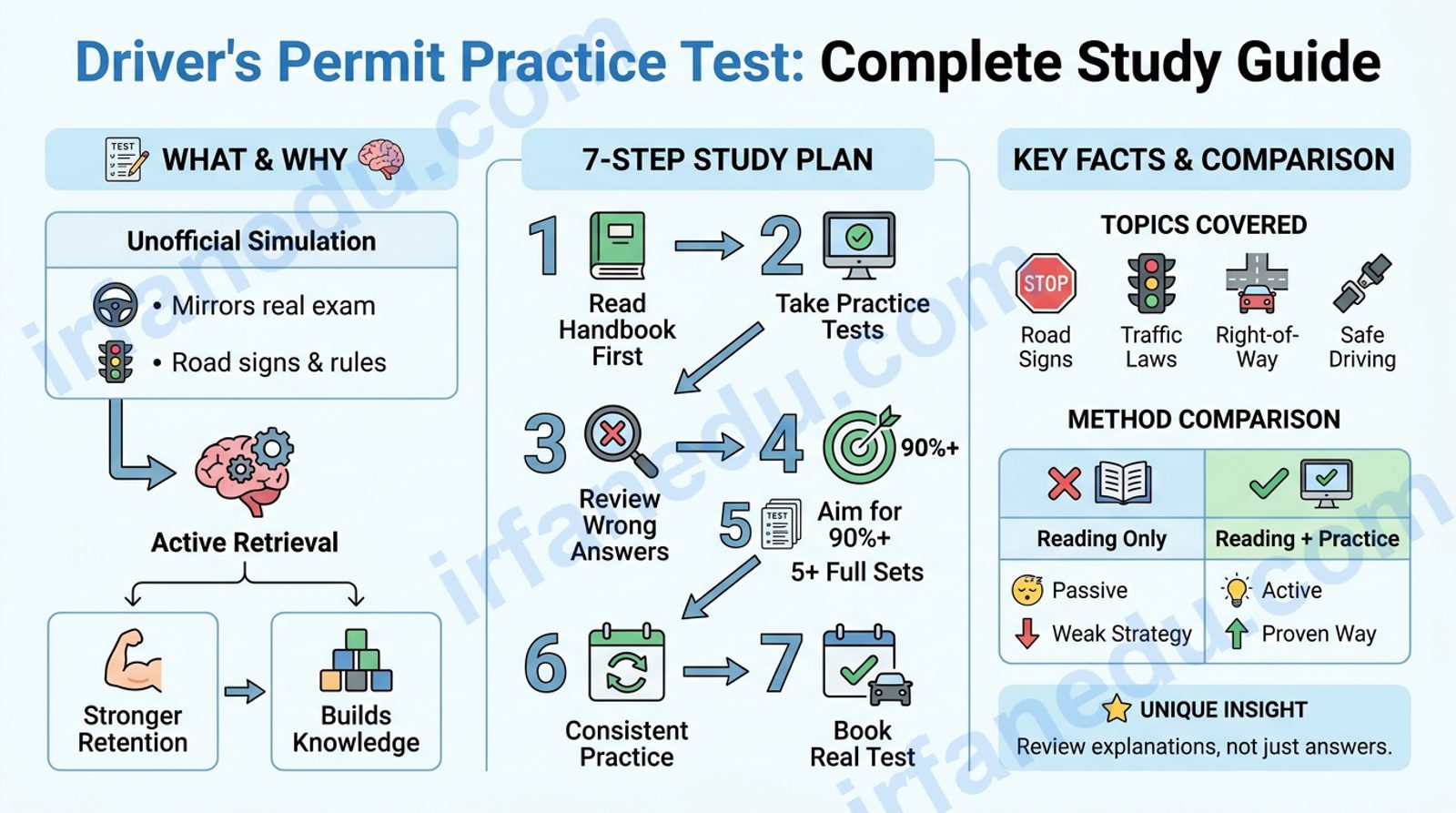
A driver’s permit practice test is a free simulation of the official written knowledge exam you must pass to get a learner’s permit. It covers road signs, traffic laws, right-of-way rules, and safe driving behavior. Consistent practice test use — combined with reading the official handbook — is the most reliable way to pass the real exam on your first attempt.
A driver’s permit practice test is a free, unofficial simulation of the official written knowledge exam required to get a learner’s permit. It covers road signs, traffic laws, right-of-way rules, and safe driving behavior. Taking multiple practice tests — ideally 5 or more full sets — is the single most proven way to pass the real exam on your first attempt.
- A permit practice test mirrors the real written driving exam in format and topic coverage.
- The exam tests road signs, traffic laws, right-of-way, speed limits, and impairment rules.
- Read the official handbook first — practice tests alone are not enough.
- Aim for 90%+ on at least 5 full practice sets before booking the real test.
- Review every wrong answer with its explanation, not just the correct answer.
- Most jurisdictions require 70–80% to pass; check your local threshold.
What Is a Driver’s Permit Practice Test?
A driver’s permit practice test is an unofficial, simulated version of the written knowledge exam that licensing authorities use to issue a learner’s permit (also called a provisional licence or learner’s licence in some countries). It is not the real test — it carries no legal weight — but it is built to reflect the real exam’s question style, topic distribution, and difficulty level.
The purpose is simple: expose your knowledge gaps before they cost you a failed attempt on the official exam. A good practice test presents multiple-choice questions drawn from the same source material as the real exam — your jurisdiction’s official driver handbook — and gives you immediate feedback on what you got wrong and why.
Practice tests are available free from many reputable websites, and some official motor vehicle authority websites publish them directly. The quality varies, so always prefer tests that are explicitly based on the official handbook for your region.
Why Taking Practice Tests Matters More Than Just Reading
Reading the driver handbook is necessary, but passive reading alone is a weak study strategy. Research in cognitive science consistently shows that active retrieval practice — testing yourself on material — produces far stronger long-term retention than re-reading the same pages.
This effect, known as the testing effect or retrieval practice effect, is well-documented in educational psychology. When you attempt a question and get it wrong, your brain encodes the correct answer more deeply than if you had simply read it. The mistake creates a memory hook.
A student who reads the handbook twice and takes zero practice tests will almost always score lower than a student who reads the handbook once and takes five practice tests. The practice tests do not just check your knowledge — they actively build it.
In my experience working with students preparing for high-stakes exams, the ones who fail their permit test on the first attempt almost always skipped the practice test phase or took only one or two tests without reviewing their wrong answers. The review step is where the real learning happens.
What Topics Does the Permit Test Cover?
The written permit test covers a defined set of topics that appear in every jurisdiction’s official driver handbook. While the exact question wording and passing score vary by location, the core subject areas are universal.
Core Topic Areas
- Road Signs: Shape, color, and meaning of regulatory, warning, and informational signs. This is typically the largest single category on the exam.
- Traffic Laws and Rules of the Road: Speed limits in different zones (school zones, residential areas, highways), lane usage, turning rules, and traffic signal meanings.
- Right-of-Way Rules: Who yields at intersections, roundabouts, crosswalks, and merge situations.
- Safe Following Distance: The 3-second rule, stopping distances at different speeds, and how weather affects braking.
- Impaired and Distracted Driving: Blood alcohol concentration (BAC) limits, zero-tolerance laws for young drivers, and mobile phone restrictions.
- Parking Rules: Where you can and cannot park, fire hydrant distances, and handicapped parking regulations.
- Emergency Procedures: What to do if your vehicle breaks down, how to respond to emergency vehicles, and railroad crossing rules.
The specific passing score, number of questions, and exact topic weighting differ by jurisdiction. Always download and read the official driver handbook from your local motor vehicle authority before taking any practice test.
Quick Facts at a Glance
| Factor | Typical Range / Detail |
|---|---|
| Number of questions on real exam | 20 to 50 questions (varies by jurisdiction) |
| Passing score | 70% to 83% correct |
| Time allowed | 25 to 60 minutes (most exams are untimed or generously timed) |
| Primary source material | Official driver handbook from your local motor vehicle authority |
| Recommended practice tests before real exam | 5 or more full sets, scoring 90%+ consistently |
| Recommended study time | 1 to 2 weeks, 30 to 45 minutes per day |
| Minimum age (typical) | 15 to 16 years old (varies by jurisdiction) |
| Cost of practice tests | Free (from reputable sources) |
How to Study for Your Permit Test: A 7-Step Plan
This step-by-step plan is the most reliable path from zero knowledge to a passing score. Follow it in order — skipping steps, especially step 1, is the most common reason students fail.
-
Download the Official Driver Handbook
Go to your local motor vehicle authority’s official website and download the current driver handbook. This is the only source the real exam draws from. Everything else is secondary. -
Read the Handbook Cover to Cover
Do not skim. Pay particular attention to road signs (memorize shapes and colors, not just text), right-of-way rules, and the impaired driving chapter — these three areas account for the majority of exam questions. -
Take a Diagnostic Practice Test
Before you study further, take one full practice test cold. This is not about passing — it is about identifying which topic areas you are weakest in. Note your score and which categories you missed. -
Return to the Handbook for Weak Areas
Go back to the specific handbook chapters that cover your missed questions. Read those sections again carefully, this time making brief notes or flashcards for the facts you missed. -
Take at Least 4 More Full Practice Tests
Space them out over several days. After each test, read the explanation for every wrong answer — not just the correct option, but why it is correct and why the wrong options are wrong. -
Target 90%+ Consistently
Do not book the real exam until you are scoring 90% or higher on multiple consecutive practice tests. The 10-point buffer above the typical 80% passing score gives you a safety margin for exam-day nerves. -
Book and Sit the Official Exam
Arrive early, bring required documents (ID, proof of residency, and any fees), and read every question on the real exam carefully before selecting an answer. Do not rush — most exams allow plenty of time.
Sample Practice Questions With Explanations
These sample questions reflect the style and difficulty of real permit test questions. Work through each one before reading the explanation.
Question 1: Road Signs
A) Stop completely
B) Yield to oncoming traffic
C) Speed limit ahead
D) No entry
Correct Answer: B
Explanation: A triangular shape with a red border universally signals “Yield.” You must slow down and give way to traffic already in the intersection or road you are entering. A stop sign is octagonal (8-sided), not triangular.
Question 2: Following Distance
A) 1 second
B) 2 seconds
C) 3 seconds
D) 5 seconds
Correct Answer: C
Explanation: The 3-second rule is the standard minimum following distance in normal conditions. Pick a fixed point (a sign or road marking), and when the car ahead passes it, count “one-one-thousand, two-one-thousand, three-one-thousand.” If you pass the point before finishing the count, you are too close. In rain, ice, or fog, double this to 6 seconds.
Question 3: Right-of-Way
A) You, because you arrived simultaneously
B) The driver to your right
C) Whoever has the larger vehicle
D) The driver going straight
Correct Answer: B
Explanation: At a four-way stop, when two vehicles arrive simultaneously, the driver to the right has the right-of-way. This rule applies regardless of vehicle size or direction of travel.
         [NORTH]
           |
     ------+------
           |
  [WEST] --+-- [EAST]  ← Driver B (to YOUR right)
           |
     ------+------
           |
         [SOUTH]
         You (Driver A)

  Rule: Driver B (to your right) goes first.
  If alone at the stop: first to arrive, first to go.
  Tie between 3+ cars: yield to the right, then proceed.
Comparing Study Methods: What Actually Works
Not all study methods are equally effective for the permit test. This comparison table shows the most common approaches and how they stack up against each other.
| Study Method | Effectiveness | Time Required | Best For | Limitation |
|---|---|---|---|---|
| Read handbook once | Low | 3–5 hours | Building baseline knowledge | Passive; poor retention without testing |
| Practice tests only (no handbook) | Low–Medium | 2–4 hours | Quick review | Misses context; question memorization without understanding |
| Handbook + 1–2 practice tests | Medium | 5–7 hours | Moderate preparation | Insufficient exposure to question variety |
| Handbook + 5+ practice tests + review wrong answers | High | 8–12 hours | First-attempt pass | Requires consistent daily effort over 1–2 weeks |
| Flashcards for road signs | High (for signs) | 1–2 hours | Road sign memorization | Does not cover traffic laws or procedures |
| Video walkthroughs | Low–Medium | 2–3 hours | Visual learners | Passive; no active retrieval practice |
The data is clear: the combination of handbook reading plus multiple practice tests plus wrong-answer review is the highest-effectiveness strategy. Everything else is a shortcut that tends to produce lower first-attempt pass rates.
Common Mistakes Students Make on the Permit Test
Understanding where students go wrong is as valuable as knowing the right answers. These are the most frequent failure points I have observed.
| Mistake | Why It Causes Failure | What to Do Instead |
|---|---|---|
| Skipping the official handbook | Practice tests alone cannot cover every nuance; the handbook is the source of truth | Read the full handbook before starting practice tests |
| Memorizing answers without understanding | Real exam questions are worded differently; memorized answers do not transfer | Read every explanation; understand the rule, not just the answer |
| Ignoring road sign shapes and colors | Many questions test shape/color recognition, not just text content | Use flashcards specifically for sign shapes and colors |
| Booking the exam after one or two practice tests | Insufficient exposure to question variety; gaps remain | Wait until you score 90%+ on 5 consecutive tests |
| Not checking local passing score | Assuming 70% is enough when your jurisdiction requires 80% | Check the exact passing threshold on your local authority’s website |
| Rushing through questions | Misreading “not” or “except” in questions leads to wrong answers | Read every word of every question; most exams allow ample time |
Treating the practice test as a pass/fail event rather than a diagnostic tool. Every wrong answer is information. Students who review their mistakes carefully after each practice test improve dramatically between attempts. Students who just retake the test without reviewing stay stuck at the same score.
What most permit test guides get wrong: they treat all topics as equally important. In practice, road signs consistently account for 30–40% of questions on written permit exams across jurisdictions — yet most study guides spend equal page time on every chapter. If you have limited study time, prioritize road sign recognition above all other topics. Specifically, focus on the shape-color system: a red octagon always means stop, a yellow diamond always means warning, a white rectangle always means a regulatory rule. Mastering the shape-color code lets you answer sign questions even when you do not recognize the specific sign — a skill no generic practice test guide teaches explicitly.
Key Takeaways
- A driver’s permit practice test is a free simulation of the official written knowledge exam — not the real test, but the best preparation for it.
- The exam covers road signs, traffic laws, right-of-way, following distance, and impaired driving rules.
- Read the official driver handbook first — it is the only authoritative source for exam questions.
- Take at least 5 full practice test sets and score 90%+ consistently before booking the real exam.
- Always review wrong answers with their explanations — this is where the real learning happens.
- Road signs account for 30–40% of most permit exams; prioritize them in your study plan.
- Most jurisdictions require 70–80% to pass; check your exact local threshold before you sit.
- Failing is not permanent — use it as diagnostic data and target your weak areas specifically.
Frequently Asked Questions
What Is a Driver’s Permit Practice Test?
A driver’s permit practice test is a free, unofficial simulation of the written knowledge exam required to obtain a learner’s permit. It mirrors the format, question types, and topics of the real test — road signs, traffic laws, right-of-way, and safe driving — so you can identify weak areas before the official exam.
How Many Practice Tests Should I Take Before the Real Exam?
Most driving education experts recommend taking at least 5 full practice test sets and scoring 90% or higher consistently before booking the real exam. One or two attempts are rarely enough to expose all your knowledge gaps.
What Topics Does the Permit Test Cover?
The permit test typically covers road signs and their meanings, right-of-way rules, speed limits in different zones, safe following distances, alcohol and drug impairment laws, and basic vehicle operation rules. The exact mix varies by jurisdiction, but these core topics appear universally.
What Is the Passing Score for a Permit Test?
Most jurisdictions require a score of 70% to 80% to pass the written permit test. Some require as high as 83% (20 correct out of 24 questions). Always check the specific passing threshold for your local licensing authority before you sit the exam.
Are Free Online Practice Tests Accurate?
High-quality free practice tests from reputable sites closely mirror the real exam’s question style and topic distribution. The key is to use tests based on your jurisdiction’s official driver handbook. Avoid generic tests that do not specify a region — their questions may not match your actual exam.
Can I Take the Permit Test Online?
Some jurisdictions allow online or remote proctored written tests, while others require in-person testing at a licensing office. Check your local motor vehicle authority’s website for current options, as policies changed significantly after 2020 and continue to evolve.
How Long Should I Study for the Permit Test?
Most students need 1 to 2 weeks of consistent study — roughly 30 to 45 minutes per day — to be well-prepared. Students who read the full official handbook AND take multiple practice tests consistently outperform those who rely on practice tests alone.
What Happens If I Fail the Permit Test?
Failing is common and not a permanent setback. Most licensing authorities allow you to retake the test after a short waiting period (often 1 to 7 days). Use the failure as diagnostic data: note which topic areas you missed and target those specifically in your next study session.
Related Test Prep Resources
If you found this guide useful, these related resources on IrfanEdu cover complementary test preparation topics:
- Complete Geometry Formula Sheet — a comprehensive reference for geometry topics that appear on standardized tests.
- Distance & Midpoint Formulas — master the coordinate geometry formulas tested on the ACT and SAT.
- Parallel and Perpendicular Lines — a clear guide to line relationships in coordinate geometry.
-
National Highway Traffic Safety Administration (NHTSA) — Teen Driving Safety
— official U.S. government resource on graduated driver licensing and permit requirements. -
Wikipedia — Graduated Driver Licensing
— overview of learner permit systems and written test requirements across jurisdictions. -
Insurance Institute for Highway Safety (IIHS) — Teen Drivers
— research on teen driver safety and the effectiveness of graduated licensing systems.
Editorial note: This article was written and fact-checked by Dr. Irfan Mansuri. All claims reflect publicly available information from official licensing authorities and peer-reviewed educational research as of August 2026. No statistics or sources have been fabricated.