
This roofing calculator gives you squares, bundles, and cost in under 30 seconds
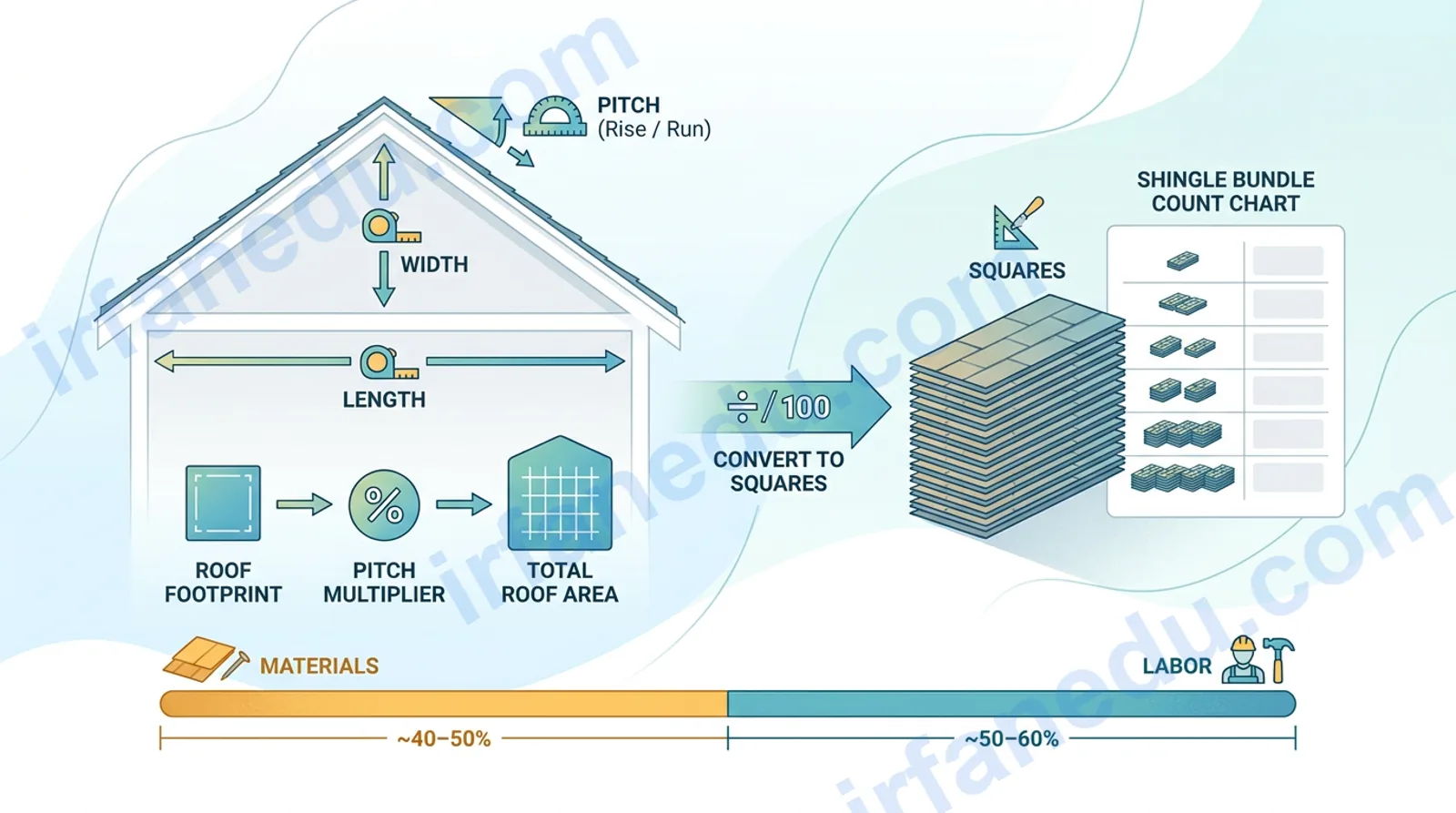
Roofing Estimate Cheat Sheet
| Roof area | Footprint (L × W) × pitch multiplier |
| 1 roofing square | 100 sq ft of actual roof surface |
| Bundles per square | 3 (standard shingles) — 4 (heavy architectural) |
| Waste factor | +10% gable | +15% hip / complex |
| Typical installed cost | $350 – $600 per square (asphalt, US 2026) |
| Pitch multiplier (6/12) | 1.118 | (4/12) 1.054 | (8/12) 1.202 |
A roofing calculator estimates your roof’s area in squares (1 square = 100 sq ft), the number of shingle bundles you need, and total material cost. Enter your roof footprint’s length, width, and pitch; the tool multiplies by a pitch factor to get true surface area, divides by 100 for squares, and multiplies by 3 bundles per square. Add 10–15% for waste.
📌 Quick Summary
- Measure your home’s footprint (L × W), not the sloped surface directly.
- Multiply by the pitch factor to get true roof area in square feet.
- Divide by 100 to convert sq ft to roofing squares.
- Multiply squares by 3 bundles (standard shingles) and add 10–15% waste.
- Material cost = squares × price per square; add 50–100% for labor.
- Always round bundle count up — you cannot buy partial bundles.
Roofing Calculator
Squares • Bundles • Material Cost — US units
ft
ft
/12
$/sq ft
%
Step-by-step solution
How to use this roofing calculator
- Choose your roof type. Select “Gable / Hip roof” for any sloped roof, or “Flat / Low-slope roof” for a commercial-style flat roof.
- Enter the footprint dimensions. Measure the outside of your home at ground level — length and width in feet. You do not need to climb the roof.
- Enter your pitch rise (the X in X/12). A common suburban home is 4/12 to 6/12. If you are unsure, a roofing contractor can confirm it in seconds with a pitch gauge.
- Enter material price per sq ft. Standard architectural shingles run $1.00–$2.00/sq ft for materials only in 2026.
- Set your waste factor. Use 10% for a simple gable, 15% for a hip or complex roof.
- Click Calculate. The result card shows your squares, bundle count, and estimated material cost with a numbered solution.
What is a roofing square, exactly?
A roofing square is 100 square feet of actual roof surface area. It is the standard unit the US roofing industry uses to price labor, order shingles, and quote jobs. When a contractor says “your roof is 22 squares,” they mean 2,200 sq ft of true sloped surface.
The square exists because it simplifies math on the job site. Shingle manufacturers package their products so that three standard bundles cover exactly one square. That relationship — 3 bundles = 1 square = 100 sq ft — is the core of every roofing estimate.
In my experience reviewing roofing bids, homeowners get confused when a contractor’s quote says “22 squares” and the house footprint is only 1,600 sq ft. The gap is the pitch multiplier. A 6/12 pitch adds about 12% more surface area, so 1,600 sq ft of footprint becomes roughly 1,789 sq ft of actual roof — closer to 18 squares, not 16. Always ask your contractor to show you the pitch multiplier they used. If they cannot, that is a red flag.
The roofing area formula and pitch multiplier table
The core formula is straightforward. True roof area equals the ground-level footprint multiplied by a pitch factor derived from the Pythagorean theorem:
  Roof Area (sq ft) = L × W × Pitch Multiplier

  Pitch Multiplier = √(rise² + 12²) ÷ 12

  Roofing Squares  = Roof Area ÷ 100

  Bundles Needed   = Squares × 3 × (1 + Waste% ÷ 100)
                     → always round UP to nearest whole bundle

  Material Cost    = Roof Area × (1 + Waste%) × Price per sq ft

  Example (6/12 pitch, 50 ft × 40 ft house):
  ┌──────────────────────────────────────────────┐
  │  Footprint = 50 × 40 = 2,000 sq ft          │
  │  Multiplier = √(36 + 144) ÷ 12 = 1.118      │
  │  True area  = 2,000 × 1.118 = 2,236 sq ft   │
  │  Squares    = 2,236 ÷ 100 = 22.36 squares   │
  │  Bundles    = 22.36 × 3 × 1.10 = 73.8 → 74  │
  └──────────────────────────────────────────────┘
Pitch multiplier quick-reference table
| Pitch (X/12) | Multiplier | Extra area vs flat | Typical roof type |
|---|---|---|---|
| 2/12 | 1.014 | +1.4% | Low-slope porch |
| 4/12 | 1.054 | +5.4% | Ranch home, low gable |
| 6/12 | 1.118 | +11.8% | Most common US suburban |
| 8/12 | 1.202 | +20.2% | Steeper gable, Cape Cod |
| 10/12 | 1.302 | +30.2% | Steep gable, Victorian |
| 12/12 | 1.414 | +41.4% | Very steep, 45-degree |
Variables and symbols
| Symbol | Meaning | Unit |
|---|---|---|
| L | Footprint length | feet (ft) |
| W | Footprint width | feet (ft) |
| rise | Vertical rise per 12 in of run | inches |
| PM | Pitch multiplier (dimensionless) | — |
| A | True roof surface area | sq ft |
| S | Roofing squares | squares (1 sq = 100 sq ft) |
| B | Shingle bundles needed | bundles |
The pitch multiplier comes directly from the Pythagorean theorem: the sloped rafter is the hypotenuse of a right triangle whose legs are the rise and the 12-inch run.
Worked examples
Example 1: Standard gable roof (6/12 pitch)
A 50 ft × 40 ft ranch home with a 6/12 pitch and architectural shingles at $1.50/sq ft.
- Footprint = 50 × 40 = 2,000 sq ft
- Pitch multiplier = √(36 + 144) ÷ 12 = √180 ÷ 12 = 1.118
- True area = 2,000 × 1.118 = 2,236 sq ft
- Squares = 2,236 ÷ 100 = 22.36 squares
- Bundles (10% waste) = 22.36 × 3 × 1.10 = 73.8 → 74 bundles
- Material cost = 2,236 × 1.10 × $1.50 = $3,689.40
Example 2: Steeper hip roof (8/12 pitch)
A 60 ft × 45 ft colonial with an 8/12 pitch and a 15% waste factor for hip cuts.
- Footprint = 60 × 45 = 2,700 sq ft
- Pitch multiplier = √(64 + 144) ÷ 12 = √208 ÷ 12 = 1.202
- True area = 2,700 × 1.202 = 3,245 sq ft
- Squares = 3,245 ÷ 100 = 32.45 squares
- Bundles (15% waste) = 32.45 × 3 × 1.15 = 111.9 → 112 bundles
Most online roofing calculators apply the pitch multiplier to the entire footprint, which is correct for a simple gable. But a hip roof with a garage attached often has two different pitch sections. In that case, split the footprint into zones, apply each zone’s multiplier separately, and add the results. Applying one multiplier to the whole footprint can under-order by 5–8% on complex homes — enough to leave you short a full pallet of shingles mid-job.
Common roofing estimate mistakes
| Wrong approach | Right approach | Why it matters |
|---|---|---|
| Measuring the sloped surface with a tape on the roof | Measure the ground-level footprint, then apply the pitch multiplier | Tape measurements on a slope are inaccurate and dangerous |
| Using 10% waste on a hip or complex roof | Use 15% for hip roofs; 20% for roofs with many dormers or skylights | Hip cuts waste significantly more shingle material |
| Rounding bundles down to save money | Always round up to the nearest whole bundle | Shingles from different production runs can have slight color variation |
| Forgetting the overhang | Add 1–2 ft to each dimension for typical eave overhang | Overhang is real roof surface that needs shingles and underlayment |
| Using material cost as the total budget | Double or triple material cost to estimate installed price | Labor typically equals or exceeds material cost in the US |
The single most expensive mistake I see homeowners make is confusing material cost with total project cost. A 25-square roof might need $3,750 in shingles at $1.50/sq ft, but the installed quote from a licensed contractor will likely run $8,750–$15,000 once you add underlayment, ice-and-water shield, ridge cap, flashing, disposal, and labor. According to the National Roofing Contractors Association (NRCA), labor accounts for 40–60% of a typical residential re-roof. Use this calculator for material budgeting, then get three contractor quotes for the full installed price.
Quick quiz: test your roofing knowledge
3-question check
1. How many square feet are in one roofing square?
2. A roof has a 4/12 pitch. Its footprint is 1,000 sq ft. What is the true roof area (rounded)?
3. You need 15 squares of shingles with a 10% waste factor. How many bundles should you order?
Reveal-on-click practice problems
Problem 1: A 45 ft × 35 ft home with a 5/12 pitch. How many squares?
Solution:
- Footprint = 45 × 35 = 1,575 sq ft
- Pitch multiplier = √(25 + 144) ÷ 12 = √169 ÷ 12 = 13 ÷ 12 = 1.083
- True area = 1,575 × 1.083 = 1,706 sq ft
- Squares = 1,706 ÷ 100 = 17.06 squares
Problem 2: You have 20 squares and need bundles with 15% waste. How many?
Solution:
- Bundles = 20 × 3 × 1.15 = 69 bundles (exactly)
- No rounding needed here — order 69 bundles.
Problem 3: Shingles cost $1.80/sq ft. True roof area is 2,500 sq ft with 10% waste. What is the material cost?
Solution: